
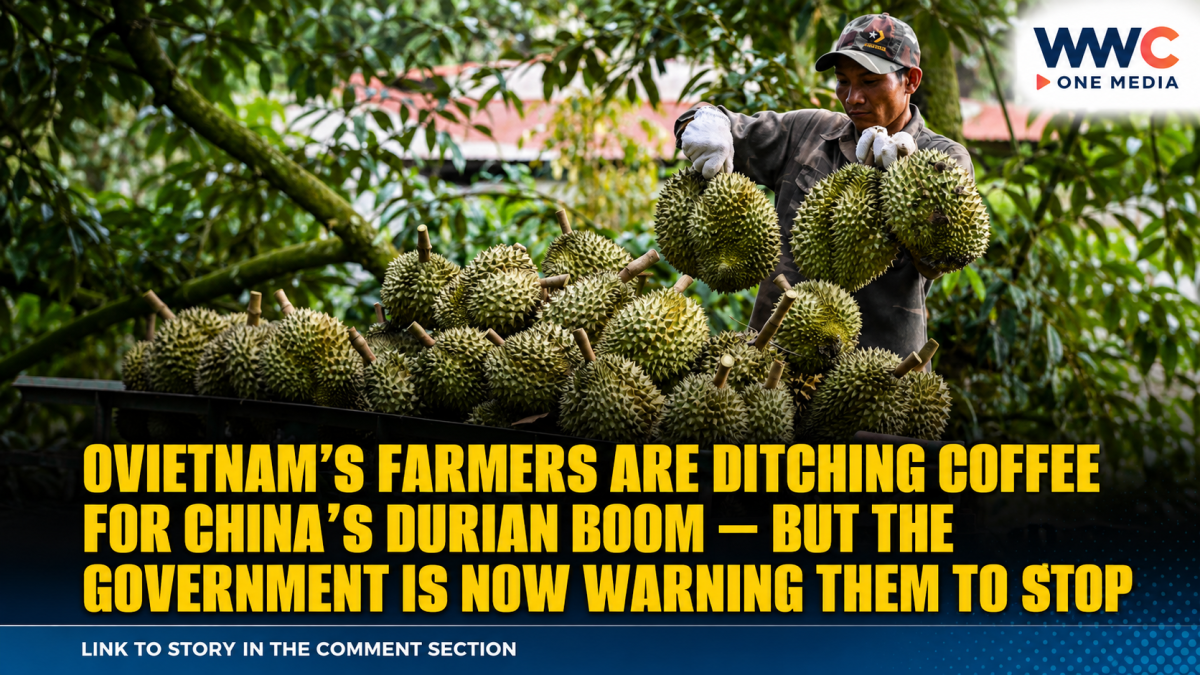
DAK LAK, Vietnam — In Vietnam’s coffee heartland, a dramatic agricultural shift is taking place.
For generations, the red basalt soils of the Central Highlands have been synonymous with coffee. Vietnam is the world’s second-largest coffee producer and its dominant supplier of robusta beans, the variety widely used in instant coffee, espresso blends and commercial coffee products.
But for a growing number of farmers, coffee is no longer the crop generating the biggest dreams.
That title increasingly belongs to durian.
Driven by extraordinary demand from China, Vietnamese growers have rapidly expanded production of the famously pungent “king of fruits,” transforming parts of the Central Highlands into one of Asia’s fastest-growing durian-producing regions.
And the money involved explains why.
Farmer Pham Xuan Lan, 56, told AFP that his roughly 400 durian trees in Dak Lak province could earn him about US$76,000 this year. He estimated that relying on coffee alone would have generated closer to US$10,000.
The difference has been life-changing.
Lan said earnings from durian have enabled him to buy a car, provide homes for his children and build a villa for his family.
His success is being repeated across a region where farmers increasingly see varieties such as Ri6, Dona and Musang King as potential tickets into China’s enormous consumer market.
Vietnam’s Durian Farms Have Expanded at Breakneck Speed
Vietnam’s durian cultivation area has grown more than fivefold over the past decade to roughly 200,000 hectares, according to figures cited by the country’s agriculture authorities.
The boom accelerated after China formally opened its market to fresh Vietnamese durians under a trade protocol signed in 2022.
Within only a few years, Vietnam emerged as Thailand’s most serious competitor.
Chinese import figures show that in 2025, China bought about 940,000 tonnes of fresh durian from Vietnam, up 27.7% from the previous year. That allowed Vietnam to surpass Thailand in shipment volume for the first time.
But there is an important distinction: Thailand remained China’s largest durian supplier by value, shipping about US$4 billion worth compared with roughly US$3.44 billion from Vietnam.
That means Vietnam has won the volume race, but the battle over premium pricing and market positioning is far from settled.
China itself imported approximately 1.87 million tonnes of fresh durian worth US$7.49 billion in 2025, illustrating just how enormous the market has become.
Vietnam’s overall durian exports are now expected to approach US$4 billion in 2026, compared with only about US$180 million in 2021, according to the CNA/AFP report.
Around 90% are expected to go to China.
That dependence is both the secret behind the boom — and potentially its biggest weakness.
China Has Turned Durian Into a Mass-Market Phenomenon
Durian was once regarded in China primarily as an expensive imported luxury.
That is changing.
Greater competition between Vietnamese and Thai exporters, faster transport links and rapidly expanding supply have helped make durian accessible to a much larger segment of Chinese consumers.
Social media has added fuel.
Durian videos on Douyin, China’s version of TikTok, have accumulated billions of views, with influencers reviewing different varieties, opening the spiky fruit on camera and promoting everything from fresh durian to durian desserts.
China’s appetite has become so large that Southeast Asian countries are effectively competing for access to what has become the world’s dominant durian market.
The United Nations Food and Agriculture Organization previously estimated that China accounted for roughly 95% of global durian exports between 2020 and 2022.
Thailand and Vietnam dominate the business, while Malaysia has been trying to increase its share after China approved imports of fresh Malaysian durians in 2024.
China is even attempting to grow more of the fruit domestically.
More than 3,000 hectares of durian plantations have been developed on the southern island of Hainan, although Chinese agricultural specialists acknowledge that domestic production remains far too small to replace Southeast Asian imports.
But Vietnam Has Already Seen How Quickly China Can Change the Rules
The enormous opportunity comes with a warning.
Vietnam’s dependence on a single buyer leaves farmers exposed to changes in Chinese regulations, inspections and consumer demand.
That vulnerability became obvious in 2025.
During the first five months of that year, the value and volume of Vietnamese fresh-durian shipments to China plunged by roughly 62% year on year, according to Chinese customs data reported by the South China Morning Post.
The disruption followed tougher Chinese inspections and food-safety requirements, forcing Vietnamese exporters to adapt before shipments recovered later in the year.
For farmers who have invested years of work and significant amounts of money converting plantations to durian, a border problem can quickly become a financial crisis.
Durian trees require careful management of irrigation, humidity, fertiliser, pests and harvesting conditions. Premium export markets also demand strict quality standards and traceability.
The fruit is lucrative when everything works.
It can be unforgiving when it does not.
One farmer interviewed by AFP, identified only as Hung, abandoned coffee entirely for durian around five years ago. He eventually returned to coffee after struggling to achieve the quality required by the market.
His experience is a reminder that the enormous returns being advertised across the countryside are far from guaranteed.
Vietnam’s Government Is Now Telling Farmers: Don’t Keep Expanding
The speed of the boom has become concerning enough that Hanoi is applying the brakes.
On August 16, Vietnam’s government published instructions requiring local authorities to tighten management of durian-growing areas and avoid further expansion of planted acreage, instead concentrating on productivity, quality, market demand and better integration between growers and exporters.
Industry officials have also warned that rapid expansion has exposed weaknesses in traceability, pest management, production organisation and quality control.
There is another danger: too much success.
If thousands of farmers plant durian at the same time, eventually those trees mature at the same time.
Supply can surge.
Prices can collapse.
Malaysian farmers have recently experienced precisely that problem, with rising production, maturing orchards and extreme weather squeezing margins even as Chinese demand remains strong.
Vietnam is trying to avoid the same trap.
Coffee Isn’t Disappearing — And China Is Buying More of It Too
The narrative that Vietnam is simply abandoning coffee also needs qualification.
Vietnam remains an agricultural superpower in coffee.
USDA-linked forecasts put Vietnamese coffee production at more than 30 million 60kg bags in the 2025-26 season, with robusta accounting for roughly 95% of output. Vietnam remains second only to Brazil in total coffee production and the world’s most important robusta supplier.
Coffee exports also remain enormous.
Vietnam shipped roughly 1.1 million tonnes of coffee in the first half of 2026, generating about US$4.78 billion, according to government figures reported by Reuters.
Ironically, China — the country driving Vietnam’s durian frenzy — is becoming a rapidly growing buyer of Vietnamese coffee as well.
Vietnam exported nearly 38,823 tonnes of coffee worth US$226.4 million to China during the first half of 2026, with volume rising almost 50% and value climbing more than 76% from a year earlier, according to Vietnamese customs figures reported by VietnamNet.
So the future may not necessarily be coffee or durian.
For farmers capable of managing both crops, diversification could prove safer than betting everything on China’s appetite for one fruit.
The Real Question Is What Happens When the Boom Ends
Right now, the economics can be irresistible.
A crop that can transform a farmer earning thousands of dollars into one earning tens of thousands will inevitably attract new growers.
But agricultural booms rarely move in a straight line.
China can tighten import rules. Consumers can change tastes. New plantations can produce too much fruit. Thailand and Malaysia can intensify competition. Hainan can increase domestic production. Climate extremes can damage harvests.
And unlike traders who can switch products in weeks, farmers make decisions measured in years.
That is why the most important story unfolding in Vietnam’s Central Highlands may not be how much money farmers can make from durian today.
It is whether they will still be making it when hundreds of thousands of newly planted trees begin producing tomorrow.




Leave a Reply