
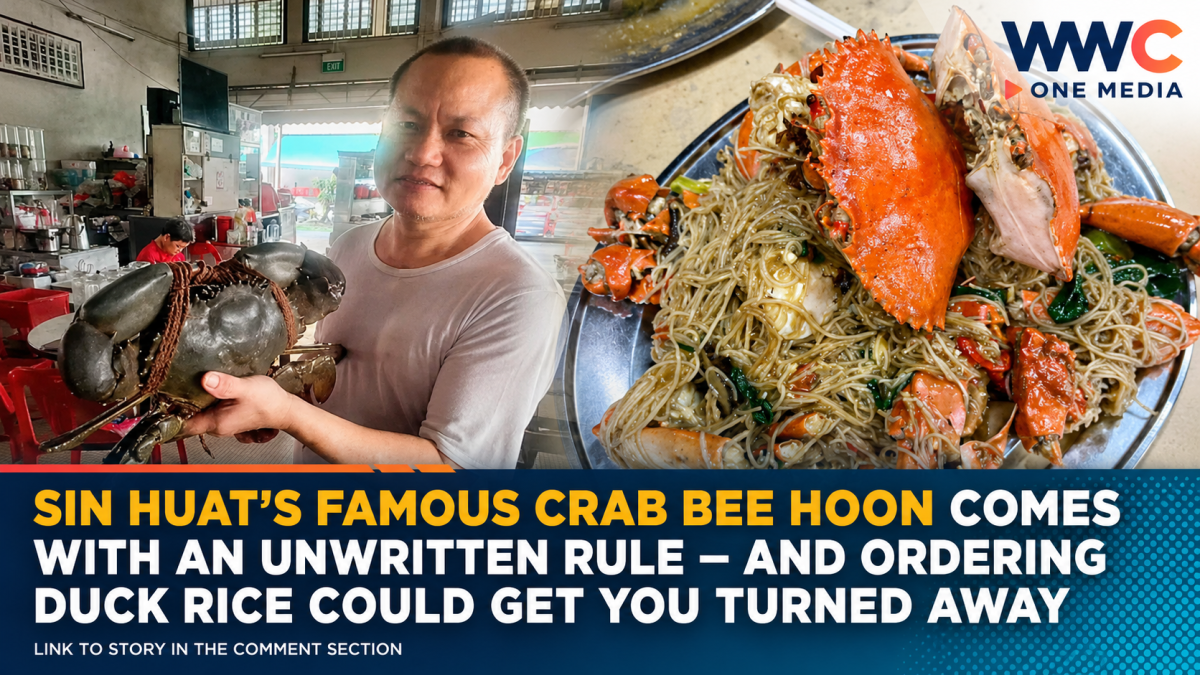
SINGAPORE — Sin Huat Eating House has spent decades building a cult following around its famously expensive crab bee hoon. But diners heading to the old-school Geylang coffeeshop may discover that getting a plate is not simply a matter of placing an order and paying the bill. Chef-owner Danny Lee has his own rules — including one involving the duck rice stall operating under the same roof.
During a recent visit by 8Days Eat host Damian Lim, Lee asked the 21-year-old hawker whether he was eating duck rice from neighbouring Sean Kee Duck Rice before agreeing to prepare his seafood.
When Lim said he was not, he asked Lee why it mattered.
Lee’s answer was unequivocal: he said he would not cook for customers who were eating the duck rice.
Why Sin Huat’s Chef Does Not Want Customers Filling Up Elsewhere
The unusual restriction apparently has less to do with competition than with what can happen while customers wait.
Lee explained that preparing his large crabs requires substantial work. His concern is that diners could order expensive seafood, eat food from another stall while waiting, become full and then cancel the seafood order after it has already been prepared.
According to the CNA Lifestyle report, which was originally published by 8Days, Lee had made a similar argument in an earlier interview after encountering customers who ate from neighbouring stalls while waiting for their Sin Huat dishes.
That distinction matters: the latest report documents Lee imposing the restriction during one visit and describes a history of similar behaviour, but it should not automatically be interpreted as a formally published restaurant policy applied identically to every customer.
The Twist: Lee Is Also the Landlord
The situation becomes more unusual because Sean Kee Duck Rice is not simply a random competitor next door.
Sin Huat Seafood Restaurant operates inside the coffeeshop alongside Sean Kee Duck Rice and Kin Turtle Soup, while Lee rents stall space to the other operators.
Sean Kee itself has a long history at the premises, operating there since 1979, according to the CNA/8Days report.
For groups hoping to visit the coffeeshop and sample several stalls at the same table, however, Lee’s approach could complicate those plans.
Then There Is the Price
Sin Huat has never been known as a bargain seafood destination.
The restaurant does not operate with a conventional printed menu for its seafood dishes. Lee personally takes orders and prices them according to the seafood available, according to CNA and 8Days.
During Lim’s recent visit, Lee warned that one of the large Sri Lankan crabs he uses would cost more than S$100.
The resulting crab bee hoon featured a crab weighing between about 1.5kg and 2kg and cost S$156. Lim said the enormous portion could comfortably feed two to three diners. He also ordered kai lan for S$10.
And S$156 is far from the biggest recent Sin Huat bill to attract attention.
Another Diner Recently Paid S$294 for Crab Bee Hoon
In June 2026, AsiaOne separately reported on a TikTok diner’s experience at Sin Huat after she was charged S$294 for a plate of crab bee hoon containing two crabs.
The diner said she waited approximately 55 minutes for the food and was stunned by the final price.
But there was a remarkable twist: despite criticising the cost and the experience, she still praised the crab’s flavour enthusiastically.
That episode reinforces what has become one of Sin Huat’s defining contradictions.
Customers may complain about the prices, the wait and Lee’s uncompromising approach — yet many still walk away talking about the food.
Michelin Still Recognises Sin Huat
Sin Huat’s reputation is not built entirely on internet hype.
The Michelin Guide currently lists Sin Huat Seafood Restaurant as a Bib Gourmand establishment, describing its fried rice vermicelli with crab as the restaurant’s main attraction and highlighting how the noodles absorb the seafood flavours.
The restaurant also carries serious culinary history.
Late celebrity chef and television host Anthony Bourdain helped introduce Sin Huat to an international audience after featuring the Geylang restaurant and later including it in his famous selection of restaurants worth eating at during one’s lifetime.
Contemporary and retrospective accounts of Bourdain’s list confirm Sin Huat was among his 13 selections, with its crab bee hoon singled out as the major draw — along with a warning that the humble-looking surroundings should not be mistaken for low prices.
A Restaurant That Refuses to Become Conventional
That may ultimately explain why Sin Huat remains one of Singapore’s most talked-about seafood restaurants.
Plenty has changed in Singapore’s dining scene since Lee began cooking at the family business decades ago, but Sin Huat still operates more like a fiercely personal chef’s domain than a modern restaurant.
There is no polished dining room.
There may be a long wait.
Seafood can cost well into three figures.
The chef may encourage customers to order more than one dish.
And, apparently, eating duck rice while waiting for your crab bee hoon could derail the entire plan.
Yet diners continue coming — and Michelin continues recognising the restaurant.
For Lim, the restriction was both understandable and restrictive. He acknowledged that the enormous crab bee hoon portions could justify Lee’s concern about diners becoming full, while noting that the rule makes it difficult for larger groups hoping to sample food from several stalls.
That tension may be exactly why Sin Huat has survived as a Singapore food institution.
The crab bee hoon is famous. The bills can be shocking. But at Sin Huat, the biggest surprise may come before the food even reaches the table.




Leave a Reply