
International Container Terminal Services Inc. has secured a major competitive advantage at Mexico’s busiest container gateway, with its Contecon Manzanillo terminal now authorized to handle deeper-draft vessels and some of the largest container ships deployed on global trade routes.
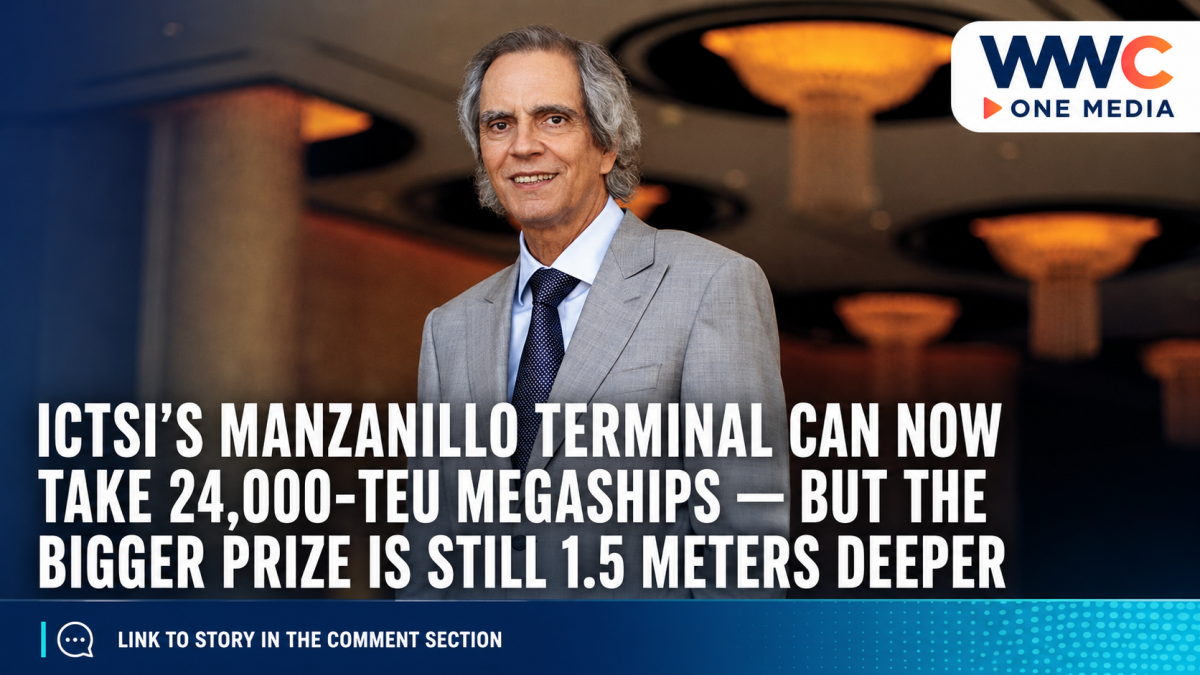
Contecon Manzanillo S.A. de C.V. (CMSA), the Mexican subsidiary of Philippine port giant International Container Terminal Services Inc. (ICTSI), has been cleared to receive vessels with drafts of up to 15.5 meters, making it the only terminal operator at the Port of Manzanillo currently authorized for that operating depth.
ICTSI said the clearance enables Contecon to serve ships measuring as much as 400 meters in length, including ultra-large container vessels with nominal capacities reaching 24,000 twenty-foot equivalent units, or TEUs.
But for ICTSI, the 15.5-meter mark is not the finish line.
The Enrique Razon-led port operator is targeting an eventual 17-meter operational draft at Contecon’s new berths—another 1.5 meters of depth that would give shipping lines greater flexibility to bring larger vessels and heavier cargo loads into Mexico’s Pacific gateway.
Bigger ships are coming—and ports have to keep up
Contecon chief executive José Antonio Contreras said the authorization reflects years of infrastructure investment aimed at keeping Manzanillo competitive as shipping lines deploy increasingly larger vessels.
That shift matters because container shipping has steadily moved toward economies of scale: bigger vessels can carry more boxes per voyage, potentially reducing transportation costs per container while concentrating significantly more cargo into individual port calls.
Mexican transport publication T21 noted that deeper water alone will not determine whether Manzanillo succeeds in the megaship era. Bigger vessels also require larger berths, longer-reach cranes, sufficient yard capacity and efficient landside connections capable of absorbing huge volumes of cargo arriving at once.
That is exactly where ICTSI has been spending.
Contecon’s Phase 3 expansion has brought its quay length to roughly 1.3 kilometers and strengthened its ability to service multiple large vessels. ICTSI has said investments in Contecon’s Phase 3A and 3B programs since 2023 have exceeded $300 million.
The terminal currently has 12 quay cranes and 43 rubber-tired gantry cranes, while the ongoing Phase 3B program includes another 227 meters of quay, two additional quay cranes and nine RTGs.
Once Phase 3B is operational, ICTSI expects Contecon’s annual handling capacity to rise from roughly 1.8 million TEUs to 2 million TEUs.
The timing is no accident: Manzanillo’s container traffic is booming
The clearance comes while the broader Port of Manzanillo is experiencing one of its strongest growth periods.
Official port figures show Manzanillo handled 2,455,956 TEUs from January through July 2026, up 11.7% from the same seven-month period in 2025.
That represented approximately 43.4% of all container traffic handled by Mexican ports during the period—meaning more than four out of every 10 containers moving through the country’s port system passed through Manzanillo.
Contecon itself is growing even faster.
According to figures cited by T21 and DataPortuaria, the ICTSI terminal handled about 1.022 million TEUs in the first seven months of 2026, representing growth of roughly 20.1% year on year.
The figures reinforce why deeper berths and larger cranes are becoming increasingly important.
Mexican business publication Expansión reported that Pacific-side Mexican ports have been outperforming Gulf ports, driven partly by rising containerized trade linked to Asia. Manzanillo alone recorded double-digit growth through July despite Mexico’s increasingly complicated trade relationship with China.
Asia is becoming even more important to ICTSI’s Mexico bet
Contecon’s expansion is also closely tied to the rapid growth of Asia-Mexico shipping.
ICTSI said earlier this year that imports from Asia handled through the terminal—particularly cargo originating from China—had grown by more than 70% over the previous four years.
The shipping lines are responding.
In July, Contecon welcomed the launch of MSC’s Sierra service, the carrier’s second dedicated Far East-Mexico service. The route links Qingdao, Tianjin and Busan with Manzanillo and Lázaro Cárdenas before returning to China, adding another direct connection between Northeast Asian manufacturing centers and Mexico.
Contecon had previously attracted Wan Hai Lines’ Asia-South America West Coast service after upgrades strengthened its ability to handle the newest generation of vessels.
PortCalls Asia reported that ICTSI’s 2023-2026 investment program for Contecon would exceed $300 million as the company prepared the terminal for larger, deeper-draft ships increasingly deployed across Pacific routes.
There is another bottleneck ICTSI still has to solve
The megaship clearance gives Contecon an important waterfront advantage, but putting a 24,000-TEU-capable vessel alongside a berth is only part of the challenge.
Thousands of containers still have to move efficiently from ship to yard—and then from the port into Mexico’s industrial and consumer centers.
ICTSI is therefore expanding landside infrastructure as well.
The company disclosed in April that Contecon’s Phase 3 works include additional rail infrastructure, while a new rail service is designed to raise train capacity by 50%, increasing operations from trains carrying 60 container wagons to trains capable of handling 110.
The terminal is strategically positioned to serve major economic centers including Mexico City, Guadalajara and Monterrey, as well as automotive manufacturing corridors stretching across central Mexico.
That network becomes even more important when bigger vessels arrive: the advantage of unloading thousands of additional containers at the dock can quickly disappear if yards, trucks, railways or customs cannot move them out fast enough.
Manzanillo is part of ICTSI’s much larger global expansion
The Mexican expansion also fits into ICTSI’s aggressive worldwide investment program.
The company has earmarked approximately $740 million in capital expenditures for 2026, with completion of Contecon Manzanillo’s Phase 3B among its major spending priorities alongside terminal expansions in the Philippines, Brazil, the Democratic Republic of Congo and other markets.
ICTSI entered the second half of the year from a position of financial strength. The Philippine Star reported that the group earned about $590 million in net income during the first half of 2026, up 22%, while revenue climbed 27% to roughly $1.92 billion and consolidated container volume increased 16% to about 8.12 million TEUs.
For Manzanillo, however, the next milestone may matter more than the one ICTSI has just announced.
The terminal can now operate at a draft of 15.5 meters.
Its new berths were designed for 17 meters.
If ICTSI reaches that target while container volumes and Asia-Mexico trade continue their current trajectory, the real story may no longer be whether Manzanillo can accommodate the world’s megaships—but how many of them shipping lines decide to send there.




Leave a Reply