
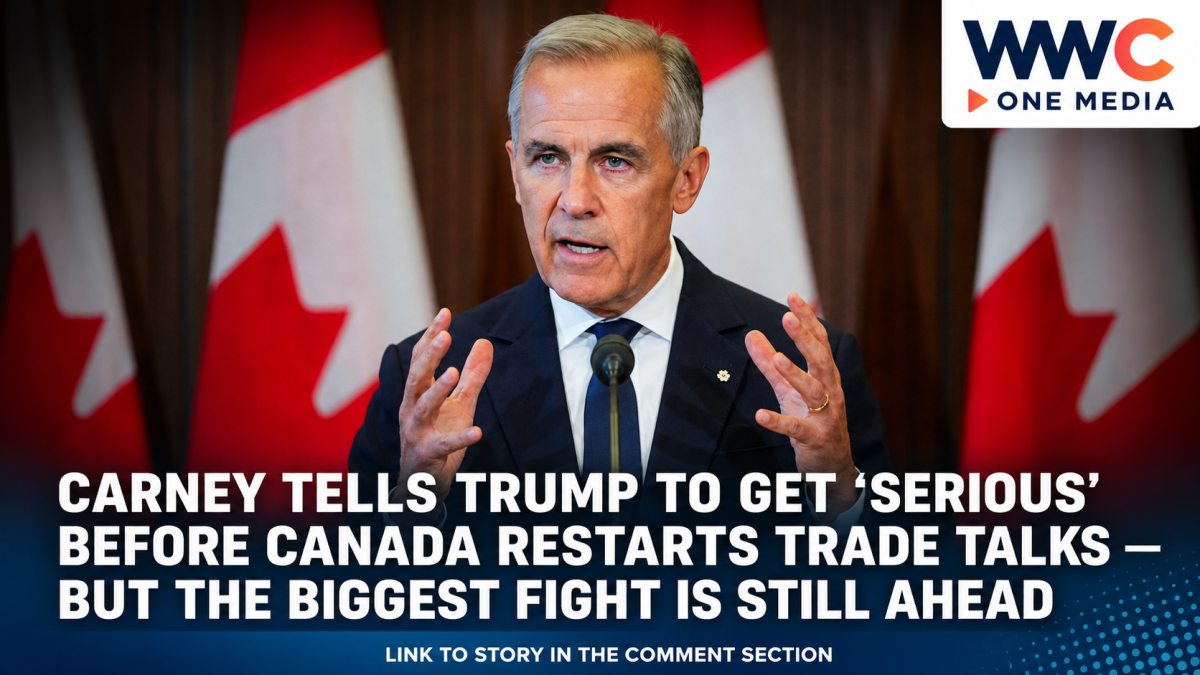
Canada-U.S. trade tensions are entering a more dangerous phase, with Prime Minister Mark Carney refusing to return to negotiations until Washington adopts what he calls a more constructive approach — while billions of dollars in tariffs, critical industries and the future of North American trade hang in the balance.
OTTAWA — Canadian Prime Minister Mark Carney has delivered one of his clearest warnings yet to the United States: Canada is willing to negotiate, but it will not rush back to the table simply because pressure from Washington is increasing.
Speaking to reporters on September 1, Carney said serious negotiations could resume once the United States stops the political theatrics and begins approaching Canada as a genuine negotiating partner.
Canada suspended bilateral trade negotiations on August 21 after Ottawa said American negotiators introduced unacceptable last-minute conditions to a proposed agreement intended to prevent another round of U.S. tariffs. Reuters and CNA reported that Carney still believes a mutually beneficial agreement is possible — but only if it respects Canadian sovereignty and protects strategically important Canadian industries.
The breakdown has transformed what appeared to be a difficult trade negotiation into a much broader political confrontation between two countries whose economies have been intertwined for generations.
Carney Says Canada Won’t Accept a Deal That Hollows Out Its Industries
At the heart of Ottawa’s objections is the future of Canadian manufacturing, particularly automobiles, steel and aluminum.
Carney said Canada believed the U.S. negotiating position could eventually leave major Canadian industries subordinate to their American counterparts — or create conditions under which production would gradually disappear from Canada altogether.
That was a line Ottawa was unwilling to cross.
The automotive sector is particularly sensitive because vehicles and components routinely cross the Canada-U.S. border multiple times during production. Plants operated by companies including General Motors, Stellantis, Ford, Honda and Toyota depend on deeply integrated North American supply chains.
Reuters reported that automakers had expected negotiations to potentially lower existing tariffs, only to see the situation deteriorate after the deal collapsed. The United States has since threatened or announced substantially higher tariffs affecting Canadian vehicles and auto parts, with some automotive measures scheduled to take effect on January 1.
That means the dispute is no longer simply about which government wins a negotiation. It could determine where future factories, investment and thousands of manufacturing jobs are located.
Trump Escalates the Political Pressure
The trade dispute has also become increasingly personal.
Since the negotiations collapsed, U.S. President Donald Trump has intensified his criticism of Canada and its political leadership. He has repeatedly accused Canada of taking advantage of the United States economically and has used social media to mock the country.
Trump also signed an order directing U.S. federal agencies to use the name “Lake America” for Lake Ontario in U.S. government references — a move that does not change what Canada or international bodies call the lake.
Carney characterized those moves as counterproductive to serious diplomacy.
His message was essentially that Ottawa remains ready to negotiate — but it will not do so while simultaneously being subjected to public political pressure designed to force Canada into accepting terms it considers damaging.
Washington Says Canada Walked Away From a Deal
The United States disputes Ottawa’s characterization of the negotiations.
American officials have argued that a viable agreement was available when Canada left the negotiating table. Carney has rejected that interpretation, saying the proposal never adequately protected Canada’s major industries.
The disagreement is important because both governments are now trying to establish a very different public narrative.
Washington’s argument is that Canada rejected an opportunity for compromise.
Ottawa’s argument is that what appeared to be a compromise would actually have weakened Canada’s industrial independence.
That gap may now be harder to bridge than the tariffs themselves.
New Tariffs Raise the Stakes
The economic pressure is already increasing.
Following the collapse of the talks, the Trump administration imposed 50% tariffs on certain Canadian goods. Canada announced dollar-for-dollar retaliation targeting roughly US$20 billion worth of American imports, with the Canadian measures scheduled to take effect on September 8.
The Canadian countermeasures include products such as steel, dairy goods, appliances and agricultural equipment, according to AP.
However, the dispute has not yet expanded across the entirety of the massive Canada-U.S. trading relationship.
AP reported that the latest U.S. tariffs cover roughly US$20 billion in Canadian exports — about 5% of Canada’s exports to the United States — leaving both governments room to step back before the confrontation becomes considerably more damaging.
That window may be one of the most important factors in what happens next.
Why Neither Side Can Easily Afford a Full Trade War
Despite the increasingly hostile rhetoric, the economic relationship between Canada and the United States is simply too large to unwind without consequences on both sides of the border.
According to the Office of the U.S. Trade Representative, two-way U.S.-Canada trade in goods and services totaled an estimated US$872.3 billion in 2025.
Canada was also the largest destination for American exports in 2024 and remains one of the United States’ biggest suppliers.
The relationship is particularly important in automobiles, energy, agriculture and industrial materials.
Canada supplies the United States with substantial quantities of crude oil, electricity, aluminum and potash fertilizer, while American companies sell hundreds of billions of dollars in vehicles, machinery, energy products, agricultural goods and services into the Canadian market.
That level of integration explains why analysts cited by AP believe both governments will ultimately have strong incentives to negotiate an exit from the dispute.
A prolonged tariff battle could raise costs for manufacturers, disrupt supply chains and eventually push some of those expenses onto consumers in both countries.
The Bigger Battle: The Future of USMCA
The timing of the dispute is especially significant because Canada, the United States and Mexico are already navigating the first major review of the United States-Mexico-Canada Agreement, known as USMCA in the United States and CUSMA in Canada.
The agreement replaced NAFTA and has governed much of North American trade since July 2020.
The United States declined to simply rubber-stamp an automatic extension during the 2026 review process, instead pushing for further negotiations over issues including manufacturing, automobiles, agriculture and economic security.
That does not mean USMCA has expired.
The Canadian government says the agreement remains fully in force and can continue until 2036 while the review process continues.
But the current Canada-U.S. confrontation could make reaching a long-term agreement significantly harder.
Canada Has More at Stake — But Washington Also Faces Pressure
Canada remains more dependent on the bilateral relationship because the United States absorbs the majority of Canadian exports.
But Washington is not immune.
American automakers rely on Canadian factories and parts. U.S. Midwest refineries depend heavily on Canadian crude. Farmers use Canadian potash, while several border regions import Canadian electricity.
There is also a political calculation.
A Reuters/Ipsos survey released amid the dispute found that 57% of Americans surveyed opposed the latest tariffs on Canadian imports, compared with 20% who supported them.
That could become increasingly important as the United States approaches its November midterm elections and voters remain concerned about the cost of living.
What Happens Next Could Decide More Than Tariffs
For now, there is no confirmed date for Canada and the United States to formally restart the suspended negotiations.
Carney has deliberately left the door open.
But he has also made clear that Canada does not intend to return simply to accept an agreement Ottawa believes could sacrifice core industries or restrict its economic sovereignty.
Washington, meanwhile, continues to insist that Canada had an acceptable deal within reach.
That leaves North America’s two largest neighbors in an unusual position: economically dependent on each other, politically furious with each other, and still without a clear path back to the negotiating table.
The tariffs attracting today’s headlines may therefore be only the opening battle.
The far bigger question is whether Canada and the United States can repair enough trust to protect the integrated North American economy — before the fight over autos, manufacturing and USMCA becomes much harder to reverse.



Leave a Reply