
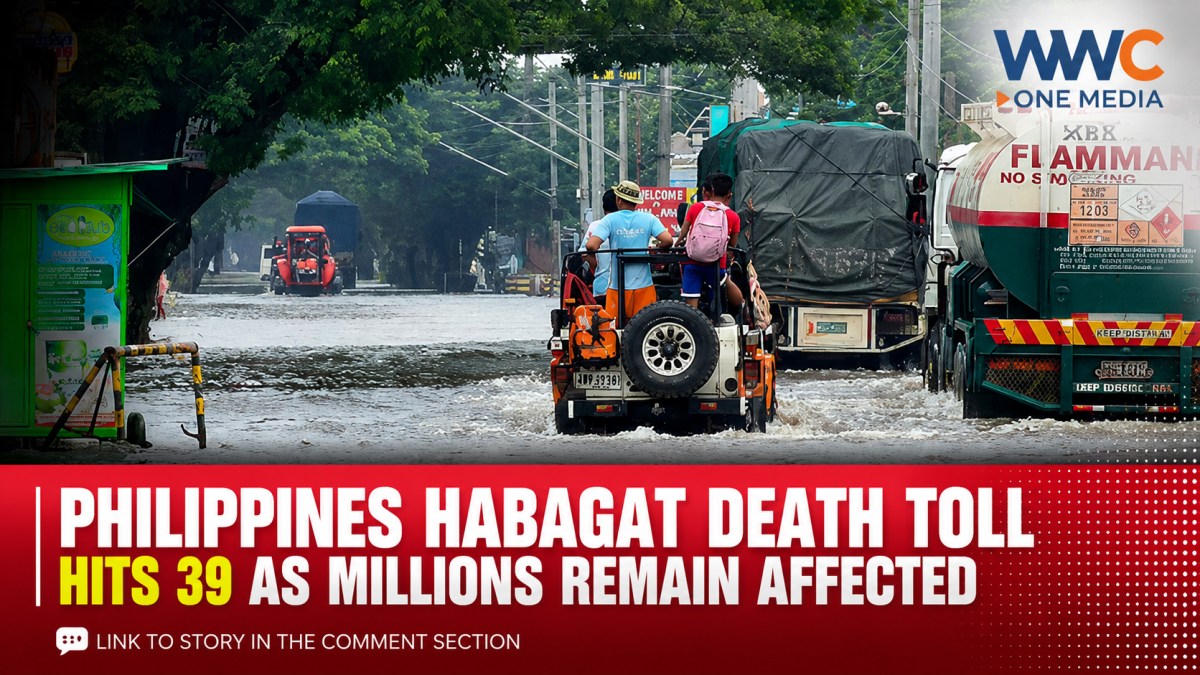
MANILA — The death toll from the combined effects of Tropical Cyclones Luis, Maymay and Neneng and the southwest monsoon, or Habagat, has climbed to 39, according to the Office of Civil Defense (OCD), as authorities continue dealing with widespread flooding, landslides and damage across the Philippines.
The latest OCD report, based on data as of 6 a.m. Wednesday, Sept. 2, shows that Benguet has recorded the highest number of fatalities at 15, with all 15 attributed to landslides. Ten deaths were reported in Baguio City, three in Atok and two in La Trinidad.
Benguet remains the hardest-hit area
Rizal and Batangas each recorded four deaths.
In Rizal, fatalities were linked to a rockslide in Rodriguez, a fallen tree in Antipolo and drowning in Binangonan. In Batangas, deaths were reported from drowning, electrocution and a landslide.
Zambales and Caloocan each recorded three deaths, while Pampanga, Quezon and Occidental Mindoro reported two fatalities each.
La Union, Pangasinan, Oriental Mindoro and Negros Occidental each recorded one death. The OCD said the fatalities resulted from landslides, rockslides, drowning, electrocution and other weather-related incidents.
The disaster has also left 20 people injured and three still missing.
More than 9 million Filipinos affected
The scale of the disaster extends far beyond the death toll.
According to the latest OCD figures, 9.4 million people, or about 2.7 million families, have been affected across Ilocos, Central Luzon, Bicol, Western Visayas, CALABARZON, the Cordillera Administrative Region, Metro Manila and MIMAROPA.
More than 71,000 people are currently staying in 968 evacuation centers, while flooding has been reported in 711 areas.
The weather systems have also damaged approximately 3,900 houses, including 538 that were totally destroyed.
Billions of pesos in damage
The economic impact is mounting.
OCD estimates put infrastructure damage at ₱6.27 billion, while agricultural damage has reached approximately ₱2.84 billion. The government has provided around ₱1.85 billion in assistance to affected communities.
The agricultural losses are particularly significant because the storms and monsoon affected farming and fishing communities across several regions. Earlier Department of Agriculture assessments already showed tens of thousands of farmers and fishers affected and more than 60,000 metric tons of agricultural production damaged or lost.
178 cities and municipalities under state of calamity
The emergency has prompted 178 cities and municipalities to declare a state of calamity, including areas across Pangasinan, Benguet, Bataan, Bulacan, Pampanga, Zambales, Tarlac, Cavite, Batangas and Occidental Mindoro.
Government agencies have expanded rescue, relief and recovery operations as communities continue to deal with flooded roads, damaged homes and unstable slopes.
The Philippine Information Agency reported that government humanitarian assistance had reached ₱1.78 billion, while the Department of Social Welfare and Development had distributed more than 2.3 million family food packs. Health teams have also conducted thousands of medical consultations in evacuation facilities and are monitoring water-borne diseases, leptospirosis, dengue and other illnesses that can increase after major flooding.
And the rain threat isn’t over
One of the biggest concerns is that the weather threat has not completely disappeared.
PAGASA said on Sept. 2 that Tropical Storm Pilandok remains far east of Northern Luzon and is forecast to leave the Philippine Area of Responsibility early Sept. 3. No tropical cyclone wind signal is currently in effect.
However, the Southwest Monsoon continues to affect Luzon and the Visayas, with PAGASA warning of strong to gale-force gusts in several areas through Sept. 4. Heavy rainfall may still trigger flash floods and landslides, particularly in vulnerable and mountainous communities.
PAGASA’s Sept. 2 regional rainfall advisory also warned of light to moderate, at times heavy, rain in portions of Batanes, Ilocos, Benguet, La Union, Pangasinan and Aurora.
Why this disaster became so dangerous
The current crisis is not the result of a single storm making a direct landfall.
Instead, the Philippines has faced the combined effects of multiple tropical cyclones and a prolonged southwest monsoon, producing repeated periods of heavy rain. In mountainous areas, saturated ground increases the danger of landslides and rockslides, while intense rainfall can rapidly overwhelm drainage systems and rivers.
Earlier in August, Quezon City recorded 201.7 millimeters of rainfall in just six hours, demonstrating the intensity of some of the monsoon episodes.
The continuing rain also means that even communities that have escaped the worst flooding may remain vulnerable to sudden landslides and rising waterways.
The Philippines is now facing a race against the next round of rain
With the death toll now at 39, thousands of families displaced and billions of pesos in damage already recorded, authorities are confronting a crisis that is still unfolding.
The immediate challenge is keeping vulnerable communities safe, delivering relief and reaching those cut off by floods and landslides.
But with Habagat still active and additional rain forecast, the bigger concern is whether already saturated ground and damaged infrastructure can withstand another round of severe weather.
And that is where the next danger may be hiding: the rain that has already killed 39 may not yet be finished.
WWC ONE MEDIA J.M.D




Leave a Reply