
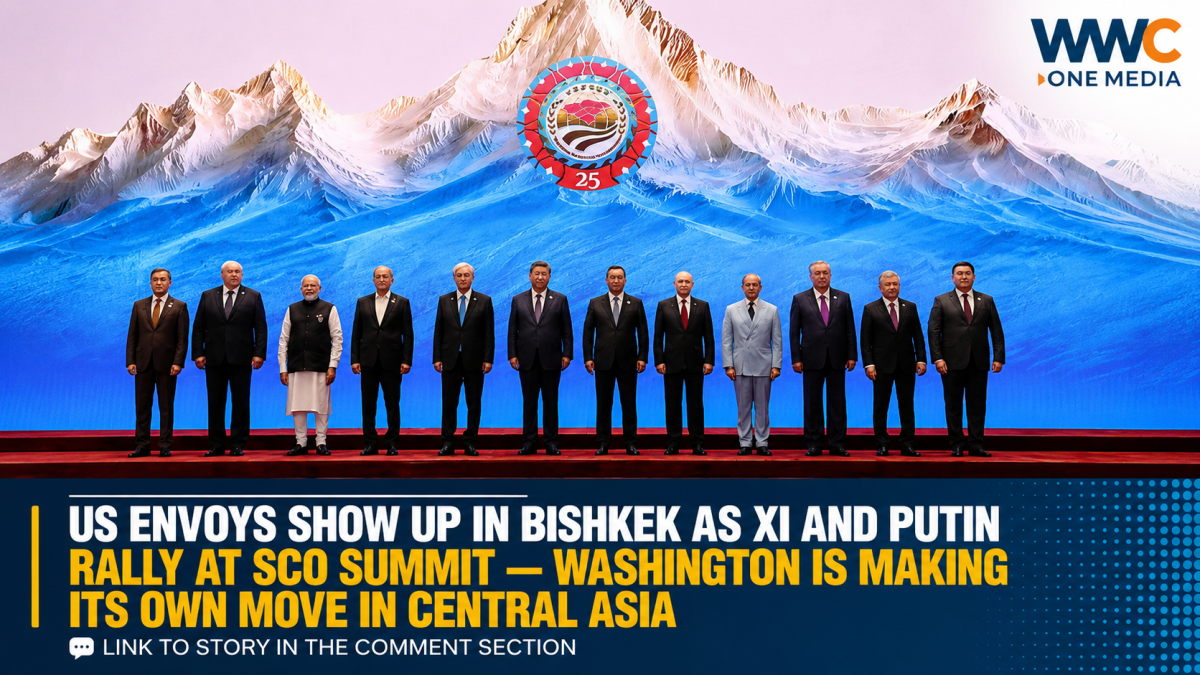
BISHKEK, Kyrgyzstan — The Shanghai Cooperation Organisation (SCO) summit was supposed to be a showcase of China, Russia and their wider Eurasian partnerships.
Instead, Washington found a way to put itself in the picture.
As Chinese President Xi Jinping, Russian President Vladimir Putin, Indian Prime Minister Narendra Modi and other leaders gathered in Bishkek for the SCO’s 25th-anniversary summit, two senior US figures arrived in the same Kyrgyz capital and began meeting Central Asian presidents.
US Special Envoy for South and Central Asia Sergio Gor and Republican Senator Steve Daines held separate meetings with leaders from Kyrgyzstan, Tajikistan and Uzbekistan, while Gor also met Kazakhstan’s President Kassym-Jomart Tokayev, according to reports and official statements.
The message was subtle but significant:
The United States may not have a seat at the SCO table, but Washington is not abandoning Central Asia to Beijing and Moscow.
Washington’s “parallel” diplomacy
Gor’s official reason for travelling to Bishkek was connected to the World Nomad Games, where he was supporting the US contingent.
But the diplomatic schedule went considerably further.
Gor and Daines met Kyrgyz President Sadyr Japarov, Tajik President Emomali Rahmon and Uzbek President Shavkat Mirziyoyev while the SCO summit was taking place. Gor also reported a meeting with Kazakh President Tokayev.
The meetings focused heavily on practical economic interests rather than simply geopolitical rhetoric.
With Uzbekistan, discussions included energy, transport, critical minerals, digital technology, artificial intelligence and agriculture, alongside preparations for future US-Central Asia meetings under the C5+1 framework.
Tajikistan highlighted potential US investment in energy, industry and mining, as well as regional security and political cooperation.
Kyrgyzstan meanwhile discussed the possibility of a 2027 C5+1 leaders’ summit, expansion of the B5+1 business platform and closer commercial ties with American companies.
Why Central Asia matters
The five Central Asian states — Kazakhstan, Kyrgyzstan, Tajikistan, Turkmenistan and Uzbekistan — sit at a strategically important crossroads between China, Russia, Iran, Afghanistan and the Caspian region.
For decades, Moscow dominated much of the region’s political and security landscape.
But China’s economic footprint has expanded rapidly, particularly through infrastructure, trade and transportation projects.
One major example is the China-Kyrgyzstan-Uzbekistan railway, which is intended to improve connections between China, Central Asia and markets farther west.
That leaves Central Asian governments with a powerful incentive to diversify their relationships rather than depend entirely on one major power.
And that is where Washington sees an opening.
Central Asia doesn’t want to choose sides
The biggest mistake would be to interpret the US diplomatic push as proof that Central Asian countries are abandoning China or Russia.
They aren’t.
Instead, the region increasingly appears to be pursuing multi-vector diplomacy — maintaining relations with Moscow and Beijing while simultaneously expanding links with Washington, Europe, Turkey, India and other powers.
That makes the region far more complicated than a simple US-versus-China contest.
A Central Asian government can cooperate with China on railways, Russia on security, the United States on critical minerals and technology, and Europe on trade — sometimes simultaneously.
For Washington, however, building those relationships gives the United States more influence over supply chains, investment and strategic resources.
Critical minerals could become the next battleground
Among the most important issues discussed during the US meetings was critical minerals.
Central Asia possesses significant deposits of resources including uranium, copper, zinc, gold and other strategic materials. The region is also increasingly being examined for lithium and rare-earth resources that could become crucial to advanced technology, energy systems and defence industries.
India Today noted that Daines has previously pushed for deeper US engagement with Central Asia and introduced legislation aimed at removing Cold War-era trade restrictions affecting the region.
For Washington, therefore, Central Asia is not only about geopolitics.
It is also about the future supply chains behind technology, energy and national security.
And then there is the SCO
The timing makes the US outreach especially striking.
The SCO, founded in 2001 by China, Russia and four Central Asian states, has grown into a 10-member organization that now includes China, Russia, India, Pakistan, Iran, Belarus, Kazakhstan, Kyrgyzstan, Tajikistan and Uzbekistan.
Its 2026 summit brought Xi, Putin, Modi, Iranian President Masoud Pezeshkian and other leaders together in Bishkek.
The organization used the summit to promote greater cooperation on security, trade, connectivity and economic development while presenting itself as part of a broader push toward a more multipolar international system.
The final Bishkek Declaration also condemned military strikes against Iran, describing them as violations of international law and the UN Charter. Analysts cautioned, however, that the SCO’s support for Tehran may be more symbolic than a guarantee of concrete assistance.
China is strengthening its own position
Beijing is hardly standing still.
During Xi’s visit, China and Kyrgyzstan signed a treaty on “eternal good-neighborliness, friendship and cooperation” and a joint declaration aimed at deepening their strategic partnership.
The agreements come as China expands infrastructure and economic cooperation across Central Asia.
That makes the US diplomatic activity in Bishkek more consequential.
Washington is entering a region where China already has deep economic connections and Russia retains longstanding political and security relationships.
The real contest may be influence — not alliances
The most important takeaway is that this is not yet a new Cold War-style division of Central Asia.
The Central Asian governments have shown little interest in choosing between Washington, Beijing and Moscow.
They have something more valuable:
options.
By engaging multiple powers, these governments can compete for investment, technology, infrastructure, security cooperation and access to international markets.
For Washington, the challenge will be turning high-level meetings into durable economic relationships.
For Beijing and Moscow, the challenge is preventing their traditional influence from becoming diluted.
And for the Central Asian states, the strategy may be the simplest of all:
Keep everyone interested.
The US envoys’ appearance in Bishkek therefore may have been more than diplomatic coincidence. It was a reminder that even as China and Russia try to shape a post-Western Eurasian order, Washington is still fighting for influence in the very region where Beijing and Moscow have traditionally had the strongest hand.
WWC ONE MEDIA J.M.D




Leave a Reply