
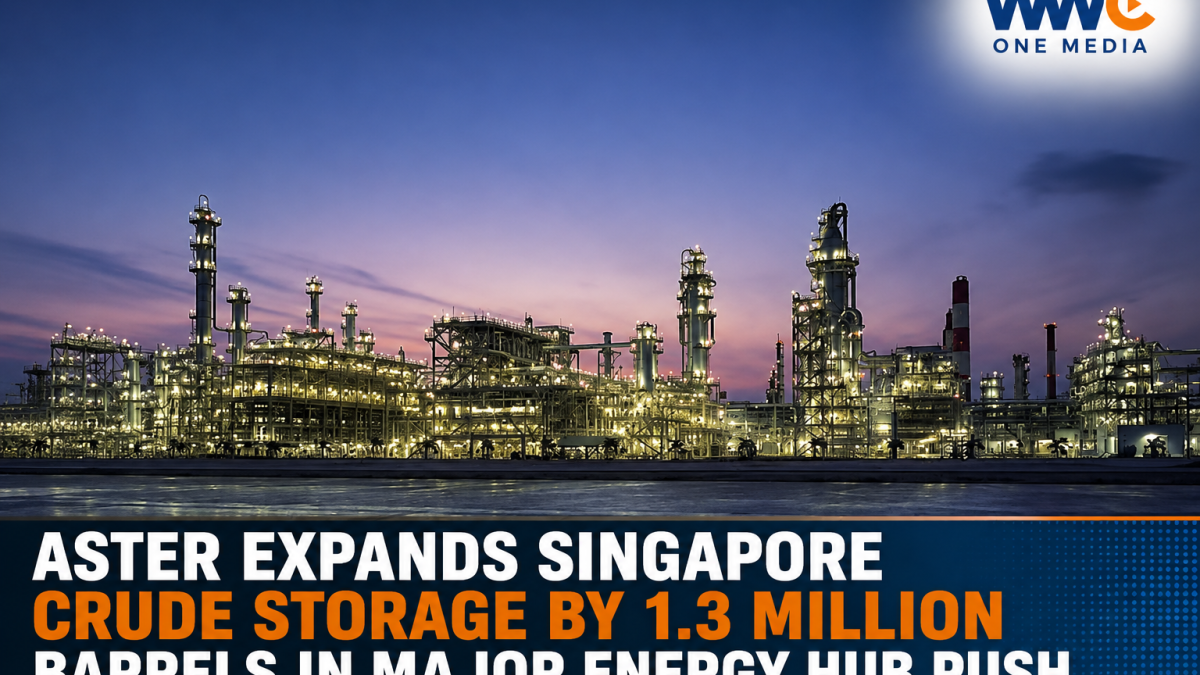
SINGAPORE — Aster is expanding Singapore’s crude oil storage capacity by more than 1.3 million barrels, marking a significant new investment in the city-state’s energy infrastructure and reinforcing its position as one of Asia’s most important oil trading hubs.
The expansion comes with the launch of Aster Port & Terminals (APT), a new storage and logistics business that will consolidate the company’s marine, terminal and storage infrastructure into a commercial platform serving both Aster and third-party customers.
As part of its first major investment, APT awarded contracts to Overseas Technical Engineering and Construction, a subsidiary of Malaysia’s DIALOG Group, and Singapore-based engineering company PEC to rejuvenate crude oil storage tanks at Pulau Bukom.
The project will increase available crude storage capacity by more than 1.3 million barrels, although Aster has not disclosed the financial value of the investment.
A Massive Infrastructure Platform
Aster’s new platform brings together a substantial network of energy infrastructure across Pulau Bukom and Pulau Ular.
According to the company, the integrated operation includes 13 marine wharves, up to 4.3 million cubic metres of tank storage capacity, and a single buoy mooring capable of receiving Very Large Crude Carriers carrying up to 2 million barrels of oil.
The infrastructure builds on more than six decades of terminal operations at Bukom, a strategically important site in Singapore’s energy and petrochemical industry.
Opening Storage Infrastructure to Commercial Customers
The launch of APT represents more than just an expansion of storage tanks.
Aster is turning its existing infrastructure into a broader commercial platform, allowing third-party customers to access its storage and marine facilities.
Aster Deputy CEO Andre Khor said the move is part of a strategy to transform the company into a more integrated energy platform.
The expansion could create new commercial opportunities while strengthening Singapore’s role as a regional center for oil trading, storage and logistics.
Why Singapore’s Oil Storage Matters
Singapore sits at the crossroads of major global shipping routes and remains one of the world’s most important energy trading centers.
Additional storage capacity can give energy companies greater flexibility to manage crude supplies, respond to market disruptions and optimize trading opportunities.
The move also comes as global energy markets face continuing uncertainty over geopolitical tensions and supply routes. Singapore’s oil-product inventories recently climbed to a three-week high, highlighting the strategic importance of storage infrastructure in the regional energy market.
Part of a Bigger Aster Expansion
The storage investment is the latest in a series of projects aimed at expanding Aster’s presence in Singapore’s energy sector.
Aster operates an integrated Bukom oil and chemicals complex that includes a refinery with approximately 300,000 barrels-per-day capacity and a major petrochemical operation. Earlier reports also indicated that the company has been pursuing refinery upgrades and infrastructure improvements to increase processing flexibility and allow larger crude carriers to access its facilities.
With the launch of Aster Port & Terminals, the company is now positioning itself beyond refining and chemicals and deeper into the energy logistics business.
A Bigger Question for Asia’s Energy Future
The addition of 1.3 million barrels of crude storage may sound like a technical infrastructure upgrade, but it reflects a much larger strategic shift.
As global oil flows become increasingly vulnerable to geopolitical tensions and supply disruptions, control over storage, shipping access and terminal infrastructure is becoming just as important as producing the oil itself.
For Singapore, already a major global energy trading hub, Aster’s expansion could further strengthen its role in the movement of crude across Asia.
And as competition intensifies for control of the world’s energy supply chains, one question is emerging: Is Singapore quietly building an even bigger advantage in the global oil trade?
WWC ONE MEDIA J.M.D


Leave a Reply