
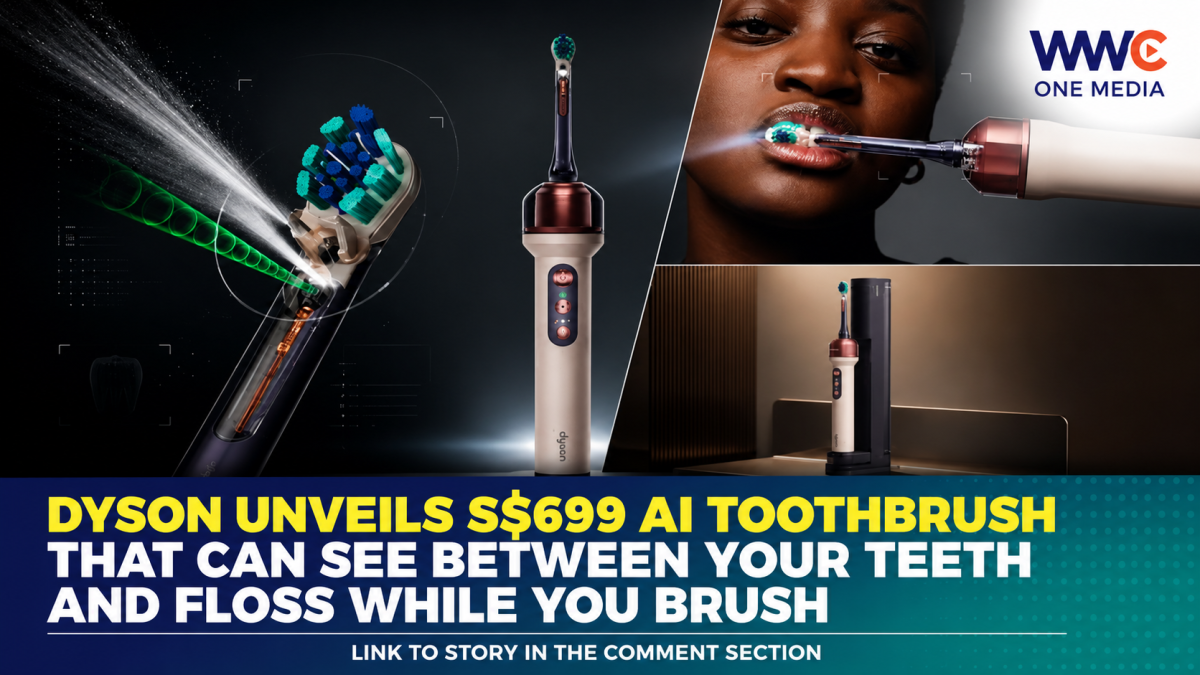
Dyson has taken one of the most ordinary bathroom routines and given it a distinctly futuristic upgrade.
The company has launched the Dyson CameraJet, a smart electric toothbrush that combines brushing, precision flossing and mouth rinsing — while using a tiny camera and artificial intelligence to identify gaps between your teeth. The device was unveiled in Paris on Sept. 1 and is now available in Singapore for S$699.
A toothbrush that can actually “see” your teeth
At the centre of the CameraJet is a 100,000-pixel macro-lens camera built into the brush head.
The camera analyses up to 28 images per second while Dyson’s machine-learning system, called Gap Optical Targeting, identifies, tracks and predicts the spaces between teeth.
When the system detects an interdental gap, a precision jet can automatically direct mouthrinse into the area. Dyson says the jet can activate in as little as 100 milliseconds.
That means the device is designed to brush and precision-floss at the same time, potentially eliminating one of the most frequently skipped parts of a dental routine.
You can watch inside your own mouth
Perhaps the strangest feature is the camera itself.
The CameraJet connects to the MyDyson app through Wi-Fi and Bluetooth, allowing users to view a live feed from inside their mouths while brushing.
The app can also provide guided cleaning, coverage mapping and feedback about areas that may have been missed.
For anyone uncomfortable with the idea of a camera inside a toothbrush, Dyson says the images are not recorded or stored on the device or in the cloud, and that neither Dyson nor third parties can access them.
Dyson built a special jet for flossing
Unlike conventional water flossers that commonly use a narrow stream, Dyson says the CameraJet uses a wider, conical jet designed to provide broader coverage while being gentler on the gums and enamel.
The toothbrush has a 12.5ml mouthrinse tank and a diaphragm pump designed to maintain fluid delivery even when the device is held at different angles. Its docking station can automatically refill the tank.
Dyson has also developed its own low-foaming mouthrinse and non-foaming toothpaste. The reason is practical: excessive foam could interfere with the camera’s ability to see the spaces between teeth.
It is not cheap
The CameraJet costs S$699 in Singapore, putting it firmly in the premium category for electric toothbrushes. The system is available in Ceramic Pink and Ceramic Ultra Blue.
Replacement brush heads cost S$49 for a twin pack in Singapore, while Dyson’s toothpaste and mouthrinse start at S$15 each, according to The Straits Times.
For comparison, the device is priced at US$499.99 in the US and £419.99 in the UK, although the exact package and pricing vary by market.
Singapore played a major role in its development
The CameraJet also has a significant Singapore connection.
According to The Straits Times, the six-year development project involved 661 Dyson engineers, with about 300 based in Singapore. Singapore-based teams contributed to technology development, engineering, prototyping, testing and other areas.
Dyson engineers also worked with the National University of Singapore’s Faculty of Dentistry to develop a synthetic “proxy plaque” material for testing the device’s cleaning performance.
Does it actually clean better?
This is where the marketing claims need some context.
Dyson says its CameraJet is clinically proven to improve gum health and remove plaque compared with a manual toothbrush. The company’s website cites a six-week clinical study involving 204 participants. Dyson also reports laboratory testing showing its variable sonic oscillation removed up to 69% more plaque than market-leading premium electric toothbrushes in certain hard-to-reach areas.
However, independent reviewers have been more cautious about what those numbers mean in everyday use.
TechRadar tested the CameraJet for a week and praised its cleaning performance and technology, but noted its high price, a learning curve and some mess when using the jet-flossing function. Allure likewise described the technology as impressive while saying more testing would be needed to determine whether it ultimately outperforms much cheaper combinations of an electric toothbrush and conventional floss.
That distinction matters: Dyson’s laboratory and clinical claims should not automatically be interpreted as proof that the CameraJet is superior to every other oral-care method for every user.
The bigger question: do we really need a camera in a toothbrush?
The CameraJet represents a broader shift in consumer technology: everyday appliances are increasingly incorporating cameras, sensors, artificial intelligence and connectivity.
For Dyson, the goal is straightforward — use technology to help people clean areas they frequently miss.
But at S$699, consumers will have to decide whether seeing inside their mouths and receiving AI-assisted precision flossing is worth the premium.
The technology may sound futuristic today.
But if cameras can now guide a toothbrush between your teeth, the question is no longer whether AI can enter your bathroom.
It’s how much of your daily routine you’re willing to let it watch.
WWC ONE MEDIA J.M.D


Leave a Reply