
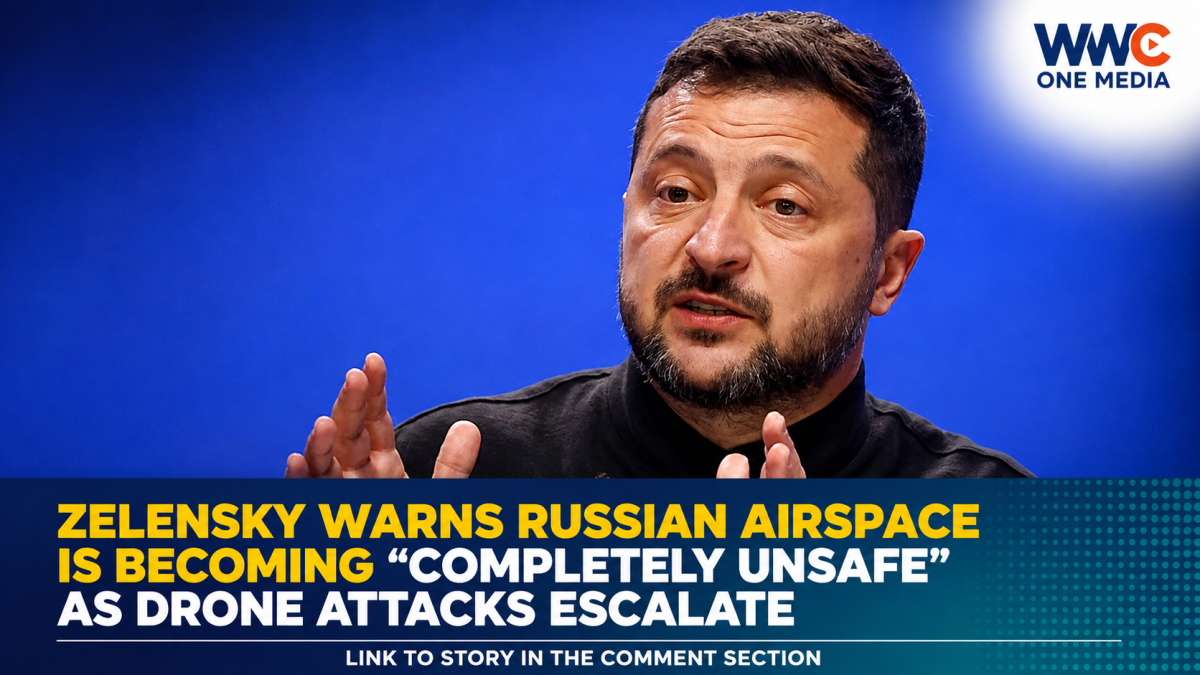
Ukrainian President Volodymyr Zelenskyy has issued a stark warning to airlines, insurers and aviation authorities, saying Russian airspace is becoming increasingly dangerous as Ukraine expands its long-range drone operations inside Russia.
In his Sept. 1 video address, Zelenskyy said the growing presence of Ukrainian drones means airlines and other aviation operators need to reconsider the risks of using Russian airspace and major Russian airports.
He stressed that Ukraine does not intend to target civilian aircraft, but warned that the scale of drone activity over Russia would have to be taken into account.
“Russian airspace is becoming completely unsafe,” Zelenskyy said, according to NHK and other reports.
Ukraine pushes warning to aviation authorities
The warning did not stop with airlines.
On Sept. 2, Ukraine formally asked the International Civil Aviation Organization (ICAO) to encourage its member states to prohibit civil aircraft operations in Russian airspace.
Ukraine’s infrastructure minister told ICAO that Kyiv believes the risk of a civilian aviation tragedy should be minimised as drone and missile activity increases.
The move effectively takes Zelenskyy’s warning from a political statement to an international aviation-safety issue.
However, there has been no blanket international closure of Russian airspace as a result of the warning.
Russia says it can protect civilian aviation
Moscow has rejected the suggestion that Russian civil aviation cannot operate safely.
Russia’s Transport Minister Andrei Nikitin said authorities were continuously improving flight-safety and airport-security measures and were working with the military and National Guard.
He said Russia would not allow significant disruption to civilian aviation.
Russian President Vladimir Putin also characterised Zelenskyy’s warning as “state terrorism,” according to Reuters.
The two sides therefore remain sharply divided over the aviation risk: Kyiv says the growing number of drones makes Russian skies increasingly hazardous, while Moscow says it can maintain the safety of civilian flights.
Flights are already being disrupted
The warning comes as Russian airports have experienced repeated disruptions linked to Ukrainian drone activity.
Reuters reported that on Sept. 2, Moscow’s Sheremetyevo Airport recorded 21 cancelled flights and 235 delays, while Vnukovo recorded 22 cancellations and 94 delays, according to Flightradar24 data.
Pegasus Airlines also cancelled some Russia-bound flights, although the Turkish carrier attributed the cancellations to “technical and operational” reasons rather than directly linking them to Zelenskyy’s warning.
Flydubai said it was monitoring the changing situation and warned passengers that some services could experience delays or diversions.
Why the issue is particularly serious
Unlike most European and US airlines, some carriers from countries including China, Turkey, the United Arab Emirates and other Gulf states continue to use Russian airspace.
For airlines, flying through Russian territory can offer shorter routes between Europe and Asia, potentially saving time and fuel.
But the growing presence of military drones introduces a different calculation: the risk of an aircraft being misidentified, intercepted or caught in an attack or air-defence operation.
Aviation risk advisory firm Osprey Flight Solutions has warned that Ukrainian drone and missile strikes could continue deep inside Russian territory through 2026, including around Moscow and St Petersburg. It also identified the possibility of miscalculation or misidentification in areas connected to the conflict.
There is a tragic precedent
The aviation concerns are also shaped by previous incidents in the region.
In 2014, Malaysia Airlines Flight MH17 was shot down over eastern Ukraine, killing all 298 people aboard. The European Court of Human Rights later found Russia responsible for the destruction of the aircraft.
More recently, 38 people died in the 2024 Azerbaijan Airlines crash after the aircraft diverted toward Kazakhstan. Putin later said two Russian missiles detonated near the plane after Ukrainian drones entered Russian airspace.
Those incidents have intensified concerns about the consequences of military activity occurring close to civilian flight routes.
What happens next?
Ukraine’s latest appeal now places the issue before international aviation authorities.
For passengers, however, the situation is more complicated than simply saying that “Russian airspace is closed.”
It is not.
Some airlines continue to operate through or to Russia, while others already avoid Russian airspace because of the wider security environment. Airlines are making their own operational decisions based on risk assessments, government guidance and changing conditions.
What is clear is that the war is increasingly affecting the skies far beyond the battlefield.
Ukraine says its drone campaign will continue.
Russia says it can protect its aviation system.
And airlines now face an increasingly difficult question:
How much risk is acceptable when the skies themselves are becoming part of the battlefield?
WWC ONE MEDIA J.M.D




Leave a Reply