
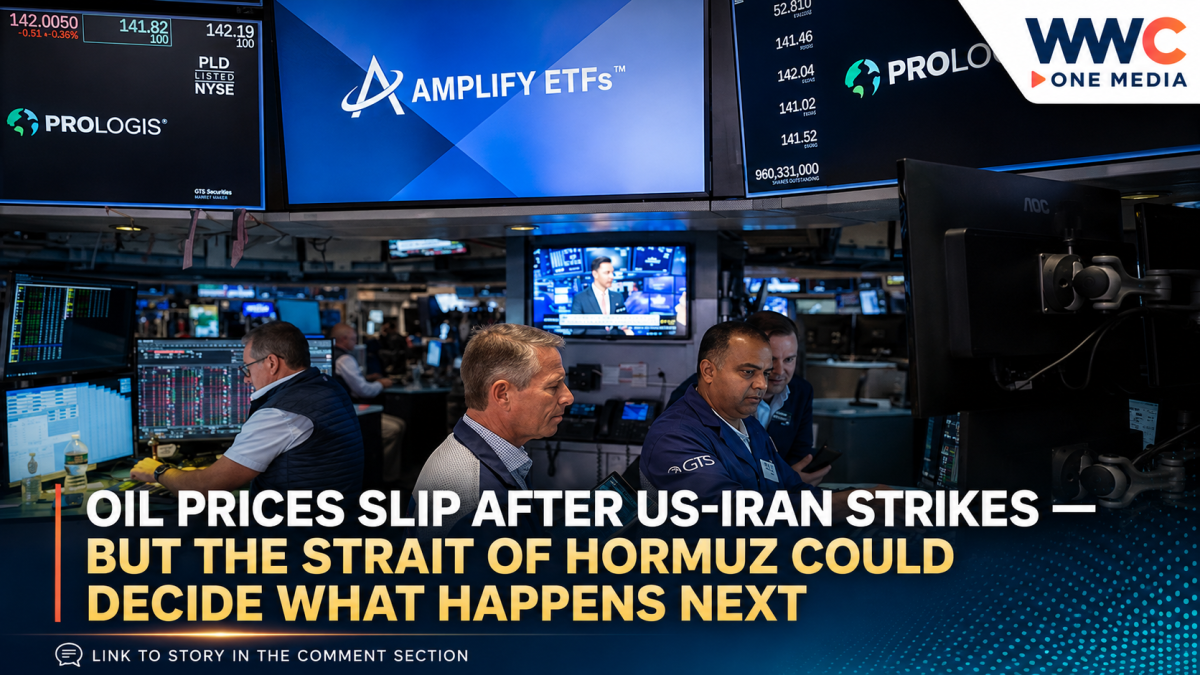
Oil prices edged lower in Asian trading on Thursday, September 3, but the relatively modest retreat offered little evidence that the latest Middle East risk premium is disappearing.
Brent crude futures fell 43 cents, or 0.45%, to $95.20 a barrel at 0029 GMT, while US West Texas Intermediate crude slipped 24 cents, or 0.26%, to $90.77, according to Reuters data carried by CNA. The pullback came after an extraordinarily volatile Wednesday session in which both benchmarks moved between gains of roughly $2 and losses of about $1 per barrel.
The immediate reason for Thursday’s decline was a tentative easing in the latest round of fighting between Washington and Tehran. But underneath that calmer price action sits a much bigger problem for energy markets: oil shipments through the Strait of Hormuz remain severely disrupted, and another military escalation could quickly send crude higher again.
Oil retreats, but traders are nowhere near relaxed
Wednesday’s session showed how sensitive the market has become to every development involving Iran and the United States.
Brent ultimately settled 98 cents higher at $95.63 a barrel, while WTI gained 79 cents to $91.01. Both benchmarks reached their highest intraday levels since July 24 as traders reacted to the most significant exchange of attacks between the United States and Iran since July.
The latest military confrontation included US strikes against Iranian radar, air-defense, maritime and mine-laying capabilities, followed by Iranian missile and drone attacks against US-linked military positions elsewhere in the Middle East.
Associated Press reporting described the latest violence as the end of roughly a month-long lull in direct military action, with Iran retaliating against US interests in the Gulf after American strikes on Iranian targets.
President Donald Trump suggested on Wednesday that the renewed US campaign would not continue for an extended period, helping take some of the immediate heat out of crude prices.
But he simultaneously warned that Washington remained prepared to strike again—leaving traders with no guarantee that the current pause will last.
That contradiction is helping keep oil elevated: the market is pricing in the possibility of de-escalation while refusing to ignore the risk of another sudden disruption.
The biggest danger is still the Strait of Hormuz
For oil traders, the central issue is no longer simply whether another missile is fired.
It is whether tankers can safely move through the Strait of Hormuz, the narrow waterway connecting the Persian Gulf with global markets.
Before the war, roughly one-fifth of the world’s oil supply passed through the strait, making it one of the most strategically important energy chokepoints on Earth. The New York Times reported that more than 130 ships a day crossed the waterway before the conflict.
Current traffic looks dramatically different.
Preliminary Kpler shipping data cited by Reuters showed only four commodity vessels transiting the Strait of Hormuz on Wednesday, compared with a 10-day average of roughly 13.
The numbers may undercount actual movement because some ships turn off tracking systems to reduce their visibility in dangerous waters. Even allowing for that limitation, shipping activity remains far below pre-war conditions.
That is why crude can fall 40 cents in one session without convincing traders that the underlying crisis has disappeared.
A single attack on a tanker, renewed mining activity or another round of US-Iran strikes could immediately increase insurance, freight and security costs—and potentially force more vessels away from the region.
One surprising number shows oil is still getting through
There is, however, another side to the story.
US Energy Secretary Chris Wright said 17 million barrels of oil crossed the Strait of Hormuz on Monday, describing it as the largest volume to move through the waterway since the war disrupted normal trade.
That figure suggests producers and shipping companies have found ways to move substantial quantities of crude despite the conflict.
But the coexistence of a reported 17-million-barrel day and extremely low vessel-count data also highlights how difficult the market has become to read.
Some ships are reportedly operating without normal tracking signals, while ship-to-ship transfers and other unconventional trading arrangements complicate efforts to determine exactly how much oil is moving through the region at any given moment.
That uncertainty itself is bullish for prices because traders must price in risks they cannot easily measure.
US inventories add another layer of support
Geopolitics is not the only reason oil remains near recent highs.
US commercial crude inventories fell by 4.5 million barrels to 424.5 million barrels during the week ended August 28, according to Energy Information Administration data reported by Reuters.
That drop was significantly larger than analysts had expected.
US refinery utilization also climbed to 98%, its highest level since August 2018, while crude exports increased to around 4.5 million barrels per day.
Those figures suggest the physical US oil market is relatively tight at the same time geopolitical risks are threatening supplies from the Middle East.
The combination helps explain why crude has remained resilient even when traders receive temporary signs of military de-escalation.
OPEC+ may have limited ability to calm the market
Normally, a surge in oil prices would immediately turn attention toward OPEC+ and whether the producer alliance might release additional barrels.
But this time, the picture is more complicated.
Reuters reported that key OPEC+ members are expected to leave their October production policy unchanged when they meet on Sunday.
The group has already completed the planned unwinding of a 1.65 million-barrel-per-day production cut, but actual increases in output have lagged planned quota increases as conflicts affecting Iran, Russia and Kazakhstan interfere with exports.
In other words, announcing additional production does not necessarily mean those barrels can reach international buyers quickly—particularly when one of the world’s most important shipping corridors remains under military pressure.
Why $95 oil matters far beyond energy markets
The consequences extend well beyond oil companies and commodity traders.
Higher crude prices eventually feed into gasoline, diesel, aviation fuel, transportation costs and consumer prices.
The New York Times reported that Brent has climbed more than 30% since the beginning of the Iran war, while disruptions to Hormuz have also pushed up refined-fuel costs.
Those inflation risks are already spilling into broader financial markets.
Recent Reuters reporting noted that rising energy prices have contributed to higher bond yields and renewed concern that persistent inflation could keep interest rates elevated.
That means the next major move in oil could influence much more than the price motorists pay at the pump.
It could also affect inflation expectations, central-bank decisions, currencies, government borrowing costs and global stock markets.
What happens next?
For now, the market appears caught between two competing forces.
On one side are signs that Washington and Tehran may allow the latest confrontation to cool, at least temporarily.
On the other is the reality that the Strait of Hormuz remains dangerously unpredictable, tanker movements are still heavily disrupted and both sides have demonstrated that they are willing to restart military operations with little warning.
That leaves Brent near $95—not because traders are certain supplies will be lost, but because they cannot be certain they will not be.
And that distinction could determine whether the current oil rally finally fades—or whether the next confrontation sends crude sharply higher again.
WWC ONE MEDIA MJE




Leave a Reply