
Workers miss shifts. Businesses lose customers. Deliveries slow down. Retailers see foot traffic disappear. And for employees paid only for days they actually report for work, a transport disruption can quickly become lost income.
That is the bigger argument now being pushed by the Parañaque Integrated Terminal Exchange (PITX): the Philippines should treat reliable transportation not simply as a commuter issue, but as part of the country’s economic resilience strategy.
At the PITX Media Forum held on August 28, government officials, transport operators, researchers and business representatives argued that better connections among trains, buses, roads and other transport systems could help cities continue functioning during floods, severe weather, fuel disruptions and other emergencies.
And PITX says one change in commuter behavior already offers a glimpse of what better connectivity can do.
PITX Says LRT-1 Link Changed Its Evening Rush
PITX reported that its evening passenger peak shifted from around 7 p.m. to 6 p.m. following its connection with the LRT-1 Cavite Extension.
PITX officials interpret the change as an indication that some Cavite-bound passengers are reaching the terminal earlier after taking the train rather than relying entirely on road transport.
The observation does not mean every passenger has automatically cut an hour from his or her commute. But it provides a potentially important example of how connecting a major rail line directly with a bus terminal can change travel patterns.
The LRT-1 Cavite Extension Phase 1 began commercial operations on November 16, 2024, adding five stations: Redemptorist-ASEANA, MIA Road, PITX, Ninoy Aquino Avenue and Dr. Santos.
The extension created a direct rail connection between PITX and the wider LRT-1 network running through Parañaque, Pasay, Manila, Caloocan and Quezon City.
That integration is central to PITX’s larger argument: a transport hub becomes considerably more useful when passengers can transfer easily between different modes instead of beginning another complicated journey after reaching the terminal.
The Bigger Target: Metro Manila in One or Two Transfers
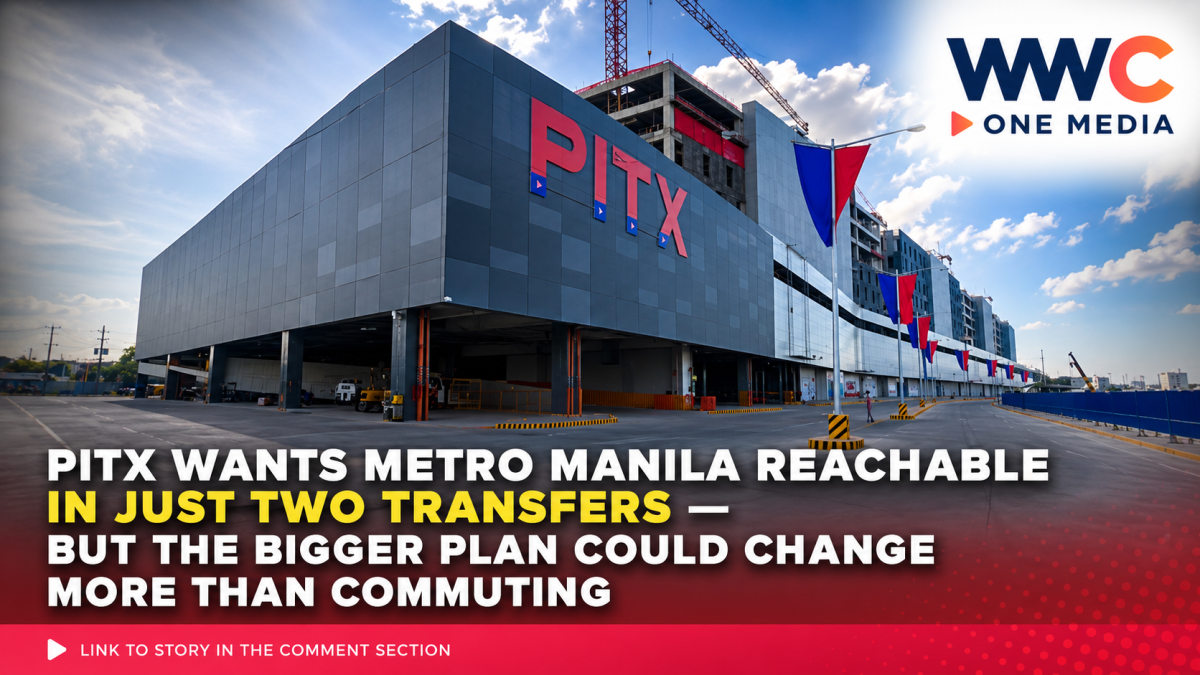
MWM Terminals Chief Operating Officer Mohit Malhi said PITX ultimately wants passengers traveling from the terminal to destinations across Metro Manila to need only one or, at most, two transfers.
That goal may sound modest, but every additional transfer introduces another possible failure point.
A commuter can miss a connecting bus. A route may suddenly lack vehicles. Flooding could close a road. Long queues may form at another terminal.
During normal days, those problems mean inconvenience and longer travel times. During typhoons, fuel shortages or major infrastructure disruptions, they can leave thousands of people unable to reach work or essential services.
PITX officials also told BusinessMirror that the terminal monitors routes and passenger waiting times, with a target of keeping normal waits on particular routes to 20 minutes or less.
When operators cannot provide enough capacity, PITX said it coordinates with them and may seek additional units through regulators.
Why Businesses Are Paying Attention
The issue extends far beyond transportation companies.
Leechiu Property Consultants Associate Director Edward Gador told the forum that accessibility has become an important consideration for companies deciding where to locate offices.
For employers, a theoretically attractive office location becomes less competitive if employees regularly struggle to get there.
Retail businesses face a similar problem: stores need customers, employees and deliveries to arrive reliably. When transportation fails, all three can be affected at once.
That relationship between mobility and economic activity is particularly relevant given PITX’s enormous passenger base.
The terminal handled 32.45 million passengers during the first half of 2026, bringing cumulative foot traffic since its 2018 opening to 271.67 million.
It was averaging about 180,000 passengers a day while serving 32 city routes and 80 provincial routes, according to MWM Terminals figures reported in July.
At that scale, even relatively small improvements—or disruptions—can affect large numbers of commuters.
Metro Manila’s Traffic Problem Already Carries a Huge Price Tag
The economic argument is backed by a much broader congestion problem.
A frequently cited Japan International Cooperation Agency study estimated that transportation costs associated with Metro Manila congestion reached about P3.5 billion per day in 2017.
Without sufficient intervention, the figure was projected to climb to P5.4 billion per day by 2035. JICA has continued citing those estimates while supporting transportation and traffic-management programs in the Philippines.
The numbers are older estimates rather than a measurement of today’s exact daily losses, but they illustrate why transportation efficiency has increasingly become an economic policy issue rather than merely a question of commuter convenience.
The government’s challenge is therefore not simply to build more infrastructure.
The systems have to connect.
Data Could Become the Next Critical Piece
Participants at the PITX forum also pointed to another part of the resilience equation: data.
Experts from the University of the Philippines National Center for Transportation Studies said transport modeling could help authorities identify vulnerable locations, predict where disruptions are likely to cause the biggest problems and prepare alternative routes before a crisis occurs.
That approach mirrors broader efforts by JICA and Philippine authorities to improve traffic-data management and intelligent transportation systems in Metro Manila. JICA and the Metropolitan Manila Development Authority have been working on a comprehensive traffic-management program that includes stronger databases and modern traffic-management technology.
The principle is straightforward: authorities cannot reroute passengers effectively during a major disruption if they do not know where demand is building, where capacity is disappearing and which alternatives remain available.
PITX Is Becoming More Than a Bus Terminal
PITX’s resilience campaign also reflects how the facility itself has evolved.
Opened in 2018 as the country’s first major “landport,” PITX was designed as an integrated terminal linking different public transportation modes. It now combines provincial and city buses, jeepneys and direct rail access through LRT-1.
PITX and Megawide have also been promoting transit-oriented development around transport hubs, arguing that placing offices, shops and services close to major transportation connections can reduce unnecessary travel and make businesses less vulnerable to commuting problems.
That is where the latest resilience push becomes more ambitious.
Instead of viewing transportation as a collection of separate bus routes, railways, roads and terminals, PITX is arguing for an interconnected ecosystem in which transportation, workplaces, commercial areas and essential services reinforce one another.
The Real Test Comes When the Network Is Disrupted
The concept is convincing on paper. The harder question is whether agencies, operators and local governments can make it work when Metro Manila is under pressure.
Participants at the forum called for closer coordination among national agencies, LGUs, transport companies, infrastructure operators, planners and businesses during disruptions ranging from severe flooding to fuel and supply-chain shocks.
No major new funding package or nationwide transport project was announced at the forum.
What emerged instead was a strategy: connect existing and future infrastructure better, reduce unnecessary transfers, use data to anticipate failures and put workplaces and services closer to transportation.
For millions of Filipino commuters, that could translate into something much simpler—fewer hours lost traveling and fewer journeys derailed when one part of the system fails.
But for the Philippine economy, the stakes are considerably larger.
Because if PITX’s argument is correct, the country’s next major transportation breakthrough may not come from building another isolated road, terminal or railway.
It may come from finally making all of them work together.
WWC ONE MEDIA MJE




Leave a Reply