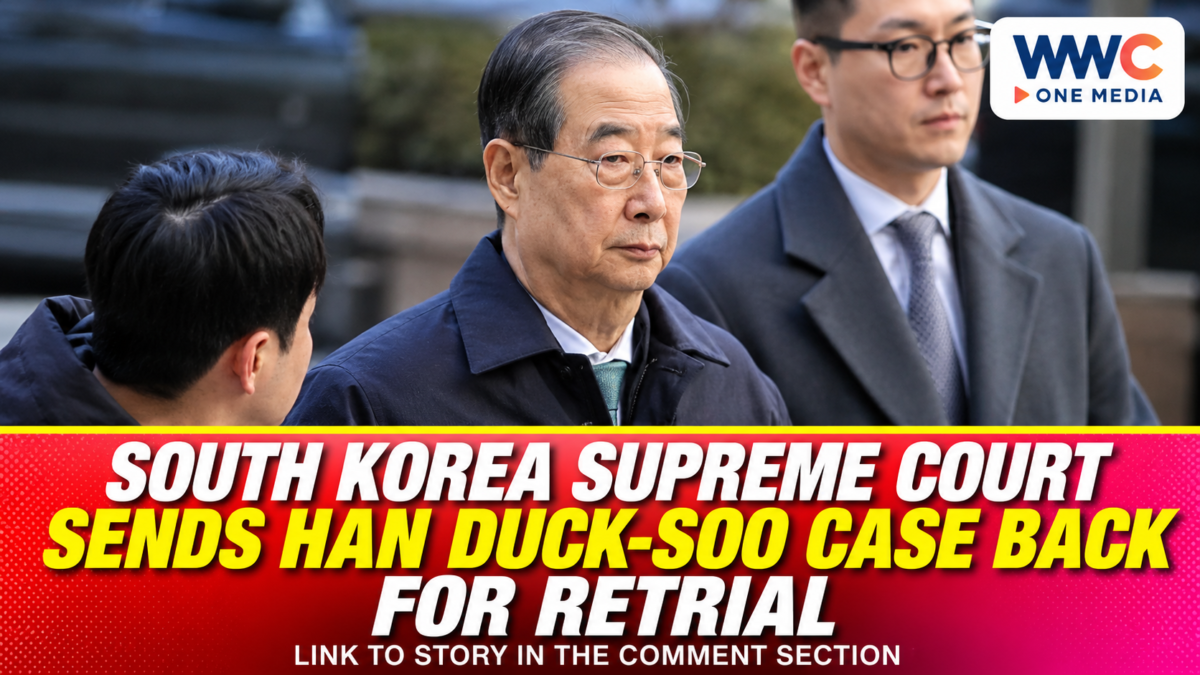
South Korea’s Supreme Court on Nov. 19, 2026, overturned the guilty portions of former Prime Minister Han Duck-soo’s appellate ruling and sent his case back to the Seoul High Court, reopening a prosecution that had resulted in a 15-year prison sentence. The decision did not clear Han of all the findings against him: the justices upheld key conclusions involving his actions after former President Yoon Suk Yeol declared emergency martial law in December 2024.
The ruling draws an important legal distinction between Han’s conduct before and after the declaration. The Supreme Court found insufficient evidence to establish that his pre-declaration effort to create the appearance of a properly convened Cabinet meeting was driven by an intention to disrupt the constitutional order. But it found no basis to overturn the lower court’s conclusions on two other alleged actions after martial law was declared.
The case now returns to the Seoul High Court, where the judges must reconsider the parts of the conviction affected by the Supreme Court’s decision. The outcome could determine how much criminal responsibility Han ultimately faces for his role in the constitutional crisis.
Why the Supreme Court overturned the 15-year ruling
Han’s case reached the Supreme Court under case number 2026Do7341, formally listed as a matter involving allegations of aiding the leader of an insurrection.
The full bench reviewed three categories of conduct that had formed part of the lower court’s finding that Han played an important role in an insurrection.
The first concerned the appearance of Cabinet deliberation before Yoon announced martial law. The prosecution argued that Han’s actions helped give the declaration an appearance of procedural legitimacy.
The Supreme Court concluded that the evidence presented by the special counsel was insufficient to establish that Han had the required purpose of disrupting the constitutional order in this part of the case.
That finding was significant because the court did not treat every action surrounding the martial law declaration as proof of the same criminal intent. It assessed the conduct separately and examined whether the evidence supported the specific legal requirement.
The distinction does not amount to a finding that the martial law declaration itself was lawful. The court’s reasoning separated the constitutionality of the declaration from the question of whether the evidence established Han’s individual criminal responsibility for each alleged act.
Two post-declaration actions remain serious findings
The Supreme Court did not overturn the lower court’s conclusions on the other two categories of conduct connected to the insurrection charge.
One involved efforts to obtain signatures from Cabinet members on documents indicating their attendance at a meeting after martial law had been declared.
The other concerned discussions about plans to block key institutions and implement orders involving the interruption of electricity and water supplies to selected media organisations.
The court found that the lower court had not made an error in its assessment of these two categories of conduct.
This distinction matters. The Supreme Court did not simply dismiss the prosecution’s case against Han or declare that the entire insurrection-related conviction lacked evidentiary support. It identified a specific part of the lower court’s reasoning that required reversal while leaving other findings intact.
The court’s official summary also makes clear that the case involved separate charges beyond the insurrection-related allegations.
False documents and perjury findings were not wiped out
Han also faced charges involving the preparation and use of false official documents, as well as perjury.
The Supreme Court found no error in the lower court’s partial guilty findings involving the preparation of false official documents and their use. It likewise upheld the relevant partial guilty findings on the perjury charge.
The court separately rejected the prosecution’s appeal concerning the use of the falsely prepared document.
These details are important because the headline result — reversal of the 15-year sentence — can easily be misunderstood as a complete acquittal.
That is not what the Supreme Court announced. Its decision preserved parts of the lower court’s findings while requiring the appellate court to reconsider the overall judgment.
For readers following the wider legal fallout from Yoon’s administration, WWC has also examined the separate Supreme Court proceedings involving former first lady Kim Keon Hee. Her case involves different charges and must not be confused with Han’s proceedings.
Why the entire guilty portion had to be sent back
The Supreme Court’s explanation of the remand is central to understanding why the 15-year sentence was overturned even though two of the three insurrection-related findings survived review.
The court said the part requiring reversal was connected to the remaining guilty portions through the rules governing offences treated as one crime or as concurrent offences under South Korean criminal law.
As a result, the affected guilty portion of the appellate judgment had to be overturned and returned to the Seoul High Court rather than simply removing one allegation and leaving the original sentence untouched.
In practical terms, the appellate court must now reconsider the case in light of the Supreme Court’s legal conclusions. It cannot disregard the higher court’s finding that the evidence was insufficient to establish the required purpose in the pre-declaration Cabinet-meeting issue.
At the same time, the findings that survived Supreme Court review remain important to the proceedings on remand.
The decision therefore creates a new sentencing and legal assessment stage rather than ending the case.
The ruling’s wider significance for South Korea
The proceedings remain part of the legal reckoning over the Dec. 3, 2024, emergency martial law declaration.
The case is particularly significant because it tests how criminal responsibility is assessed when senior government officials are accused of actions connected to an unconstitutional exercise of executive power.
The Supreme Court’s approach illustrates why courts must distinguish between political responsibility, participation in government decisions and the specific elements required to establish a criminal offence.
A senior official’s position does not automatically establish criminal guilt. Prosecutors must prove the relevant conduct and the required intent under the applicable law.
That principle also means that a partial reversal should not be presented as a declaration that every allegation was unfounded. The Supreme Court preserved important findings while identifying a specific evidentiary problem.
Other proceedings connected to the martial law crisis continue to form part of South Korea’s political and judicial landscape. WWC previously covered the special counsel’s case against Daegu Mayor Choo Kyung-ho, which concerns a separate set of allegations and should not be treated as part of Han’s case.
The broader political context also includes legal proceedings involving figures connected to Yoon’s former administration, including the case involving Unification Church leader Han Hak-ja. These cases are legally distinct, even where they intersect with the same period of political upheaval.
What happens next
Han’s case returns to the Seoul High Court for proceedings consistent with the Supreme Court’s ruling.
The appellate court will have to account for the reversal involving the pre-declaration Cabinet-meeting issue while addressing the findings that the Supreme Court left intact. It must then determine the appropriate legal outcome and sentence under the remanded case.
The Supreme Court’s decision does not itself impose a new prison term or establish that Han has been fully acquitted. The next ruling from the Seoul High Court will be important in determining the final direction of the case.
For now, the central question is how the appellate court will reassess Han’s criminal responsibility when one part of the insurrection allegation has been overturned but other findings remain.
Frequently asked questions
Why did South Korea’s Supreme Court overturn Han Duck-soo’s 15-year sentence?
The court found insufficient evidence to establish that Han intended to disrupt the constitutional order through his actions concerning the appearance of Cabinet deliberation before martial law was declared. Because that issue affected the overall guilty portion of the appellate judgment, the court overturned the affected ruling and remanded the case.
Was Han Duck-soo acquitted of the insurrection charge?
No. The Supreme Court left intact the lower court’s findings concerning two categories of post-declaration conduct: efforts to obtain Cabinet members’ signatures on attendance-related documents and discussions involving plans to block key institutions and interrupt utilities to selected media organisations.
What happened to the false-document and perjury charges?
The Supreme Court found no error in the lower court’s partial guilty findings involving false official documents and perjury. It also rejected the prosecution’s appeal concerning the use of the falsely prepared document.
Will Han Duck-soo face another trial?
The case has been sent back to the Seoul High Court for reconsideration. The remand requires the appellate court to follow the Supreme Court’s legal findings when it reviews the affected portions of the case.
Does the Supreme Court ruling mean Han’s 15-year sentence is final?
No. The 15-year appellate sentence was overturned in the affected guilty portion, and the case has been returned to the Seoul High Court. A new determination is required before the outcome and any sentence can be settled.