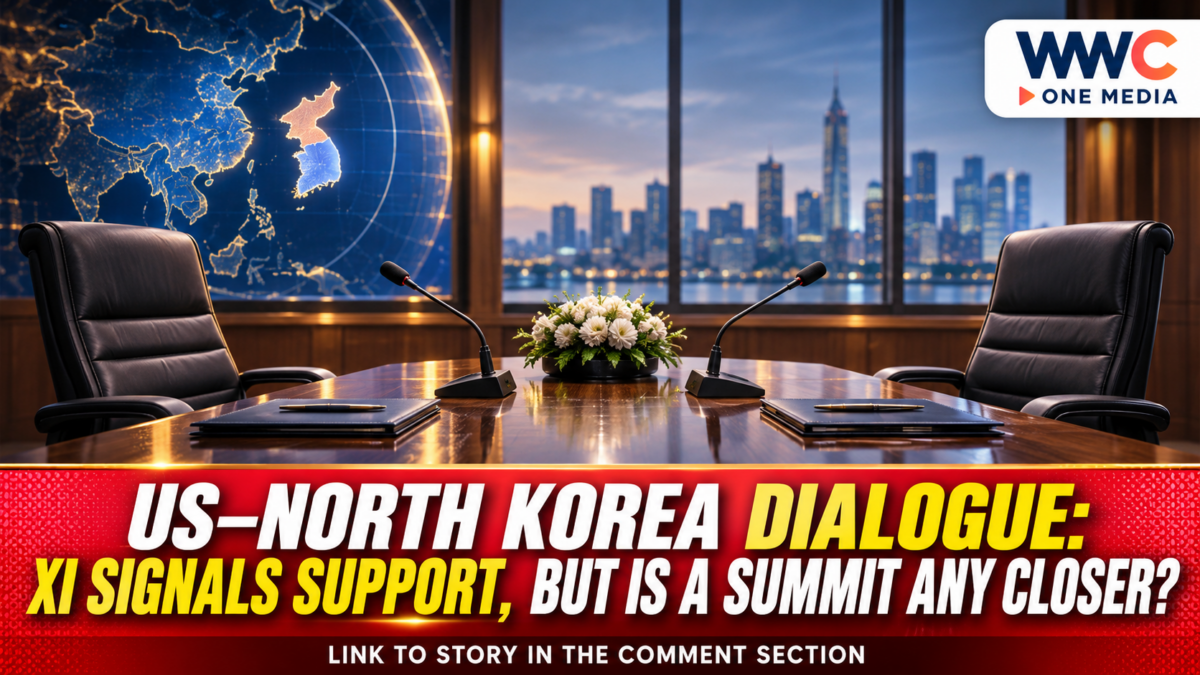
On Nov. 18, Chinese President Xi Jinping expressed support for efforts to ease tensions on the Korean Peninsula, including dialogue between the United States and North Korea, during a meeting with South Korean President Lee Jae Myung in Shenzhen. The South Korean presidential office disclosed the position in its official account of the leaders’ talks, but announced no agreement to convene a US–North Korea summit. 대한민국 청와대
The statement gives renewed diplomatic weight to the question of whether Washington and Pyongyang could return to direct engagement. It also highlights the difference between governments supporting dialogue in principle and the much harder work of securing an agreed meeting, agenda and negotiating terms.
For now, the public record establishes China’s support for dialogue and Seoul’s continuing effort to reduce tensions. It does not establish that a new round of US–North Korea negotiations has begun.
Xi’s position puts dialogue back into the regional discussion
The Nov. 18 meeting was the third summit between Lee and Xi since their previous encounters in Gyeongju in November 2025 and Beijing in January 2026. The South Korean readout says the two leaders discussed bilateral relations and regional issues, including the Korean Peninsula. 대한민국 청와대
Lee asked China to play a constructive role in addressing Korean Peninsula issues. The official account says Xi assessed Seoul’s efforts to improve inter-Korean relations and reduce tensions positively, adding that China would continue to play a constructive role.
The readout then makes a specific reference to North Korea-US dialogue: Xi supported various efforts to ease tensions on the peninsula, including such dialogue. That is the clearest new diplomatic detail in the published account.
However, the wording does not say China has arranged a meeting, that North Korea has accepted negotiations or that Washington and Pyongyang have agreed on terms.
The distinction matters. Diplomatic support can help create a favourable environment, but it is not a substitute for direct contact between the parties.
Seoul’s policy still centres on reducing tensions
South Korea’s stated approach has been to pursue peaceful coexistence while trying to restore communication with North Korea.
In a Sept. 3 address, Foreign Minister Cho Hyun said the government remained committed to easing tensions and building trust with Pyongyang. He also acknowledged that North Korea had not given a positive response to Seoul’s efforts at that point. Ministry of Foreign Affairs of Korea
Cho said the government had suspended loudspeaker broadcasts directed at North Korea and dismantled related equipment. He also described Seoul’s proposal for inter-Korean working-level military talks as an effort to reduce the risk of accidental clashes.
On the US–North Korea track, the minister said Seoul would continue diplomatic efforts to facilitate a resumption of dialogue and coordinate closely with Washington.
That position provides context for Lee’s request to Xi. Seoul is seeking support from regional partners while maintaining its alliance with the United States.
WWC has previously examined how South Korea’s appeal for Chinese support for peninsula peace fits into that diplomatic strategy.
APEC meetings created opportunities, not proof of a breakthrough
The discussions took place during the Asia-Pacific Economic Cooperation leaders’ gathering in Shenzhen on Nov. 18–19. APEC’s published schedule confirms the dates and location of the leaders’ meeting. APEC
South Korea’s Nov. 19 presidential briefing also described Lee’s exchanges with US President Donald Trump during a welcome dinner hosted by Philippine President Ferdinand Marcos Jr. The briefing characterised the dinner as an informal opportunity for leaders to talk about matters of mutual interest. It said Lee and Trump exchanged greetings. 대한민국 청와대
The same briefing records a separate conversation between Lee and Trump about future diplomatic schedules and South Korea–US cooperation during the APEC welcome dinner in Shenzhen. It does not say that they discussed a planned Trump–Kim meeting or reached an arrangement for negotiations with Pyongyang.
That limit is important when interpreting summit diplomacy. Leaders can use the same international gathering to exchange views without holding formal negotiations on every issue raised in the wider regional agenda.
A meeting, a brief conversation and an agreed diplomatic process are different developments. The available South Korean readouts do not establish that the latest encounters moved the United States and North Korea into formal talks.
The diplomatic obstacles remain substantial
Even if the governments were to resume contact, the substance of any negotiations would remain difficult.
North Korea’s nuclear programme is a central issue in the longstanding dispute. The US and South Korea have maintained that denuclearisation is a key objective, while North Korean officials have repeatedly rejected pressure to abandon the country’s nuclear capabilities.
WWC’s previous examination of North Korea’s position on nuclear expansion and regional military cooperation provides context for why a diplomatic opening would not automatically produce agreement.
There is also a wider regional dimension. Russia’s relationship with Pyongyang has become another factor in the diplomatic environment. A recent meeting between Vladimir Putin and a senior North Korean official illustrates why developments involving Moscow may also matter to the broader Korean Peninsula picture.
These relationships do not prove that any country can deliver a breakthrough. They do show why renewed US–North Korea engagement would take place within a complicated regional setting.
What happens next
The next meaningful indicators would be official confirmation of direct contact, an announced meeting or a published statement identifying an agreed process.
A statement supporting dialogue is politically relevant, but it does not tell the public whether the two sides have exchanged proposals, agreed on an agenda or settled the conditions for talks.
South Korea has said it will continue coordinating with the United States and seeking ways to ease tensions. China has now publicly expressed support for efforts that include US–North Korea dialogue.
The practical test is whether those positions lead to contact that both Washington and Pyongyang acknowledge. Until then, a new summit remains unconfirmed.
Frequently asked questions
Did China support US–North Korea dialogue?
Yes. South Korea’s official account of the Nov. 18 meeting between Lee Jae Myung and Xi Jinping says Xi supported efforts to ease Korean Peninsula tensions, including US–North Korea dialogue. 대한민국 청와대
Did Xi Jinping announce a Trump–Kim summit?
No. The South Korean readout records support for dialogue but does not announce a summit or say that a meeting has been arranged.
Have the United States and North Korea restarted formal negotiations?
The South Korean public records reviewed for this update do not confirm that formal negotiations have restarted.
What does South Korea want from China?
Lee asked China to play a constructive role in addressing Korean Peninsula issues. The South Korean readout says Xi agreed that China would continue to play a constructive role.
Why is renewed dialogue difficult?
The nuclear issue remains a major obstacle. The two sides have long differed over North Korea’s nuclear capabilities and the conditions under which negotiations should take place.