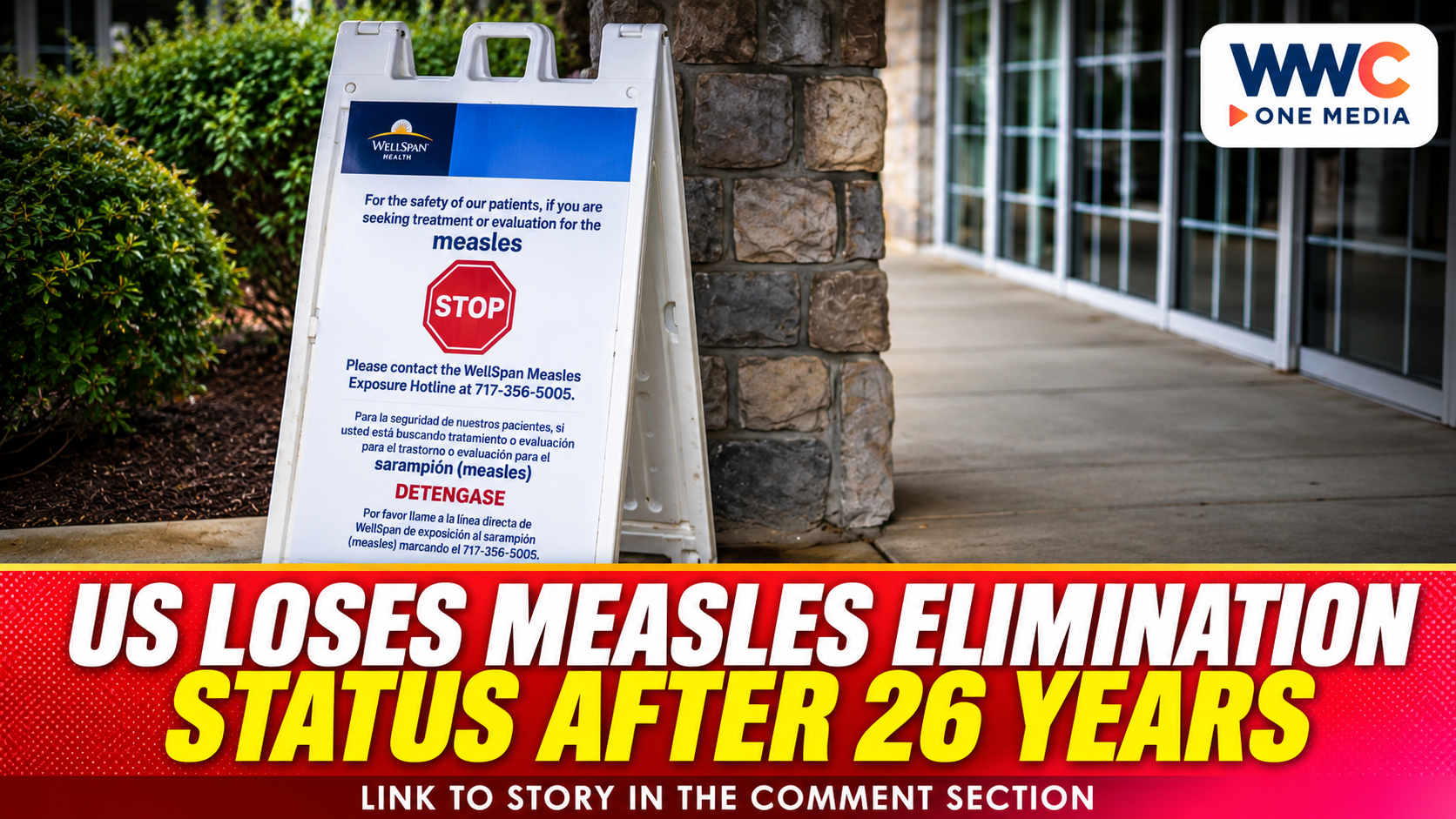
The United States has lost its measles elimination status after health authorities determined that the virus had continued circulating through an uninterrupted transmission chain for at least 12 months. The decision, announced on Nov. 17, 2026, ends a 26-year period in which the country had been considered free of endemic measles transmission.
The development comes as the United States records thousands of confirmed infections in 2026, prompting renewed calls from medical organisations for stronger vaccination coverage, surveillance and outbreak control.
The decision does not mean measles is spreading everywhere in the country, nor does it mean the United States can no longer control outbreaks. It means the virus has become established through sustained local transmission rather than appearing only through imported cases.
Why the US Lost Its Measles Elimination Status
The Pan American Health Organization’s Regional Verification Commission reviewed epidemiological and laboratory evidence during its Nov. 10–13 meeting.
It concluded that the United States, Mexico and Bolivia had each experienced uninterrupted circulation of the same measles virus genotype and lineage for at least 12 months. PAHO Director Dr. Jarbas Barbosa accepted the commission’s recommendations, resulting in the three countries losing their national elimination status.
For the United States, the relevant transmission chain began on Jan. 20, 2025, reaching the 12-month threshold on Jan. 20, 2026.
The distinction is important. A country can experience imported infections and outbreaks without automatically losing elimination status. The decisive factor is whether the same virus lineage continues circulating without interruption for at least a year.
The Americas had already lost its regional measles-free verification in November 2025 after sustained transmission was re-established in Canada. The latest decision concerns the national status of the United States, Mexico and Bolivia.
US Measles Cases Have More Than Doubled From 2025
The latest US Centers for Disease Control and Prevention surveillance update recorded 5,412 confirmed measles cases as of Nov. 12, 2026.
Of those, 5,394 were reported across 47 jurisdictions, while 18 involved international visitors. The CDC also recorded 43 new outbreaks during 2026.
The scale of the increase is clear when compared with the 2,289 confirmed cases reported for the whole of 2025. The 2026 total had already exceeded that figure before the end of November.
The CDC reported that 96% of confirmed cases in 2026 were associated with outbreaks. That included cases linked to outbreaks that began in both 2025 and 2026.
The agency’s current surveillance page also lists six measles deaths for 2026, while warning that the figure may change as additional information and reviews become available.
These figures are not simply a measure of how many people became ill. They show how sustained transmission can place pressure on public-health teams responsible for identifying cases, tracing contacts and preventing further spread.
Doctors and Medical Organisations Want Vaccination Gaps Addressed
The loss of elimination status has prompted strong responses from US medical organisations.
The American Academy of Pediatrics urged increased vaccination and stronger federal leadership following the decision. Its president, Andrew D. Racine, said the return of endemic measles was a preventable failure to protect children.
The American Medical Association also called for coordinated action across government, healthcare and public-health agencies. Its Nov. 17 statement emphasised that declining vaccination coverage leaves communities more vulnerable to preventable infections.
The CDC’s own response identified vaccination access, surveillance and rapid outbreak response as priorities. The agency said it would work with state, local, tribal and territorial health departments to identify communities at increased risk and close gaps in protection.
These responses point to a central problem: national vaccination averages can conceal communities where protection is considerably lower.
Falling Childhood Coverage Leaves More Room for Outbreaks
The CDC reported that measles, mumps and rubella vaccination coverage among US kindergartners fell from 95.2% during the 2019–2020 school year to 92.4% in 2025–2026.
The agency estimated that approximately 280,000 kindergartners were at risk during the 2025–2026 school year.
The 95% benchmark matters because measles spreads extremely efficiently. When vaccination coverage falls below the level needed to maintain community protection, the virus can move quickly through groups of people who lack immunity.
Two doses of the measles, mumps and rubella vaccine are about 97% effective against measles, according to CDC guidance. One dose is about 93% effective.
Vaccination does not mean that breakthrough infections are impossible. However, high coverage reduces the opportunity for sustained transmission and helps protect people who are too young or medically unable to receive the vaccine.
Why the US Development Matters to the Philippines
The American situation is relevant to the Philippines because measles transmission does not stop at national borders. International travel can introduce infections into communities where vaccination gaps remain.
That does not mean the US decision automatically changes the Philippines’ elimination status or proves that a particular traveller is infected. It highlights why local immunisation programmes and disease surveillance remain important even when communities have not reported a major outbreak.
WWC has previously examined how local vaccination gaps can complicate disease prevention, including Mandaue City’s struggle to reach eligible children.
Other local efforts show why prevention continues even in places reporting no active cases. In Vigan, health authorities organised a campaign targeting 2,779 children, while Oriental Mindoro expanded access to free measles-rubella vaccination.
The importance of reaching children before outbreaks grow was also evident in Vigan’s supplemental vaccination campaign.
What Happens Next?
The United States can regain measles elimination status, but it must demonstrate that endemic transmission has been interrupted for at least 12 consecutive months.
PAHO’s framework also requires evidence of strong vaccination coverage, reliable disease surveillance, laboratory capacity and effective outbreak response. The commission must review the evidence before the country can be re-verified.
The CDC has pledged to work with public-health partners to restore elimination status. Its Nov. 17 statement also identified funding and technical support for state and local response efforts.
For now, the immediate priority is stopping ongoing transmission and reaching communities where vaccination protection is insufficient.
The loss of the designation is a serious public-health setback, but it is not permanent. The challenge is whether the United States can rebuild the level of community protection and surveillance needed to prevent measles from becoming established again.
Frequently Asked Questions
1. Has the United States officially lost its measles elimination status?
Yes. PAHO announced on Nov. 17, 2026, that the United States had lost its national elimination status after sustained transmission of the same virus lineage for at least 12 months.
2. How many measles cases has the US reported in 2026?
The CDC reported 5,412 confirmed cases as of Nov. 12, 2026. The figure includes 5,394 cases reported by 47 jurisdictions and 18 among international visitors.
3. Does losing elimination status mean measles is spreading throughout the entire US?
No. It means the virus has circulated continuously through an established transmission chain for at least 12 months. It does not mean every state or community is experiencing an outbreak.
4. Can the United States regain measles elimination status?
Yes. It must demonstrate that endemic transmission has been interrupted for at least 12 consecutive months and provide evidence of effective vaccination, surveillance and outbreak-response systems.
5. How effective is the MMR vaccine against measles?
CDC guidance says two doses are about 97% effective against measles, while one dose is about 93% effective. People with questions about their vaccination history should consult a qualified healthcare professional.