
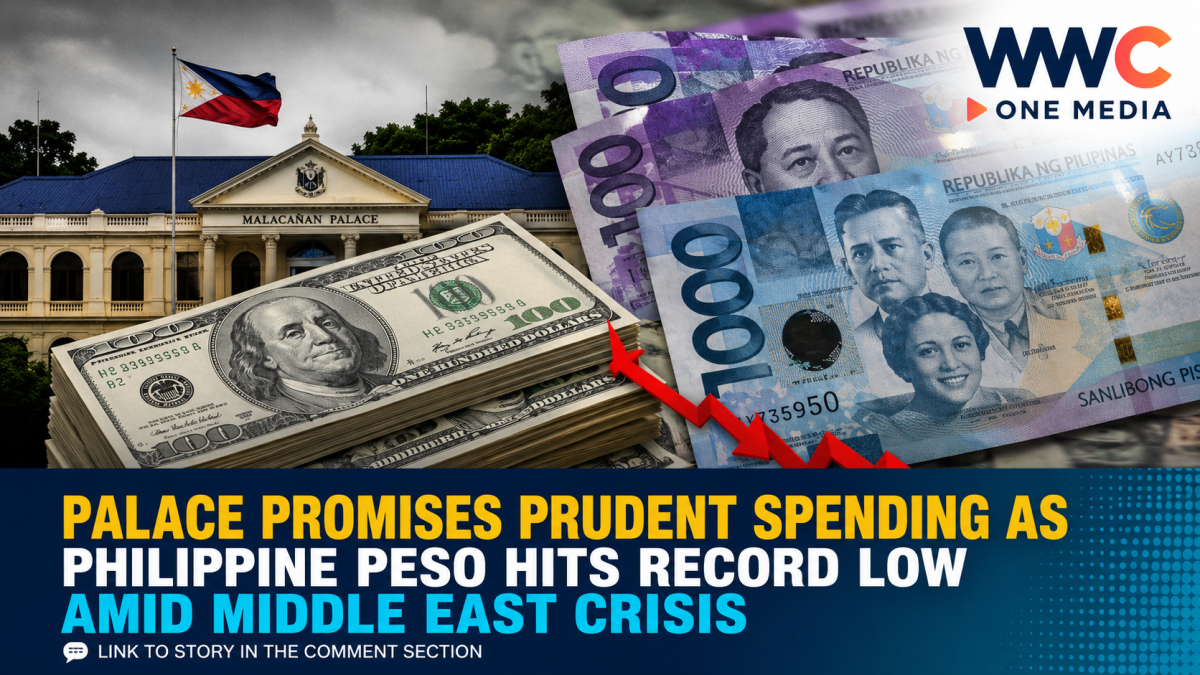
The Philippine government is signaling a more cautious approach to public spending as the peso plunges to another historic low, with Malacañang saying government funds must be used more deliberately and directed toward priority programs as global instability pushes up energy costs and pressures the economy.
The warning comes after the peso closed at ₱62.56 against the US dollar on September 2, its weakest level on record. The currency opened at ₱62.40 and traded as low as ₱62.69 during the session, according to the Philippine News Agency and market data cited in its report.
The latest decline came as renewed fighting in the Middle East pushed oil prices higher and intensified concerns across global financial markets.
Why the peso is under pressure
The peso’s latest slide is part of a broader wave of pressure hitting emerging Asian currencies.
Reuters reported that the Philippine currency reached around ₱62.652 per dollar during intraday trading, leading losses among Asian currencies as investors moved toward safer assets amid higher US Treasury yields and rising oil prices.
Oil prices climbed above US$95 a barrel, increasing concerns for the Philippines because the country is a net importer of oil. More expensive energy can feed into transportation, electricity, manufacturing and food costs, while a weaker peso makes dollar-priced imports even more expensive.
Analysts cited by Reuters also pointed to the Philippines’ external position and relatively weak real interest rates as additional factors weighing on the currency. Slower growth in remittances from some major source markets could provide less support for the peso as well.
Government spending comes under a brighter spotlight
Against this backdrop, Malacañang said the government will be more deliberate about how public money is spent, emphasizing priority projects and responsible use of government resources.
That approach is particularly significant as the administration faces pressure from several directions at once: higher global energy costs, currency weakness, elevated borrowing costs and the need to continue funding infrastructure and social programs.
The government’s position is not that public spending will stop. Rather, the focus is expected to be on prioritizing essential and productive programs while avoiding unnecessary expenditures.
That message is consistent with President Ferdinand Marcos Jr.’s broader fiscal-discipline policy. Earlier this year, Marcos backed a proposal to reduce unprogrammed appropriations to below 5% of the national budget, with the administration arguing that tighter controls would promote more disciplined budgeting.
The stock market is feeling the shock, too
The peso’s weakness was accompanied by losses on the Philippine Stock Exchange.
The PSEi fell 0.67% to 6,053.23 on September 2, while the All Shares Index declined 0.31%. Services recorded the biggest sectoral decline at 1.46%, followed by financials, property, holding firms, and mining and oil.
Philstocks Research attributed the market’s pullback to higher global yields and oil prices caused by renewed military exchanges between the United States and Iran, with the peso’s record decline adding further pressure on investor sentiment.
What a weaker peso means for ordinary Filipinos
A record-low exchange rate isn’t just a number on a financial screen.
When the peso loses value against the dollar, imported products and inputs can become more expensive. That can affect fuel, food ingredients, machinery, electronics and other goods with significant dollar-linked costs.
It can also increase the peso cost of servicing dollar-denominated obligations.
At the same time, Filipinos receiving US-dollar remittances may receive more pesos when converting their money, providing some offset for families dependent on overseas income.
The overall impact, however, depends on how long the currency weakness lasts and how much of the higher import cost is passed on to consumers.
The BSP cannot simply “fix” the exchange rate
The Bangko Sentral ng Pilipinas has previously emphasized that it manages excessive movements in the currency rather than defending a particular peso-dollar level indefinitely.
BSP Governor Eli Remolona Jr. has said the central bank can slow sharp depreciation but cannot permanently fix the exchange rate at a specific level because doing so would require using foreign-exchange reserves.
The BSP has also already raised its benchmark policy rate to 5%, its third consecutive meeting with a rate increase, as policymakers balance inflation risks and economic conditions.
Why the next moves matter
The immediate concern is whether the combination of higher oil prices, a stronger US dollar, global financial-market volatility and geopolitical uncertainty will continue pushing the peso lower.
For the government, the challenge is equally difficult: maintain spending on essential services and economic programs while ensuring that scarce public resources are used efficiently.
The peso’s record low therefore puts two issues under the spotlight at the same time—the cost of global instability and the government’s ability to manage its finances at home.
For now, there is no evidence that the record exchange rate alone signals an economic crisis. But if oil prices remain elevated and global risk sentiment deteriorates further, pressure on the peso—and eventually on prices paid by Filipino consumers—could intensify.
And with the peso already breaking records, the question now is how far the currency can fall before the pressure starts showing up more sharply in everyday household expenses.
WWC ONE MEDIA G.A




Leave a Reply