
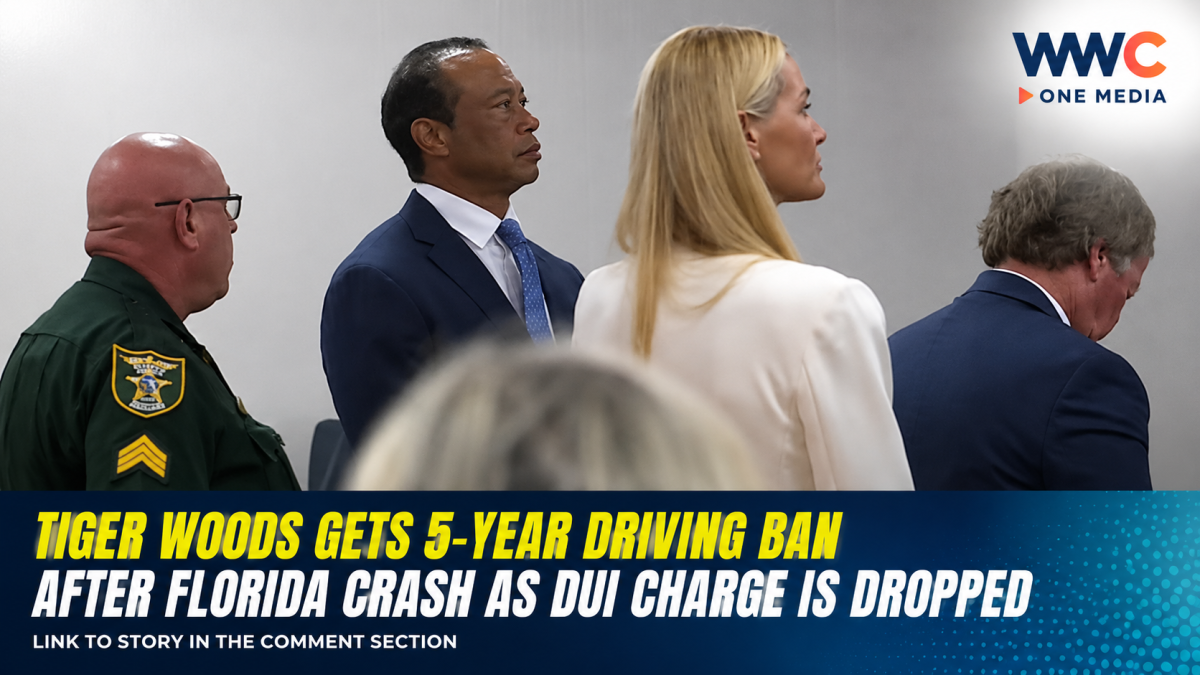
STUART, Florida — Tiger Woods has reached a plea deal that brings his Florida driving case to an end—but not without a major penalty.
The 50-year-old golf superstar pleaded no contest to a reduced reckless-driving charge Wednesday following the March rollover crash near his home on Jupiter Island. A Florida judge suspended Woods’ driver’s license for five years and ordered him to pay fines and court costs.
The development closes a case that initially carried a far more serious allegation: driving under the influence with property damage.
Prosecutors ultimately abandoned the DUI charge, saying the available evidence was not strong enough to prove that Woods was impaired by medication when the crash occurred. Two forensic toxicologists who reviewed the case reportedly concluded there was insufficient evidence of impairment and pointed to Woods’ established tolerance to pain medication.
The crash that started the case
The incident happened on March 27, 2026, on South Beach Road on Jupiter Island.
According to investigators, Woods was driving a Land Rover when he attempted to pass a truck towing a trailer. His SUV clipped the trailer and overturned, coming to rest on its side. Neither Woods nor the other driver was injured, although authorities said the collision caused about $5,000 in damage to the truck.
Woods told deputies that he had been looking down at his phone and changing the radio station when he struck the truck, according to the arrest report.
The road had a 30-mph speed limit, and investigators said Woods appeared to have been traveling at a high rate of speed while attempting the pass.
Why did the DUI charge disappear?
This became the central issue in the case.
Deputies at the scene reported signs they believed indicated impairment. Woods took a breath test that showed no alcohol, but he declined a urine test that could have been used to detect drugs or medications. Investigators also found two pills later identified as hydrocodone in his pocket.
Woods told authorities he had taken prescription medications, including Vicodin, which contains hydrocodone.
But prosecutors later obtained his prescription and pharmacy records and consulted two toxicologists. According to State Attorney Thomas Bakkedahl, the experts determined there was insufficient proof to establish that Woods was impaired at the time of the crash. His history of medical treatment and long-term use of pain medication also complicated efforts to interpret signs of impairment.
Bakkedahl described the DUI case as particularly difficult to prove and defended the decision to accept the reduced plea.
What does “no contest” mean?
Woods’ plea is important to characterize correctly.
A no-contest plea is not an admission of guilt, but the court treats it as a conviction for purposes of the criminal case. Woods agreed to accept the consequences of the reduced charge rather than contest it.
He also pleaded no contest to refusing to submit to testing following the crash.
The penalties include a five-year driver’s-license suspension, with the separate suspension terms running concurrently, meaning the total driving ban is five years rather than ten. He was also ordered to pay fines and court costs. Different reports have broken down the monetary penalties differently, but reporting from the hearing places the fines at roughly $1,500 before additional court costs and fees.
Judge Darren Steele delivered an especially blunt warning to Woods.
If Woods drives during the suspension, the judge warned that there would be no exception and that he could immediately face jail.
There is, however, one unusual exception
Despite losing his driver’s license, Woods can still legally operate a golf cart in Florida under the circumstances described by prosecutors, because state law allows adults to operate certain golf carts without a driver’s license.
For one of the most recognizable golfers in the world, it is an unusual footnote to a case that began with an overturned SUV.
The case adds another chapter to Woods’ troubled driving history
The March crash was not Woods’ first major driving incident.
His history includes the highly publicized 2009 crash, a 2017 DUI arrest, and the devastating 2021 Los Angeles-area crash that left him with serious leg injuries.
The latest incident also comes during a difficult period in Woods’ professional career.
He has not competed in a PGA Tour event since the 2024 Open Championship, while continuing to deal with the physical consequences of multiple surgeries and injuries. He has nevertheless remained involved in the sport’s future, including work with the PGA Tour’s Future Competition Committee.
Following the March arrest, Woods said he was stepping away to seek treatment and focus on his health. Court records later indicated that he spent time at an inpatient treatment facility.
Woods leaves court without speaking
Woods appeared at the Martin County Courthouse on Wednesday with his girlfriend, Vanessa Trump, who sat behind him during the proceeding.
He said little during the hearing and left the courthouse without speaking to reporters. His longtime manager, Mark Steinberg, said Woods was not absolved of accountability and was continuing treatment while prioritizing his health.
The outcome means Woods avoids a DUI conviction—but the five-year loss of his driving privileges ensures that the March crash will continue to cast a shadow over one of golf’s most celebrated careers.
For now, the biggest question may no longer be what happened in that Florida crash—but what comes next for Tiger Woods, both away from the wheel and on the golf course.
WWC ONE MEDIA J.M.D




Leave a Reply