
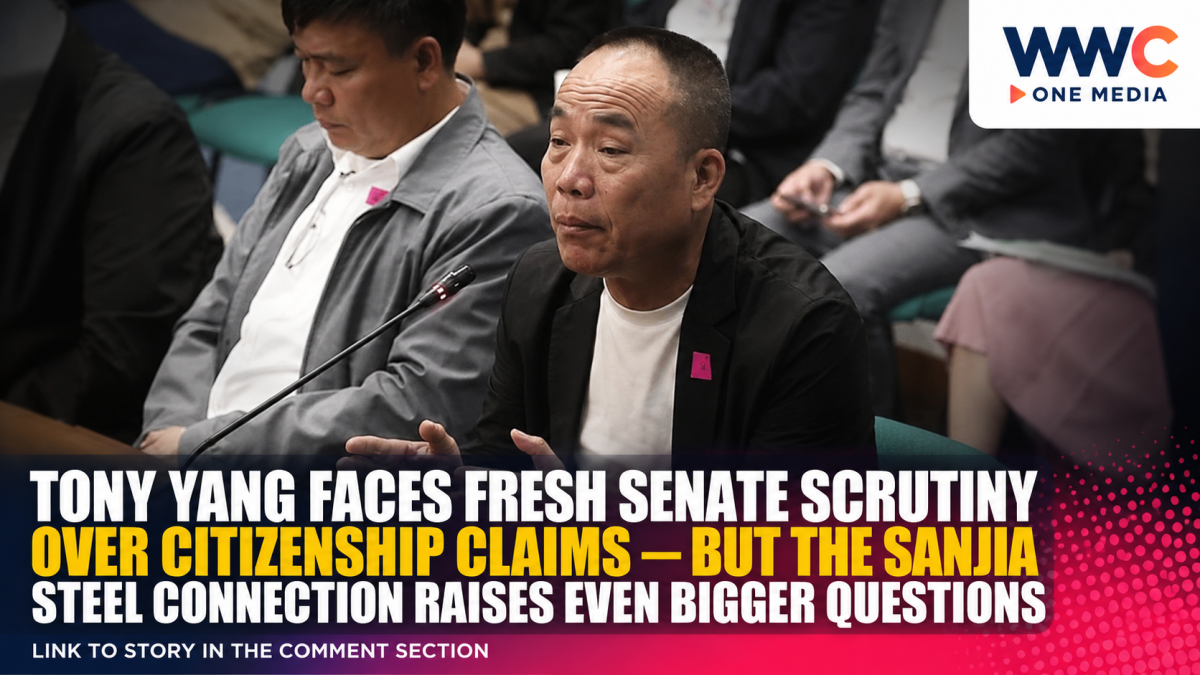
MANILA, Philippines — Controversial businessman Tony Yang is once again at the center of a Senate inquiry, with lawmakers examining questions surrounding his claimed Philippine citizenship and his links to the company behind the controversial Sanjia Steel operation in Misamis Oriental.
The renewed scrutiny comes as authorities continue investigating the steel facility and the people connected to it, putting Yang’s disputed identity and business dealings back under the national spotlight.
Yang, whose real name is Yang Jianxin, previously admitted during a Senate investigation that he was born in China and had used the name Antonio Maestrado Lim in the Philippines. He also acknowledged possessing a Philippine birth certificate that he said was fraudulently obtained.
The National Bureau of Investigation later filed criminal complaints against Yang involving alleged falsification of public documents, perjury and violations of the Anti-Alias Law. The NBI said its investigation found that Yang used aliases and a Philippine birth certificate to establish and register several corporations.
Among the companies identified in the NBI investigation was Philippine Sanjia Steel Inc., the firm that has since become the subject of a major government operation in Misamis Oriental.
Why Sanjia Steel is now under the microscope
The Sanjia Steel controversy escalated in May 2026 after government authorities raided the company’s facility in Tagoloan, Misamis Oriental.
The operation involved the Presidential Anti-Organized Crime Commission, National Bureau of Investigation and other government agencies, with authorities arresting dozens of Chinese nationals working at the facility.
The government has said the investigation involves alleged violations concerning immigration, labor regulations, hazardous radioactive materials and the quality of steel products.
The Philippine News Agency reported that authorities detected elevated radiation readings in parts of the facility and were investigating allegations involving radioactive materials in imported scrap. Officials also raised concerns over allegedly substandard steel products and whether such materials may have entered the Philippine construction market.
Authorities said 316 Filipino workers were displaced following the shutdown, while 120 Filipino workers were described by investigators as having been rescued from the facility.
However, these allegations have not gone uncontested.
Sanjia rejects allegations
Sanjia Steel has denied wrongdoing and pushed back against the government’s characterization of the operation.
The company said Yang was no longer a shareholder and had allegedly divested his interests years earlier. Sanjia also maintained that its foreign technical personnel had valid immigration and employment documents.
The company further disputed allegations involving radioactive materials and substandard steel, arguing that regulatory and compliance concerns should have been handled through the appropriate civilian agencies.
Sanjia described the raid as harassment and said it intended to seek independent assessments of its operations.
Those competing claims are important because the government’s investigation and the company’s defense represent different sides of an issue that remains subject to legal and regulatory proceedings.
The citizenship issue remains central
Yang’s citizenship controversy predates the Sanjia Steel raid.
During a Senate investigation in September 2024, Yang admitted that he was a Chinese national and acknowledged using the identity Antonio Maestrado Lim. His testimony prompted lawmakers and investigators to examine how he obtained Philippine identity documents and how those documents were subsequently used in business transactions.
The NBI later said Yang had used the Filipino identity in corporate registrations, including companies connected to Sanjia Steel.
Yang was arrested in 2025 after authorities served warrants stemming from the criminal complaints. The NBI said the cases included three counts each of falsification of public documents and perjury, plus a violation of the Anti-Alias Law.
Why the Senate inquiry matters
The latest Senate scrutiny puts a much larger question on the table: How were disputed identity documents allegedly used to gain access to Philippine business and corporate systems in the first place?
The issue extends beyond one businessman.
It raises questions about the effectiveness of government systems for verifying citizenship, birth records, corporate registrations and the identities of individuals allowed to establish businesses in strategic industries.
The controversy has also become intertwined with broader government investigations into foreign nationals, Philippine offshore gaming operations and alleged organized criminal networks.
Defense Secretary Gilbert Teodoro Jr. has previously linked Yang to the Sanjia Steel controversy and described the facility as a matter of national-security concern. The government has repeatedly maintained that its actions were directed at alleged violations of Philippine law and were not intended to target Chinese nationals as a group.
The PAOCC has likewise stressed that being arrested or investigated does not automatically establish guilt and that owners, officers and other responsible individuals should only face charges when supported by evidence and due process.
For Yang, however, the latest Senate attention puts an already controversial chapter back in the headlines.
The immediate question is no longer simply who Tony Yang is.
It is how his disputed identity was able to intersect with Philippine corporate structures, business operations and a steel facility that is now at the center of multiple government investigations.
And as senators dig deeper, the answers could reveal whether the controversy was the result of isolated failures — or evidence of much larger weaknesses in the country’s systems for verifying foreign identities and monitoring sensitive businesses.
WWC ONE MEDIA MJE




Leave a Reply