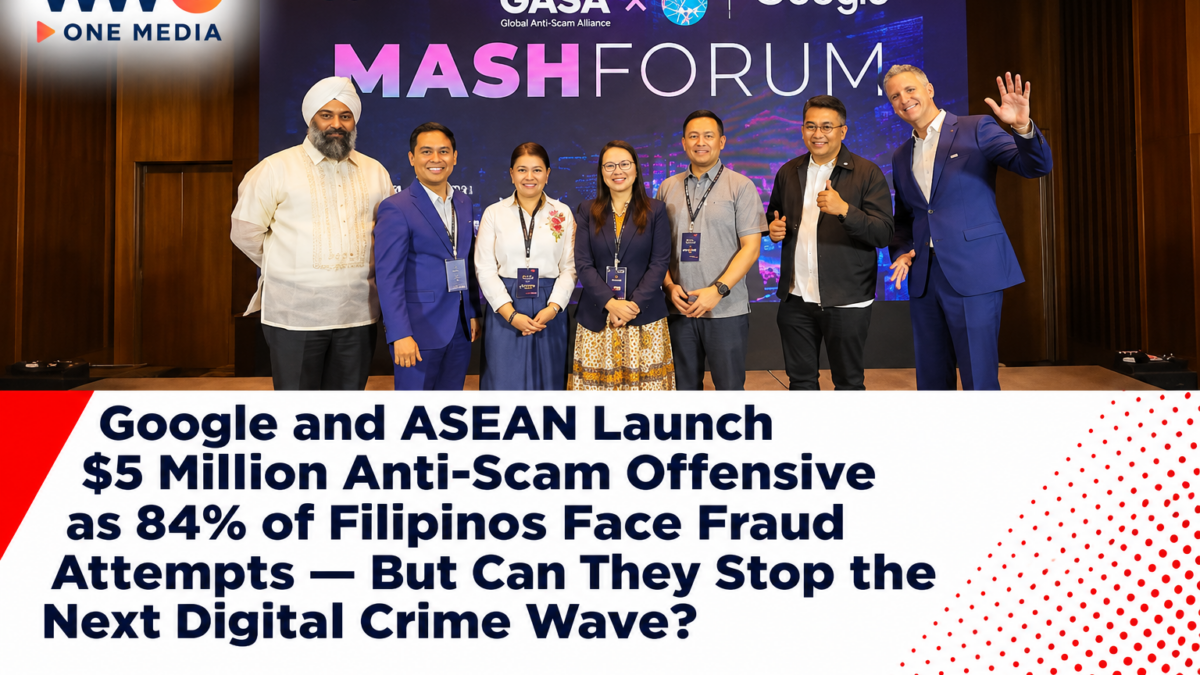
MANILA, Philippines — November 12, 2026 — Southeast Asia is intensifying its battle against online fraud as the ASEAN Foundation, backed by Google.org, launches a free regional anti-scam education platform designed to help millions of people identify, avoid and report increasingly sophisticated digital scams.
The new Scam Ready ASEAN Resource Hub, unveiled in Manila on November 10, brings together online safety lessons, interactive learning tools and information about scam-reporting channels across the region’s 11 member states.
The initiative is part of the US$5-million Scam Ready ASEAN program, supported by Google’s philanthropic arm, Google.org.
Its goal is to reach 3 million people across Southeast Asia through educational activities, training, awareness campaigns and regional partnerships.
The announcement comes amid an alarming rise in digital fraud.
According to the Global Anti-Scam Alliance, online scams and related fraud caused an estimated US$23.6 billion in losses across Southeast Asia in 2024.
In the Philippines, the State of Scams Philippines 2026 report found that 84% of surveyed adults had encountered at least one scam attempt during the preceding year, compared with 77% in the previous survey.
Yet many people who recognize the danger continue interacting with fraudsters.
The new program aims to close that gap by teaching people how scams operate before they become victims.
But with artificial intelligence making fraudulent messages, fake identities and impersonation schemes increasingly convincing, can education and technology keep Southeast Asians one step ahead of organized cybercriminals?
ASEAN Foundation and Google Launch Free Anti-Scam Resource Hub
The ASEAN Foundation introduced the Scam Ready ASEAN Resource Hub during its inaugural regional public-private partnership dialogue in Manila on November 10–11.
The platform, accessible at https://scamreadyasean.org, is designed to provide practical cybersecurity education to communities throughout Southeast Asia.
Its materials are intended for different groups, including students, working adults, parents, caregivers and senior citizens.
Rather than relying entirely on technical cybersecurity language, the program uses interactive activities and localized guidance to help users recognize common forms of online deception.
The hub includes a regional scam-prevention curriculum developed with insights from the Internet Society and the Global Cyber Alliance, alongside the experience of local implementing partners.
It also provides a directory of scam-reporting hotlines and contact centers covering all 11 ASEAN member states.
The ASEAN Foundation says the platform is intended to make online safety education more accessible while encouraging stronger cooperation among governments, technology companies and community organizations.
Google.org Commits $5 Million to Scam Prevention Across Southeast Asia
The Scam Ready ASEAN program is supported by a US$5-million funding commitment announced by Google.org in September 2025.
The program operates from 2025 through 2027.
Its activities include public awareness campaigns, training programs, community outreach and education through interactive digital tools.
The initiative seeks to reach 3 million people across the region.
It also includes a train-the-trainer model intended to prepare local educators and community leaders to teach scam-prevention skills.
Google’s support is significant because major technology platforms play an important role in how scammers reach potential victims.
Fraudulent advertisements, impersonation accounts, malicious websites and deceptive communications can expose people to financial and identity-related risks.
However, education cannot replace law enforcement, payment-system safeguards or the responsibilities of digital platforms to address malicious activity.
The program is designed to complement broader efforts rather than serve as a complete solution to online fraud.
Why the Philippines Has Become a Major Focus
The Philippines faces substantial challenges involving digital financial scams.
The 2026 State of Scams Philippines report found that 84% of surveyed Filipino adults encountered a scam attempt during the previous year.
That was higher than the 77% recorded in the preceding survey.
The report also found that 58% of respondents expressed confidence in their ability to identify scams.
Nevertheless, 60% of those who encountered a scam still interacted with a suspected scammer.
Only 4% reported the incident to authorities, according to the study.
These findings suggest that awareness does not always translate into safer behavior.
People may recognize some fraudulent tactics but still respond to messages that appear urgent, credible or emotionally convincing.
Scammers often exploit fear, financial pressure, excitement or misplaced trust.
Someone who knows that scams exist may still believe a particular message is legitimate because it appears to come from a bank, employer, police officer, delivery company or family member.
That is why the new initiative emphasizes practicing responses to realistic scenarios, rather than simply warning people that scams are dangerous.
A ₱121.8 Billion Philippine Scam Problem
The national financial impact is also substantial.
The 2026 State of Scams Philippines report estimated annual scam-related losses of approximately ₱121.8 billion.
The figure is based on survey findings and statistical estimates.
It is not an audited government accounting of confirmed criminal losses.
Nevertheless, it illustrates the potentially enormous economic cost of fraudulent activities.
As WWC ONE MEDIA previously reported in its coverage of RCBC’s expanded anti-fraud partnership with Gogolook, Philippine banks are investing in tools designed to help customers recognize suspicious calls and messages.
RCBC’s initiative involves access to the Whoscall anti-scam application for eligible customers.
That bank-led program is separate from Scam Ready ASEAN.
However, both reflect the growing need to strengthen public awareness as digital banking, online commerce and mobile payments become more widely used.
Google’s Be Scam Ready Game Turns Fraud Prevention Into Practice
One of the Resource Hub’s major features is Google’s Be Scam Ready educational game.
The game presents scenarios designed to resemble common fraudulent interactions.
Players can practice identifying suspicious messages, recognizing manipulation techniques and making safer decisions.
The aim is to provide a risk-free environment where people can learn from mistakes before encountering similar situations in real life.
For example, scam-awareness exercises may teach users to recognize fake payment requests, suspicious links, impersonation attempts and messages designed to create artificial urgency.
The game is already available in several Asian markets, and Google has announced plans to expand its availability, including in the Philippines, Indonesia, Japan, Malaysia and Vietnam.
However, an educational simulation cannot guarantee that someone will never become a victim.
Fraud techniques constantly change, and even experienced internet users can be deceived.
The purpose is to improve recognition, judgment and response.
More Than 2,300 Anti-Scam Trainers Have Been Recruited
The ASEAN Foundation reports that Scam Ready ASEAN has recruited 2,332 master trainers across the region.
That exceeds its original goal of 2,000.
The trainers are intended to help deliver scam-prevention education within local communities and institutions.
The program has also engaged 20 local implementing partners across ASEAN’s 11 member states.
Together, these partners are supporting plans to provide structured training to at least 550,000 learners.
These numbers demonstrate organizational progress.
But recruitment figures should not be confused with completed training outcomes.
The fact that 2,332 trainers have been recruited does not establish that all 550,000 intended learners have completed instruction.
The program’s longer-term success will depend on how many people actually receive training and whether that training improves their ability to avoid scams.
ASEAN Digital GrandPals Focus on Older Adults
The initiative also recognizes that older adults may need different types of digital safety support.
The ASEAN Foundation has recruited 151 ASEAN Digital GrandPals.
These community participants are intended to help increase scam awareness among at least 22,000 older people and members of their communities.
Digital safety education for older adults can be especially important when new technologies or payment systems are unfamiliar.
Scammers may exploit uncertainty by pretending to provide technical assistance, financial help or urgent account verification.
However, older adults should not be portrayed as inherently unable to recognize scams.
People across all age groups can become victims.
Effective education should account for differences in digital experience without relying on stereotypes.
AI Is Making Online Scams Harder to Recognize
Artificial intelligence is changing how fraudulent content can be produced.
Criminals can use AI tools to create convincing messages, translate deceptive content and imitate familiar styles of communication.
Synthetic voices, altered photographs and generated videos can make impersonation attempts more believable.
These capabilities may allow scammers to target more people with less effort.
As WWC ONE MEDIA reported in its coverage of INTERPOL’s warning about agentic AI and automated cyberattacks, law enforcement specialists are concerned that AI could make existing fraud techniques faster and more scalable.
The threat does not depend entirely on criminals developing new types of scams.
More effective versions of familiar schemes can be equally dangerous.
This is why security experts increasingly emphasize both technological safeguards and public education.
Automated systems may help identify suspicious activity, while informed users can provide an additional layer of protection.
Scam Compounds Reveal the Human Cost of Organized Fraud
Online scams are not always the work of isolated criminals operating from personal computers.
Some are associated with organized, cross-border criminal networks.
Authorities and human rights organizations have documented cases involving people recruited through fraudulent employment advertisements and subsequently forced to participate in scam operations.
As WWC ONE MEDIA reported in its examination of Filipinos recruited into scam compounds in Myanmar, supposed overseas employment opportunities have sometimes concealed dangerous working conditions and coercion.
These operations create different groups of victims.
There are people who lose money to fraudulent investment or romance schemes.
There are also individuals who may be trafficked or forced into criminal activities under threats or confinement.
The existence of such networks illustrates why regional cooperation matters.
Education can reduce vulnerability among potential victims, but dismantling organized criminal operations requires coordinated investigations, financial intelligence, victim protection and prosecution.
Pasay Scam Hub Raid Shows Why Cooperation Matters
The Philippines has also investigated alleged international scam operations operating within its borders.
In November, police uncovered a suspected fraud facility in Pasay City.
Investigators reported finding staged police offices and equipment allegedly used to impersonate law-enforcement authorities during communications with foreign victims.
A Chinese national and two Malaysian nationals were arrested, while authorities found 159 foreign nationals inside the facility.
As WWC ONE MEDIA reported in its coverage of the Pasay scam hub raid, the alleged operation involved fake parcel investigations and attempts to persuade victims that they were dealing with legitimate police officials.
The Pasay case is separate from the ASEAN Foundation–Google initiative.
But it illustrates the regional character of online fraud.
Potential victims may live in one country while the suspected operators, communications infrastructure and financial transactions are located in others.
Combating this type of activity requires information-sharing between countries.
Bangko Sentral ng Pilipinas Supports Scam Ready ASEAN
The Bangko Sentral ng Pilipinas has expressed support for the initiative.
During the Philippine launch of Scam Ready ASEAN in October 2026, BSP Governor Eli Remolona emphasized the importance of making digital financial services safer as access expands.
The central bank’s involvement is relevant because online financial fraud can undermine trust in electronic payments and banking services.
Consumers who fear losing money through digital transactions may become less willing to use legitimate online financial tools.
Strengthening financial literacy and scam awareness can therefore support broader digital inclusion.
However, awareness campaigns should be accompanied by effective dispute-handling processes, secure payment systems and appropriate regulatory oversight.
The BSP’s support also highlights the role of financial authorities in addressing risks that extend beyond traditional cybersecurity.
ASEAN’s New Hub Will Support Regional Reporting and Cooperation
The Resource Hub includes information about reporting channels and contact centers across ASEAN’s 11 member states.
This feature addresses a practical problem.
Many scam victims are unsure where to seek assistance.
They may report suspicious activity only to the platform where they received a message, without informing their bank or relevant authorities.
Others may avoid reporting entirely because of embarrassment, uncertainty or concern that the process will be difficult.
A clear directory of appropriate reporting channels can help people identify where to seek assistance.
The platform also aims to improve cooperation among participating institutions.
The November 10–11 Manila gathering was the first in a planned series of at least nine regional and national public-private partnership dialogues.
The discussions are intended to help participating organizations exchange knowledge, identify common priorities and develop more coordinated responses.
However, a training hub does not itself investigate crimes or recover stolen money.
Those responsibilities remain with the relevant authorities and financial institutions.
What Should Filipinos Do When They Encounter a Suspected Scam?
The initiative’s launch provides an opportunity to reinforce several practical precautions.
People should independently verify unexpected requests for money, account information or sensitive personal details.
A message that appears to come from a bank or government agency should be checked through an official website, verified application or independently obtained contact number.
Suspicious links and attachments should not be opened merely because the sender claims that action is urgent.
One-time passwords, passwords and authentication codes should not be disclosed to unsolicited callers or message senders.
People who suspect they have transferred money to a scammer should promptly contact their bank or payment provider through official support channels.
They should also preserve relevant messages and transaction details for reporting.
These steps can reduce risk, but they cannot guarantee complete protection against every form of fraud.
The safest response to an unexpected high-pressure request is often to stop the interaction and verify it independently.
Google Announces a Separate $6 Million Regional Initiative
Google is also expanding its wider anti-scam efforts across Asia-Pacific.
On November 3, Google.org announced US$6 million in funding for The Asia Foundation and the Tech for Good Institute.
The initiative will support community training, locally developed AI-powered defenses and policy research.
This funding is separate from the US$5 million committed to the ASEAN Foundation’s Scam Ready ASEAN program.
The two initiatives share a broad goal of improving digital safety, but they involve different partner organizations and program activities.
Together, they demonstrate the growing attention being given to financial fraud across the Asia-Pacific region.
But the effectiveness of these investments will ultimately depend on measurable results rather than the size of the announcements.
Can Scam Ready ASEAN Actually Reduce Fraud?
The initiative has already established a regional partnership network, recruited more than 2,300 trainers and launched a free educational hub.
Its digital awareness campaigns have generated more than 8 million online impressions.
However, online impressions are not equivalent to unique individuals trained or protected.
A social media post can be viewed more than once, and seeing educational content does not necessarily mean a person has developed lasting scam-prevention skills.
The three-million-person target is also a program objective, not an independently verified figure for people already protected.
Future evaluation should examine whether participants become better at recognizing fraudulent requests, refusing suspicious transactions and reporting incidents.
The ultimate goal should be fewer victims and lower losses.
But those outcomes may be difficult to attribute to a single program because scam activity also depends on law enforcement, technology, financial regulation and criminal behavior.
The Bottom Line: Southeast Asia Needs More Than Scam Warnings
The launch of the Scam Ready ASEAN Resource Hub represents an important regional effort to make digital safety education more accessible.
Supported by US$5 million from Google.org, the initiative aims to reach 3 million people across Southeast Asia.
It combines training, interactive learning, local partnerships and information about reporting channels.
The program comes at a critical time.
An estimated US$23.6 billion was lost to scams across Southeast Asia in 2024, while survey data suggest that a large majority of Filipino adults encountered scam attempts during the past year.
Artificial intelligence and cross-border criminal networks are making digital fraud increasingly difficult to detect and disrupt.
The ASEAN Foundation and Google are betting that better-informed communities can become an important line of defense. But awareness alone cannot defeat organized fraud without effective technology safeguards, financial protection and coordinated law enforcement.
As Google and ASEAN expand their anti-scam campaign across the region, can three million better-informed internet users help turn the tide against online criminals—or will increasingly sophisticated AI-powered scams continue outpacing the systems designed to stop them?