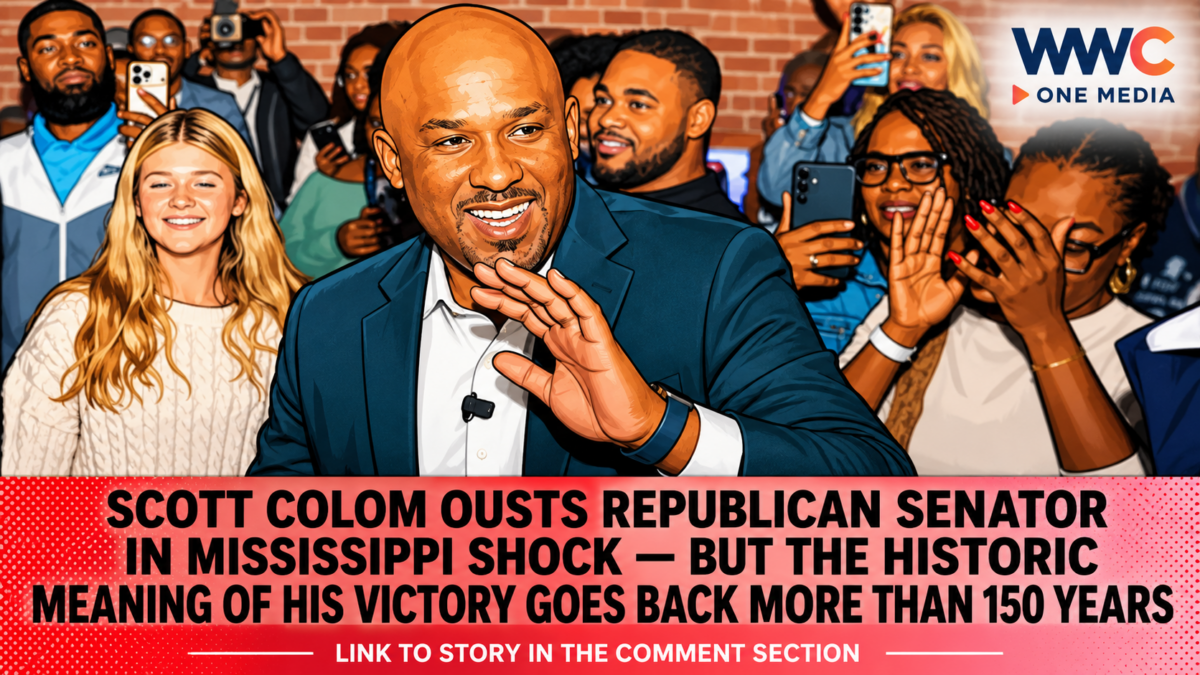
JACKSON, MISSISSIPPI — A state long associated with Republican dominance has delivered one of the biggest surprises of the 2026 US midterm elections.
Democrat Scott Colom has defeated Republican incumbent Senator Cindy Hyde-Smith in Mississippi, ending a decades-long stretch without a Democratic Senate election victory in the state and making history as its first Black senator elected by popular vote.
The Associated Press called the race on November 11, after election officials spent more than a week counting outstanding absentee and provisional ballots. Colom, a 43-year-old district attorney, won by a margin of only a few thousand votes.
The result is significant far beyond Mississippi. It represents a stunning Democratic breakthrough in a state that President Donald Trump carried by nearly 23 percentage points in the 2024 presidential election.
But Colom’s victory is not simply another seat changing political hands. It carries a historical significance stretching back to the Reconstruction era after the American Civil War.
A NARROW WIN THAT ENDED A DECADES-LONG REPUBLICAN HOLD
Colom defeated Hyde-Smith in one of the closest and most closely watched Senate contests of the 2026 midterms.
With approximately 99% of precincts reporting when the race was called, Colom led with 49.2% of the vote against Hyde-Smith’s 48.7%. Independent candidate Ty Pinkins received approximately 2%.
The difference was roughly 4,645 votes out of more than 960,000 cast.
The result followed days of uncertainty as local election officials processed absentee ballots and Mississippi’s affidavit ballots, which function similarly to provisional ballots elsewhere in the United States.
The Associated Press projected Colom as the winner on November 11. Hyde-Smith subsequently conceded and congratulated him.
The narrow margin explains why the result took so long to emerge. It also illustrates how a relatively small number of outstanding ballots can determine control of a Senate seat in a closely divided contest.
Mississippi’s election result had been watched nationally because Democrats had already made major gains in the 2026 midterms. Colom’s victory added another Republican-held Senate seat to the Democratic column.
For a wider look at the outstanding contests and the uncertainty surrounding the final congressional numbers before the Mississippi race was called, see WWC ONE MEDIA’s report, Democrats Secure Congress, but 12+ US Election Races Remain Uncalled — Could Alaska and Mississippi Deliver an Even Bigger Political Shock?.
WHY COLOM’S VICTORY IS HISTORIC
The most striking part of the result is its place in Mississippi’s racial and political history.
Colom is the first Black person elected to represent Mississippi in the US Senate since the Reconstruction era. The last Black senator from the state was Blanche K. Bruce, who was elected by the Mississippi legislature in 1874 and served in the Senate from 1875 to 1881.
Bruce was born into slavery in 1841 and later became one of the most prominent African American political figures of the Reconstruction period.
Another Black Mississippian, Hiram Revels, had also served in the Senate during Reconstruction, from 1870 to 1871.
There is an important distinction in how these historic milestones are described: Bruce and Revels were chosen by the state legislature, as senators were selected before the 17th Amendment established direct election by voters. Colom is the first Black senator elected directly by Mississippi voters.
That distinction matters because Mississippi’s political history includes decades of racial exclusion, voter suppression and barriers that prevented Black residents from exercising their voting rights.
Colom’s victory therefore represents both a political upset and a major milestone in the state’s history.
HOW A DEMOCRAT WON IN A STATE TRUMP CARRIED BY 23 POINTS
Mississippi has been a difficult state for Democrats in recent decades.
Republicans have dominated statewide politics, and the Senate seat had remained in Republican hands for years. Trump won the state by nearly 23 points in 2024, making Colom’s victory particularly unexpected.
But the campaign focused on issues that reached beyond party loyalty.
Colom repeatedly highlighted the cost of living, rising prices and the economic pressures facing ordinary Mississippians, including rural and agricultural communities.
One of his most widely circulated campaign advertisements targeted Hyde-Smith after she appeared to dismiss concerns about high beef prices by suggesting consumers had other protein options.
Colom’s campaign turned the comment into a memorable political message: voters could choose another senator instead.
The advertisement helped give his campaign a distinctive identity and drew attention to the incumbent’s response to everyday economic concerns.
Colom also took an unusual approach to campaigning during Trump’s visit to Mississippi in October. Rather than avoiding the president’s supporters, he approached people waiting outside a rally, introduced himself and asked about their concerns.
His strategy was to challenge Hyde-Smith’s record and her relationship with the administration without treating every Trump voter as an opponent.
That approach helped him present himself as a candidate seeking support across the state rather than relying exclusively on Democratic voters.
BLACK VOTER TURNOUT AND ECONOMIC DISCONTENT HELPED CHANGE THE RACE
Mississippi has one of the largest Black shares of any state’s electorate in the United States, at close to 40%.
Strong turnout in the Mississippi Delta and other majority-Black areas was an important part of Colom’s path to victory.
But the result was not explained by one factor alone.
Reporting by the Associated Press, NPR and Mississippi Today pointed to a combination of strong Black voter participation, economic frustration, dissatisfaction with the incumbent and a broader shift in voter sentiment across the state.
The election also unfolded during a difficult period for the Trump administration, with rising costs and the economic consequences of tariffs and the war involving Iran becoming campaign issues.
Colom criticised policies he argued were hurting Mississippi residents, particularly farmers and households already facing higher expenses.
At the same time, he sought to reassure voters who might have been wary of a Democratic candidate by emphasising his support for issues such as the Second Amendment and by presenting himself as a candidate focused on Mississippi rather than national party labels.
The outcome suggests that even in a state with a strong Republican voting history, economic concerns and candidate-specific issues can create opportunities for an upset.
WHO IS SCOTT COLOM?
Colom, 43, is a prosecutor from north Mississippi who served as district attorney for the state’s 16th Circuit Court District.
His political career has included several historic firsts.
At 28, he became the youngest and first Black judge appointed in the history of Lowndes County. He later became Columbus’s first Black city prosecutor before winning election as district attorney in 2015.
He built his public profile through local legal work before launching his Senate campaign against Hyde-Smith.
Colom’s family background also reflects a political contrast: his father was a judge appointed by Republican President Ronald Reagan, while his mother was an attorney.
His campaign presented his candidacy as an effort to represent all Mississippians, including voters in rural, suburban and urban communities.
After the result was called, Colom’s victory was celebrated by national Democratic figures, including Senate Democratic leader Chuck Schumer and former President Bill Clinton, who had campaigned on his behalf.
WHAT HAPPENS TO THE US SENATE AFTER THIS UPSET?
Colom’s victory adds to the Democratic gains in the 2026 midterm elections, in which the party captured control of both chambers of Congress.
The new Senate majority will give Democrats greater influence over legislation, investigations, government spending and presidential appointments when the new Congress convenes in January 2027.
However, winning the Senate does not mean Democrats can automatically pass every bill they support. Many major pieces of legislation still face procedural hurdles, including the 60-vote threshold generally needed to overcome a filibuster.
The result also creates a more difficult political environment for Trump during the final two years of his presidency.
WWC ONE MEDIA previously examined the broader consequences of the Democratic takeover in Democrats Win at Least 54 Senate Seats, Threatening Trump’s Supreme Court Legacy — But Could a 2028 Victory Flip the 6–3 Conservative Majority?.
The Senate majority could influence the confirmation of federal judges and other presidential nominees, although it does not give Democrats control of the Supreme Court or the power to remove sitting justices.
Colom’s election is therefore part of a wider shift in Washington, but the practical consequences will depend on how the new majority uses its power and whether it can maintain unity across its members.
A HISTORIC WIN — BUT THE FINAL OFFICIAL PROCESS STILL MATTERS
Although the Associated Press called the race for Colom and Hyde-Smith conceded, a media projection is not the same as formal state certification.
Mississippi’s election authorities still have to complete the official canvassing and certification process. Mississippi Today reported that the AP’s call was based on results that had not yet been certified and that legal challenges remained possible.
That distinction is important in a race decided by fewer than 5,000 votes.
It does not change the significance of the AP’s projection or Hyde-Smith’s concession, but it is necessary to distinguish a projected winner from a formally certified result.
The broader election has also prompted debate over the future of American politics. Trump has questioned aspects of the 2026 midterm results, but allegations about election irregularities require evidence and should not be confused with the ordinary process of counting and verifying outstanding ballots.
WWC ONE MEDIA has examined that controversy in Trump Questions 2026 Midterm Election Results After Democrats Capture Congress — But Where Is the Evidence of His Voting-Machine Claims?.
MORE THAN A SENATE SEAT: A NEW CHAPTER IN MISSISSIPPI HISTORY
Scott Colom’s victory carries two major messages.
Politically, it shows that a state long considered safely Republican can become competitive when voters respond to economic concerns, candidate performance and changing political conditions.
Historically, it marks the return of a Black Mississippian to the US Senate for the first time since the Reconstruction era — and, more specifically, the first time the state’s voters have directly elected a Black senator.
Colom has said he hopes his work will make it easier for future generations of young Black Mississippians to pursue public office.
That ambition may prove to be one of the most enduring parts of his victory.
The immediate challenge, however, will be turning an extraordinary campaign result into effective representation for a state divided by deep political and economic differences.
Mississippi has made history. The question now is whether Colom can deliver the kind of leadership that makes this victory more than a milestone in the state’s past.