NEW DELHI, INDIA — November 12, 2026 | WWC ONE MEDIA | Asia Business, Infrastructure, Manufacturing and Geopolitics
India is accelerating its push to manufacture giant tunnel-boring machines domestically as China prepares to impose new export restrictions on specialized construction equipment, raising fears that Beijing could disrupt critical infrastructure projects across one of the world’s fastest-growing major economies.
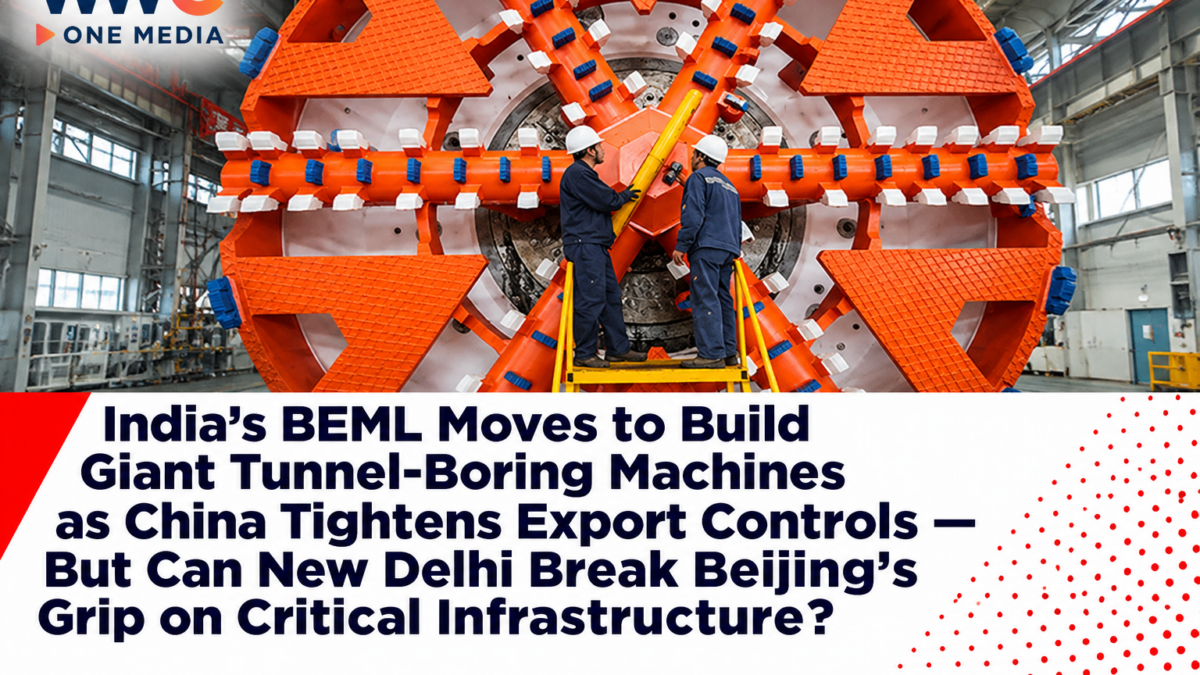
At the center of India’s industrial response is BEML Limited, the state-controlled engineering and manufacturing company pursuing domestic production of tunnel-boring machines (TBMs), the enormous industrial systems used to carve underground passages for metro railways, highways, hydropower facilities and strategic transportation networks.
The move comes as India confronts a growing economic and geopolitical vulnerability: its dependence on foreign manufacturers, particularly Chinese suppliers, for sophisticated machinery essential to building modern infrastructure.
According to Bloomberg’s November 12 report, BEML’s tunneling-equipment initiative forms part of India’s broader effort to reduce reliance on Chinese machinery.
The stakes extend far beyond construction contracts.
With Beijing’s latest export-licensing requirements scheduled to take effect on November 18, India faces a crucial test of whether it can develop competitive domestic manufacturing capabilities before restrictions on foreign equipment and components begin affecting major projects.
The developments also reflect an increasingly important global trend in which countries are treating industrial supply chains as matters of national security.
As previously examined by WWC ONE MEDIA in its coverage of India’s dependence on Chinese battery technology, New Delhi faces similar challenges in other strategic industries where China’s production scale and technological advantages remain difficult to replicate.
China Controls a Major Share of the Global Tunnel-Boring Machine Market
Tunnel-boring machines are among the most technologically demanding pieces of equipment used in modern construction.
Depending on their design, these machines can excavate through rock, soil and mixed geological formations while supporting tunnel construction deep below cities, rivers and mountain ranges.
They are essential to major infrastructure developments, including underground metro systems, high-speed railway corridors, highways and hydropower projects.
China has emerged as one of the world’s dominant suppliers.
According to Chinese state-media figures cited by Bloomberg, Chinese manufacturers account for approximately 70% of the global tunnel-boring machine market.
That concentration gives Beijing considerable influence over the availability of machinery needed for major engineering projects around the world.
For India, the dependence creates particular concerns.
The country is expanding its transportation infrastructure while constructing roads and railways across difficult Himalayan terrain near its disputed border with China.
Any disruption to the supply of tunneling machinery could complicate construction schedules, increase procurement costs and force contractors to seek alternative suppliers.
Industry specialists warn that replacing established suppliers is not as simple as purchasing machines from another country.
Sophisticated tunnel-boring systems require specialized engineering, precision components, technical maintenance and reliable spare-parts networks.
These challenges could make India’s effort to develop a domestic manufacturing industry both strategically important and commercially difficult.
November 18 Export Restrictions Raise the Stakes
China’s latest export controls are scheduled to take effect on November 18, 2026, introducing licensing requirements for specified tunneling and other specialized construction equipment.
The measures cover certain tunnel-boring machines, components and equipment associated with operations in challenging high-altitude environments.
Chinese authorities have cited the possible civilian and military applications of the controlled technology.
According to Bloomberg’s earlier reporting, the rules could subject destinations involved in territorial disputes with China to stricter scrutiny.
That has heightened concerns in India, which maintains a longstanding border dispute with Beijing.
The restrictions do not necessarily amount to a blanket prohibition on exporting all tunnel-boring machines to India.
Instead, the licensing framework could introduce additional uncertainty over whether particular equipment shipments or components receive approval.
Even limited delays could affect contractors operating on tight construction schedules.
The restrictions also expose a less visible weakness: dependence on replacement parts.
Heavy tunneling machines operate under intense mechanical pressure and require regular maintenance.
If essential components become difficult to obtain, machines already operating on Indian construction sites could face downtime.
The geopolitical implications are significant.
As WWC ONE MEDIA previously reported on diplomatic efforts between Narendra Modi and Xi Jinping, India and China have attempted to improve economic cooperation despite unresolved security concerns along their Himalayan frontier.
The tunneling-equipment dispute demonstrates how fragile that cooperation can become when critical supply chains intersect with national security.
BEML Emerges as a Key Player in India’s Manufacturing Strategy
BEML is positioned to become an important participant in India’s efforts to manufacture advanced construction and infrastructure machinery domestically.
The state-controlled company already operates across engineering-intensive industries, including defense equipment, mining machinery and railway rolling stock.
Its existing industrial experience provides a potential foundation for developing more sophisticated tunneling systems.
However, manufacturing a complete tunnel-boring machine requires capabilities extending beyond conventional heavy-equipment assembly.
A competitive domestic producer must develop or source specialized cutting systems, hydraulic equipment, drive mechanisms, control electronics and components capable of withstanding demanding geological conditions.
The company’s initiative also builds on an existing infrastructure partnership.
In April 2026, BEML and the Delhi Metro Rail Corporation announced an agreement to collaborate on railway and metro projects in India and overseas.
The announcement highlighted the importance of developing indigenous propulsion systems and tunnel-boring machines as part of India’s self-reliance strategy.
The partnership illustrates how India could combine established public-sector engineering capabilities with the practical requirements of major infrastructure operators.
Nevertheless, establishing a sustainable domestic manufacturing industry will require more than technical ambition.
India must demonstrate that locally manufactured machines can meet stringent reliability standards, compete economically with imported alternatives and receive adequate support throughout their operational lifetimes.
India Considers $1.2 Billion Incentive Program to Reduce Import Dependence
India’s industrial strategy could receive a major boost from a proposed government incentive package for advanced construction and infrastructure equipment.
Reuters reported that New Delhi was considering a $1.2 billion manufacturing incentive scheme designed to encourage domestic production of machinery that India currently imports.
According to the report, the proposed seven-year program aims to attract approximately $1.8 billion in new investment.
Potential beneficiaries include BEML, engineering conglomerate Larsen & Toubro and other manufacturers involved in advanced industrial equipment.
The initiative is intended to encourage local production of high-value machinery, including tunnel-boring systems, firefighting equipment and elevators used in high-rise buildings.
Importantly, the proposed program would include domestic value-addition targets.
These requirements are designed to encourage manufacturers to produce more components locally rather than simply assemble fully imported systems.
However, the proposed incentive program should not be confused with an already disbursed government subsidy or a confirmed BEML investment commitment.
Its effectiveness will depend on final policy approval, implementation and the response of private and public-sector manufacturers.
India’s larger construction and infrastructure equipment market was valued at approximately 1 trillion rupees, or $10.5 billion, according to Reuters.
That market provides a potentially substantial domestic customer base for manufacturers capable of supplying advanced equipment at competitive prices.
Chinese Tunneling Machinery Imports Have Already Fallen Sharply
India’s dependence on Chinese tunneling machinery has become increasingly complicated since the deadly border clashes between Indian and Chinese troops in 2020.
The confrontation triggered heightened scrutiny of economic and technological dependencies between the two countries.
According to Reuters, India imported approximately $18 million worth of tunneling machinery from China during fiscal year 2022–23.
That figure fell to approximately $3 million in 2023–24, before dropping to $500,000 in 2024–25.
Imports stood at approximately $800,000 in 2025–26.
These figures illustrate a sharp contraction in shipments from China, although they do not, by themselves, establish that India’s total demand for tunneling equipment has declined.
Changes in procurement, sourcing arrangements and project delivery schedules can affect annual import values.
Bloomberg previously reported that Chinese customs delays affected attempts by German tunneling-equipment manufacturer Herrenknecht to supply machinery for Indian infrastructure projects.
The experience demonstrated that dependence can extend beyond the nationality of the manufacturer.
Even machinery produced by international companies may encounter export restrictions when manufacturing facilities, components or supply chains are located in China.
For India, developing genuine technological independence could therefore require diversification across the entire equipment supply chain.
Larsen & Toubro Joins the Race for Domestic Tunnel-Boring Technology
BEML is not the only Indian industrial company exploring domestic tunneling technology.
Engineering and construction giant Larsen & Toubro has also been developing a tunnel-boring machine prototype.
Bloomberg previously reported that company president R. Shankar Raman described the initiative as a potential step toward manufacturing machinery for internal requirements and eventually supplying other customers.
However, he also acknowledged the difficulty of competing with China’s established industrial scale and pricing.
Chinese manufacturers benefit from extensive supply networks, accumulated engineering experience and large production volumes.
Indian companies entering the industry may initially face higher costs as they develop manufacturing capabilities and establish reliable component suppliers.
That creates a commercial challenge.
If infrastructure contractors continue choosing imported machines solely on the basis of initial purchase prices, domestic manufacturers may struggle to achieve the production volumes needed to become competitive.
Supportive government procurement policies, technology partnerships and long-term order commitments could help bridge that gap.
But these measures will need to balance industrial-development goals against the risk of increasing infrastructure construction costs.
Could India’s Infrastructure Boom Become More Expensive?
India’s infrastructure expansion is a major driver of economic activity.
Large-scale projects involving metro networks, expressways, high-speed rail, tunnels and strategic border roads are creating demand for sophisticated engineering equipment.
India’s Road Transport and Highways Minister Nitin Gadkari has outlined ambitions for up to $9.6 billion in tunneling investment over five years, according to Bloomberg’s earlier reporting.
The potential demand could make India an attractive location for international tunneling-equipment manufacturers seeking to establish alternative production hubs.
However, supply-chain disruptions may also introduce cost pressures.
Contractors facing longer delivery times could need to renegotiate procurement arrangements or source machinery from higher-cost suppliers.
Additional maintenance expenses could emerge if replacement components become harder to obtain.
Infrastructure delays can also have wider economic consequences, particularly when transportation projects are intended to reduce travel times, improve logistics or support industrial investment.
The risks resemble challenges seen elsewhere in Asia.
In the Philippines, WWC ONE MEDIA recently reported on delays affecting foreign-financed infrastructure projects and the additional financing costs associated with slow implementation.
Although the underlying causes differ, both cases highlight the importance of reliable equipment, effective execution and resilient financing arrangements for large public infrastructure developments.
India-China Rivalry Is Becoming a Battle Over Industrial Technology
The growing dispute over tunneling machinery reflects a broader shift in the relationship between India and China.
For years, their economic ties have combined strong commercial interdependence with persistent political and security tensions.
China remains a critical supplier of manufactured goods and industrial inputs to India.
At the same time, New Delhi has been pursuing domestic manufacturing initiatives intended to strengthen supply-chain resilience.
The challenge is particularly acute in industries where advanced equipment manufacturing requires years of specialized research, industrial investment and engineering experience.
As explored in WWC ONE MEDIA’s analysis of India’s foreign-policy strategy and China border negotiations, New Delhi is seeking to maintain economic relationships with major global powers while protecting strategic autonomy.
Tunnel-boring machines may appear far removed from the better-known geopolitical disputes involving semiconductors, rare-earth minerals and artificial intelligence.
But they reveal the same underlying question.
What happens when critical equipment required for national development is controlled by a country with which the buyer has unresolved strategic disputes?
For India, the answer increasingly involves developing domestic technology, diversifying suppliers and reducing dependence on potentially vulnerable international supply chains.
What Happens Next?
Three developments will determine whether India’s tunneling-equipment ambitions translate into meaningful industrial progress.
First, the implementation of China’s November 18 export controls will reveal how restrictive the new licensing system becomes in practice.
Second, the development and commercialization of domestic tunnel-boring technology by BEML, Larsen & Toubro and other manufacturers will show whether India can move beyond prototypes and industrial plans.
Third, the government’s proposed equipment-manufacturing incentives could influence how quickly companies invest in advanced production capabilities.
These developments may unfold over several years rather than weeks.
Domestic machine production will not automatically eliminate reliance on imported cutting tools, electronics, hydraulic components or other specialized technology.
Nor will local manufacturing guarantee lower costs during the early stages of industry development.
Nevertheless, the effort represents an important strategic opportunity.
If Indian companies can establish reliable, competitive tunneling-equipment production, the country could reduce supply disruptions, strengthen its industrial base and potentially serve international customers.
Failure would leave infrastructure contractors exposed to many of the same procurement vulnerabilities they face today.
For BEML and India’s policymakers, the question is no longer simply whether the country needs its own tunnel-boring machines. It is whether India can develop them quickly enough, reliably enough and competitively enough to loosen China’s grip on one of the most important technologies beneath its infrastructure boom.
But as Beijing tightens export controls, can India’s industrial giants build an alternative before the next major infrastructure project runs out of time?