
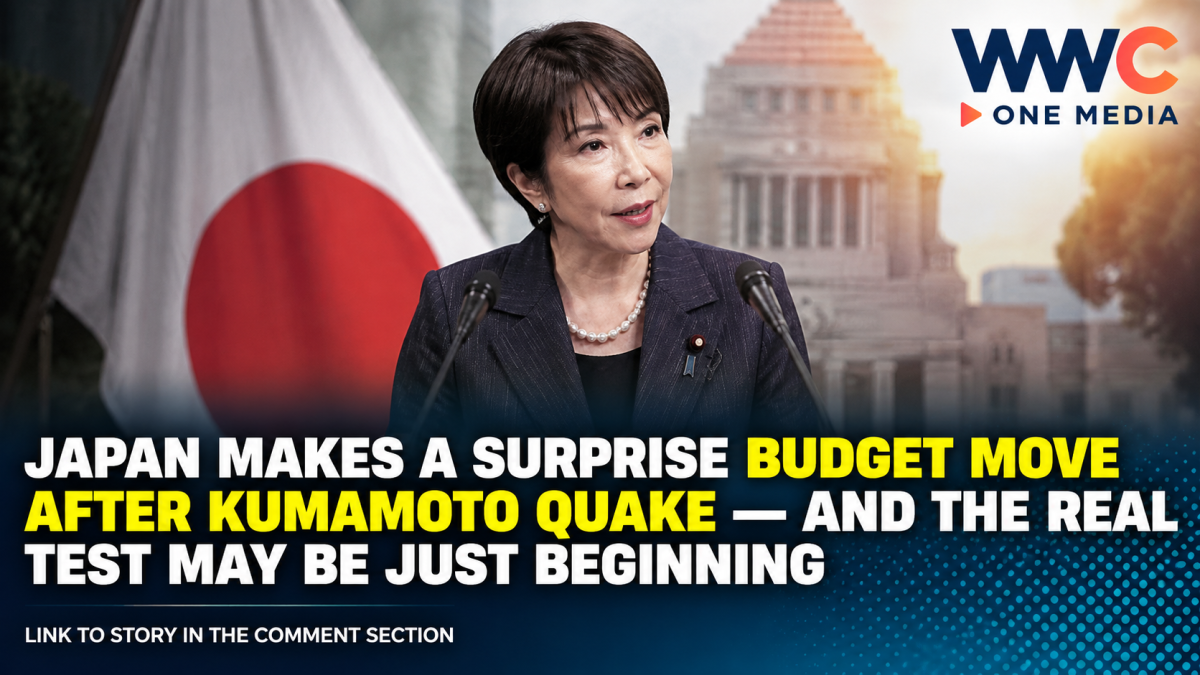
Japan is preparing to break with recent spending habits by forgoing a second supplementary budget for fiscal 2026, even as the government continues dealing with the aftermath of the devastating Kumamoto earthquake and heavy rains across the country.
Government and ruling-party sources told Jiji Press that Prime Minister Sanae Takaichi does not currently intend to submit another supplementary budget when the Diet convenes for a possible extraordinary session in early October. Instead, the administration believes existing reserve funds can cover the immediate costs of disaster response.
The decision is significant because calls for another emergency budget had grown after the powerful July 28 earthquake in Kumamoto. The magnitude 7.1 disaster caused widespread damage and initially prompted some officials within the administration to consider another spending package.
But the government now says it has enough resources available without immediately turning to another supplementary budget.
Around ¥800 billion remains in the government’s general contingency reserves, while approximately ¥1.9 trillion is still available in a separate reserve established to respond to the continuing situation in the Middle East. Jiji Press reported that these funds give the government room to respond to disasters and other emergencies without immediately drafting another extra budget.
Takaichi wants to end Japan’s reliance on extra budgets
The decision fits a broader fiscal strategy promoted by Takaichi.
The prime minister has repeatedly argued that Japan should reduce its dependence on supplementary budgets and instead make more spending decisions through the regular annual budget process.
Chief Cabinet Secretary Minoru Kihara reinforced that position on Thursday, saying supplementary budgets should be limited to measures that are genuinely urgent and necessary. The government will instead use contingency reserves when circumstances require a rapid response.
That approach was already evident in August, when the government authorized ¥147.8 billion from the contingency reserve for measures responding to the Kumamoto earthquake and related disaster needs. The Prime Minister’s Office said the funds were intended to support affected communities, restore infrastructure and strengthen emergency assistance.
Earlier, the government had also used ¥24.2 billion from the contingency reserve for initial earthquake-response measures before approving the larger ¥147.8 billion package.
The Kumamoto crisis is not being abandoned
Skipping a second supplementary budget does not mean Tokyo is walking away from reconstruction assistance.
Japan has already expanded disaster support for Kumamoto. The government applied its post-disaster livelihood reconstruction assistance law across the prefecture, allowing households whose homes were destroyed or damaged by the earthquake to receive assistance of up to ¥3 million for rebuilding, repairs or rent.
The government has also been preparing broader support for affected communities, including infrastructure restoration, disaster-waste disposal, assistance for businesses and measures aimed at reviving tourism after cancellations following the earthquake.
The question now is whether existing reserves will remain sufficient if reconstruction costs rise or another major disaster strikes.
Why markets are watching the decision
The budget decision comes at a particularly sensitive moment for Japan’s finances.
Japan’s government bond market has been under pressure, with the 10-year Japanese government bond yield recently moving above 3% for the first time since 1996. Investors have been increasingly concerned about inflation, rising government borrowing costs and the scale of Prime Minister Takaichi’s broader spending ambitions.
Reuters has also reported that U.S. Treasury Secretary Scott Bessent has been pressing Japan to move away from expansive fiscal policies and for the Bank of Japan to raise interest rates as inflation and yen weakness remain concerns.
That creates a delicate balancing act for Tokyo: provide enough support for households and disaster-hit communities while avoiding additional fiscal expansion that could further unsettle bond markets.
The bigger budget battle may be coming in 2027
Ironically, the decision to avoid a second supplementary budget in fiscal 2026 comes as Japan prepares for an enormous fiscal debate over its 2027 budget.
Government ministries and agencies have submitted record requests totaling roughly ¥143 trillion for fiscal 2027, according to Reuters, as Takaichi’s administration pursues a growth-oriented investment strategy.
Takaichi has said the government aims to keep new government bond issuance for fiscal 2027 at around ¥40 trillion. That would still be substantially above the ¥32.7 trillion planned for fiscal 2026, while the government faces sharply higher debt-servicing costs as bond yields rise.
This is where the government’s latest decision becomes more than a technical budget maneuver.
By refusing to immediately create another supplementary budget, Takaichi is signaling that emergency spending should increasingly be absorbed through existing reserves and the regular budget process.
But with disaster reconstruction needs, inflation pressures, higher interest costs and an enormous 2027 spending wishlist all competing for limited fiscal room, Japan’s promise of greater budget discipline could soon face its toughest test.
For now, Tokyo is choosing restraint. The bigger question is whether that restraint can survive the next economic or natural-disaster shock.
WWC ONE MEDIA MJE



Leave a Reply