SYDNEY, AUSTRALIA / MANILA, PHILIPPINES — November 12, 2026 — Australia’s artificial intelligence infrastructure boom is entering a crucial new phase after Blackstone-backed data center giant AirTrunk signed an agreement with Danish renewable energy developer European Energy Australia to advance major solar, wind and battery projects in New South Wales.
The proposed development could deliver 610 megawatts of new renewable electricity generation alongside more than 800 megawatt-hours of battery storage, providing an important potential source of power for AirTrunk’s expanding network of hyperscale data centers.
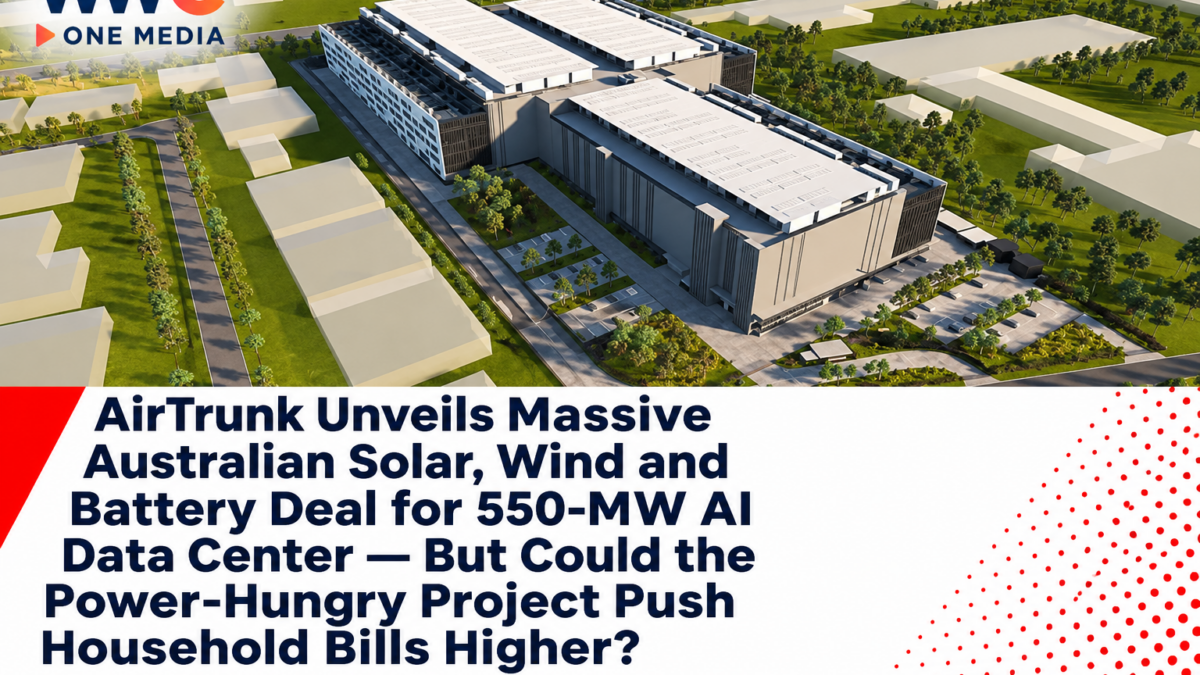
The partnership is particularly significant for the company’s proposed 550-megawatt data center campus at Kurri Kurri, a former industrial site in the Hunter region northwest of Newcastle.
The Australian Financial Review reported that the clean energy development could involve approximately A$1.5 billion in investment.
However, the projects remain in development, and the companies have not finalized a long-term power purchase agreement covering the proposed Hunter facilities.
The announcement comes as Australia faces an increasingly difficult energy challenge.
Artificial intelligence and cloud computing are driving unprecedented demand for electricity, raising concerns about whether new data centers could place additional pressure on household power bills and electricity networks.
For AirTrunk, the renewable energy initiative represents an attempt to demonstrate that digital infrastructure growth can be supported by new electricity supply rather than simply drawing more power from an already stretched grid.
But the question remains: Can Australia’s renewable energy industry expand quickly enough to power the AI revolution without shifting enormous infrastructure costs onto ordinary households?
AirTrunk Signs Major Renewable Energy Agreement With European Energy
AirTrunk and European Energy Australia announced an exclusivity agreement to advance two renewable energy projects in the Hunter region of New South Wales.
The partnership includes a proposed 260-MW solar development, a wind project with capacity of up to 350 MW and a battery energy storage system capable of storing more than 800 MWh.
The solar and wind projects together represent up to 610 MW of generation capacity.
Battery storage would help manage the variability of renewable electricity by storing energy for use when it is needed.
The projects are intended to support AirTrunk’s electricity requirements across New South Wales, including its proposed Kurri Kurri data center.
The partners are also discussing a potential long-term power purchase agreement.
Such agreements can provide renewable energy developers with greater revenue certainty while giving large electricity consumers access to contracted electricity supplies.
However, the agreement signed so far concerns exclusive project-development cooperation.
It is not confirmation that all generation and storage facilities will be built, that the power purchase agreement has been executed, or that renewable supply is already available for Kurri Kurri.
Those outcomes depend on future commercial arrangements, financing, planning approvals and grid connections.
Solar and Battery Projects Target 2030, Wind Farm Eyes 2032
The development timeline illustrates the scale of the challenge.
European Energy expects the proposed solar and battery projects to begin operations around 2030.
The wind project is targeted for 2032.
Those dates are development targets rather than guaranteed commissioning deadlines.
The projects would connect to Ausgrid’s upgraded 132-kilovolt network in the Hunter-Central Coast Renewable Energy Zone.
The connections remain subject to final arrangements and technical assessments.
Building renewable electricity infrastructure on this scale requires approvals, transmission access, equipment procurement, construction and testing.
Even when sufficient generation capacity is planned, projects can face delays because of grid congestion, permitting requirements or financing constraints.
For AirTrunk, the timetable raises an important operational question.
The company’s demand for computing capacity is growing rapidly, but large renewable energy projects can take several years to complete.
The pace of electricity infrastructure development may therefore become just as important as the construction of the data centers themselves.
Why AirTrunk’s 550-MW Kurri Kurri Data Center Matters
At the center of the partnership is AirTrunk’s proposed hyperscale data center at Loxford, near Kurri Kurri.
The development would occupy the site of a former aluminium smelter, repurposing land with a long industrial history.
According to planning information reported by industry publications, the proposed campus has a total power requirement of approximately 550.5 MW.
That is an enormous amount of potential electrical demand.
If a facility drew 550 MW continuously, it would consume approximately 4.8 terawatt-hours of electricity over a full year.
That calculation is illustrative, not a forecast of the campus’s actual annual consumption.
Real electricity use would depend on operating capacity, utilization, equipment efficiency and other factors.
The planned campus forms part of Australia’s efforts to become a major location for artificial intelligence and cloud computing infrastructure.
But the proposal has also raised concerns about electricity supply, water consumption, local development impacts and the costs of connecting large facilities to the grid.
AirTrunk says the project would use air-based cooling rather than drawing on community water supplies for cooling.
The company has also committed to funding its grid connection and associated on-site infrastructure.
These commitments will be scrutinized as the project moves through Australia’s planning process.
Can 610 MW of Renewables Really Power a 550-MW Data Center?
The comparison between the proposed renewable generation and the data center’s potential electricity demand requires careful interpretation.
On paper, the planned 610 MW of solar and wind capacity is greater than the Kurri Kurri campus’s proposed 550-MW power requirement.
But that does not mean the renewable projects could supply the data center continuously.
Solar panels generate electricity when sunlight is available.
Wind turbines depend on wind conditions.
Their combined output varies throughout the day and across seasons.
A 610-MW renewable portfolio will therefore produce less electricity annually than a hypothetical 610-MW facility operating at full capacity every hour.
Battery storage can help manage those fluctuations, but it does not create additional electricity.
The announced 800-plus MWh figure describes the amount of energy the battery could store, not its maximum discharge power.
AirTrunk has acknowledged that additional renewable generation and firming capacity will be needed to support Kurri Kurri and its wider New South Wales operations.
That distinction is essential when evaluating claims about renewable-powered data centers.
A project can secure renewable energy contracts and still depend on the wider grid during periods when contracted solar or wind output is insufficient.
Australia Wants AI Data Centers to Pay for Their Own Power
The AirTrunk agreement arrives as Australian policymakers develop stricter expectations for large electricity consumers.
The federal government wants new data centers to support additional clean energy generation and storage rather than simply consuming existing electricity supplies.
New South Wales has also established guidelines expecting data center developers to fund the energy supply and infrastructure their projects require.
The objective is to protect ordinary households and businesses from bearing unnecessary costs associated with the AI expansion.
The concern is particularly significant because electricity networks may require expensive upgrades to accommodate large new industrial loads.
If those costs are spread across customers, households could face higher charges even if they receive no direct benefit from the new facilities.
As WWC ONE MEDIA reported in its coverage of Malaysia’s proposed separate electricity market for AI data centers, governments across Asia are increasingly asking how large technology companies should pay for their expanding electricity requirements.
Australia faces a similar challenge.
It wants to attract digital infrastructure investment while ensuring that energy development remains financially fair and reliable.
Google and AirTrunk Warn Against Excessive Grid Charges
The debate has become more complicated because major technology companies are also concerned about the cost of new regulations.
Google and AirTrunk have warned that proposed changes to Australia’s electricity connection rules could increase project costs and discourage investment.
The proposed reforms would require large electricity users to contribute more toward network upgrades and provide financial protections against infrastructure being built but later left underused.
AirTrunk argues that developers should pay costs directly attributable to their projects, rather than being charged for upgrades that provide wider public benefits.
Google has raised similar concerns about consistency and transparency.
The dispute reveals two legitimate but competing objectives.
Governments want large energy consumers to fund the costs they impose on electricity networks.
Technology companies want predictable charges that do not make projects commercially unviable.
Finding the correct balance will be important as Australia’s data center industry expands.
AI Data Centers Could Consume 13% of Australia’s Electricity by 2035–36
The scale of future electricity demand helps explain why the issue is attracting so much attention.
According to the Australian Energy Market Operator, data centers could account for approximately 13% of Australia’s total electricity consumption by 2035–36, compared with roughly 3% at present.
These figures are projections rather than guaranteed outcomes.
Actual demand will depend on the number of facilities built, advances in computing efficiency, project cancellations and the pace of AI adoption.
Nevertheless, the forecast illustrates the potential transformation of the electricity system.
Australia is simultaneously attempting to retire aging coal-fired power stations, expand renewable energy and maintain reliable electricity supplies.
Large data centers add another major source of demand.
If renewable generation and electricity networks expand too slowly, the result could be higher costs, delays and additional pressure on existing infrastructure.
The AirTrunk-European Energy partnership is an attempt to respond to that challenge by linking proposed data center development with new power generation.
AirTrunk Builds on Newly Opened Mulwala Solar Farm
The companies already have an operating renewable energy partnership in Australia.
Earlier in November, European Energy and AirTrunk officially opened the 31-MW Mulwala Solar Farm in southern New South Wales.
The facility has completed testing and is supplying electricity to the National Electricity Market.
Under the existing offtake arrangement, most of its electricity is contracted to AirTrunk.
The project demonstrates a renewable energy development that has progressed beyond planning and into commercial operations.
A portion of its electricity is also sold into the wider grid.
The earlier arrangement involves AirTrunk and Google, with contracted renewable energy certificates supporting matched electricity consumption.
However, the operating Mulwala Solar Farm is separate from the newly proposed Hunter projects.
Its completion does not mean the larger solar, wind and battery developments are already generating electricity.
AirTrunk Targets 100% Renewable Electricity Matching by 2030
AirTrunk says it is working toward matching all of its electricity consumption with renewable energy by 2030.
The target forms part of the company’s broader net-zero commitments.
During its 2026 financial year, approximately 73% of the electricity used across its portfolio was matched with renewable energy.
That represents substantial progress toward its stated goal.
But renewable electricity matching should not automatically be interpreted as continuous, around-the-clock use of renewable power.
Matching can involve contractual arrangements and energy certificates that account for renewable generation over defined periods.
The electricity actually consumed by a data center comes from the grid and depends on the generation available at a particular time.
Achieving a higher standard of hourly renewable matching would require more detailed coordination among electricity generation, storage and consumption.
For companies such as AirTrunk, the distinction will become increasingly important as governments and customers demand stronger evidence of clean-energy performance.
Blackstone’s AirTrunk Expansion Adds Financial Pressure
AirTrunk has attracted enormous financial backing as the demand for hyperscale computing infrastructure accelerates.
Blackstone and the Canada Pension Plan Investment Board acquired the company in 2024 in a transaction valuing it at approximately A$24 billion.
The business has subsequently pursued substantial financing for expansion across Asia-Pacific.
In October 2026, AirTrunk announced a A$4.25-billion green loan supporting expansion of its SYD3 data center in Western Sydney.
It has also secured financing for projects in Malaysia.
Such investments demonstrate the scale of capital required to support modern AI infrastructure.
Data center developers must finance land, buildings, cooling equipment, electrical systems and computing-related infrastructure.
Increasingly, they must also secure access to reliable energy.
The renewable energy partnership could help address one of the most important operating constraints.
However, the A$1.5-billion investment figure reported for the Hunter clean-energy initiative should be understood as an indicative project estimate, not evidence that AirTrunk has already committed that amount in completed construction spending.
The Global AI Boom Is Creating an Electricity Crisis
Australia’s challenge is part of a much larger transformation.
Artificial intelligence requires extensive computing infrastructure, particularly for training and operating advanced models.
Those computers consume electricity and generate heat, creating additional demand for cooling systems.
The rapid construction of data centers is therefore increasing pressure on energy markets worldwide.
As WWC ONE MEDIA reported in its analysis of BloombergNEF’s global electricity-demand outlook, global data center electricity consumption could rise toward 2,354 terawatt-hours annually by 2035.
The forecast also identified a substantial pipeline of proposed gas-fired generation associated with data center development.
That creates a major climate-policy dilemma.
Technology companies are promising cleaner operations while expanding an industry that requires enormous amounts of power.
If electricity demand grows faster than renewable energy supply, some developers may turn to fossil-fuel generation to meet construction and operating timelines.
The outcome will influence whether AI infrastructure expansion supports or complicates national decarbonization goals.
Google Makes Its Own Massive Power Investment
Other technology companies are also securing large-scale electricity arrangements.
As WWC ONE MEDIA reported in its coverage of Google’s approximately 3.6-GW power agreement with Constellation Energy, the search and cloud-computing giant has agreed to long-term electricity arrangements intended to support its expanding infrastructure.
Google’s agreement involves nuclear generation rather than the solar and wind projects under discussion between AirTrunk and European Energy.
Nevertheless, both developments reveal the same commercial pressure.
Access to reliable power has become a critical factor in deciding where large computing facilities can be built.
For technology companies, electricity availability may increasingly influence investment decisions alongside land prices, connectivity and access to skilled workers.
The Philippines Faces a Similar Data Center Challenge
The AirTrunk partnership offers lessons for the Philippines as the country seeks more investment in cloud computing, artificial intelligence and digital infrastructure.
Large data centers require reliable electricity, competitive tariffs and access to suitable sites.
The Philippines has opportunities to expand its role in regional digital infrastructure, but electricity costs and grid reliability remain important considerations.
As WWC ONE MEDIA reported in its coverage of Meralco PowerGen and VITRO exploring renewable-powered data centers, energy developers and digital infrastructure companies are beginning to examine ways of coordinating electricity generation with future computing facilities.
The Philippine partnership involves feasibility studies rather than completed new data centers.
But the approach is similar to Australia’s effort to connect digital growth with electricity planning.
Both countries face a fundamental requirement: Data centers must have sufficient reliable power to operate without creating unnecessary financial pressure on other electricity consumers.
Renewable energy can contribute to that solution, but storage, grid infrastructure and backup arrangements remain important.
Could Australia’s Renewable Energy Partnership Become a Model for Asia?
The AirTrunk-European Energy arrangement could provide a useful example for other countries seeking to support large-scale computing while expanding renewable electricity.
A development model linking new data centers with new generating capacity could create opportunities for renewable energy investors.
Long-term electricity contracts can improve revenue visibility for project developers.
Battery storage can help manage variations in renewable output.
Local communities may also benefit from construction jobs, infrastructure investment and other commitments.
However, the model’s success will depend on actual delivery.
The proposed Hunter projects must secure approvals, financing and grid connections.
Their generation and storage must become operational.
And AirTrunk must finalize suitable electricity supply arrangements.
Until those milestones are achieved, the agreement is a significant development commitment rather than proof of a fully renewable-powered data center.
What Happens Next for AirTrunk?
Several milestones will determine the partnership’s success.
The first is whether the companies complete development work and obtain necessary approvals for the Hunter renewable projects.
The second is whether a long-term power purchase agreement is signed.
The third is whether the projects secure grid connection arrangements through the Hunter-Central Coast Renewable Energy Zone.
The fourth is whether construction proceeds on the proposed timetable, with solar and batteries targeted for 2030 and wind generation for 2032.
Meanwhile, the Kurri Kurri data center proposal must progress through its own planning process.
AirTrunk will also need additional renewable generation and firming capacity for its wider electricity needs.
The company’s ability to meet these obligations will influence how investors, regulators and local communities assess its expansion.
The Bottom Line: Australia’s AI Revolution Is Becoming an Energy Revolution
AirTrunk’s agreement with European Energy Australia highlights a major shift in the economics of artificial intelligence infrastructure.
Building large data centers is no longer simply about obtaining land, financing and sophisticated computing equipment.
It is also about securing reliable electricity.
The proposed Hunter partnership could add 610 MW of solar and wind generation alongside more than 800 MWh of battery storage.
These facilities would help support AirTrunk’s New South Wales operations, including its proposed 550-MW Kurri Kurri campus.
But the projects are not yet operational, and a long-term electricity purchase agreement remains under discussion.
Australia must also ensure that the growing demand from AI infrastructure does not impose unreasonable costs on households and other businesses.
AirTrunk’s partnership is an important step toward linking digital infrastructure investment with new clean energy generation. The much harder challenge is turning those plans into dependable, affordable electricity.
As Australia prepares for an unprecedented wave of AI data center construction, could AirTrunk’s renewable energy partnership become the model for a cleaner digital economy—or will the extraordinary electricity demand of artificial intelligence outpace the country’s ability to deliver the power it needs?