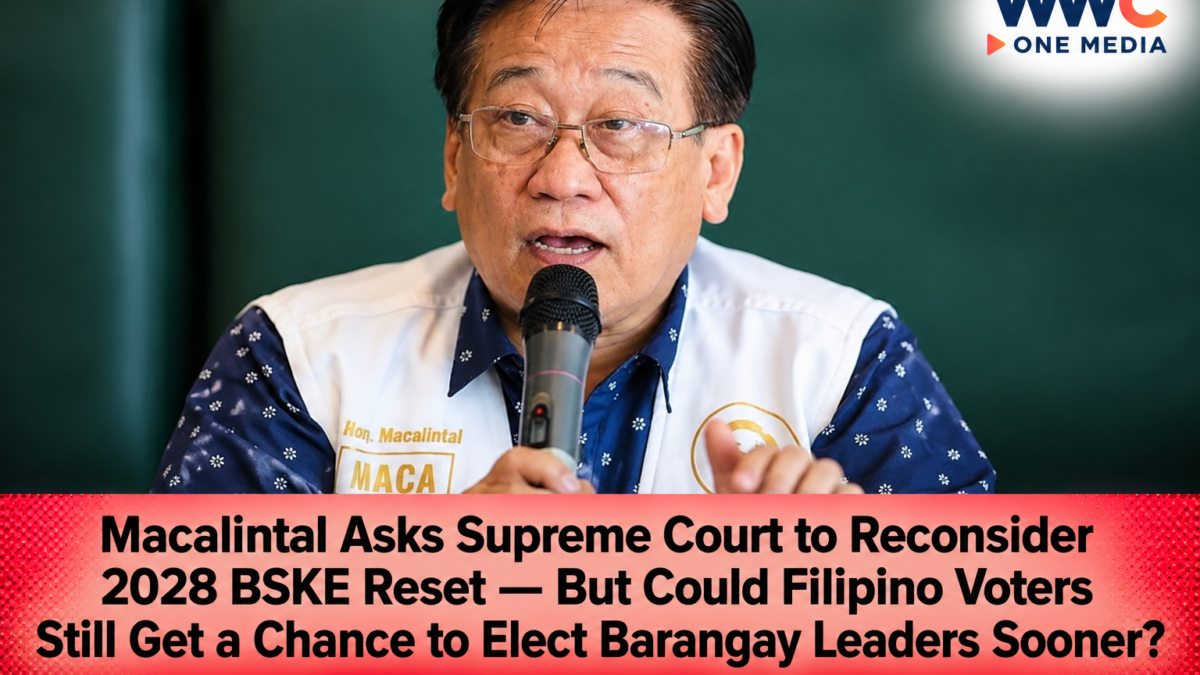
MANILA, Philippines — November 12, 2026 — The battle over the postponement of the Barangay and Sangguniang Kabataan Elections (BSKE) is not over yet. Election lawyer Romulo Macalintal has asked the Supreme Court (SC) to reconsider its decision upholding the law that moved the next barangay and youth council elections to November 2028.
In a motion for partial reconsideration filed on Tuesday, November 10, Macalintal proposed what he described as a “win-win solution”: recognize Congress’ authority to establish five-year terms for barangay and Sangguniang Kabataan officials, but strike down the postponement of the November 2026 elections.
His proposal seeks to separate two issues that have become central to the controversy: the power of lawmakers to determine the length of local officials’ terms and the constitutional limits on delaying elections.
The move follows the Supreme Court’s decision affirming the constitutionality of Republic Act No. 12326, which extended the terms of barangay and SK officials from four years to five years and scheduled the next BSKE for November 2028.
The latest appeal could reopen debate over voters’ right to choose their local leaders. However, it does not automatically restore the 2026 elections. The Supreme Court must first act on Macalintal’s motion.
Macalintal Offers a “Win-Win” Solution to the Supreme Court
Rather than asking the Supreme Court to invalidate the entire law, Macalintal is proposing a narrower legal remedy.
He wants the justices to uphold Congress’ authority to set or extend the terms of barangay and SK officials while declaring unconstitutional the provision that moved the November 2026 BSKE to 2028.
In practical terms, his proposal would allow the five-year term to apply to officials elected in the next BSKE, but he wants that election conducted at the earliest practicable date.
He also asked the Court to direct the Commission on Elections (Comelec) to organize the polls as soon as reasonably possible, with the succeeding regular elections to take place five years after the next election.
Macalintal argues that this approach would preserve the legislative power of Congress while restoring voters’ opportunity to choose their barangay and youth council representatives.
His motion does not ask the Court to reject every provision of Republic Act No. 12326. Instead, it challenges the legal consequence of moving the scheduled election.
That distinction is important because the Supreme Court’s majority decision was based largely on the difference between a law setting officials’ terms and a law whose primary purpose is postponing an election.
Why the Supreme Court Previously Upheld the 2028 BSKE Schedule
On November 6, the Supreme Court announced that it had upheld the constitutionality of Republic Act No. 12326 and dismissed Macalintal’s original petition.
The law, signed by President Ferdinand Marcos Jr. on September 24, 2026, increased the terms of barangay and SK officials from four years to five years.
It also moved the next regular BSKE from November 2, 2026, to the second Monday of November 2028, which falls on November 13.
The majority ruled that the measure was primarily a law fixing the terms of local officials, not an election-postponement law.
According to the Court, Congress has constitutional authority to determine the terms of barangay officials, provided that the transition to the new term is reasonable and not unduly long.
The justices also considered the government’s arguments about continuity of local programs, the resources needed to conduct elections, and the potential conflict between barangay election preparations and the May 2028 national and local elections.
The Court concluded that the new five-year term and the November 2028 election schedule were constitutionally permissible.
The decision was written by then Associate Justice Rodil V. Zalameda, who is now Chief Justice.
The ruling was not unanimous: nine justices concurred, five dissented, and one justice was on leave.
The 2023 Macalintal Guidelines Are at the Center of the Dispute
One of the most important legal questions concerns the Supreme Court’s 2023 ruling in Macalintal v. Commission on Elections.
That earlier case involved Republic Act No. 11935, which postponed the 2022 BSKE.
The Supreme Court struck down that postponement and established that election delays must be supported by important, substantial or compelling reasons.
Macalintal argues that those guidelines should also apply to the latest change in the election schedule.
His position is that Congress cannot avoid the constitutional standards governing election postponements simply by describing a measure as a law fixing the terms of elected officials.
The Supreme Court majority disagreed.
It ruled that Republic Act No. 12326 has a different primary purpose: establishing a five-year term for barangay and SK officials. The movement of the election date, according to the majority, is an effect of implementing that new term rather than the law’s principal objective.
This difference in legal interpretation is at the heart of Macalintal’s latest appeal.
The question is whether the Court will continue treating the 2028 schedule as an incidental consequence of changing officials’ terms or reconsider whether the postponement itself must independently satisfy the standards established in 2023.
Five Supreme Court Justices Previously Dissented
The latest motion also comes after five justices expressed opposition to the majority ruling.
Senior Associate Justice Marvic Leonen and Associate Justices Alfredo Benjamin Caguioa, Ramon Paul Hernando, Ricardo Rosario and Antonio Kho Jr. dissented from the decision upholding Republic Act No. 12326.
Their concerns centered on the effect of extending the terms of officials elected in 2023 without allowing voters to decide whether those officials should continue serving.
Leonen argued that Congress may establish a five-year term for future barangay officials, but should not decide on behalf of voters who will remain in office during a period when an election would otherwise have taken place.
Caguioa also questioned whether the government’s reasons for moving the elections were sufficiently compelling, warning that repeated postponements could weaken the electorate’s right to vote.
Justice Antonio Kho Jr. argued that the law should be viewed as both a measure fixing terms and one postponing elections, meaning the 2023 guidelines should apply.
The existence of five dissenting votes does not mean Macalintal has already secured enough support to reverse the ruling. The Court must independently consider the arguments raised in the motion and determine whether reconsideration is warranted.
What Happens to Barangay and SK Officials Already in Office?
For now, incumbent barangay and SK officials remain in office under the applicable hold-over provision until their successors are elected and qualified.
The Supreme Court explained that their continued service does not mean Congress has appointed them to a new term. Rather, they remain in office under the legal transition framework while the next election is awaited.
Republic Act No. 12326 also changes the rules on consecutive service for barangay officials, reducing the maximum number of consecutive terms from three to two.
The distinction matters because the law does not simply create a new election date. It changes the length of officials’ terms and the transition rules governing those already serving.
For residents, the practical consequence is that the officials elected in October 2023 will remain in office until the next BSKE under the current legal framework, unless the Supreme Court changes the ruling or another lawful measure alters the schedule.
Comelec Must Follow the Law Unless the Supreme Court Changes It
The Commission on Elections is central to the dispute because it is responsible for preparing and administering the BSKE.
Before the Supreme Court ruling, Comelec had already explained that it would comply with whatever final legal direction the Court issued regarding Republic Act No. 12326.
WWC ONE MEDIA previously reported on the poll body’s position in its coverage, Comelec Ready to Act if Supreme Court Intervenes in BSKE Postponement.
With the Supreme Court now upholding the law, the existing schedule points to November 13, 2028.
Macalintal’s motion does not itself authorize Comelec to resume preparations for a November 2026 election. The poll body must follow the law and any binding court orders.
The public should therefore avoid treating the filing of a motion for reconsideration as an announcement that the election has been moved back to 2026.
NAMFREL and Election Advocates Continue to Raise Voters’ Rights Concerns
The controversy is also drawing attention from election watchdogs.
The National Citizens’ Movement for Free Elections (NAMFREL) said it respects the Supreme Court’s decision but will continue advocating for regular, credible and meaningful elections.
The group has raised concerns about voters losing an opportunity to renew or withdraw the mandate of local officials elected in 2023.
NAMFREL has also emphasized the importance of holding officials accountable between elections.
Its position adds another dimension to the dispute: even if the five-year term is legally valid, questions remain about how the extended period in office affects local democratic accountability.
WWC ONE MEDIA has also covered the watchdog’s criticism in NAMFREL Says BSKE Postponement Raises Questions Over Political Convenience.
The debate is not limited to lawyers and lawmakers. Barangay residents, SK members, prospective candidates and election administrators are all affected by the schedule.
Why the 2028 Election Schedule Matters to Filipino Voters
The BSKE is one of the country’s most direct forms of local democratic participation.
Barangay officials handle community-level concerns involving public services, local development, peace and order, and coordination with city and municipal governments. Sangguniang Kabataan officials represent youth interests and lead programs for young residents.
Moving the elections to 2028 means voters will wait longer before choosing their next barangay and SK representatives.
The schedule also places the BSKE in the same year as the May 2028 national and local elections, although the barangay and SK polls are scheduled for November.
The Supreme Court majority considered the need to avoid conflicts in election preparations and the costs of conducting separate electoral exercises.
Critics, however, argue that administrative convenience should not override the public’s opportunity to vote.
WWC ONE MEDIA previously examined the election calendar and the role of Comelec in BSKE 2026 in Limbo: Comelec Keeps Preparing for November 2 Polls as Congress Pushes 2028 Reset.
For voters, the immediate issue is whether the Supreme Court will reconsider the legal basis for the 2028 schedule.
What Happens Next? The Supreme Court Must Decide Whether to Reconsider
Macalintal’s motion for partial reconsideration now places the issue back before the Supreme Court.
The justices may deny the motion, grant it in whole or in part, or take other procedural steps permitted under the Court’s rules.
Until the Court issues a new ruling or order changing the situation, Republic Act No. 12326 remains in effect and the next regular BSKE remains scheduled for November 13, 2028.
There is also no automatic return to the November 2, 2026 election date simply because Macalintal has filed his appeal.
The legal challenge is therefore still unresolved, even though the Supreme Court has already upheld the law in its initial decision.
For now, the dispute comes down to one fundamental question: Can Congress extend the terms of barangay and SK officials while moving an election without separately meeting the constitutional standards for postponing polls?
Macalintal wants the Court to draw a clearer line between those two powers.
The Supreme Court’s next move could determine whether Filipino voters must wait until 2028 to choose their barangay and youth leaders—or whether the 2026 elections could still return to the calendar.