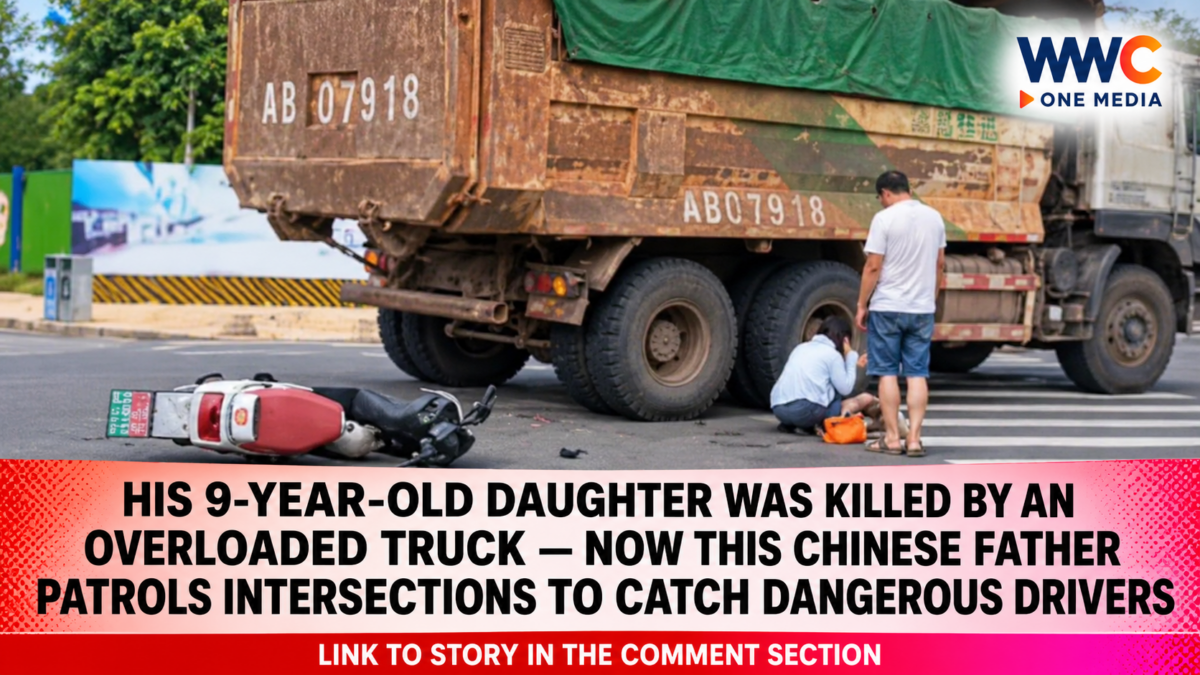
JIANGXI, China — A grieving father in southeastern China has turned his personal tragedy into a campaign for safer roads, spending his days watching busy intersections and recording dangerous driving by heavy vehicles after an overloaded dump truck killed his nine-year-old daughter.
Wu Zhisheng put his work aside and began monitoring roads near schools and playgrounds, where large trucks, construction vehicles and other commercial vehicles regularly pass.
Armed with a smartphone, he records suspected traffic violations and sends the footage to police. According to the South China Morning Post (SCMP), Wu has documented more than 20 heavy vehicles allegedly committing traffic violations, including running red lights, driving against traffic, overloading and concealing licence plates.
His campaign began after a devastating collision on August 1, 2026, when a turning tipper truck struck an electric bicycle carrying his wife and their two daughters in Jiangxi province.
Their nine-year-old daughter, Zijin, died at the scene. His wife and their five-year-old daughter were injured.
The subsequent investigation uncovered serious safety violations involving the truck, including excessive overloading and defective braking equipment.
For Wu, the tragedy raised a question that now drives his daily efforts: How many other families could lose someone because dangerous vehicles are allowed to remain on the road?
The Crash That Changed One Father’s Life
The accident happened at approximately 3:04 p.m. on August 1 at the intersection of Ping’an Avenue and Hehua Road in Rongjiang New Area, Ganzhou, Jiangxi province.
Wu’s wife, identified in Chinese reports as Zou, was riding an electric bicycle with their two daughters when a heavy dump truck made a right turn and struck the bicycle.
The nine-year-old girl, Zijin, was run over by the truck and died at the scene.
Her mother and five-year-old sister survived but sustained injuries.
According to the investigation findings published by Chinese media outlet The Paper, the truck was travelling along the road before turning right into Hehua Road. Its right-front wheel came into contact with the left-front portion of the electric bicycle.
The collision caused the bicycle to fall, after which the truck’s right rear wheel ran over the older child.
The accident left one child dead, two people injured and a family facing the consequences of a tragedy that could have been prevented.
The Truck Was Carrying Almost Twice Its Permitted Weight
One of the most alarming findings involved the weight of the truck.
Investigators established that the dump truck had an approved gross vehicle weight of 25 tonnes.
However, its actual weight at the time of the accident was 48.159 tonnes.
That meant it was carrying an additional 23.159 tonnes — approximately 92.6% above its permitted total weight.
In other words, the truck was almost twice as heavy as its approved limit.
The investigation also found that the vehicle had a defective braking component.
A leak was identified in the left-side brake chamber on the truck’s third axle. Its side-protection equipment also failed to meet applicable technical safety standards.
The truck was travelling at an estimated speed of approximately 18.1 to 20.4 kilometres per hour when the collision occurred.
Investigators found that the driver failed to give way to the electric bicycle travelling straight ahead while making the right turn.
These findings were central to the official determination of responsibility.
Police Found the Truck Driver Fully Responsible — Despite Violations Involving the Electric Bicycle
The investigation also identified violations involving the electric bicycle.
According to the official accident findings, the vehicle had been modified and was carrying more passengers than permitted.
The mother and both children were also not wearing helmets.
The nine-year-old was seated at the rear, while the five-year-old was positioned on the front footboard.
These violations were identified as factors that increased the severity of the consequences.
However, an important distinction emerged from the police traffic accident determination: the electric bicycle rider’s violations were not considered the cause of the collision.
The truck driver was found fully responsible for the accident.
The investigation identified his failure to yield while turning, excessive vehicle weight and defective safety equipment as direct causes.
This distinction is important because the presence of safety violations by one road user does not automatically mean that person caused the crash.
The official findings placed responsibility for the collision on the truck driver.
Investigation Also Identified Problems Involving Two Companies
The investigation did not stop with the truck driver.
It also examined the role of the transport company and the construction contractor connected to the vehicle’s operations.
The transport company, Ganzhou Yahang Engineering Construction Co., was found to have failed to properly implement its safety responsibilities and vehicle-management procedures.
Investigators said inadequate vehicle management allowed a truck that did not meet technical safety requirements to operate on the road.
The investigation also found that the vehicle was transporting construction waste despite unresolved approval procedures involving the disposal and transportation of construction waste.
The construction contractor, Jiangxi Construction Engineering Third Construction Co., was found to have failed to establish the required safety-management agreement with the transport company.
Investigators also cited deficiencies in construction-waste management and the release of an overloaded vehicle operated by a transport provider that had not completed the required approval procedures.
The report recommended administrative penalties against the electric bicycle rider, the two companies and four relevant individuals.
The findings suggest that the accident involved more than one failure in road and workplace safety management.
However, administrative recommendations should not be confused with criminal convictions. The available reports do not establish that the companies or their personnel have been criminally convicted in connection with the case.
Truck Driver Faces Criminal Proceedings After November 2 Court Hearing
The case reached court on November 2, 2026.
The driver, identified by his surname Zhu, was prosecuted on suspicion of causing a traffic accident, an offence under Chinese law.
According to The Paper, the prosecution sought a prison sentence of between two and two-and-a-half years.
Zhu pleaded not guilty, and the case was heard at the Ganzhou Economic and Technological Development Zone People’s Court.
The driver had previously been placed under criminal compulsory measures by judicial authorities.
As of the reports available on November 12, no final judgment or conviction had been announced.
The distinction matters: the police determination of responsibility in a road accident and the criminal court’s final decision are separate legal processes.
Wu has also indicated that he intends to pursue civil claims involving the driver, the vehicle’s insurer, the transport company and the construction contractor.
His legal representative has argued that the accident should be examined as a combination of driver misconduct and failures in corporate safety management, rather than being treated only as an individual driver’s mistake.
A Father Turns His Grief Into a Road-Safety Campaign
After the accident, Wu began visiting busy intersections around his community.
He reportedly focuses on roads near schools and playgrounds, where children and other vulnerable road users may encounter large commercial vehicles.
His recordings have captured more than 20 heavy vehicles allegedly committing traffic violations.
The reported offences include:
- Running red lights.
- Driving against the direction of traffic.
- Suspected overloading.
- Concealing or obstructing licence plates.
Wu sends the footage to traffic authorities and also shares some recordings online to draw attention to dangerous driving.
His decision to put his work aside reflects his frustration over what happened to his daughter and his determination to prevent another family from experiencing a similar loss.
He told Chinese media that if the truck driver had properly stopped before turning right, his daughter might still be alive.
His efforts have attracted attention because they highlight a problem that is difficult to address through road rules alone: regulations can exist, but they cannot protect people if drivers, transport companies and contractors fail to follow them.
His Younger Daughter and Wife Are Still Living With the Aftermath
The consequences of the accident did not end at the intersection.
According to reporting by Xiaoxiang Morning News, Wu’s younger daughter continued experiencing severe emotional distress after witnessing the collision.
The five-year-old reportedly suffered nightmares and woke up crying during the night.
She also had difficulty returning to kindergarten and continued recalling the traumatic incident during sessions with a psychological counsellor.
Wu’s wife also sustained serious injuries and underwent multiple skin-grafting procedures.
The family’s recovery has therefore involved both physical treatment and the emotional consequences of losing a child.
The tragedy has also strengthened Wu’s determination to pursue accountability beyond the driver.
His family is seeking answers about how a severely overloaded truck with defective safety components was allowed to operate.
Why Overloaded Trucks Are a Serious Road-Safety Threat
Overloading is not simply a paperwork violation.
A truck carrying significantly more weight than its approved limit places additional demands on its braking system, tyres, suspension and other mechanical components.
The additional weight can also affect vehicle handling, stability and stopping distance.
When a heavily loaded truck approaches an intersection, the consequences of a dangerous turn or failure to yield can be particularly severe for cyclists, motorcyclists and pedestrians.
The Jiangxi accident illustrates how multiple safety failures can combine:
- Excessive loading: The truck weighed more than 48 tonnes despite an approved limit of 25 tonnes.
- Defective equipment: Investigators identified a leak in a braking component and non-compliant side-protection equipment.
- Unsafe turning: The driver failed to yield to the electric bicycle travelling straight ahead.
- Corporate safety failures: Investigators identified problems involving the transport company and construction contractor.
- Vulnerable road users: The collision involved a family travelling on an electric bicycle, with a child losing her life.
The case demonstrates why effective road safety requires more than penalising drivers after a collision.
Vehicle inspections, loading controls, employer accountability and enforcement against dangerous driving all matter.
The Problem Is Not Limited to China: Overloaded Trucks Have Also Raised Safety Concerns in the Philippines
The tragedy also resonates beyond China.
In the Philippines, authorities have repeatedly warned that overloaded trucks and trailers pose serious risks to motorists and can damage roads and bridges.
In January 2024, the Philippine News Agency reported that the Land Transportation Office had ordered a continuing crackdown on overloaded trucks and trailers.
The agency cited complaints involving overloaded vehicles and warned that excessive loads threaten the safety of other road users.
The issue became particularly visible after the December 2024 Katipunan flyover accident in Quezon City, when a truck crashed into several vehicles, killing four people and injuring 24.
In January 2025, the LTO reported that 262 trucks had been apprehended for various safety violations following the incident. Common violations included overloading and worn-out tyres.
The Philippine experience shows why enforcement must extend beyond the driver to include vehicle owners and companies responsible for keeping commercial vehicles roadworthy.
WWC ONE MEDIA previously reported on the continuing dangers involving commercial vehicles in Singapore:
Lim Chu Kang Crash: Lorry Allegedly Crossed Double-White Lines While Overtaking, Hitting Motorcycle.
The incident involved dashcam footage that appeared to show a lorry crossing into the opposite lane while overtaking, resulting in a collision with a motorcycle.
It illustrates how a dangerous manoeuvre involving a heavy vehicle can place other road users at immediate risk.
Other Recent Crashes Show How Quickly Dangerous Driving Can Escalate
The issue of road safety has also resurfaced in other recent incidents involving commercial vehicles and ordinary motorists.
In October 2026, a lorry crash in Singapore’s Lim Chu Kang area left three people injured after a vehicle allegedly crossed double-white lines while overtaking.
In another incident covered by WWC ONE MEDIA, a viral collision in Melaka raised questions about traffic management at a busy junction after two cars crashed during the state election period.
The distinction in that case was important: the footage prompted questions about traffic control, but it did not establish that a political convoy caused the collision.
Another Singapore incident involved a private-hire vehicle that collided with a car before mounting a kerb and narrowly avoiding other road users.
PHV Crashes Into Car, Mounts Kerb and Narrowly Misses Vehicles in Chai Chee Street Near-Miss.
These incidents are not directly connected to the Jiangxi crash, but they illustrate a common road-safety concern: a single dangerous driving decision can place multiple people in danger within seconds.
A separate fatal collision in Cebu also demonstrated the devastating consequences of unsafe driving.
Three Cases Filed Against Cebu SUV Driver After Woman Dies in Fatal Road Crash.
The case involved a woman who died after being struck by an SUV while walking along General Maxilom Avenue. Criminal and administrative proceedings followed.
Together, these incidents underline why road safety must be treated as a responsibility shared by drivers, vehicle owners, employers and enforcement authorities.
What Wu’s Campaign Reveals About Road-Safety Enforcement
Wu’s efforts have attracted attention because he is doing something that road authorities are generally expected to do: monitor traffic violations and report dangerous vehicles.
His recordings may help authorities identify vehicles that violate traffic rules, but citizen monitoring cannot replace professional enforcement.
Police and transport regulators still need to investigate reports, verify evidence, conduct vehicle inspections and impose penalties where violations are established.
The more difficult question is whether the system can prevent dangerous vehicles from reaching public roads in the first place.
The Jiangxi investigation identified problems involving the truck’s mechanical condition, its excessive load and the management practices of the companies connected to its operation.
That makes the case especially significant.
If only the driver is held accountable, broader weaknesses in vehicle management and construction-waste transportation could remain unaddressed.
The investigation’s administrative recommendations may therefore prove important in determining whether the tragedy leads to wider changes.
The Bigger Question: How Many More Families Must Suffer Before Road Safety Is Taken Seriously?
Wu Zhisheng’s campaign began with the loss of his nine-year-old daughter.
Now, instead of returning to an ordinary routine, he spends his days watching intersections and recording dangerous behaviour by heavy vehicles.
His actions have brought attention to more than 20 suspected traffic violations, but they cannot undo what happened to his family.
The official investigation has already identified serious failures: an overloaded truck, defective safety equipment, an unsafe turning manoeuvre and weaknesses in company-level safety management.
The driver has faced criminal proceedings, while investigators have recommended administrative action involving other parties.
But the lasting significance of this case will depend on whether those findings lead to stronger enforcement and safer roads.
A nine-year-old girl lost her life when a truck carrying almost twice its permitted weight turned across her family’s path. Her father is now documenting dangerous vehicles in the hope that another child will not suffer the same fate. Will his campaign force authorities and transport companies to take road safety more seriously — or will the next preventable tragedy happen before the warnings are heard?