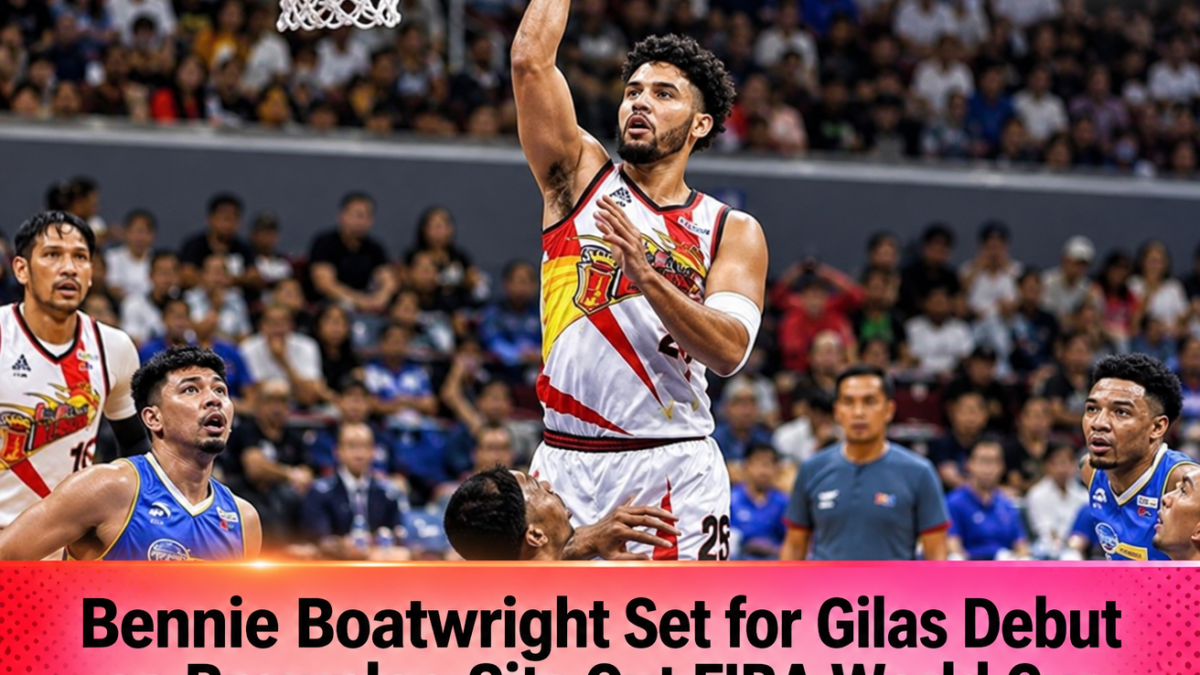
MANILA, Philippines — Gilas Pilipinas is preparing for a major roster change ahead of the fifth window of the 2027 FIBA Basketball World Cup Asian Qualifiers, with newly naturalized big man Bennie Boatwright set to make his long-awaited national team debut.
The Samahang Basketbol ng Pilipinas (SBP) has named Boatwright as the Philippines’ naturalized player in its 12-man lineup for the November qualifiers, replacing Justin Brownlee, who will miss the upcoming games because of health concerns.
The change gives head coach Tim Cone a new offensive option and additional size in the frontcourt. But it also raises a major question: Can Boatwright adjust to the national team’s system quickly enough to make an immediate impact?
The Philippines faces Syria on November 27 before meeting Iran on November 29 in Seremban, Malaysia. Both games are important to Gilas’ campaign to qualify for the 2027 FIBA World Cup in Qatar.
With the qualifying race entering a crucial stage, the Philippines cannot afford to waste the opportunity.
Bennie Boatwright Finally Gets His Gilas Opportunity
Boatwright’s inclusion marks the next step in a naturalization process that has been followed closely by Philippine basketball fans.
The 6-foot-10 forward-center completed his naturalization and secured his Philippine passport in October, clearing a major requirement for his planned national team appearance.
His addition is particularly important because of the absence of Brownlee, who has been one of Gilas’ most dependable naturalized players in recent international competitions.
Boatwright brings a different offensive profile.
He is known for his ability to stretch the floor with perimeter shooting while also providing size and scoring options near the basket. His combination of height and shooting could give Cone more flexibility in building lineups against physically imposing opponents.
The former San Miguel Beermen import is currently playing for the Fujian Sturgeons in the Chinese Basketball Association (CBA).
That club commitment, however, creates a preparation challenge for Gilas.
Tim Cone Faces a Race Against Time to Integrate Boatwright
Boatwright’s arrival is a welcome development, but he will not have the luxury of a long training camp with the national team.
According to Daily Tribune and Tiebreaker Times, Cone expects Boatwright to join Gilas in Kuala Lumpur on November 23 after completing his CBA commitments.
That leaves only a short period before the Philippines opens its qualifying campaign against Syria on November 27.
Cone acknowledged that the limited preparation time makes the situation difficult. The coaching staff will have to introduce Boatwright to the team’s offensive and defensive schemes while finding ways to maximize his strengths.
The challenge is not simply getting him into the lineup.
Gilas must determine how to use his shooting, size and ability to operate in the frontcourt without disrupting the chemistry already established by the returning players.
Cone has nevertheless welcomed the addition, pointing to Boatwright’s talent and the possibilities his size and perimeter shooting create.
The new naturalized player could become a valuable weapon, but his effectiveness may depend on how quickly he understands the system and develops chemistry with his teammates.
Why Justin Brownlee Is Missing From the Fifth-Window Roster
Boatwright’s arrival comes as a significant change for Brownlee, who will not be part of the Philippines’ 12-man lineup.
Gilas head coach Tim Cone cited health concerns involving Brownlee’s blood pressure and heart issues.
The development is a setback for a national team that has relied heavily on Brownlee’s scoring, experience and leadership in major international competitions.
Brownlee played a central role in some of Gilas’ most memorable victories, including the Philippines’ historic gold-medal campaign at the 2023 Asian Games.
His absence also means Cone must find a different way to organize the team’s offense and manage pressure situations.
Boatwright is not necessarily a direct replacement in playing style. Instead, he gives Gilas another option with a different combination of height, shooting and frontcourt versatility.
For the coaching staff, the immediate priority is making that adjustment work before the November games.
Gilas Pilipinas’ 12-Man Lineup for the November FIBA Qualifiers
The SBP’s final 12-man roster combines returning national team mainstays, overseas-based players and key PBA contributors.
Gilas Pilipinas roster:
- Rhenz Abando
- Bennie Boatwright
- AJ Edu
- Juan Gomez de Liaño
- Quentin Millora-Brown
- Chris Newsome
- CJ Perez
- Mike Phillips
- Kevin Quiambao
- Dwight Ramos
- Kai Sotto
- Scottie Thompson
The lineup gives Cone several options in the frontcourt, particularly with Boatwright, Sotto, Edu, Millora-Brown and Phillips available.
Kai Sotto’s return is another major boost. The 7-foot-3 center made an important contribution during the fourth qualifying window, helping the Philippines defeat Jordan and Iran in August.
Rhenz Abando also returns to the national team setup, bringing athleticism and perimeter defense to the roster.
The combination of experienced guards and a taller frontcourt could give Gilas a different look against its next opponents.
Carl Tamayo and Calvin Oftana Also Miss the November Window
Boatwright and Brownlee are not the only major roster developments.
Gilas will also be without Carl Tamayo and Calvin Oftana.
Tamayo is sidelined by a badly sprained ankle, according to Cone. The Korean-based forward had already played seven of the Philippines’ eight qualifying games before the injury affected his availability.
Oftana, meanwhile, has begged off from the fifth window because his wife is expected to give birth around the time of the national team’s games.
Their absences reduce the number of established options available to Cone, making the contributions of the returning players even more important.
The coaching staff will need to manage the available lineup carefully, particularly with the two games scheduled just two days apart.
Philippines Faces Syria and Iran in Crucial Qualifying Games
Gilas enters the fifth window with a 4-4 win-loss record, placing fifth in Group E.
The standings make the upcoming games especially important.
| Group E team | Win-loss record |
|---|---|
| Australia | 8-0 |
| New Zealand | 6-2 |
| Iran | 5-3 |
| Jordan | 5-3 |
| Philippines | 4-4 |
| Syria | 2-6 |
The Philippines will first face Syria on November 27, followed by a rematch against Iran on November 29.
Syria enters the window with a 2-6 record, while Iran holds a 5-3 slate and is among the stronger teams in the group.
The two matchups offer different challenges.
Against Syria, Gilas will be expected to capitalize on its talent advantage and avoid a costly setback. The game against Iran is likely to be a tougher test, particularly because the Iranian team is ahead of the Philippines in the standings.
The FIBA schedule lists both games at Karisma Arena in Seremban, Malaysia.
What Gilas Must Do to Reach the 2027 FIBA World Cup
The November window is part of the second round of the 2027 FIBA Basketball World Cup Asian Qualifiers.
Results from the first round carry over, meaning every victory and defeat remains important as the teams compete for qualification.
Under the current format, the top three teams from each second-round group qualify for the World Cup, alongside host Qatar.
That leaves Gilas with limited room for error.
The Philippines needs to climb the Group E standings and secure enough victories in the remaining games to finish among the qualifying positions.
The November matchups are therefore more than ordinary international fixtures. They could have a major impact on the country’s chances of returning to the World Cup.
The Philippines is scheduled to host its final qualifying window in February 2027, giving the team another opportunity to strengthen its position after the Malaysia games.
Gilas’ Frontcourt Could Become Its Biggest Advantage
One of the most interesting aspects of the new roster is the number of big men available to Cone.
Boatwright, Sotto, Edu, Millora-Brown and Phillips give Gilas several options in terms of size, rebounding, rim protection and offensive spacing.
Fastbreak reported that Cone is optimistic about the team’s ability to use its imposing frontcourt to create matchup problems for opponents.
The challenge will be balancing those options with the team’s perimeter offense and defensive rotations.
Boatwright’s outside shooting could help open the floor for Sotto and Edu, while the team’s guards can look for opportunities to attack defenses that collapse toward the paint.
However, size alone will not guarantee victories.
Gilas must also protect the ball, defend the perimeter, rebound consistently and execute under pressure—especially against Iran, which currently holds a better record in Group E.
The Bigger Picture: Gilas Must Build Beyond One Naturalized Star
The change from Brownlee to Boatwright also highlights the importance of building a national team capable of adapting when key players are unavailable.
Brownlee has delivered major contributions for the Philippines, but international qualifying campaigns require depth, flexibility and a reliable supporting cast.
The return of players such as Kai Sotto and Rhenz Abando, together with the availability of Boatwright, gives Cone more options.
The development of Gilas has also been a continuing subject of coverage at WWC One Media. In its report on Gilas Pilipinas’ defeat to South Korea during its Asian Games preparations, WWC examined the questions surrounding Brownlee’s availability and the challenges facing Cone’s roster.
The national team’s rivalry with regional basketball powers also remains an important storyline. WWC previously covered China’s renewed pursuit of Asian Games basketball gold and its looming rematch with Gilas.
Another report examined Zavier Lucero’s potential defensive role in Gilas’ challenge against China, highlighting the importance of versatile players who can defend multiple positions.
These stories underline a larger reality: Gilas needs a deep and adaptable player pool to remain competitive against Asia’s strongest national teams.
Can Bennie Boatwright Make His Debut Count?
Boatwright’s inclusion gives Gilas Pilipinas a new source of size, shooting and offensive versatility at a critical stage of the 2027 FIBA World Cup Asian Qualifiers.
But his debut will come with pressure.
He must adjust to Cone’s system, build chemistry with his teammates and help the Philippines collect important victories against Syria and Iran.
At the same time, Gilas must cope with Brownlee’s absence and the unavailability of Tamayo and Oftana.
The roster has talent. The frontcourt has size. The remaining question is whether the team can turn those advantages into results.