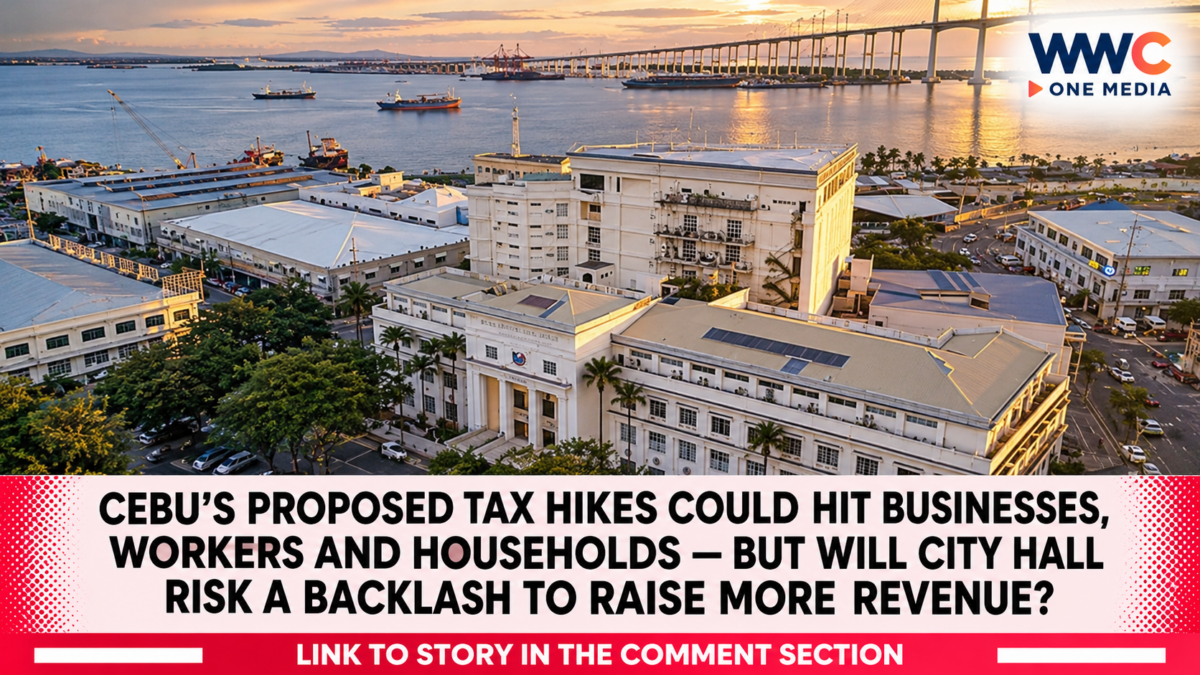
Cebu City is considering a major overhaul of its decades-old Revenue Code that could generate as much as ₱500 million in additional annual income. But as City Hall looks for more money to fund public services, business groups and a tax expert are warning that higher taxes and fees could put more pressure on companies, workers and ordinary households already dealing with rising costs.
The debate intensified after University of San Jose-Recoletos School of Law Dean Jonathan Capanas cautioned city officials against rushing into tax adjustments during a public hearing on November 10.
Capanas, a certified public accountant, warned that increasing tax rates does not automatically translate into higher government collections. If businesses are pushed beyond what they can afford, some could reduce operations or close, potentially weakening the very economic activity that generates local revenue.
His warning puts a difficult question before the Cebu City Council: can the city raise more money without discouraging the businesses, investments and employment opportunities that sustain its economy?
The proposed revision is not yet an enacted tax increase. It remains subject to legislative scrutiny and public consultation.
Cebu City’s 1993 Revenue Code Faces a Major Overhaul
City Treasurer Emma Villarete presented the proposed revision of Cebu City’s Revenue Code, which has been in effect since 1993.
According to Villarete, the existing framework needs updating to reflect modern business activities, changing economic conditions and the growing demands placed on local government services.
She said the proposed revisions are intended not only to adjust rates but also to reorganize business classifications to account for industries and commercial activities that were not adequately covered when the current code was introduced.
Villarete also cited recommendations from the Commission on Audit and the Bureau of Local Government Finance calling for the city to update its revenue measures.
The city faces increasing expenses as its population grows and demand rises for services such as scholarships, senior citizen assistance, health programs and waste management.
One example raised during the hearing was the city’s garbage collection and disposal spending.
Villarete said Cebu City generates approximately ₱100 million from garbage-related collections while spending around ₱1 billion on the service.
She estimated that the proposed Revenue Code revisions could generate an additional ₱300 million to ₱500 million annually on top of existing collections of approximately ₱3 billion.
That projected revenue could help narrow the gap between the city’s income and its growing service obligations.
However, Capanas argued that revenue generation must be balanced with the ability of taxpayers to pay.
Tax Expert Warns Higher Rates Could Backfire
Capanas questioned whether the timing was appropriate for imposing additional financial obligations on businesses and residents.
He warned that companies already facing inflation, rising operating expenses and economic uncertainty could struggle with higher tax bills.
The danger, he argued, is that excessive increases could result in business closures, weaker compliance and lower economic activity instead of the additional revenue City Hall expects.
He also urged the council to examine alternative sources of income and review government spending before relying heavily on higher taxes.
Among the alternatives he raised were improving collection efficiency, reviewing expenditures, expanding the tax base through economic growth and maximizing non-tax revenues.
He specifically questioned what happened to proceeds from the sale of properties at the South Road Properties (SRP), suggesting that the city should also examine whether existing assets and other revenue sources are being used effectively.
Capanas proposed that any necessary increases be introduced gradually rather than imposed all at once.
His position is not that Cebu City should never update its tax code. Rather, he is calling for a careful assessment of whether the proposed adjustments are necessary, practical and affordable under current economic conditions.
The Freeman separately reported on his warning, including his argument that the city must balance stronger revenue collection with fiscal discipline and the capacity of taxpayers to pay.
Business Groups Flag Potential Increases of Up to 339 Percent
The debate is not limited to the city’s overall revenue target.
The Cebu Consumer Rights Advocates (CCRA) has raised concerns about specific provisions in the proposed 379-page revenue code, arguing that some adjustments could significantly increase operating expenses for businesses.
In a statement reported by SunStar Cebu and The Freeman, CCRA convenor Nathaniel Chua warned that higher local taxes and fees could discourage expansion, weaken investment and put jobs at risk.
Among the provisions questioned by the group are proposed increases in local business taxes for wholesalers, distributors and manufacturers.
CCRA said wholesalers and distributors with annual gross sales of ₱50 million could face increases of up to 339 percent in local business taxes.
Manufacturers with annual gross sales of ₱500 million could face increases of as much as 225 percent, according to the group’s assessment of the proposal.
These figures refer to the potential increases identified by CCRA in the draft measure. They should not be interpreted as confirmed increases already being collected by Cebu City.
The group argued that high gross sales do not necessarily mean high profits. Businesses operating on narrow margins may have substantial revenue but limited money left after paying for inventory, salaries, rent, utilities, logistics and other expenses.
If tax obligations rise sharply, companies could delay investments, reduce hiring or reconsider where they maintain their operations.
CCRA specifically warned that some businesses might consider transferring distribution hubs or other activities to neighboring local government units, including Mandaue City and Talisay City.
Such a shift could affect employment and commercial activity within Cebu City.
Proposed Garbage Fees Could Also Hit Households and Small Businesses
One of the most contentious parts of the draft code involves proposed waste collection charges.
According to CCRA’s review, annual garbage fees for residential houses, apartments and condominiums could increase to ₱5,000 from the current ₱300.
Small neighborhood businesses, including carinderias and sari-sari stores, could face annual garbage fees of as much as ₱10,000, compared with the current ₱365, the group said.
The proposed changes also raise concerns for market vendors and other small operators.
CCRA pointed to potential increases in waste-related charges for ambulant vendors and higher market fees, including proposed changes to arkabala charges.
For households, a higher annual garbage fee could add to expenses already affected by food, electricity, transportation and other essential costs.
For small businesses, the impact could be more complicated.
A neighborhood eatery, for example, must manage food purchases, wages, utilities, rent and waste disposal. Additional charges may appear manageable individually, but the combined impact of several new fees could reduce already limited operating margins.
The group has also questioned a proposed annual occupational tax covering non-professional workers, including grocery clerks, salon employees, factory workers and restaurant service crews.
The proposal has raised questions about whether workers should bear additional costs simply for holding certain jobs.
These are concerns raised by CCRA about the draft code, not proof that every listed fee will be approved in its current form.
Inflation and El Niño Add to the Pressure
The timing of the proposed changes is another major concern.
Capanas argued that the city must account for inflation and the possible economic effects of El Niño before implementing additional tax obligations.
Prolonged hot and dry conditions can increase electricity consumption, raise operating expenses and put pressure on water and energy resources.
Businesses that rely on refrigeration, air-conditioning, manufacturing equipment or water-intensive operations could face additional costs.
Households may also experience higher utility expenses, making it more difficult to absorb new local charges.
The Philippine Statistics Authority’s September 2026 inflation report for the bottom 30 percent of income households showed Cebu City’s inflation rate for that group reaching 10 percent, up from 9.5 percent in August.
That figure applies specifically to the bottom 30 percent income group, rather than the entire city’s population. Nevertheless, it illustrates the financial pressure facing lower-income households.
For small enterprises, the combination of rising input costs and additional local fees could make it harder to maintain prices, retain workers and invest in expansion.
This is why Capanas has urged the council to consider the economic consequences of the proposed adjustments rather than focusing exclusively on projected collections.
The Debate Is Also About Cebu City’s Competitiveness
Cebu City is one of the country’s major commercial centers, with businesses operating across retail, manufacturing, distribution, tourism, professional services and other industries.
Its economic strength depends not only on the amount of revenue the local government collects but also on its ability to attract businesses, support entrepreneurs and retain employment.
CCRA warned that a higher tax burden could weaken the city’s competitiveness if companies find neighboring areas more attractive for their operations.
The group’s concern is particularly relevant for businesses with multiple locations or distribution networks, which may have greater flexibility in deciding where to establish facilities.
However, the possibility of businesses relocating should be treated as a risk raised by the advocacy group—not as an established outcome of the proposed code.
The actual impact would depend on the final tax rates, the types of businesses covered, available exemptions, operating costs and the comparative policies of neighboring cities.
The wider national business environment also matters.
In related coverage, WWC ONE MEDIA examined concerns over the cost of doing business in the Philippines in its report, BIR Corruption Isn’t Going Away? PCCI Executive Warns Kickbacks Could Be Bigger Than the Taxes Collected.
The report discussed allegations raised by a Philippine Chamber of Commerce and Industry representative about unofficial payments during tax examinations. Those allegations concern national tax administration, not Cebu City’s proposed local tax code, but they highlight why businesses place importance on predictable, transparent and fair government charges.
Cebu City Must Balance Revenue Needs With Taxpayer Protection
City Hall’s position reflects a different but equally important concern: local governments need sufficient and sustainable revenue to provide essential services.
The Local Government Code gives local government units authority to establish local revenue sources and impose taxes, fees and charges within the limits set by law.
But the authority to collect revenue does not eliminate the need to assess whether a proposed measure is reasonable, properly supported and fair to taxpayers.
The Department of Finance, together with the Department of the Interior and Local Government and the Department of Trade and Industry, issued Joint Memorandum Circular No. 01-2026 to clarify the application of local taxes, fees and charges to registered business enterprises availing of tax incentives.
The circular, which took effect on March 30, 2026, reflects the national government’s broader effort to make local tax administration clearer and more consistent for businesses.
For Cebu City, the challenge is to ensure that its proposed revisions support public services without creating unnecessary uncertainty or discouraging investment.
WWC ONE MEDIA previously examined the national government’s approach to tax administration in BIR Chief Unveils Tax Modernization Push — But Will It Finally Make Compliance Easier for Filipinos?.
Another related issue is whether local governments can improve collection without simply increasing rates. WWC ONE MEDIA also reported on the Bureau of Internal Revenue’s move toward more data-driven enforcement in BIR Teams Up With IMF for Smarter Tax Crackdown—These 4 Industries Are Now in the Spotlight.
Although the BIR’s national enforcement program is separate from Cebu City’s local revenue code, both developments raise a common policy question: how can government improve revenue collection while keeping compliance fair and manageable?
What Happens Next to Cebu City’s Proposed Revenue Code?
The proposed measure still has to go through the City Council’s review and legislative process.
The November 10 hearing allowed officials and stakeholders to discuss the draft, including its revenue projections, proposed rates and potential economic effects.
Another public hearing is scheduled for November 17, with November 24 reserved for additional discussions if needed, according to earlier reporting by The Freeman.
The council will have to examine the concerns raised by Capanas, business groups and other stakeholders before deciding what provisions should be retained, revised or removed.
Key questions remain:
- Will the proposed business tax increases be reduced, phased in or retained?
- Will micro-enterprises and qualified Barangay Micro Business Enterprises receive exemptions or other protections?
- Will garbage fees be supported by a clear study of actual collection and disposal costs?
- Can Cebu City improve collection efficiency and maximize non-tax revenue before imposing additional charges?
- Will the final code provide enough time for businesses and households to adjust?
The answers will determine whether the proposed overhaul becomes a more sustainable revenue framework or creates additional financial pressure on taxpayers.
The Bigger Question: Can Cebu City Raise More Revenue Without Losing the Businesses That Pay It?
Cebu City’s proposed Revenue Code revision is ultimately a debate about how a growing city should finance its public services.
City Hall argues that its existing revenue framework is outdated and that additional income is needed to meet rising demands for waste management, social assistance, education and other services.
Business groups and Capanas, meanwhile, are warning that higher taxes and fees could undermine the ability of companies and households to meet those same demands.
Both sides face a difficult balancing act.
A city cannot provide reliable services without sufficient revenue. But a revenue strategy that places excessive pressure on businesses may weaken employment, investment and economic activity over time.
The proposed ₱300-million to ₱500-million annual revenue increase may look attractive on paper. Whether it can be achieved without damaging the city’s business environment will depend on the details of the final measure, its implementation and the safeguards provided to taxpayers.
For now, Cebu’s business owners, workers and residents are waiting for the City Council to decide which provisions will survive public scrutiny.
Will Cebu City find a way to strengthen its finances while protecting local businesses—or could a tax overhaul intended to raise millions end up costing the city jobs, investment and economic momentum?