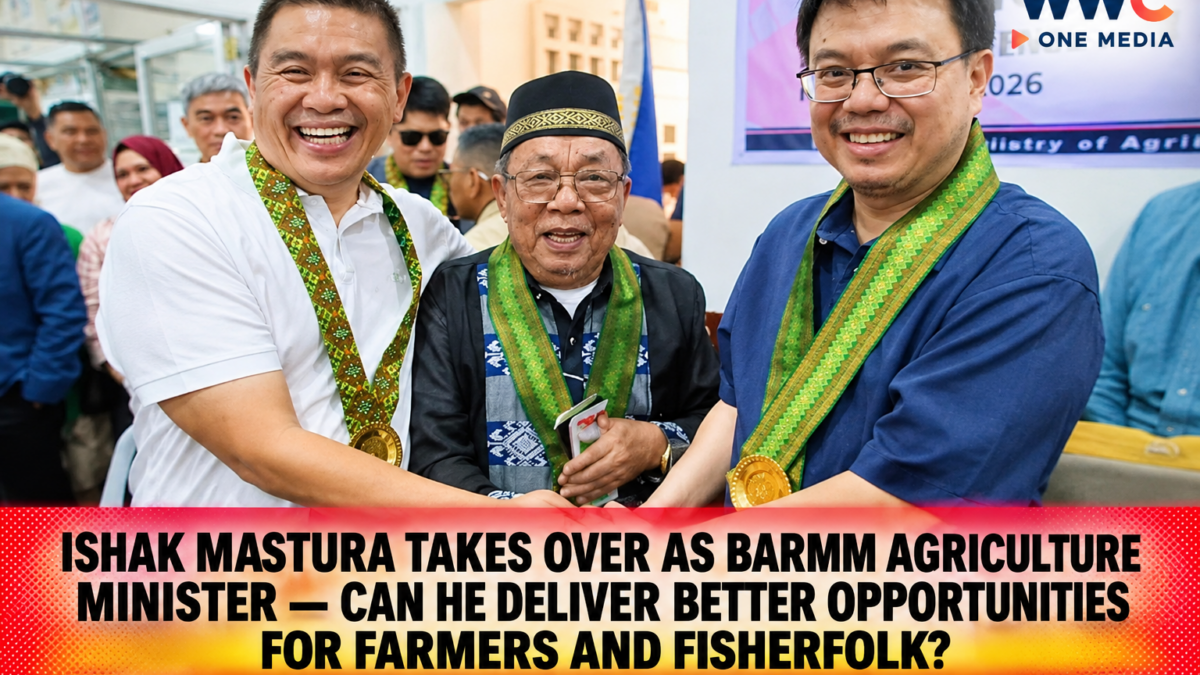
Ishak Mastura Takes Over as BARMM Agriculture Minister — Can He Deliver Better Opportunities for Farmers and Fisherfolk?
COTABATO CITY, Philippines — November 11, 2026 — The Bangsamoro region has a new agriculture chief, and expectations are growing over whether the leadership change can translate into better opportunities for farmers, fisherfolk and agricultural communities across the autonomous region.
Ishak V. Mastura, an elected member of the Bangsamoro Parliament and former regional investment official, formally assumed leadership of the Ministry of Agriculture, Fisheries and Agrarian Reform (MAFAR-BARMM) on Tuesday, November 10, during a turnover ceremony at the ministry’s main office in Cotabato City.
His appointment comes as local officials reaffirm their support for agricultural development and poverty-reduction programs across the region. The challenge ahead is significant: improving farm productivity, strengthening fisheries, expanding investment opportunities and ensuring that rural communities benefit from government programs.
The leadership transition also places renewed attention on the economic potential of Bangsamoro’s agricultural lands and fishing communities.
Ishak Mastura Takes Over From Abunawas Maslamama
Mastura officially received the agriculture ministry from Abunawas L. Maslamama, who previously headed MAFAR-BARMM and has now moved to the position of Senior Minister under the Office of Chief Minister Abdulraof Macacua.
During the turnover ceremony, Maslamama expressed his support for Mastura and pledged to assist in advancing the ministry’s programs and public-service responsibilities.
The transition follows Macacua’s announcement of the new BARMM Cabinet in November.
According to the Philippine News Agency, Mastura was among the officials appointed to lead the autonomous government’s ministries under its new Government of the Day. The selection process reportedly attracted more than 60 applicants for various government positions.
The appointment is particularly notable because Mastura brings experience in both government administration and investment promotion.
Before assuming his new position, he served as regional trade secretary under the former Autonomous Region in Muslim Mindanao (ARMM). He also previously chaired the region’s Regional Board of Investments for approximately a decade.
That background could prove relevant as BARMM seeks to strengthen the relationship between agricultural production, private investment and regional economic development.
Local Leaders Promise Support for Farmers and Fishing Communities
The transition has received support from local officials, including Maguindanao del Norte Vice Governor Marshall Sinsuat.
Sinsuat said he and members of the provincial board would support the implementation of MAFAR-BARMM programs intended to improve agricultural productivity in their province.
His commitment is significant because Maguindanao del Norte has extensive agricultural and fishing resources.
The province’s 12 municipalities include areas where residents cultivate rice, corn and other short-term crops. Its waterways and wetlands also connect to the Ligawasan Delta, a major freshwater ecosystem covering approximately 220,000 hectares across Central Mindanao, according to Philstar’s report.
These natural resources provide economic opportunities for agricultural communities, but turning that potential into sustainable income requires effective government programs, reliable infrastructure and access to markets.
Datu Blah Sinsuat, a coastal municipality in Maguindanao del Norte, is also recognized for its deep-sea fishing activities and emerging investment potential.
For communities that depend on farming and fishing, the effectiveness of the new ministry’s programs will matter far beyond the leadership change in Cotabato City.
Why BARMM Agriculture Matters to the Region’s Economy
Agriculture and fisheries remain important components of economic activity in the Bangsamoro region.
MAFAR’s official mandate covers the promotion of sustainable agricultural and fisheries development, equitable land distribution and secure land tenure.
The ministry serves farmers, fisherfolk and agrarian reform beneficiaries across BARMM.
Its responsibilities therefore extend beyond increasing harvests. They also involve improving the economic conditions of rural households, supporting agricultural enterprises and helping communities gain more reliable access to productive land and markets.
The region’s agricultural potential is particularly important in communities where farming and fishing provide essential sources of income.
However, production alone does not guarantee higher household earnings.
Farmers also need access to affordable inputs, irrigation, post-harvest facilities, transportation, financing and buyers willing to purchase their products at competitive prices.
For fisherfolk, sustainable fishing practices, cold-storage facilities, processing capacity and access to commercial markets can help improve the value of their catch.
These are important areas to watch as Mastura begins his tenure.
A Previous BARMM Agricultural Proposal Could Offer Another Opportunity
Mastura’s appointment comes amid broader discussions about improving the economic position of small farmers across the region.
In January 2026, the Bangsamoro Parliament reported the introduction of Parliament Bill No. 432, known as the proposed Community-Based Agricultural Crop Enterprise Development Act of 2026.
The measure seeks to address persistent challenges affecting small-scale farming communities, including fragmented land use, low productivity, limited market access and vulnerability to climate change.
Its proposed approach includes organizing farmers into commodity clusters, providing training in modern and climate-smart agricultural practices, improving access to loans and grants, and connecting producers with local and national markets.
The proposal also identifies smallholders, women, indigenous communities and conflict-affected families as priority beneficiaries.
Importantly, the measure was reported as a proposed bill, not an already implemented program or an established benefit available to all farmers.
Nevertheless, it highlights the policy discussions taking place around the future of Bangsamoro agriculture.
Whether similar initiatives can move forward and deliver measurable benefits will be an important issue for the new minister.
Fisheries and International Cooperation Could Help Expand Regional Opportunities
Agriculture is only one part of the ministry’s responsibilities. Fisheries and aquaculture are equally important to many Bangsamoro communities.
In February 2026, the Embassy of Japan in the Philippines reported on a two-year fisheries value-chain project involving the Japanese government and the Food and Agriculture Organization of the United Nations (FAO).
The project aims to improve the productivity and resilience of BARMM’s aquaculture and fisheries sectors through more sustainable local value chains.
Its activities include supporting small-scale producers, developing alternative high-value fish species, improving value-added processing and strengthening the knowledge and skills of industry stakeholders.
The project demonstrates that agricultural and fisheries development in BARMM is also connected to international cooperation.
For the new minister, opportunities to strengthen partnerships with development organizations, investors and local producers could help improve the competitiveness of the region’s agricultural and fisheries industries.
However, existing projects and international partnerships should not automatically be interpreted as new commitments made by Mastura.
The El Niño Challenge Adds Pressure on Agricultural Development
Another issue that could affect the region’s agricultural outlook is the developing El Niño phenomenon.
Prolonged dry conditions can reduce water availability, disrupt planting schedules and affect crop productivity, particularly in communities that depend on rainfall or have limited irrigation infrastructure.
Fisheries and coastal livelihoods may also face environmental pressures, making sustainable resource management increasingly important.
WWC ONE MEDIA has previously examined the potential consequences of these conditions for Filipino farmers and food security.
Related coverage:
- El Niño Forces Filipino Farmers to Abandon Planting as DSWD Distributes Over ₱189 Million in Aid
- Davao Farmers Warned to Report El Niño Damage Immediately
- ₱30.57-Million Kalinga Irrigation Project Ends Farmers’ 15-Year Wait for Water
- Philippines May Import Up to 5 Million Tons of Rice — But the Bigger Food-Security Risk Could Come Next
These reports provide broader context on the challenges facing Philippine agriculture, including climate risks, irrigation requirements, crop protection and food security.
For BARMM, strengthening local production and helping farmers prepare for changing weather conditions could be important parts of long-term agricultural development.
What Should Farmers and Investors Expect From the New Minister?
Mastura’s background in investment promotion provides a potential connection between agricultural development and private-sector participation.
But the success of his leadership will ultimately depend on how government policies and existing programs translate into measurable improvements for communities.
Several areas deserve attention during his tenure:
1. Higher agricultural productivity
Farmers need practical support that can improve yields, reduce production costs and make farming more sustainable.
2. Better access to markets
Improved connections between producers, traders, processors and buyers could help rural households earn more from their harvests.
3. Stronger fisheries and aquaculture
Investments in sustainable fishing, processing and value-chain development could create additional economic opportunities for coastal communities.
4. More effective agrarian reform services
Land distribution and secure land tenure remain important to farmers who need stability and confidence when investing in agricultural production.
5. Climate-resilient farming
Irrigation, water management, climate-smart farming techniques and agricultural preparedness could help protect communities against increasingly unpredictable weather conditions.
These are important priorities to monitor, rather than confirmed new policy commitments from the incoming minister.
The Bigger Question: Can BARMM Turn Its Agricultural Potential Into Better Livelihoods?
Ishak Mastura’s assumption of the agriculture ministry marks a new chapter for BARMM’s agricultural and fisheries sector.
His experience in regional government and investment promotion could be useful as the autonomous region works to strengthen agricultural production and attract economic opportunities.
The support expressed by local officials also provides an encouraging starting point for coordination between the regional ministry and provincial governments.
But the real measure of success will not be the leadership turnover itself.
It will be whether farmers can produce more efficiently, fisherfolk can earn more sustainably, rural communities can access better markets and agricultural beneficiaries can experience meaningful improvements in their livelihoods.
With significant farming areas, freshwater resources and coastal fishing communities, BARMM has considerable potential.
The question now is whether the new minister can help turn those resources into lasting economic opportunities for the people who depend on them.
For Bangsamoro farmers and fisherfolk, the next chapter will be measured not by promises, but by results.