BEIJING / WOLFSBURG — November 11, 2026
Volkswagen may finally be getting the breakthrough it desperately needs in China.
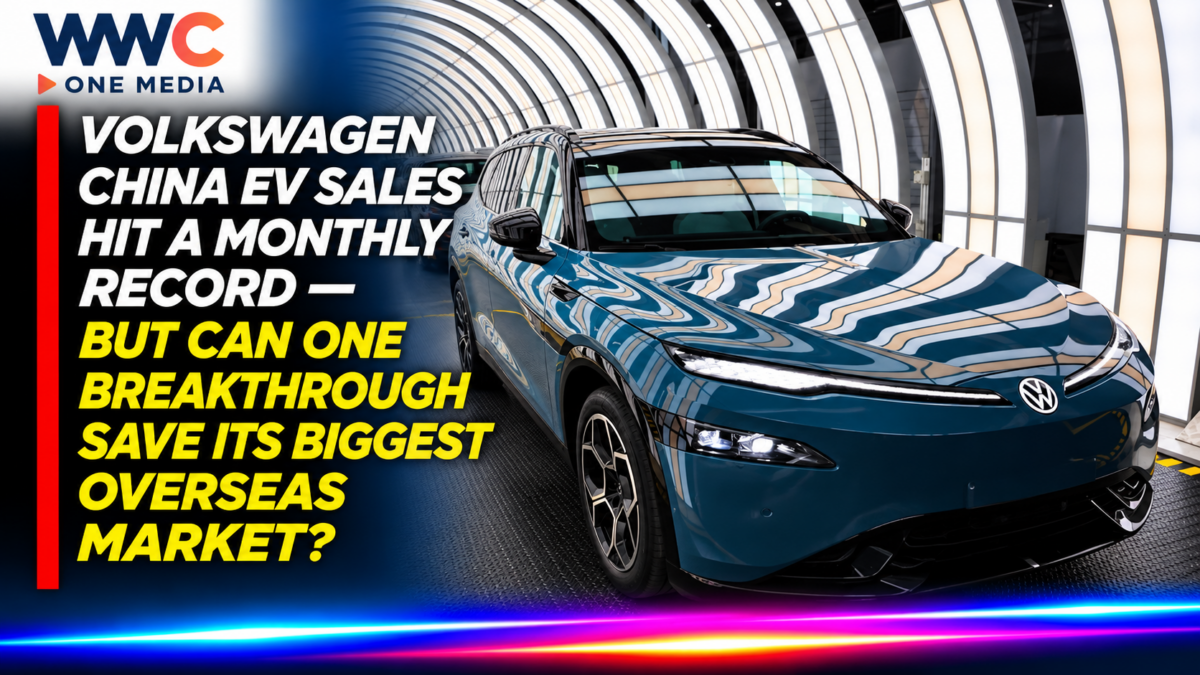
The German automotive giant’s electric-vehicle sales in the world’s largest car market climbed to a monthly record, according to a November 11 Bloomberg report, offering a potentially important sign that its efforts to rebuild its position in China are beginning to gain traction.
The development matters because Volkswagen has spent years losing ground to domestic Chinese manufacturers that have moved faster in electric vehicles, software, digital technology and pricing.
For decades, Volkswagen was among the most dominant foreign automakers in China. But the market has changed dramatically.
Companies such as BYD, Geely, Xiaomi, Xpeng and Leapmotor have reshaped consumer expectations, forcing established manufacturers to rethink how they design, develop and sell vehicles.
A record month for Volkswagen’s electric vehicles could therefore represent more than a sales milestone.
It could signal that the company is beginning to find products that Chinese consumers are willing to buy.
But one successful month does not automatically mean a complete turnaround.
Volkswagen still faces declining overall deliveries, intense domestic competition and a Chinese automotive market where traditional foreign brands are under mounting pressure.
The bigger question is whether its electric-vehicle momentum can become strong enough to reverse years of market-share losses.
Volkswagen’s China EV Sales Reach a Monthly Record
Bloomberg’s November 11 report identifies a monthly record for Volkswagen’s electric-vehicle sales in China.
That is an encouraging development for a company whose transition into China’s fast-moving EV market has been more difficult than expected.
Volkswagen has been investing in new electric models, local partnerships and faster product development to compete with manufacturers that understand Chinese consumers and technological preferences.
The company’s strategy is increasingly focused on developing vehicles specifically for China rather than relying on models designed primarily for European customers.
This approach reflects a major shift in the global automotive industry.
Chinese buyers are increasingly interested in advanced software, connected services, intelligent driving features and competitive electric-vehicle technology.
Manufacturers that cannot deliver these features quickly risk losing customers to domestic competitors.
However, the reported record should be viewed in context.
Bloomberg’s accessible headline confirms the monthly milestone, but the exact sales figure and measurement period could not be independently verified from the article text available for this report.
It would therefore be misleading to assign a specific vehicle count to Bloomberg’s reported record without access to the underlying figures.
Why This Could Be an Important Turning Point for Volkswagen
China has historically been one of Volkswagen Group’s most important markets.
The country provided enormous sales volumes, manufacturing scale and profitability through its joint ventures with Chinese partners.
But the competitive environment has become increasingly difficult.
Domestic manufacturers have developed electric vehicles at a rapid pace, introduced new models more frequently and competed aggressively on price.
The result has been a significant decline in Volkswagen’s position.
Reuters reported in October that Volkswagen’s global deliveries fell 14.3% in the third quarter of 2026, with deliveries in China dropping 38.5% during the period.
For the first nine months of 2026, deliveries in China were down 30.2% year over year.
The company has also faced pressure from weaker demand for traditional combustion-engine vehicles and increasingly aggressive competition in electric vehicles.
Against that background, a monthly EV sales record offers an encouraging development.
But the key question is whether the improvement is large enough to offset weakness elsewhere in Volkswagen’s Chinese business.
China’s EV Market Is Growing in Importance — Even as Car Sales Weaken
Volkswagen’s reported record comes as electric and plug-in hybrid vehicles account for an increasingly large share of China’s automotive market.
According to final October data reported by the China Passenger Car Association (CPCA), China’s passenger new-energy vehicle retail sales reached 1.109 million units.
That represented a 13.7% decline compared with October 2025.
However, new-energy vehicles accounted for a record 67.5% of passenger-car retail sales.
The figure includes battery-electric vehicles, plug-in hybrids and extended-range electric vehicles.
The broader passenger-car market was considerably weaker.
Total passenger-car retail sales reached 1.643 million units in October, down 27.1% year over year.
The figures reveal an important distinction.
China’s electric-vehicle market is becoming more dominant in terms of market share, but that does not mean every electric-vehicle manufacturer is experiencing rising sales.
The market is also becoming more competitive, and companies are fighting for a larger share of a consumer market that has recently weakened.
For Volkswagen, the challenge is not simply to sell more EVs.
It must sell enough of them to restore its competitive position while maintaining sustainable margins.
BYD and China’s Domestic Automakers Still Set the Pace
Volkswagen is not competing in an empty market.
Chinese manufacturers have established powerful positions across different vehicle categories and price ranges.
October retail data from the CPCA showed:
- BYD led China’s passenger NEV market with 250,301 vehicles.
- Geely ranked second with 131,708.
- Leapmotor followed with 83,573.
- Changan recorded 68,925.
- SAIC-GM-Wuling reached 67,696.
- Xiaomi Auto sold 50,123.
- Xpeng recorded 36,911.
BYD alone accounted for 22.4% of China’s passenger NEV retail market during October.
The figures demonstrate the scale of the challenge facing Volkswagen.
Domestic brands are not simply competing through lower prices.
They are also developing advanced vehicle software, connected technology, intelligent driving systems and increasingly sophisticated electric platforms.
For more context, WWC ONE MEDIA previously examined how more than 65% of cars sold in China became electric or plug-in hybrid vehicles.
The growing market share of electrified vehicles highlights why Volkswagen cannot afford to treat its Chinese EV strategy as a secondary business.
Volkswagen’s Partnership With Xpeng Was Supposed to Accelerate Its Comeback
One of Volkswagen’s most important moves was its partnership with Chinese electric-vehicle manufacturer Xpeng.
The companies announced their collaboration in 2023, with the goal of developing electric vehicles tailored to Chinese consumers.
The partnership was intended to help Volkswagen shorten development timelines and gain access to technology better suited to the local market.
The first jointly developed vehicle, the ID. UNYX 08, was therefore closely watched as a test of the strategy.
However, its initial sales performance was disappointing.
Reuters reported on October 20 that the electric SUV averaged just 267 vehicles per month between its April launch and August, according to data from automotive consultancy ThinkerCar.
That was far below Volkswagen’s original monthly sales target of 3,622 vehicles for 2026, based on company planning documents reviewed by Reuters.
The figures demonstrate how difficult it can be for a traditional global automaker to translate a technology partnership into commercial success.
Developing a vehicle with local technology is only one part of the challenge.
The company must also establish brand recognition, attract customers, maintain competitive pricing and build an effective distribution network.
Volkswagen has said sales of its UNYX models were picking up, but the early figures illustrate the difficulty of its China recovery.
Volkswagen Is Trying to Develop Cars at China’s Speed
The speed of product development has become one of the defining competitive advantages of China’s automotive industry.
Chinese manufacturers can introduce new vehicles, software features and technology upgrades far more quickly than many traditional automakers were accustomed to doing.
Reuters reported that Volkswagen’s Chinese market strategy has been under pressure partly because its traditional development cycles were not sufficiently aligned with the pace of local competition.
The company has been working to shorten development timelines, reduce costs and make its vehicles more relevant to Chinese consumers.
This includes greater reliance on local engineering, software partnerships and China-specific platforms.
The objective is to move away from a model in which China mainly receives vehicles developed elsewhere.
Instead, Volkswagen wants its Chinese operations to become a source of innovation.
That shift could eventually help the company compete more effectively not only in China but also in other markets.
The Volkswagen Recovery Still Faces a Serious Financial Challenge
A record month for electric vehicles does not erase Volkswagen’s wider financial difficulties.
The company has been confronting weak demand in China, restructuring costs and pressure on profitability.
In September, WWC ONE MEDIA examined the company’s financial difficulties in Volkswagen’s €10 Billion Hit as Porsche Struggles and China Slumps.
That report highlighted the combination of restructuring expenses, Porsche-related impairment charges and deteriorating market conditions.
The pressure is significant because Volkswagen must finance its next generation of electric vehicles while also restructuring parts of its existing business.
It needs to invest in batteries, software, manufacturing efficiency and new models.
At the same time, it must control costs and protect profitability.
This creates a difficult balancing act.
If Volkswagen spends too little, it risks falling further behind Chinese competitors.
If it spends too aggressively without generating sufficient sales, the transition could become financially unsustainable.
The company’s ability to convert EV growth into profitable sales will therefore be just as important as achieving monthly records.
China’s Overall Car Market Is Facing Its Own Slowdown
Volkswagen’s recovery is taking place in a challenging economic environment.
Reuters reported on November 11 that China’s domestic passenger-vehicle sales were expected to fall below 19 million units in 2026, which would mark the first time since 2014.
The China Association of Automobile Manufacturers also reported that overall vehicle sales, including commercial vehicles, declined 9.2% year over year in October.
The pressure is being felt across the industry.
Consumers have become more cautious, while manufacturers are facing price competition and changing purchasing patterns.
The slowdown is also affecting companies that previously benefited from strong demand.
This means Volkswagen’s performance cannot be assessed only by comparing it with its own historical results.
Its progress must also be measured against the wider market.
If Volkswagen’s EV sales rise while the overall market contracts, that could indicate improving competitiveness.
However, the company still needs to demonstrate that the growth can continue.
Chinese EV Makers Are Expanding Beyond Their Home Market
The pressure on Volkswagen is not limited to China.
Domestic Chinese automakers are increasingly exporting vehicles to international markets.
According to the CPCA’s October figures, China’s new-energy vehicle exports reached 582,000 units, up 144.7% year over year.
Exports have become an increasingly important source of growth for Chinese manufacturers as domestic demand weakens.
The expansion is creating new competitive pressure in Europe, Southeast Asia, Latin America and other regions.
WWC ONE MEDIA previously explored the wider industry shift in China’s EV export boom and the growing pressure on global automakers.
The challenge for Volkswagen is that the companies it is trying to catch up with in China are also becoming stronger competitors internationally.
This creates a two-sided problem.
Volkswagen must defend its position in China while also protecting its traditional markets from the growing presence of Chinese brands.
Why Technology Is Becoming More Important Than Brand Heritage
Volkswagen built much of its global reputation through engineering, reliability, manufacturing scale and established vehicle brands.
Those strengths remain important.
But consumer preferences are changing, particularly in China.
A study by Bain & Company found that 58% of surveyed Chinese consumers identified technology and vehicle features as a leading consideration when choosing a car.
That compared with 68% of American respondents and 62% of European respondents who identified price as a leading consideration.
The research suggests that manufacturers may need different strategies for different markets.
In China, digital technology, connected features and intelligent driving capabilities can play an important role in purchasing decisions.
For Volkswagen, this creates pressure to make its vehicles feel technologically competitive rather than relying solely on its traditional reputation.
WWC ONE MEDIA examined these changing consumer priorities in China Car Buyers Choose Technology Over Price as European Auto Giants Face a Bigger Threat.
The findings help explain why Volkswagen’s China strategy increasingly depends on local development and software partnerships.
What Investors Should Watch Next
Volkswagen’s reported monthly EV record is encouraging, but several indicators will determine whether the improvement becomes a genuine turnaround.
1. Continued monthly EV growth
The company needs to show that the reported record is sustainable rather than a temporary sales spike.
2. Market-share recovery
Volkswagen must demonstrate that it can win back customers from BYD, Geely, Xiaomi and other domestic manufacturers.
3. Performance of Xpeng-developed vehicles
The commercial success of the ID. UNYX models and future jointly developed vehicles will provide an important test of Volkswagen’s local partnership strategy.
4. Profitability in China
Higher EV sales will matter less if the company cannot generate acceptable margins.
5. Faster product development
Volkswagen must continue reducing the time required to develop and launch China-specific vehicles.
6. Global competitiveness
The company must determine whether its China-developed technology and products can also strengthen its position in international markets.
The Bigger Picture: A Monthly Record Is a Start, Not a Turnaround
Volkswagen’s reported monthly EV sales record offers a welcome development for a company that has struggled to adapt to China’s rapidly changing automotive market.
It suggests that its efforts to introduce more competitive electric vehicles may be starting to produce results.
But the wider numbers remain challenging.
China deliveries have fallen sharply, domestic EV manufacturers continue to dominate the market, and the overall passenger-car market is experiencing a substantial slowdown.
Volkswagen is also confronting the financial consequences of restructuring and the cost of accelerating its electric-vehicle transition.
The company needs more than one record-breaking month.
It needs sustained sales growth, improving market share, competitive technology and stronger profitability.
The reported milestone could be the beginning of a more successful chapter in China.
Or it could become another brief improvement in a much longer struggle against faster-moving competitors.
Volkswagen may finally be finding its electric-vehicle momentum in China—but can the German giant turn one record month into a comeback before BYD and its domestic rivals move even further ahead?