TOKYO, JAPAN — November 11, 2026 | WWC ONE MEDIA | Global Business, Japan Retail, Commercial Real Estate and Corporate Restructuring
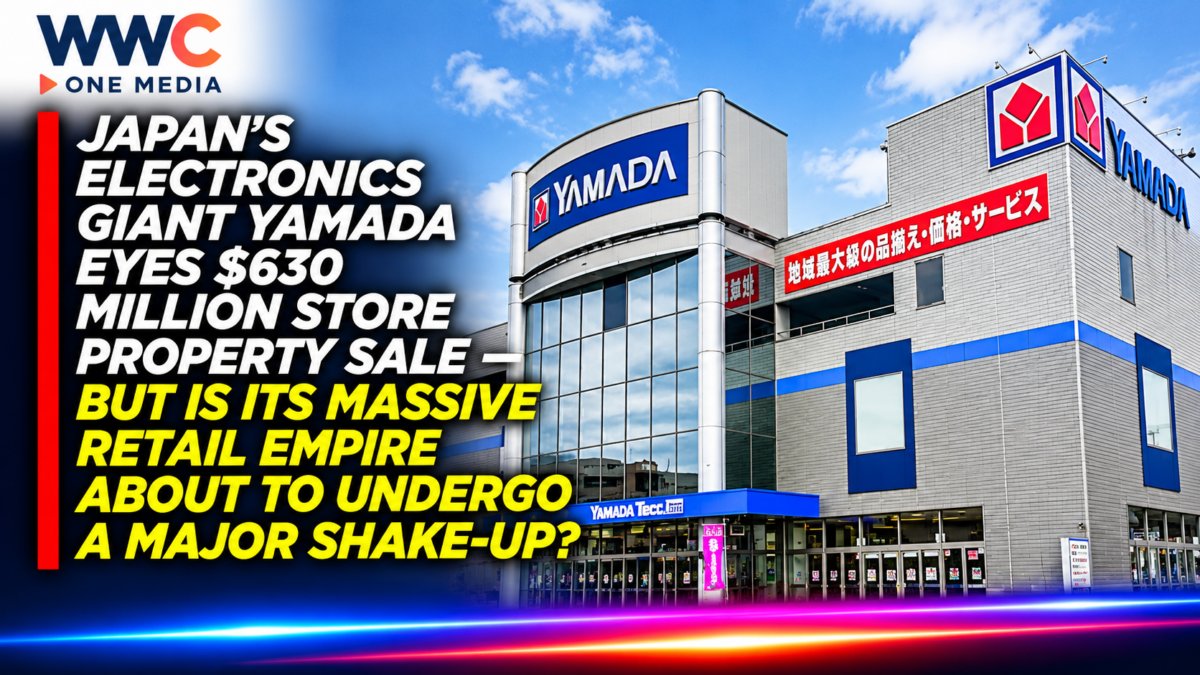
One of Japan’s largest electronics retailers is exploring a potential property transaction worth approximately $630 million, highlighting an increasingly aggressive effort to unlock value from its vast network of physical stores.
According to Bloomberg’s November 11 report, a leading Japanese electronics chain is considering a major store-property sale as the country’s retail industry undergoes significant consolidation and financial restructuring.
The development comes as Yamada Holdings, Japan’s largest electronics retailer, pursues a broader strategy of selling non-core assets, improving capital efficiency and preparing to combine operations with rival Edion.
Yamada’s latest financial disclosures show that the company has been working on an asset-disposal program involving approximately ¥130 billion in non-core assets, measured on a historical acquisition-cost basis.
The company operates approximately 927 stores and reported stronger first-half earnings earlier this month.
Revenue rose 10% to ¥880.25 billion, while net profit attributable to shareholders climbed almost 69% to ¥21.56 billion.
But the potential store-property sale raises a much bigger question.
Is Japan’s electronics retail industry discovering that the properties beneath its stores could become a powerful source of funding for expansion—or could selling valuable real estate expose retailers to higher rents and financial risks later?
Yamada Holdings Explores a Major Property Strategy
Yamada Holdings has been reviewing its asset portfolio as part of a multiyear plan to improve shareholder returns and operating efficiency.
Bloomberg reported on November 11 that a leading electronics retailer was considering a store-property disposal valued at approximately $630 million.
The transaction remains at a reported exploratory stage.
A definitive purchase agreement, buyer identity, completed sale and final transaction price have not been independently confirmed.
That distinction matters because corporate property transactions can change substantially during negotiations.
An initial valuation may differ from the final sale price.
The number of properties included may change.
Financing conditions can also affect whether a buyer proceeds.
Yamada’s official investor disclosures independently establish that the company is undertaking a broader non-core asset-disposal program, making real-estate monetization consistent with its publicly stated strategy.
However, the company’s disclosures do not establish every detail of the specific Bloomberg-reported transaction.
Yamada Plans to Dispose of Approximately ¥130 Billion in Assets
Yamada’s corporate strategy places increased emphasis on capital efficiency.
The company has identified approximately ¥130 billion in non-core business assets, measured at acquisition cost, as a priority for potential disposal.
These assets are primarily associated with its consumer-electronics operations.
Management intends to use proceeds from disposals for several purposes.
They include expanding the store network, supporting mergers and acquisitions, reducing interest-bearing debt and potentially returning capital to shareholders.
The goal is to increase the productivity of the company’s balance sheet.
Instead of retaining every property and other non-core asset indefinitely, Yamada wants to determine which holdings contribute most effectively to its future earnings.
But the amount identified for disposal should not be confused with guaranteed sale proceeds.
Historical acquisition costs can differ significantly from current market valuations.
Some assets may sell above book value.
Others could attract lower offers.
The final financial benefit will depend on actual transactions and how the company uses the proceeds.
Why Retailers Sell Properties They Still Need
A retailer may own valuable land and buildings but generate most of its operating income from selling merchandise and providing services.
That creates a potential opportunity.
Selling a property can convert a relatively illiquid asset into cash.
The retailer can then use that money to open stores, upgrade technology, repay debt or invest in other businesses.
Some transactions take the form of sale-and-leaseback arrangements.
Under such a structure, a company sells its property to an investor while agreeing to continue occupying the building as a tenant.
This allows the retailer to maintain operations at the same location while releasing capital previously tied up in real estate.
However, the structure creates new obligations.
The company may need to make rental payments for many years.
It could also lose the benefit of future appreciation in the property’s value.
A sale-and-leaseback transaction is therefore not automatically financially advantageous.
The result depends on the sale price, rental terms, financing costs and alternative uses of the cash.
Whether the specific $630 million transaction would involve a leaseback has not been independently confirmed.
Yamada Reports Stronger Earnings During Its Restructuring
The company’s latest financial results show improving operating momentum.
For the six months ended September 30, 2026, Yamada Holdings recorded approximately ¥880.25 billion in consolidated net sales, a 10% increase from the comparable period.
Operating profit increased 32.1% to ¥28.62 billion.
Net profit attributable to shareholders climbed approximately 68.7% to ¥21.56 billion.
The company attributed its performance to several factors.
These included stronger sales of air conditioners, improved retail operations, greater sales of private-label products and progress in its broader restructuring strategy.
Its electronics division generated approximately ¥700.77 billion in revenue.
The housing division contributed around ¥163.60 billion.
Yamada also operates businesses involving financial services and environmental activities.
The results indicate that the company is not relying exclusively on property disposals to support its financial performance.
Nevertheless, asset sales could provide additional resources for expansion and balance-sheet improvements.
Yamada Raises Its Full-Year Earnings Forecast
Following the stronger first-half performance, Yamada updated its outlook for the fiscal year ending March 2027.
Management now forecasts full-year net sales of approximately ¥1.78 trillion.
Operating profit is projected at ¥51.5 billion.
Net profit attributable to shareholders is expected to reach approximately ¥32.8 billion.
That represents an increase from the earlier profit forecast.
However, these are company forecasts rather than financial results already achieved.
The company must continue delivering strong sales during the second half of the fiscal year.
Consumer demand, competition and operating expenses could affect the final outcome.
Additional asset disposals may also influence reported earnings.
Investors should distinguish recurring retail profits from one-time gains generated by selling assets.
A large property sale can improve accounting profit in a particular period without necessarily increasing the underlying profitability of the retail business.
Yamada and Edion Plan a ¥2.5 Trillion Retail Giant
The potential property transaction comes amid one of Japan’s most significant retail restructuring initiatives.
In June, Yamada Holdings and rival electronics retailer Edion announced plans to integrate their operations.
The companies reported combined annual sales of approximately ¥2.5 trillion, based on their preceding financial results.
If implemented as planned, the combination would create a much larger business than either retailer currently operates independently.
According to Reuters and The Japan Times, the integration is intended to improve purchasing efficiency, expand private-label product development and strengthen competitiveness.
Yamada already holds a leading position in Japan’s electronics retail market.
Edion brings an extensive store network and significant presence in western Japan.
Combining their resources could create opportunities to reduce overlapping expenses and improve purchasing terms with suppliers.
However, the integration also involves financial, operational and regulatory challenges.
The final benefits will depend on how effectively the companies coordinate their businesses.
Could Property Sales Help Fund the Yamada–Edion Integration?
A major retail merger can require substantial investment.
Companies may need to modernize systems, coordinate distribution networks, refurbish stores and restructure operations.
Some locations may overlap geographically.
Management could also identify opportunities to combine warehouses, procurement arrangements and administrative functions.
Property disposals may provide financing flexibility during that process.
Selling non-core assets could reduce the need for additional borrowing.
It could also allow the company to redirect capital toward higher-return business activities.
But there is no verified evidence that the entire reported $630 million would be specifically allocated to the Edion integration.
The use of any proceeds would depend on the final transaction and management’s capital-allocation decisions.
For shareholders, the important question is whether asset disposals support lasting improvements in operating returns rather than merely producing temporary financial gains.
Japan’s Property Market Remains Attractive to Major Investors
Japan continues attracting interest from international real-estate investors.
Commercial properties in Tokyo and other major cities have benefited from strong demand for selected offices, logistics facilities, hospitality assets and mixed-use developments.
However, the investment environment is changing as Japanese interest rates rise.
Higher borrowing costs can make property acquisitions more expensive.
Investors may demand higher rental yields to compensate for the increased cost of capital.
In related coverage, WWC ONE MEDIA examined how PGIM Real Estate is becoming more selective about Japanese property acquisitions as rising bond yields change investment returns.
Yamada’s potential store-property sale would be assessed within this broader market environment.
Properties with strong tenants and dependable rental income may appeal to institutional buyers.
However, pricing also depends on location, lease terms, building condition and expected occupancy.
A store operated by a well-known retailer is not automatically a premium real-estate investment.
Global Investors Are Still Hunting for Major Tokyo Assets
Interest in Japanese property extends beyond domestic retailers.
Hongkong Land has been exploring commercial-property investments in Japan, including potential major transactions in Tokyo.
In related reporting, WWC ONE MEDIA examined Hongkong Land’s search for approximately $1 billion in Japanese real-estate opportunities and the difficulty of finding attractive acquisitions at suitable prices.
Those discussions are separate from Yamada’s reported property-sale plans.
They nevertheless demonstrate that international capital remains interested in Japanese commercial real estate.
For potential buyers of retail properties, Yamada’s portfolio could provide exposure to established consumer locations.
But the appeal would depend on the actual assets offered.
The value of a major urban retail property may differ considerably from that of a suburban electronics store.
Without a confirmed property list, it would be premature to estimate the rental yields or future redevelopment value of the reported transaction.
Physical Stores Still Matter in Japan’s Electronics Market
Japan’s electronics retailers face intense competition from online shopping platforms.
Consumers can compare product specifications, prices and delivery options without visiting a store.
That has increased pressure on traditional retailers to differentiate their services.
Yamada has responded by expanding its private-label offerings, developing its digital channels and modernizing larger stores.
The company operates stores under concepts including LIFE SELECT, which combines electronics with home-related merchandise and services.
Physical locations can still offer advantages.
Customers may prefer to examine expensive appliances before making a purchase.
Some products require installation, maintenance or after-sales assistance.
Retailers can also use stores as part of their distribution and customer-service networks.
The challenge is ensuring that each location generates sufficient commercial value to justify its operating costs.
Selling selected properties does not necessarily mean abandoning physical retail.
It may instead represent an effort to separate the economics of property ownership from the economics of store operations.
Japan’s Retail Industry Is Reinventing Itself
The electronics market is not the only segment of Japanese retail undergoing change.
Convenience-store operators are also experimenting with technology and new product-development strategies.
Lawson and FamilyMart have been testing artificial intelligence to generate product concepts and improve operations.
In related reporting, WWC ONE MEDIA examined how Japanese convenience-store chains are using AI to develop unusual new products while seeking to improve retail productivity.
Convenience stores operate under a different business model from consumer-electronics retailers.
But both face pressure to improve productivity and adapt to changing shopper behavior.
For Yamada, that means investing in digital commerce, product development and more productive store formats.
Real-estate restructuring could help fund those investments.
However, successful retail transformation ultimately depends on consumer demand and operating execution, not property disposals alone.
Philippine Retail Property Offers a Regional Comparison
Retailers and property owners across Asia are also reconsidering how to use their commercial assets.
In the Philippines, SM Prime Holdings has continued investing in shopping malls even as its residential-property business faces weaker demand.
In related reporting, WWC ONE MEDIA examined SM Prime’s ₱181.6-billion unsold housing inventory and its plan to support growth through malls, hotels and convention centers.
The business models are different.
SM Prime is primarily a property developer and operator, while Yamada is a retail business with substantial property-related assets.
Nevertheless, both companies must decide where additional capital can generate the greatest returns.
A property that delivers stable rental income may be more valuable to one company than to another.
The answer depends on the owner’s business strategy, financing conditions and long-term investment priorities.
Ayala Land’s Store Expansion Highlights Another Retail Strategy
Ayala Land is also increasing its exposure to retail activity.
The Philippine property company has announced plans involving more than 250 store openings across its shopping-center portfolio during the fourth quarter of 2026.
In related coverage, WWC ONE MEDIA examined Ayala Land’s holiday retail expansion and the arrival of international brands across its malls.
Ayala Land’s strategy emphasizes attracting tenants and increasing activity within properties it operates.
Yamada’s asset-disposal program is different because it involves reconsidering which assets the retailer should continue owning.
The comparison illustrates how property ownership and retail operations can support different business models.
Some companies prefer to own properties and collect rent.
Others may choose to focus more capital on selling products and serving customers.
Neither approach is universally superior.
Financial success depends on asset prices, occupancy, rental obligations and the productivity of the underlying business.
Japan’s Rising Interest Rates Could Influence the Deal
Japan’s changing monetary environment is another factor that could affect property transactions.
For many years, unusually low interest rates made it relatively inexpensive to finance Japanese real-estate acquisitions.
As borrowing costs increase, investors face a different calculation.
Higher financing expenses can reduce the amount buyers are willing to pay.
Meanwhile, property owners may be motivated to dispose of assets to reduce debt or improve their capital efficiency.
Yamada’s own financial disclosures identify increasing funding costs as a factor affecting its financial-services operations.
The broader economic environment therefore reinforces the importance of careful capital allocation.
But a potential sale valued at approximately $630 million cannot be judged solely by its headline price.
Investors would need to know the properties’ operating income, valuation basis, lease commitments and transaction costs.
Without that information, claims that the proposed sale is automatically beneficial—or harmful—would be speculative.
Five Questions That Could Determine Yamada’s Next Move
1. Will the reported $630 million transaction proceed?
Bloomberg describes a potential sale, but a completed agreement has not been independently verified.
2. Which stores or properties would be included?
The financial implications depend on the location and quality of the assets.
3. Would Yamada lease the properties after selling them?
A sale-and-leaseback arrangement could release capital while creating long-term rental obligations.
4. How would the proceeds be used?
Management has identified growth investment, debt reduction, acquisitions and shareholder returns as priorities for its broader asset-disposal strategy.
5. Can the Edion integration create lasting value?
The combination’s success will depend on operating efficiency, market competition and effective coordination.
The Bottom Line: Yamada’s Next Big Business May Be Unlocking Its Own Assets
Japan’s electronics retail sector is entering a period of substantial change.
Yamada Holdings is pursuing stronger capital efficiency, selling selected non-core assets and preparing for a major integration with Edion.
Its latest earnings show that restructuring efforts are already coinciding with improved financial performance.
First-half revenue rose 10% to ¥880.25 billion.
Net profit attributable to shareholders increased almost 69% to ¥21.56 billion.
The company also operates a nationwide network of approximately 927 stores.
Bloomberg’s report of a potential $630 million store-property sale highlights the financial value that may be tied up in that network.
But the transaction remains unconfirmed.
And even if completed, its long-term benefits will depend on pricing, lease arrangements and how management uses the proceeds.
For investors, the key question is whether Yamada can generate greater returns by owning fewer non-core assets while building a stronger retail business.
Japan’s leading electronics retailer is reportedly exploring a $630 million store-property sale while pursuing a historic combination with rival Edion. But as Yamada seeks to release cash from its vast property portfolio and redirect capital toward growth, could the strategy transform the company into a more profitable retail giant—or will selling valuable assets create new costs that undermine the benefits?