MANILA, PHILIPPINES — November 11, 2026 | WWC ONE MEDIA | Philippine Politics, Ferdinand Marcos Jr., Public Opinion and Government Accountability
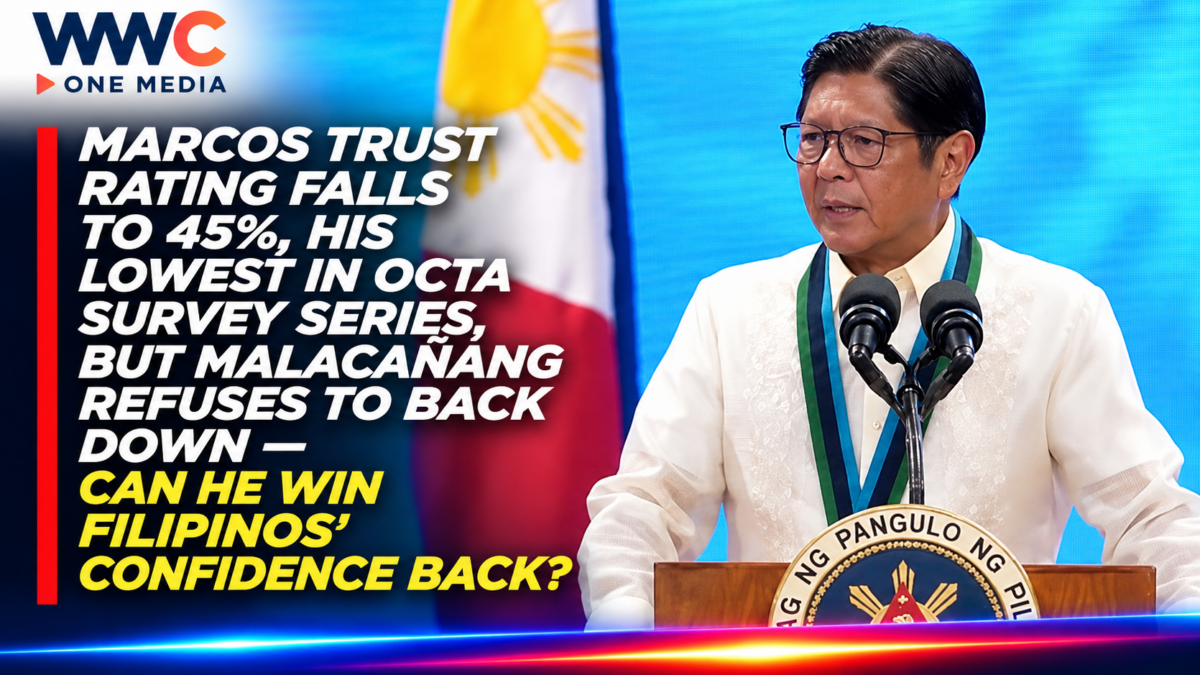
President Ferdinand “Bongbong” Marcos Jr. is facing another political challenge after his trust and performance ratings fell to their lowest levels in OCTA Research’s survey series, raising questions about public confidence in his administration.
But Malacañang insists the President will not be distracted by the unfavorable numbers.
According to the latest OCTA Research Tugon ng Masa survey, Marcos’ trust rating declined from 49% in July to 45%, while satisfaction with his performance dropped from 47% to 44%.
Public distrust also increased from 32% to 36%, while dissatisfaction with his performance climbed from 33% to 36%.
The results mark a second consecutive quarterly decline in both indicators after a recovery earlier in 2026.
Despite the findings, Palace Press Officer and Presidential Communications Office Undersecretary Claire Castro said Marcos remains focused on delivering government programs and improving Filipinos’ lives.
Castro argued that surveys do not necessarily capture the full impact of government assistance, including support for farmers, hospital patients and families participating in anti-hunger programs.
The Palace maintains that the President will continue working regardless of changes in his public ratings.
But with trust falling below 50% and dissatisfaction increasing, can Marcos convince more Filipinos that his administration’s policies are delivering meaningful improvements—or will declining public confidence become a bigger challenge as his presidency enters its final years?
Marcos Trust Rating Falls Four Points to 45%
OCTA Research’s third-quarter 2026 survey found that 45% of Filipino adults expressed trust in President Marcos.
That represents a four-percentage-point decline from the 49% recorded in July.
Distrust rose to 36%, compared with 32% in the preceding survey.
The difference between trust and distrust narrowed from 17 percentage points in July to nine points in the latest poll.
The results suggest a weakening advantage for the President among respondents expressing an opinion about his trustworthiness.
However, the remaining respondents were undecided.
It would therefore be inaccurate to say that 55% of Filipinos distrust Marcos simply because 45% expressed trust.
OCTA describes the September result as the President’s lowest national trust rating in its survey series beginning in 2022.
Performance Satisfaction Declines to 44%
The President’s performance rating also weakened.
Only 44% of respondents said they were satisfied with his performance, down from 47% in July.
The share expressing dissatisfaction increased from 33% to 36%.
This leaves an eight-percentage-point positive margin between satisfied and dissatisfied respondents.
But it also means fewer than half of those interviewed expressed satisfaction.
The latest result follows a more substantial decline earlier in the year.
In March, satisfaction stood at 55%.
It fell to 47% in July and then to 44% in the latest round.
The trend points to mounting challenges in sustaining public confidence.
Nevertheless, a survey measures opinion during a particular period. It does not establish the effectiveness or failure of every government program.
Malacañang Says Marcos Will Continue Working Despite Poll Results
In response to the latest OCTA findings, Palace Press Officer Claire Castro said survey results should serve as reminders rather than complete assessments of the President’s work.
She emphasized that government programs continue reaching Filipinos who need assistance.
Among the initiatives she cited were support for agricultural communities, the Zero Balance Billing policy for eligible hospital patients and the Walang Gutom Program.
Castro suggested that some beneficiaries of these initiatives might not have been included among the respondents.
She maintained that Marcos would continue performing his duties whatever the numbers showed.
Her remarks reinforce a position Malacañang has taken during previous polling cycles: the administration says public-service delivery remains its priority, whether approval ratings rise or fall.
But the political challenge remains.
Government programs can produce measurable benefits while some members of the public remain dissatisfied with overall leadership.
Those two observations are not necessarily contradictory.
Why OCTA’s Survey Methodology Matters
The latest Tugon ng Masa survey was conducted from September 28 to October 4, 2026.
Researchers interviewed 1,200 Filipino adults nationwide through face-to-face surveys.
OCTA reported a national margin of error of ±3 percentage points at a 95% confidence level.
The methodology is important because the results are based on a sample rather than interviews with every adult Filipino.
A properly designed probability survey seeks to represent the broader population through sampling and statistical procedures.
The Palace’s observation that certain program beneficiaries may not have been interviewed is therefore not, by itself, evidence that the results are invalid.
A meaningful challenge to the survey’s representativeness would require examination of its sampling, weighting, response patterns and other methodological details.
The findings should also be interpreted carefully.
The four-point decline in trust is larger than the reported single-survey margin of error, but assessing the statistical significance of a change between two independent surveys requires considering uncertainty in both measurements.
OCTA’s reported series nevertheless shows a sustained downward movement since March.
Luzon Remains Marcos’ Strongest Major Regional Base
The national ratings conceal significant geographical differences.
OCTA found that Balance Luzon, which excludes Metro Manila, remained the only major geographical area where Marcos secured majority ratings on both indicators.
His trust rating there stood at 54%, while performance satisfaction reached 55%.
However, trust in Balance Luzon also fell sharply from the previous survey.
OCTA recorded a nine-percentage-point decline in that region.
This suggests that even areas where the President retains comparatively stronger support are experiencing changes in public sentiment.
The survey also found an eight-point decline in trust among respondents classified as Class ABC.
At the same time, not every demographic moved in the same direction.
The lowest-income Class E recorded higher trust and performance ratings than the national average.
These differences underline why a single national figure cannot fully describe the public’s views.
Mindanao Remains Marcos’ Weakest Region
The regional contrast is particularly striking in Mindanao.
OCTA recorded only 28% trust in Marcos among Mindanao respondents.
Satisfaction with his performance stood at 27%.
Those were his lowest ratings among the major geographical areas.
The survey also found a substantial increase in the proportion expressing distrust or dissatisfaction in the region.
However, Mindanao’s regional ratings should be interpreted with their applicable sampling uncertainty, which is wider than the national margin of error.
The results show a significant geographical divide in political opinion.
They do not establish why every individual respondent gave a particular answer.
Public attitudes may be affected by economic conditions, political loyalties, perceptions of public services and other factors that the poll cannot isolate individually.
Sara Duterte’s Ratings Hold Steady
OCTA also measured the ratings of Vice President Sara Duterte.
Her national trust rating stood at 48%, up one percentage point from July.
Satisfaction with her performance reached 46%, also up one point.
OCTA said those small changes were within the margin of error and did not establish a meaningful recovery from her earlier declines.
The Vice President’s strongest ratings remained in Mindanao, where she received 94% trust and 88% performance satisfaction.
In Balance Luzon, her trust and satisfaction ratings were both 25%.
These findings contrast with Marcos’ stronger results in that region.
Nationally, Duterte’s ratings were slightly higher than the President’s, but the three-point difference in trust and two-point difference in satisfaction are within the survey’s margin of error.
It would therefore be misleading to claim that the survey establishes an unequivocal national lead for either official.
Other Pollsters Have Also Recorded Public Dissatisfaction
OCTA is not the only polling organization measuring political attitudes.
A separate Pulse Asia survey conducted September 17–24, 2026 found that 30% of respondents approved of Marcos’ performance, while 49% disapproved.
The same Pulse Asia survey placed his trust rating at 29%, with 48% expressing distrust.
Those results differ substantially from OCTA’s figures.
But the numbers should not be combined or treated as if they came from the same survey.
Pulse Asia interviewed 2,400 adults and reported a national margin of error of ±2 percentage points.
Its questions, measurement methods and fieldwork dates differed from OCTA’s.
Different research organizations can generate different results because of methodology, wording, sampling and other considerations.
The proper comparison is within each pollster’s consistent series.
Taken together, the results demonstrate why public approval remains an important political issue, but they do not justify claiming that one survey automatically invalidates another.
The Cost of Living Remains an Important Public Concern
The administration is operating in a difficult economic environment.
Households continue to confront concerns over food prices, transportation costs, employment and the affordability of essential services.
These issues can influence how voters evaluate political leaders.
In related reporting, WWC ONE MEDIA examined a UK research firm’s sharply reduced Philippine growth forecast and the pressures facing the domestic economy.
That economic assessment is separate from the OCTA survey.
The poll does not prove that a particular inflation rate or economic forecast caused the President’s ratings to decline.
Nevertheless, economic performance is an important component of public debate over the administration’s effectiveness.
For many families, the political question is whether government policies translate into improved purchasing power and financial security.
Government Assistance Is Part of the Palace’s Defense
Castro’s response emphasized the administration’s social-protection and public-assistance initiatives.
Programs targeting hunger, health-care costs and agricultural difficulties are designed to support vulnerable households.
Other government institutions are providing financial assistance to people affected by emergencies.
That loan initiative is separate from the specific anti-hunger and hospital programs cited by Castro.
It provides context for the types of government assistance available to affected communities.
However, funds allocated for assistance are not necessarily funds already distributed.
And the existence of a program does not establish how its beneficiaries assess the President.
Evaluating the administration’s claims requires evidence of actual service delivery, coverage and outcomes.
Governance and Public Trust Go Beyond Financial Assistance
Government performance is evaluated through more than economic assistance.
Transparency, institutional accountability and communication also affect how citizens perceive leadership.
Marcos has repeatedly emphasized the importance of protecting press freedom and maintaining public confidence in institutions.
In related coverage, WWC ONE MEDIA examined the President’s commitment to defending press freedom and the questions surrounding implementation of that pledge.
The article concerns a separate policy issue.
But it illustrates how public confidence can depend on whether government commitments are matched by actions.
Surveys cannot by themselves determine whether a particular institution has performed effectively.
They can, however, provide political leaders with information about how their performance is being perceived.
A constructive response involves examining both the perceptions and the underlying outcomes.
Disaster Response Also Shapes Public Expectations
Government responses to natural disasters and public emergencies remain another important responsibility.
The Philippines regularly experiences typhoons, floods and other hazards that disrupt lives and livelihoods.
Citizens may evaluate leadership through the speed and effectiveness of relief, recovery and public communication.
In related coverage, WWC ONE MEDIA reported on the deployment of ₱6.1 million in relief assistance to communities affected by emergencies in the Cordillera region.
The report concerns a separate response effort and is not evidence of how respondents answered OCTA’s survey.
It nevertheless provides a relevant example of the public services through which administrations can be judged.
For the government, the challenge is not simply announcing allocations.
It is ensuring that assistance reaches intended beneficiaries efficiently, fairly and transparently.
Can Marcos Recover His Public Ratings?
The President has experienced previous improvements in public support.
In March 2026, OCTA recorded a recovery in his trust and performance ratings to 54% and 55%, respectively.
That followed weaker readings in December 2025.
The latest decline therefore does not demonstrate that a future recovery is impossible.
But neither does it guarantee that public confidence will rebound.
A sustained recovery could depend on the public’s perception of economic conditions, government services, accountability and national leadership.
The administration may also seek to communicate its accomplishments more effectively.
Yet communication alone cannot substitute for measurable improvements in public outcomes.
For the President, the challenge is translating government activity into results that Filipinos recognize and value.
Five Questions After the Latest OCTA Poll
1. Will the President’s ratings recover?
The next comparable survey rounds will help determine whether the decline continues or reverses.
2. Can government programs improve public satisfaction?
The impact depends on actual delivery, eligibility and outcomes.
3. Why is regional opinion so divided?
OCTA’s results show sharply different support patterns, particularly between Balance Luzon and Mindanao.
4. How should the Palace respond to criticism?
The administration can continue public-service delivery while examining the concerns reflected in the survey.
5. Will economic conditions influence future ratings?
Household purchasing power, employment and other issues remain potential influences, although the poll does not establish individual causes.
The Bottom Line: Marcos Says He Will Keep Working, but Public Confidence Is Weakening
The latest OCTA Research survey presents a difficult political picture for President Ferdinand Marcos Jr.
His trust rating has fallen to 45%.
His performance satisfaction rating has declined to 44%.
Both are the lowest national readings in OCTA’s current series.
Public distrust and dissatisfaction have also increased.
Yet Malacañang maintains that the President remains committed to government service and that the full impact of public programs cannot be captured by survey numbers alone.
Both the results and the government’s response deserve scrutiny.
A representative survey is a meaningful measurement of public sentiment, but it is not a complete audit of government performance.
Likewise, citing government programs does not automatically explain away unfavorable polling results.
The longer-term test will be whether improvements in economic conditions, public services and governance are reflected in greater public confidence.
Marcos says falling survey numbers will not stop him from working for Filipinos. But with trust at 45%, performance satisfaction at 44% and regional support increasingly divided, can his administration turn its remaining years into a political recovery—or will the next survey reveal an even deeper crisis of public confidence?