MANILA, PHILIPPINES — November 11, 2026 | WWC ONE MEDIA | Philippine Politics, National Budget, DPWH and Government Accountability
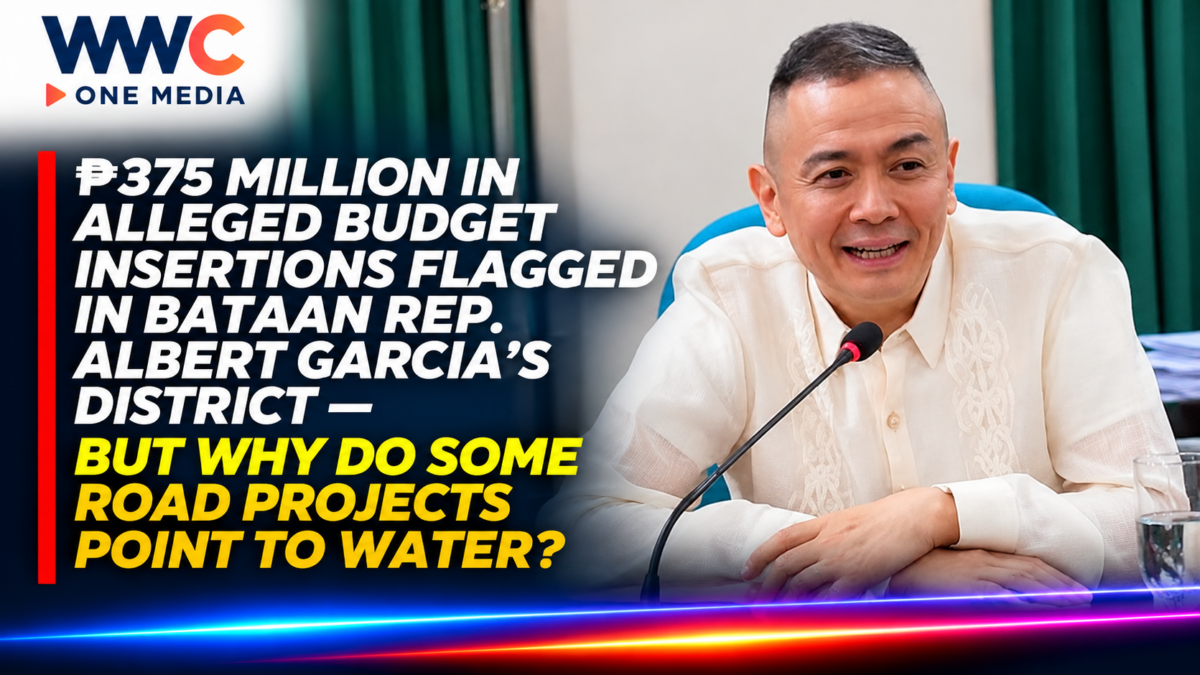
A new controversy involving the Philippines’ proposed ₱7.2-trillion national budget has placed Bataan Second District Representative Albert “Abet” Garcia under scrutiny after a budget watchdog questioned ₱375 million in alleged additions covering 22 Department of Public Works and Highways (DPWH) projects in his congressional district.
The People’s Budget Coalition wants Garcia, a senior vice chairperson of the House Committee on Appropriations, to explain how the questioned projects entered the House-approved version of the 2027 national budget.
According to an investigation reported by Bilyonaryo News Channel, Garcia’s district received approximately ₱684 million in proposed DPWH allocations, including the disputed ₱375 million.
But the controversy extends beyond the amount involved.
The watchdog also identified infrastructure entries, including farm-to-market roads, whose listed geographical coordinates allegedly pointed to bodies of water rather than the expected project locations.
The findings have intensified questions about the accuracy of congressional budget documents and whether projects added during House deliberations were supported by the appropriate agency records.
Garcia has rejected claims that the budget amendments were improper.
He has argued that the changes were based on government agency validation and the needs of local communities, while acknowledging that some location discrepancies could result from typographical errors.
The watchdog disputes that explanation and is demanding greater transparency.
With hundreds of millions of pesos in proposed infrastructure spending now under scrutiny, can Congress produce the records proving that every questioned project is legitimate—or will a closer examination uncover more problems in the country’s 2027 budget?
Watchdog Questions ₱375 Million in DPWH Projects
The People’s Budget Coalition raised concerns over 22 infrastructure projects worth approximately ₱375 million in Bataan’s Second District.
According to Bilyonaryo News Channel, the watchdog identified the amount by examining changes to the proposed 2027 national budget.
The district’s total proposed DPWH allocation was reported at around ₱684 million.
The contested ₱375 million therefore represents approximately 55% of the reported district allocation.
That percentage illustrates the scale of the disputed additions.
However, the figures concern proposed budget allocations, not confirmed amounts already disbursed or spent.
The watchdog has not established through a completed criminal or administrative proceeding that the entire ₱375 million was fraudulently inserted.
The immediate question is whether the added projects were properly documented, technically evaluated and supported by valid government agency requests.
Why Are Some Road Projects Listed in Bodies of Water?
One of the investigation’s most striking findings concerns geographical coordinates.
The watchdog flagged infrastructure entries, including farm-to-market roads, whose coordinates reportedly pointed to bodies of water.
Infrastructure project documents commonly include location information that helps officials identify where public works are supposed to be constructed.
When coordinates appear inconsistent with a project’s description, several explanations are possible.
The information could contain a typographical mistake.
The coordinates could refer to an incorrect reference point.
Or the entry could reflect a more serious problem with project documentation.
The discrepancy alone does not prove that a project is fictitious.
But it creates a legitimate reason for further verification.
The relevant agencies should be able to supply accurate project locations, descriptions, technical plans and supporting documents.
If coordinates are wrong, correcting them before funds are implemented would help prevent confusion, delays and potential misuse.
Albert Garcia Says the Discrepancies May Be Clerical Errors
Garcia has previously suggested that the unusual coordinates could be explained by errors in extensive budget documentation.
During an October 26 briefing, he acknowledged the possibility of typographical mistakes and emphasized the need for validation.
The House has since provided a more specific example.
In a November 9 official statement, House leaders said a farm-to-market road initially flagged because its coordinates pointed to the sea had been checked with the Department of Agriculture.
According to Garcia, the agency confirmed that the particular entry involved a typographical error.
That explanation is relevant.
However, confirmation of an error in one project entry does not necessarily resolve every discrepancy involving the 22 questioned DPWH projects.
The responsible agencies would need to identify which records were affected, explain the corrections and provide the relevant supporting documents.
People’s Budget Coalition Rejects the House’s Explanation
The People’s Budget Coalition has expressed skepticism about the clerical-error explanation.
Its national coordinator, Mary Abigail Modales, accused House officials of obscuring the true nature of the disputed amendments.
The group also raised concerns about projects allegedly added without supporting records corresponding to the proposals originally submitted by government agencies.
Coalition representative Zy-Za Nadine Suzara criticized what she described as rushed budget preparation.
The watchdog argues that documentation problems become especially serious when billions of pesos in public infrastructure projects are under consideration.
Its allegations have not been established as judicial findings.
But the group maintains that lawmakers should disclose the complete record of changes between the executive’s National Expenditure Program and the House-approved General Appropriations Bill.
In related reporting, WWC ONE MEDIA examined the People’s Budget Coalition’s call for a complete audit trail of every major change to the proposed ₱7.2-trillion 2027 national budget.
The central issue is traceability.
The public should be able to determine when a project entered the spending plan, which records supported it and whether it passed the required review.
Garcia Denies Unauthorized Budget Insertions
Garcia has defended the House’s broader budget process.
During a November 9 press briefing, he rejected claims that the House-approved spending proposal contained improper pork-barrel allocations.
He argued that the changes were made during the legislative budget process and were validated by the agencies concerned.
Garcia also maintained that representatives were communicating the needs of their constituents rather than pursuing purely political allocations.
The House’s position is that legislative amendments should not automatically be characterized as unlawful insertions.
That distinction is important.
Congress has constitutional authority to deliberate on and amend the national budget, subject to applicable limits and legal requirements.
An amendment is not inherently illegal simply because lawmakers propose it.
However, the legality of an amendment does not eliminate the need for supporting documentation, accurate project information and compliance with budget procedures.
The question in this case is whether the questioned allocations satisfy those requirements.
House Leaders Say Amendments Total ₱115 Billion, Not ₱1 Trillion
The dispute involving Garcia’s district forms part of a much larger disagreement over the proposed 2027 budget.
The People’s Budget Coalition has flagged more than ₱1 trillion in proposed allocations that it believes require closer scrutiny or pose risks involving political patronage.
House leaders reject the characterization.
On November 9, they said changes made through the Budget Amendments Review Subcommittee totaled approximately ₱115 billion.
Garcia and his colleagues argued that many adjustments involved technical corrections, agency requests and the redistribution of funds from slow-moving programs to priorities considered ready for implementation.
The competing figures do not necessarily measure identical categories of spending.
The watchdog’s broader total includes several types of questioned allocations, while the House cites a narrower total for changes processed through a particular review mechanism.
In related coverage, WWC ONE MEDIA examined how Filipino citizen watchdogs identified approximately ₱172 billion in questioned public works projects and demanded greater disclosure of congressional amendments.
The totals should not be added together because they may overlap or measure different classifications.
A reliable comparison requires project-by-project reconciliation.
Previous Infrastructure Allegations Show Why Documentation Matters
The Philippines has faced repeated controversies involving the inclusion of infrastructure projects in national budgets.
Separate proceedings involving former House Speaker Martin Romualdez have drawn attention to questions about project documentation and technical review.
That is a separate controversy involving different projects and a different budget year.
It does not establish wrongdoing by Garcia.
But both stories highlight the importance of knowing whether public works projects were properly assessed before receiving legislative funding.
Documents showing technical feasibility, location, scope and cost are crucial to public accountability.
Without accessible records, citizens cannot easily distinguish legitimate amendments from questionable allocations.
What Happens to the ₱375 Million Now?
The House-approved 2027 budget is not yet the final national budget.
The spending proposal must proceed through further legislative review, including Senate deliberations and the reconciliation of differences between the two chambers.
That means questioned project entries may still be reviewed, amended, reduced or removed before the budget becomes law.
Even if an allocation survives the legislative process, appropriation does not automatically mean that cash has been released or spent.
Government agencies must follow applicable rules governing fund releases, procurement and project implementation.
For the disputed Bataan projects, an effective review would examine the original agency proposals, House amendments and supporting technical documents.
It would also determine whether the listed coordinates accurately identify the intended project locations.
The goal should be to establish a verifiable record rather than assume either that every project is illegitimate or that every discrepancy is harmless.
The Government’s Spending Portal Could Help Track Public Funds
Budget transparency does not end with the passage of an appropriations law.
Citizens also need information showing how authorized funds are released and used.
President Ferdinand Marcos Jr. has institutionalized the Centralized Open Monitoring Platform for Appropriations and Spending Statistics, or COMPASS.
The platform is intended to consolidate information on appropriations, allotments, obligations and disbursements.
In related reporting, WWC ONE MEDIA examined how Executive Order No. 126 established COMPASS as a government-wide platform for monitoring public spending.
Such systems can support accountability when they contain complete, accurate and regularly updated information.
However, a spending portal cannot automatically resolve disputes over the origin of budget amendments.
It must be complemented by a clear legislative record showing when and why particular allocations were introduced.
The public needs to see both sides of the process: how a project was approved and what eventually happened to the money.
Why the Controversy Matters to Bataan Residents
For communities in Bataan’s Second District, the issue goes beyond national political arguments.
Legitimate infrastructure projects can improve transportation, support agriculture and connect communities to markets and public services.
Farm-to-market roads can reduce transportation difficulties for producers.
Other road improvements may strengthen access to schools, businesses and health facilities.
Residents therefore have an interest in ensuring that worthwhile projects are not automatically discarded because of political controversy.
But they also have a right to expect that public funds are supported by accurate documents and realistic plans.
A project with inconsistent location information deserves correction and proper review.
The central test is whether the proposed infrastructure addresses an identifiable community need and can be implemented lawfully and effectively.
Five Questions Congress Must Answer
1. What exactly are the 22 questioned DPWH projects?
The complete list should identify each project’s description, location and proposed cost.
2. Why did the district allocation reportedly increase by ₱375 million?
Records should show when and how the allocations entered the House version.
3. Which projects contain incorrect coordinates?
Each discrepancy should be checked against the responsible agency’s technical documents.
4. Who validated the proposed allocations?
The reviewing agencies and the documentation supporting their assessments should be identifiable.
5. Will the Senate retain or revise the projects?
The final outcome will depend on continuing legislative scrutiny and the reconciliation of the budget versions.
The Bottom Line: The ₱375-Million Dispute Is a Test of Budget Transparency
The People’s Budget Coalition’s allegations concerning 22 DPWH projects in Bataan’s Second District have placed Representative Albert Garcia at the center of a wider debate over the credibility of the proposed 2027 national budget.
The watchdog says approximately ₱375 million in questioned projects was added to a district allocation totaling around ₱684 million.
It also points to unusual project coordinates and alleged gaps in supporting documentation.
Garcia denies that the House’s amendments were improper and maintains that the allocations were based on agency validation and local needs.
House officials have cited at least one coordinate discrepancy that they say was confirmed as a typographical error.
The available evidence does not establish that Garcia personally inserted the projects, received funds or committed a crime.
But it does establish a public dispute that merits documentary clarification.
The next step should be a transparent comparison of the original budget proposals, House amendments and relevant agency records.
A budget watchdog has raised questions about ₱375 million in proposed infrastructure projects in Albert Garcia’s Bataan district, including road entries whose coordinates allegedly point to water. But with the lawmaker defending the amendments as legitimate and Congress preparing for further budget negotiations, will the official documents settle the controversy—or uncover more discrepancies in the nation’s ₱7.2-trillion spending plan?