BUENOS AIRES, ARGENTINA — November 11, 2026 | WWC ONE MEDIA | World News, Religion & Society
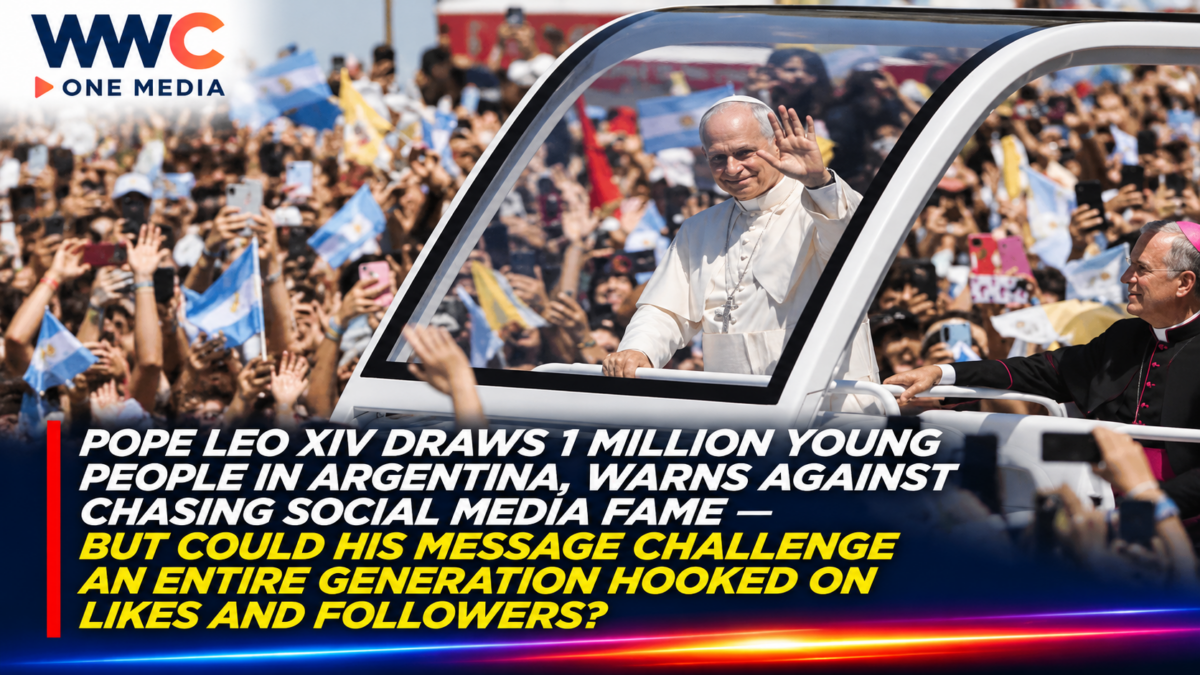
An estimated one million young people gathered in Argentina’s capital to see Pope Leo XIV, but the Catholic leader delivered a message that went far beyond a historic religious celebration: stop allowing money, physical appearance and social media popularity to determine your worth.
During a massive nighttime prayer vigil in Buenos Aires on Tuesday, November 10, the pontiff warned young people against worshipping what he described as the modern-day idols of society, including success at any cost, wealth, superficial beauty and the relentless pursuit of popularity.
He also confronted a problem familiar to millions of young people worldwide: the pressure to gain approval on social media, even when it means lying, betraying others or humiliating someone online.
The gathering at the Monumento de los Españoles in Buenos Aires attracted approximately one million people, according to the Vatican and international news reports.
Crowds stretched for miles along Avenida del Libertador as the Pope travelled through the area in his open-air popemobile. Thousands raised their smartphones, waved flags and chanted as he greeted the enormous gathering.
But amid the excitement, Leo delivered a serious challenge to a generation increasingly exposed to digital comparison, online competition and the pressure to appear successful.
“Do not bow down before anything that cannot give you life,” the Pope urged.
His message was particularly striking because it came during an event where thousands of young people were using their phones to record and share the experience.
The pontiff was not condemning technology itself. Rather, he questioned the growing influence of popularity, appearance and public approval over personal identity and human relationships.
And with an estimated one million people listening, his warning raises a much bigger question: Can a message about finding value beyond online attention resonate with a generation whose everyday lives are increasingly shaped by likes, followers and digital validation?
Pope Leo Warns Young People Against the Modern-Day Idols of Social Media
The Pope’s November 10 address centered on the dangers of allowing temporary rewards and superficial achievements to become the most important goals in life.
He identified several modern-day idols: success at any cost, money, obsession with physical appearance, popularity and the uncontrolled pursuit of pleasure.
But one of his most direct warnings concerned the behavior people sometimes display online.
Leo cautioned that the desire for other people’s approval can push individuals into lying, betraying others or humiliating someone through social media.
His remarks addressed a familiar problem in digital culture.
Social media platforms allow people to share achievements, experiences and personal milestones with audiences around the world. However, they can also create pressure to constantly demonstrate popularity, attractiveness, wealth and success.
For some users, the number of followers, likes and views becomes a measure of personal achievement.
The Pope challenged that mindset.
His message suggested that the pursuit of recognition becomes destructive when it damages personal dignity, relationships and the freedom to make responsible decisions.
He also warned against pornography and addictive substances, describing them as forms of pleasure that can eventually enslave individuals.
The central message was not that young people should abandon modern technology or avoid enjoying life.
Instead, Leo encouraged them to recognize the difference between using technology and allowing the pursuit of approval to control their decisions.
One Million Young People Fill Buenos Aires for Historic Papal Vigil
The gathering took place at the Monumento de los Españoles in Palermo, Buenos Aires, on Tuesday evening.
Approximately one million young people attended the prayer vigil, making it one of the largest gatherings of Pope Leo’s 12-day South American tour.
The crowd extended along Avenida del Libertador, with many pilgrims arriving hours before the Pope’s appearance.
When Leo travelled through the gathering in his popemobile, people waved Vatican flags, raised their phones and chanted enthusiastically.
Security personnel also brought babies forward for the pontiff to bless.
The atmosphere combined religious devotion with the excitement of a major international public event.
The scale of the gathering was particularly significant because the Catholic Church has been facing increasing competition from rapidly growing evangelical denominations across Latin America.
Argentina remains a country with deep Catholic traditions, but religious affiliation and participation have changed over recent decades.
Leo’s visit was therefore an opportunity to reconnect with younger generations and encourage them to remain engaged with the Church.
The Pope’s predecessor, Francis, was born in Buenos Aires but never returned to Argentina after becoming pontiff.
Leo’s visit marks the first papal journey to Catholic-majority Argentina since 1987.
The Pope Also Celebrated Mass Before 650,000 People in Córdoba
The Buenos Aires vigil was not the only enormous gathering during Leo’s third day in Argentina.
Earlier on Tuesday, November 10, approximately 650,000 people attended an outdoor Mass in Córdoba, Argentina’s second-largest city.
The event took place at the grounds of the Military Aviation School, where pilgrims gathered to participate in the celebration.
According to Vatican News and international reporting, the Pope emphasized holiness, perseverance and the importance of remaining connected to Christ.
He encouraged the faithful to follow the examples of Argentina’s saints and continue sharing their faith with others.
The pontiff later returned to Buenos Aires to lead the nighttime youth vigil.
The two events demonstrated the extraordinary logistical scale of his visit, which required him to travel hundreds of kilometres between major gatherings in a single day.
The numbers also highlight the level of public attention surrounding his first visit to Argentina as Pope.
Earlier Buenos Aires Mass Drew 2.5 Million People
The latest youth gathering followed an even larger public celebration one day earlier.
On Monday, November 9, approximately 2.5 million people attended an outdoor Mass along Avenida del Libertador in Buenos Aires, according to city officials cited by ABC News and Reuters.
That event became the largest gathering of Leo’s 18-month papacy at the time.
Pilgrims travelled from different parts of Argentina, with some reportedly covering more than 1,000 kilometres to participate.
Many arrived early and remained overnight to secure places near the route.
The three major gatherings demonstrate the extraordinary public interest surrounding the pontiff’s South American tour:
- November 9: Approximately 2.5 million at the Buenos Aires Mass.
- November 10: Approximately 650,000 at the Córdoba Mass.
- November 10: Approximately 1 million at the Buenos Aires youth vigil.
These are separate events and their attendance figures should not be combined as if they represent unique individuals.
Nevertheless, the numbers show how the Pope’s visit has become one of the most significant public religious events of his papacy.
Why Pope Leo’s Message About Online Popularity Matters
The Pope’s warning comes at a time when social media has become deeply integrated into everyday life.
For many young people, platforms such as Instagram, TikTok, Facebook and YouTube are not simply entertainment services.
They are also spaces for communication, education, business, creativity and personal expression.
However, digital platforms can expose users to constant comparisons with other people’s appearances, lifestyles and achievements.
A carefully edited photograph can create unrealistic expectations.
A viral video can make popularity appear more important than personal character.
Online arguments can encourage users to attack others for attention or approval.
The Pope’s remarks addressed these broader cultural pressures rather than any one platform.
His criticism was especially relevant to the idea that people must constantly prove their value to an online audience.
That message also connects with growing international discussions about youth mental well-being, cyberbullying, online exploitation and responsible technology use.
The important distinction is that social media itself is not necessarily harmful.
The problem arises when the pursuit of digital recognition encourages destructive behavior or replaces meaningful relationships and personal values.
Leo’s address challenged young people to think about what they are pursuing and what they may be sacrificing in the process.
Pope Leo Tells Young People It Is Never Too Late to Start Again
Beyond his warning about social media, the Pope delivered another important message: people should not believe that their mistakes have permanently closed the door to a better future.
During the vigil, Leo drew inspiration from the biblical story of three young men who refused to worship an idol despite facing punishment.
He used their courage as an example of remaining faithful under pressure.
He also encouraged people who had drifted away from the Church, struggled with personal problems or made mistakes to consider beginning again.
The pontiff addressed the young people with a message of acceptance and hope.
He emphasized that there is a place for everyone in the Church, including those carrying personal wounds, doubts and difficult experiences.
He also referred to the question that had emerged from one young participant’s testimony: “Who told you that it was too late?”
The message was that no one should assume they are beyond the possibility of change or redemption.
The Pope encouraged young people to pursue holiness while recognizing that personal growth involves acknowledging weaknesses and seeking help.
His message combined a warning against destructive behavior with reassurance that mistakes do not have to define a person’s entire life.
Young Argentinians Share Stories of Addiction, Faith and Personal Struggles
The prayer vigil also featured testimonies from young Argentinians who shared their personal experiences and challenges.
One particularly moving account came from 25-year-old Agustín Cristian Schinca.
He described his struggle with drug addiction, which began when he was 15, and how he eventually received support from the Hogar de Cristo community.
After experiencing homelessness and difficult personal circumstances, he found assistance through the organization.
He now helps other young people facing similar problems.
His testimony gave additional context to the Pope’s warning about addictive substances and the importance of communities that welcome people experiencing hardship.
Other young participants discussed their work helping vulnerable children, their religious vocations and the difficulty of integrating faith into everyday professional and personal responsibilities.
The testimonies demonstrated that the gathering was not exclusively about large attendance figures or public celebrations.
It also provided an opportunity for young people to raise real-life concerns directly with the pontiff.
Leo encouraged them to continue helping others, even when the results of their efforts are not immediately visible.
He also emphasized that work, education and relationships can become meaningful expressions of faith when approached with love and responsibility.
Pope Leo’s Argentina Visit Also Carries a Political Message
Although the youth vigil focused primarily on faith and personal responsibility, the Pope’s wider visit has attracted significant political attention.
During his time in Argentina, Leo has spoken about poverty, economic hardship and the responsibility of political leaders to protect vulnerable communities.
His comments have drawn attention because of the economic policies of President Javier Milei.
Milei has pursued an aggressive austerity programme aimed at reducing public spending and controlling inflation.
However, the government’s cuts have generated concerns among Church leaders and social organizations about their impact on poor households and vulnerable populations.
The Pope has urged political leaders not to make the poorest citizens bear the burden of economic adjustments.
During his visit, he also emphasized the importance of ensuring that economic growth benefits disadvantaged communities.
His comments have highlighted a broader debate in Argentina about the relationship between economic reform, social protection and inequality.
However, it is important to distinguish the Pope’s pastoral message from direct political campaigning.
His criticism of policies affecting vulnerable people does not mean that he has endorsed a particular political party.
Instead, he has repeatedly emphasized the responsibility of institutions to protect human dignity.
The Catholic Church Faces a Growing Challenge Across Latin America
Leo’s visit comes at a significant moment for the Catholic Church in South America.
The region has historically been one of the most important centers of Catholicism worldwide.
However, evangelical Protestant churches have expanded their presence in several Latin American countries.
Some younger people have also become less connected to organized religion.
This creates a challenge for Catholic leadership.
Maintaining religious traditions requires more than organizing large public celebrations.
The Church must also address the concerns of younger generations, including economic uncertainty, personal relationships, digital culture, education and social inequality.
The Pope’s emphasis on welcoming people with questions and personal difficulties appears designed to strengthen that connection.
His message also builds on the inclusive language associated with his predecessor, Pope Francis, particularly the call for a Church that welcomes everyone.
During the Buenos Aires vigil, Leo encouraged young people to bring their experiences, doubts and struggles into the Church rather than believing they must have perfect lives before seeking spiritual guidance.
Pope Leo’s South American Tour Continues to Uruguay and Peru
The Argentina visit forms part of Leo’s ambitious 12-day South American journey, which runs through November 17.
The tour includes Uruguay, Argentina and Peru.
The journey is especially significant because Leo spent decades serving as a missionary and religious leader in Peru before his election as Pope.
The Vatican has described the trip as a homecoming.
His appearances in Uruguay and Argentina have already attracted enormous crowds, while his upcoming engagements in Peru are expected to carry particular personal significance.
The journey also gives the pontiff an opportunity to address regional concerns involving poverty, inequality, social instability and the role of the Catholic Church in public life.
The demanding schedule has attracted attention because Leo is also the first US-born Pope.
His ability to connect with different communities across the region will be an important part of his early international leadership.
Why the Pope’s Message Could Resonate Beyond Argentina
The warning about online popularity is not limited to Catholic communities or Latin America.
Young people in the Philippines, United States, Europe and other parts of the world face similar pressures involving social media and public approval.
In the Philippines, where social media plays a major role in everyday communication, digital platforms have become important spaces for education, entertainment, commerce and personal expression.
But online popularity can also influence how people view their own appearance, financial status and relationships.
The Pope’s message provides an opportunity to reconsider the importance of personal dignity in a culture where attention can sometimes become a form of currency.
It also highlights the importance of treating others responsibly online.
The challenge is not simply to spend less time on social media.
It is to ensure that digital interactions do not encourage dishonesty, humiliation, exploitation or the belief that personal worth depends on public recognition.
For religious communities, the message also reinforces the responsibility to provide support for young people dealing with addiction, loneliness and personal difficulties.
The Bigger Question: Can a Million-Person Message Change Digital Culture?
Pope Leo XIV has delivered one of the most striking messages of his South American tour in front of an estimated one million young people.
His warning was direct: do not allow money, appearance, popularity or the pursuit of pleasure to become the idols that control your life.
He also reminded those struggling with mistakes and personal difficulties that it is never too late to begin again.
The gathering was an extraordinary demonstration of the Pope’s ability to attract public attention.
But the long-term impact of his message will depend on whether young people carry those lessons beyond the historic event.
Social media will remain part of everyday life. Digital platforms will continue influencing communication, business and entertainment.
The real challenge is learning how to use these tools without allowing online approval to determine personal identity.
As one million young people listened to Pope Leo’s warning against chasing popularity, a much bigger question emerged: Can his message inspire a generation to stop measuring success through likes and followers — or will the pressure for online attention remain stronger than the values he urged them to protect?