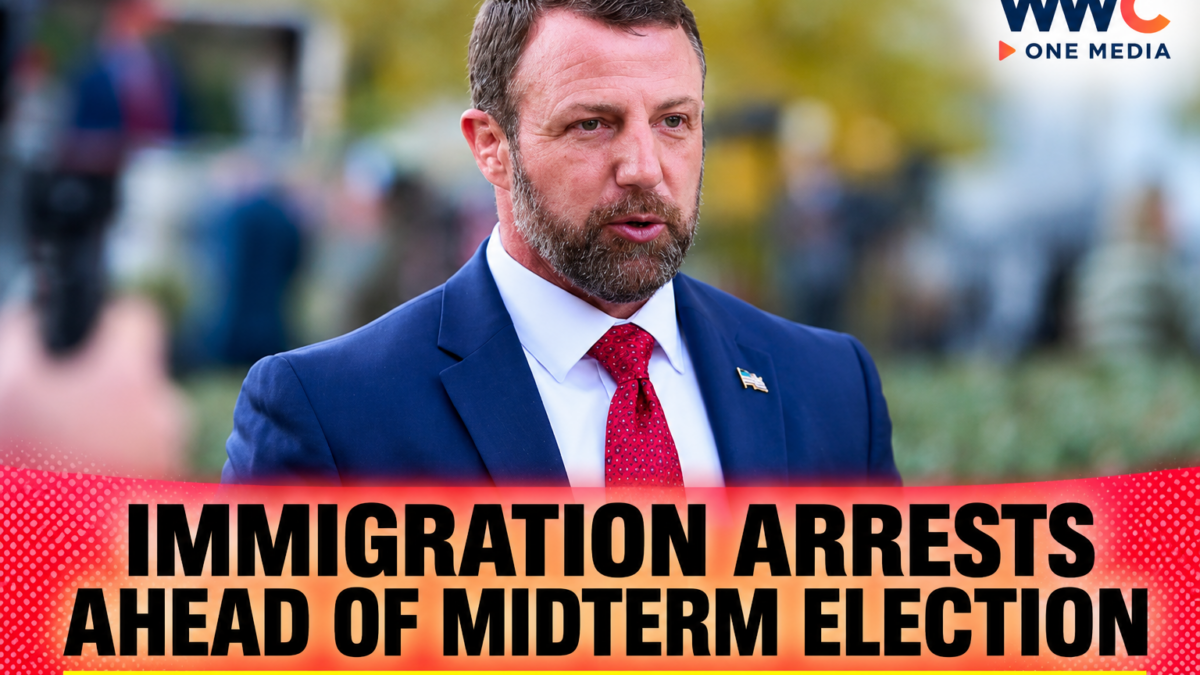
Democrats Won Congress, Trump Promised Immigration Talks, and Stephen Miller Got Promoted — So Why Are ICE Arrests Still Continuing?
WASHINGTON, November 11, 2026 — President Donald Trump has suggested that his aggressive immigration crackdown may have gone too far, but for immigrants and their families across the United States, the arrests have not stopped.
Despite the Republican Party’s sweeping losses in the November 3 midterm elections, immigration enforcement operations have continued across the country. People have reportedly been detained at airports, routine immigration appointments and other everyday locations, while families and community organizations raise concerns about the consequences.
The developments expose a major contradiction inside the Trump administration.
In his first major television interview after the Republican defeat, Trump acknowledged that his deportation policies might have been too aggressive for some voters. He also expressed interest in negotiating with Democrats on an immigration agreement.
But within hours of those comments, he appointed Stephen Miller, one of the central architects of his hard-line immigration agenda, as White House chief of staff.
Homeland Security Secretary Markwayne Mullin has also made clear that the administration has no intention of stopping deportations.
For immigrant communities, the political discussion in Washington has yet to produce an immediate change on the ground.
The question now is whether Trump’s apparent openness to compromise represents a genuine policy shift—or simply a change in political messaging after a major electoral setback.
Trump’s Immigration Comments Raise Hopes of a Policy Shift After Midterm Defeat
Trump’s remarks came after Democrats secured control of both chambers of Congress in the November 3 midterm elections, delivering a major setback to Republicans.
In an interview with CBS’s 60 Minutes, recorded Friday and aired Sunday, November 8, Trump acknowledged that his administration’s immigration crackdown may have been too aggressive for some voters.
He also indicated that he could work with Democrats on an immigration agreement.
Trump suggested that a possible deal could continue targeting people accused or convicted of serious crimes while creating room for certain immigrants who have lived and worked in the United States for years.
The comments represented a notable change in tone from an administration that had made mass deportation a central political and policy objective.
However, an expression of willingness to negotiate is not the same as a change in federal enforcement rules.
The administration has not announced a nationwide suspension of immigration arrests, and federal officials continue to defend the deportation campaign.
That distinction is important for millions of immigrants whose cases may depend on existing immigration law, court proceedings and individual circumstances.
Stephen Miller’s Promotion Sends a Different Message About Immigration Enforcement
One of the most consequential developments came when Trump appointed Stephen Miller as his new White House chief of staff.
Miller has been a leading figure behind the administration’s restrictive immigration policies and mass-deportation strategy.
His appointment raised questions about whether the White House was genuinely preparing to moderate its approach.
Rather than signaling an immediate retreat, the promotion places a prominent immigration hard-liner in one of the most influential positions inside the administration.
Miller’s role could shape policy discussions, agency priorities and the president’s approach to negotiations with Congress.
However, the appointment itself does not change immigration statutes or independently authorize federal agencies to disregard court orders.
The administration must still operate within applicable laws and constitutional requirements.
The timing nevertheless sends a powerful political message: Trump’s willingness to discuss a possible deal with Democrats is happening alongside the elevation of an adviser closely associated with his enforcement agenda.
For additional context, WWC One Media examined the appointment in its report, Trump Replaces Susie Wiles With Immigration Hardliner Stephen Miller After Democrats Seize Congress.
Homeland Security Says Deportations Will Continue Despite Republican Losses
Homeland Security Secretary Markwayne Mullin has delivered a more direct message about the administration’s immediate intentions.
In a public statement after the election, Mullin said deportations would continue and emphasized that Immigration and Customs Enforcement does not take days off.
He specifically said enforcement would continue during holidays and on Election Day.
That position contrasts with Trump’s suggestion that his administration may need to reconsider how aggressively it carries out deportations.
For immigration officers, the message from the department has been that existing enforcement responsibilities remain in place.
For immigrants, it means the midterm results have not automatically changed the risk of detention.
The Associated Press reported that advocates continued receiving accounts of arrests after the election, including detentions involving people who had pending asylum applications or other ongoing immigration matters.
The cases have intensified concerns about how federal authorities are identifying, questioning and detaining individuals across the country.
An Argentine Couple With Work Permits Was Arrested While Traveling to a Funeral
One of the cases described by the Associated Press involved an Argentine married couple from Orlando, Florida.
Gustavo Romanello and Agustin Baccega were reportedly traveling to Phoenix to attend the funeral of a friend when they were arrested at the airport on Saturday.
According to family friend Jonathan Batchelor, both men had work permits while pursuing asylum after entering the United States approximately six years earlier.
Batchelor said the couple had no criminal records and were working as acrobats in Florida.
He was speaking with them by phone when the arrest happened.
According to his account, officers approached the couple as they were leaving the airport. The conversation reportedly turned toward their asylum status before both men were taken into custody.
The couple remained in immigration detention at the time of the AP report.
The Department of Homeland Security did not immediately respond to requests for comment about their arrests.
Their case highlights an important distinction in the immigration debate: having a work permit or a pending asylum application does not automatically provide permanent immigration status.
However, each person’s circumstances, procedural protections and eligibility to remain in the country must be evaluated under applicable immigration law.
Venezuelan Twin College Soccer Players Were Detained in Alabama
Another case involved 19-year-old Venezuelan twins Luis and Carlos Orta-Santoro.
The brothers were traveling back to college after visiting their parents when they were stopped in a small city in central Alabama.
They are soccer players at Wallace State Community College in Hanceville.
Their relatives said both brothers had pending asylum applications, valid work permits and no criminal records.
The Department of Homeland Security offered a different explanation for their immigration situation.
The agency said the brothers had entered the United States legally but had overstayed in violation of immigration law. It also said that pending asylum applications do not confer legal immigration status and that their cases would be heard by an immigration judge.
Their aunt, Carolina Orta, said the family was devastated by the arrests.
The college also expressed support for the students, describing them as valued members of its community and hoping for a positive resolution.
The case illustrates why immigration status cannot always be reduced to a simple distinction between having entered legally and having permanent permission to remain.
Asylum proceedings, work authorization and immigration status are separate legal matters, and their consequences depend on the individual’s circumstances.
An 8-Year-Old Haitian Boy’s Detention Sparks Anger in San Diego
Perhaps one of the most emotionally difficult cases involved an 8-year-old Haitian boy who had been living with his uncle in San Diego after his father was deported the previous year.
According to the AP report, the uncle took the child to an ICE office after the boy was summoned on November 4.
The child was subsequently taken into custody.
The uncle was not the boy’s legal guardian.
San Diego Unified School District officials raised concerns about the child’s separation from his family, school and community.
In a letter to senior administration officials, Superintendent Fabi Bagula and school board members said the detention had left the child without the support of the people and institutions that had become part of his daily life.
They also emphasized that children should not lose access to education because of circumstances surrounding their families.
ICE defended its actions, while local advocates criticized the decision.
Johny Oxeda, a pastor with Fairmount Haitian Community Church, said the organization helped secure legal representation for the boy.
Guerline Jozef of Haitian Bridge Alliance strongly condemned the detention, describing it as harmful to the child.
The case has become another example of the difficult questions surrounding immigration enforcement involving minors and family members who are not their legal guardians.
Immigration Arrests Are Also Happening at Everyday Locations
The AP report describes concerns extending beyond high-profile immigration raids.
Advocates in Florida said arrests were occurring in places such as supermarkets, pharmacies and gas stations.
Some people under immigration supervision were reportedly detained when they appeared for scheduled appointments at ICE offices.
In Los Angeles, residents were also alarmed after masked federal officers and vehicles gathered outside the emergency entrance of Adventist Health White Memorial Medical Center.
A local resident described seeing numerous vehicles with tinted windows and no license plates near the hospital.
The Justice Department’s top prosecutor in Los Angeles, Bill Essayli, said officers were bringing a detainee there for medical treatment. He also said two people were arrested for assaulting federal agents.
The Department of Homeland Security said ICE does not target hospitals, schools or churches.
The hospital, meanwhile, emphasized that it does not participate in immigration enforcement and that its commitment to patient care and safety would remain unchanged.
The incident attracted residents and protesters, demonstrating how immigration operations can affect the atmosphere around public institutions even when officials dispute claims about their purpose.
These cases have contributed to broader concerns about whether immigrants feel safe accessing essential services or attending routine appointments.
Why Democrats’ Midterm Victory May Not Immediately Stop ICE Arrests
Democrats’ victory gives the party significant new power in Washington, but it does not automatically give lawmakers authority to terminate the president’s immigration enforcement program.
The incoming Congress is expected to pursue investigations into Immigration and Customs Enforcement and the Department of Homeland Security.
Democratic lawmakers have also discussed stronger oversight, accountability measures and possible changes to immigration enforcement practices.
However, several obstacles remain.
First, Trump will continue serving as president for the remaining two years of his term.
Second, the administration has already received substantial funding for immigration enforcement, making an immediate operational shutdown difficult.
Third, major legislative changes would require navigating the Senate’s procedural rules and potentially overcoming a presidential veto.
The Washington Post’s reporting on the post-election immigration debate also highlighted the limits of what Democrats can accomplish even after taking control of Congress.
The party may be better positioned to investigate enforcement operations, question officials and use budget negotiations to pursue changes than to immediately reverse the administration’s entire immigration agenda.
WWC One Media previously examined the political implications in its report on Democrats capturing both chambers of Congress after the midterm elections.
The new congressional majority may create more pressure on federal agencies, but the immediate direction of enforcement remains largely under the executive branch.
Immigration Enforcement May Have Become a Political Liability for Republicans
The election results also raise questions about the political cost of Trump’s deportation strategy.
Immigration was one of the issues shaping the 2026 midterm campaign, alongside the economy and the cost of living.
Reuters reported that Latino voters helped drive Democratic gains in several Republican-leaning areas.
Its reporting highlighted how immigration enforcement and deportations influenced political discussions among Latino voters, alongside concerns about affordability.
The report estimated that approximately 14.5 million Latino voters participated in the election, a record.
In majority-Latino counties with Senate races, Republican vote share declined significantly compared with 2024.
The findings do not mean that Latino voters share one political position or that immigration alone determined the outcome.
Economic concerns, candidate quality, local issues and other national developments also mattered.
However, the results suggest that aggressive immigration enforcement may have become a political vulnerability for Republicans in communities where immigration policy directly affects families, workers and local businesses.
A separate AP Voter Poll, cited in Associated Press reporting, found that approximately six in ten midterm voters believed the administration’s immigration enforcement actions had gone too far.
That finding gives Democrats a potential political opening as they prepare to scrutinize federal enforcement operations.
ICE Arrests and Deportations Are Not the Same Thing
Another important part of the debate is the difference between immigration arrests and actual deportations.
An arrest means a person has been taken into immigration custody. Deportation is a separate legal and administrative process that can involve immigration proceedings, removal orders, appeals and logistical arrangements.
Reuters reported in September that immigration arrests had increased sharply, reaching nearly 51,000 in August based on preliminary government data reviewed by the news agency.
However, deportations did not rise at the same pace.
The report explained that legal proceedings, detention capacity, available flights and the willingness of receiving countries to accept deportees can limit the number of people removed.
It also found that a growing number of people arrested had no criminal conviction or pending criminal charge, according to figures analyzed by the Deportation Data Project.
This distinction matters because a high number of arrests does not automatically translate into an equal number of completed deportations.
It also helps explain why the administration can continue expanding arrests while still facing practical and legal obstacles to achieving its deportation targets.
The Reuters findings provide important background to the cases described in the latest AP report, particularly those involving people with ongoing asylum proceedings.
What Could Happen to Trump’s Immigration Crackdown Next?
The coming months could bring a political and legal confrontation between the White House and the incoming Democratic-controlled Congress.
Several developments will be worth watching.
1. Congressional investigations
Democrats may use committee hearings, subpoenas and oversight powers to examine ICE operations, detention conditions and the Department of Homeland Security’s enforcement decisions.
2. Possible changes to enforcement tactics
The administration could consider adjustments to specific practices without abandoning its broader deportation agenda.
3. Budget negotiations
Federal immigration funding could become a major issue when lawmakers debate government spending and future appropriations.
4. Legal challenges
Immigration enforcement decisions involving asylum seekers, children and people with ongoing immigration proceedings may face additional scrutiny in court.
5. The White House’s direction
Stephen Miller’s new role could influence whether the administration maintains its current strategy or considers limited compromises with Democrats.
6. Public opinion
The political impact of immigration enforcement may continue shaping debates ahead of the 2028 presidential election.
For now, there is no confirmed nationwide pause in immigration arrests or deportations.
The administration continues to defend its enforcement operations, while immigrant-rights advocates and Democratic lawmakers are demanding greater accountability.
The Bottom Line: Trump’s Immigration Rhetoric May Be Changing, but the Arrests Have Not Stopped
The Republican Party’s midterm defeat has created a new political reality in Washington.
Trump has acknowledged that his immigration crackdown may have been too aggressive for some voters and has expressed interest in reaching an agreement with Democrats.
But his appointment of Stephen Miller, the continued enforcement message from Homeland Security Secretary Markwayne Mullin and the arrests documented across the country suggest that a major policy reversal has not yet happened.
The cases involving the Argentine couple, the Venezuelan college soccer players and the Haitian child show why the debate extends beyond campaign promises and political calculations.
For immigrant families, the consequences can involve detention, separation, disrupted education and uncertainty over legal proceedings.
For the administration, the challenge is balancing its enforcement objectives with legal requirements, public accountability and changing voter expectations.
For Democrats, the challenge is turning their new congressional majority into meaningful oversight and policy changes.