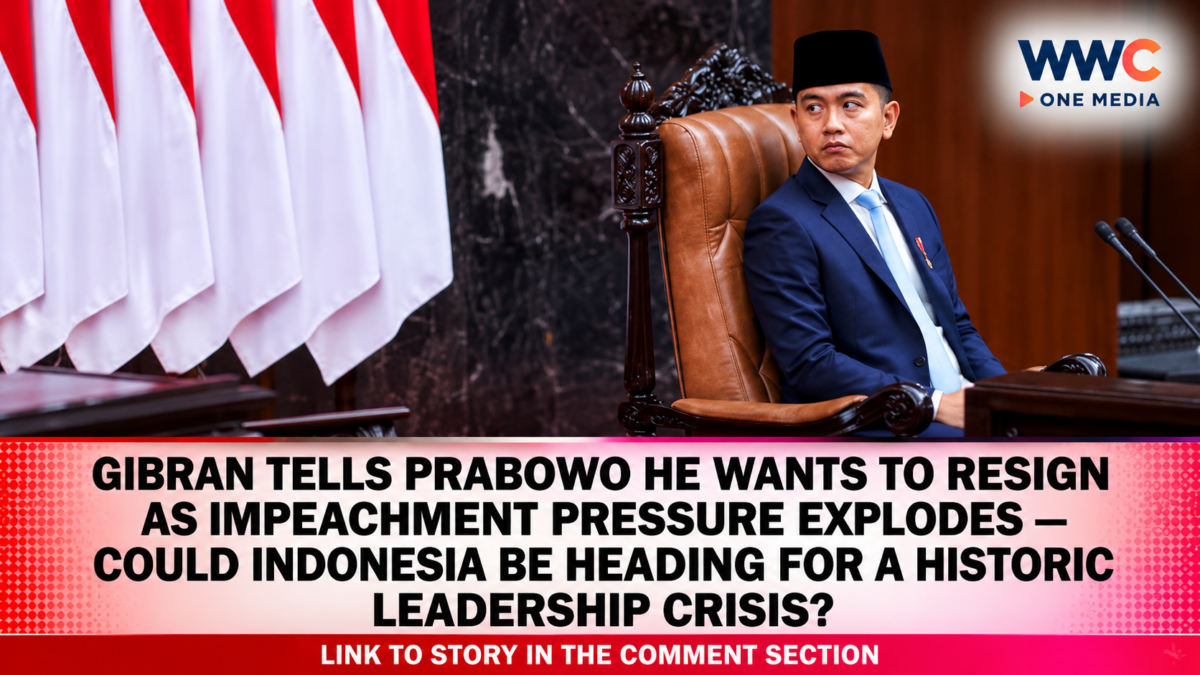
Indonesia has been plunged into fresh political uncertainty after Vice-President Gibran Rakabuming Raka reportedly told President Prabowo Subianto that he intended to resign, as mounting questions over his educational qualifications fuel calls for parliamentary action and possible impeachment.
The announcement, confirmed by State Secretary Prasetyo Hadi on November 10, 2026, followed a meeting between Gibran and Prabowo that lasted approximately two and a half hours at the presidential residence in Jakarta.
According to Prasetyo, Gibran expressed his intention to step down in response to developments surrounding recent Constitutional Court and Supreme Court decisions concerning the education documents he submitted during the 2024 election.
However, one crucial detail remains unresolved: Gibran’s stated intention to resign does not mean he has formally left office. Prasetyo did not confirm that a written resignation had been submitted or that Prabowo had accepted it.
The presidential spokesperson also denied reports that Prabowo had rejected Gibran’s request, without confirming whether the president had agreed to it.
The development comes as Indonesian lawmakers consider using their parliamentary powers to investigate Gibran’s eligibility, potentially opening a constitutional process that could threaten his position as vice-president.
What began as a dispute over academic documentation has now become a major political test for Prabowo’s administration, his governing coalition and his relationship with former president Joko Widodo, Gibran’s father.
Gibran Raises Resignation During 2.5-Hour Meeting With Prabowo
The resignation development emerged after Gibran met Prabowo on November 10 to discuss the growing controversy surrounding his eligibility for office.
State Secretary Prasetyo Hadi told reporters that the vice-president had communicated his intention to resign during their discussion.
Prasetyo rejected reports that Prabowo had refused the request. However, he stopped short of announcing that the president had accepted Gibran’s intention to leave.
The meeting took place against the backdrop of growing pressure from lawmakers and public criticism over the documents Gibran used to establish his educational qualifications during the 2024 presidential election.
Gibran later spoke to reporters at the presidential palace, describing Prabowo as a father figure and saying the president had offered him advice.
He also indicated that Prabowo had encouraged him to continue fighting through legal channels, including proceedings at the State Administrative Court and a legal challenge to the Supreme Court ruling.
Notably, Gibran did not publicly announce that he had submitted a formal resignation letter during his subsequent remarks.
The distinction is important. At this stage, the confirmed development is that he communicated an intention to resign during a meeting with the president, not that Indonesia has already begun a completed transfer of the vice-presidential office.
Two Court Decisions Put Gibran’s Educational Credentials Under Scrutiny
The political crisis intensified following two separate court developments in October 2026.
The first came on October 6, when Indonesia’s Constitutional Court dismissed a petition seeking to invalidate Gibran’s 2024 election victory.
Although the court rejected the petition, its reasoning raised significant questions about the evidence presented concerning Gibran’s overseas education.
The judges said they found no convincing evidence in the proceedings establishing that Gibran possessed a foreign diploma or equivalent qualification proving completion of senior high school, as required under Indonesian election law.
However, the court also explained that it could not disqualify him through that particular election-dispute proceeding because he had already been sworn into office.
The second development came from the Supreme Court on October 30, when it ruled against the validity of the high-school equivalency certificate used in connection with Gibran’s candidacy.
The decisions have intensified questions about whether the documentation submitted to Indonesian election authorities satisfied the country’s legal requirements.
But neither ruling automatically removed Gibran from the vice-presidency.
The Constitutional Court dismissed the petition seeking to annul his election victory, while the Supreme Court decision concerned the validity of the administrative certificate.
These are separate legal questions, and any attempt to remove a sitting vice-president must follow the appropriate constitutional process.
Why Gibran’s Education Background Became a National Political Issue
Gibran, 39, is the eldest son of former Indonesian president Joko Widodo, widely known as Jokowi.
His education history includes studies at Orchid Park Secondary School in Singapore, further education at UTS Insearch in Australia and a bachelor’s degree through the Management Development Institute of Singapore.
The controversy is not simply about whether Gibran attended schools overseas or eventually obtained a university degree.
The central question is whether the documents submitted to Indonesian authorities adequately demonstrated that he had completed senior high school or an equivalent qualification required for presidential and vice-presidential candidates.
Indonesia’s election law establishes an educational requirement for candidates seeking the country’s two highest elected offices.
During the court proceedings, the documentation used to establish Gibran’s educational equivalency came under scrutiny, including questions about the underlying graduation certificate.
Gibran has defended his educational background, while the courts’ findings have created renewed uncertainty over whether the documents met the applicable requirements.
The latest developments have moved the issue beyond an academic-document dispute and into a broader debate about election administration, public accountability and constitutional eligibility.
Parliament Considers Action That Could Lead to Impeachment
Gibran’s reported resignation intention comes as Indonesian lawmakers consider whether to formally address the court decisions through parliamentary procedures.
The House of Representatives, or DPR, has several constitutional oversight mechanisms available to it.
These include the right of interpellation, which allows lawmakers to request explanations from the government; the right of inquiry, which permits investigations into certain government policies and actions; and the right to express an opinion on matters involving alleged legal or constitutional violations.
The last mechanism could become particularly significant if lawmakers formally pursue allegations that Gibran no longer satisfies the requirements for office.
Under Indonesia’s constitutional framework, impeachment is not automatic. The DPR must first adopt a formal position alleging specified constitutional violations or that the vice-president no longer meets the requirements for office.
The matter would then proceed to the Constitutional Court for examination. If the constitutional requirements are met, the People’s Consultative Assembly would have a role in the final decision.
This means that a parliamentary inquiry or motion does not immediately remove Gibran.
It would take several institutional and legal steps before an impeachment could result in his removal.
According to reporting by The Straits Times, lawmakers were preparing to pursue a motion of opinion, with forms reportedly circulating among members of Parliament for signatures.
The political significance is considerable because the debate is no longer limited to opposition figures. Some parties within Prabowo’s governing coalition have also been discussing possible parliamentary responses to the court rulings.
Prabowo Has Not Publicly Confirmed Accepting Gibran’s Resignation
One of the biggest unanswered questions is what Prabowo intends to do next.
The president has not publicly confirmed that he has accepted a formal resignation from his deputy.
Instead, Gibran said Prabowo advised him to continue defending his position through legal proceedings.
The vice-president also indicated that he wanted an opportunity to establish the validity of his education documents through the appropriate legal channels.
This creates an unusual political situation: Gibran reportedly expressed an intention to resign, but his subsequent public comments emphasized his willingness to continue fighting the legal challenge.
It remains unclear whether his resignation statement represents a final decision, a response to mounting political pressure or an intention that could change as the legal process develops.
Until there is a formal resignation and the relevant constitutional procedures are completed, Gibran remains Indonesia’s vice-president.
Prabowo and Jokowi’s Political Relationship Faces Another Test
The controversy has also placed renewed attention on the relationship between Prabowo and Jokowi.
Gibran became Prabowo’s running mate in the 2024 presidential election, with the support of his father, who had served as Indonesia’s president for a decade.
Their partnership helped Prabowo secure a decisive election victory.
However, relations between the two political camps have since attracted growing scrutiny amid disputes involving government appointments, political influence and the latest controversies.
The education-document dispute is especially sensitive because Gibran’s position is closely tied to the political legacy of his father.
Any parliamentary action against the vice-president could therefore have implications beyond Gibran personally.
It could also affect the relationship between Prabowo’s administration and the political network associated with Jokowi.
Reuters has reported that the tensions between the two camps have been growing, while lawmakers consider whether to use their constitutional powers to address Gibran’s eligibility.
Nevertheless, the existence of political tension does not establish that Prabowo or Jokowi directed the parliamentary developments.
The legal questions and political relationships must be assessed separately.
A Separate Wiretapping Scandal Adds to Indonesia’s Political Uncertainty
The Gibran controversy is unfolding alongside another major political issue involving allegations of illegal surveillance targeting Prabowo and other prominent figures.
Indonesian authorities have detained three senior police officers in connection with an investigation into alleged unauthorised wiretapping.
One of those detained was former national police chief Listyo Sigit Prabowo, who had recently been appointed to a senior position in the presidential administration.
The investigation has attracted attention because Listyo was widely regarded as close to Jokowi, having led the National Police during the former president’s administration.
Prabowo subsequently removed Listyo from his presidential chief-of-staff position.
The timing has fueled speculation about political divisions within Indonesia’s governing establishment.
However, the wiretapping investigation and the dispute over Gibran’s education credentials are separate matters. There is no established evidence that they are part of one coordinated political operation.
The developments nevertheless add to the pressure facing Prabowo as his administration deals with questions involving political loyalty, security institutions and parliamentary accountability.
What Happens If Gibran Actually Resigns?
If Gibran formally resigns and the resignation takes effect under the applicable constitutional procedures, Indonesia would face the process of filling the vacant vice-presidential position.
The country’s Constitution provides a mechanism for the president to propose two candidates to the People’s Consultative Assembly, which then elects a replacement vice-president.
That process would introduce another important political calculation for Prabowo because the selection would require consideration of the balance among parties and political groups represented in the legislature.
But this scenario remains conditional.
There has been no confirmed formal resignation or completed vacancy as of the latest reports reviewed for this article.
If Gibran instead withdraws his resignation intention and continues challenging the court decisions, the dispute could shift back toward legal proceedings and parliamentary scrutiny.
Either way, the government faces a difficult period as lawmakers decide whether to pursue a formal investigation.
Indonesia’s Political Crisis Could Have Wider Consequences
Indonesia is Southeast Asia’s largest economy and one of the region’s most influential democracies.
Political uncertainty involving its president and vice-president can have implications for government continuity, investor confidence and the country’s international standing.
The current controversy also raises broader questions about how candidate qualifications are verified, how court decisions are implemented and how constitutional institutions should respond when the eligibility of a sitting national leader is challenged.
For Prabowo, the immediate challenge is to maintain political stability while allowing the legal and parliamentary processes to proceed.
For Gibran, the challenge is whether he can resolve the controversy surrounding his education documents and determine his political future.
For Parliament, the decision is whether to pursue a formal constitutional response or seek another way to address the court findings.
The coming days could therefore prove critical.
Gibran has expressed an intention to resign, but no formal departure has been confirmed. Prabowo has not publicly announced that he has accepted a resignation, and lawmakers are still considering their next steps.
Indonesia is now facing a question that could reshape its political landscape: Will Gibran ultimately leave the vice-presidency, or will he fight to retain his position as Parliament moves closer to a potentially historic constitutional showdown?
Related WWC ONE MEDIA reports
- Indonesia Parties Weigh Parliamentary Inquiry Into Vice President Gibran’s Education Credentials as Prabowo-Jokowi Rift Deepens
- Indonesia Court Dismisses Challenge to Gibran’s Education Credentials — But Its Ruling Raises a Bigger Legal Question
- Indonesia Considers Presidential Palace Bug Sweeps After Explosive Wiretapping Scandal
- Indonesia Deploys Nearly 21,000 Troops to Jakarta as Three Police Generals Are Detained in Wiretapping Scandal