Kennedy Family Takes on Trump Over 250-Foot Washington Arch Near JFK’s Grave — Could His Biggest Monument Project Be Stopped?
WASHINGTON, D.C. — November 11, 2026 — President Donald Trump’s ambitious plan to build a towering 250-foot triumphal arch near Arlington National Cemetery has encountered another powerful opponent: the Kennedy family.
Nine descendants of former US Attorney General Robert F. Kennedy and Senator Edward M. Kennedy have asked a federal judge to allow them to join existing legal challenges against the controversial project, arguing that the proposed structure could cast shadows over their relatives’ graves and permanently damage historically significant views surrounding Arlington National Cemetery.
The legal move, filed on Tuesday, November 10, adds one of America’s most recognizable political families to the growing opposition against Trump’s proposed monument.
The relatives argue that the massive structure would interfere with the solemn atmosphere of the cemetery, affect the experience of visitors paying tribute to fallen Americans and obstruct important views connecting Arlington with Washington’s historic landmarks.
Among the memorials potentially affected are the gravesites of former President John F. Kennedy, Robert F. Kennedy and Edward M. Kennedy, along with the Eternal Flame at JFK’s gravesite.
The development comes just days after US District Judge Tanya Chutkan temporarily blocked the Trump administration from beginning construction for 14 days while legal challenges proceed.
For Trump, the dispute threatens one of his most ambitious efforts to reshape the American capital.
For the Kennedy family, the issue is about protecting the historical integrity of a place where several generations of their relatives are remembered.
And for Washington, the controversy raises a much bigger question: Can a sitting president build a monumental landmark of this scale without the necessary congressional authorization?
Nine Kennedy Family Members Join the Fight Against Trump’s Monument
According to the Associated Press, nine members of the Kennedy family filed a motion on November 10 seeking permission to intervene in existing lawsuits challenging the Trump administration’s proposed arch.
The relatives are descendants of Robert F. Kennedy and Edward M. Kennedy.
Those identified in the filing include:
- Rory Kennedy
- Maxwell Kennedy
- Christopher G. Kennedy
- Kerry Kennedy
- Courtney Kennedy
- Kathleen Kennedy Townsend
- Joseph P. Kennedy II
- Joseph P. Kennedy III
- Edward M. Kennedy Jr.
The family is represented by attorneys Norman Eisen and Steve Jonas of the Democracy Defenders Fund.
Their legal argument centers on the potential impact of the proposed structure on the Kennedy memorials and the surrounding historic landscape.
The relatives contend that the arch would cast shadows over family gravesites and interfere with sightlines that were deliberately preserved when the memorials were established.
They also argue that the project would intrude on a nationally significant cemetery without the congressional approval required for such a major undertaking.
Importantly, the filing is a motion to intervene in existing litigation, not a final court ruling against the project.
The judge must still determine whether the family members can formally participate in the proceedings.
Why the Kennedy Family Says Trump’s Arch Could Damage JFK’s Memorial
The Kennedy family’s strongest objection concerns the location and enormous scale of the proposed monument.
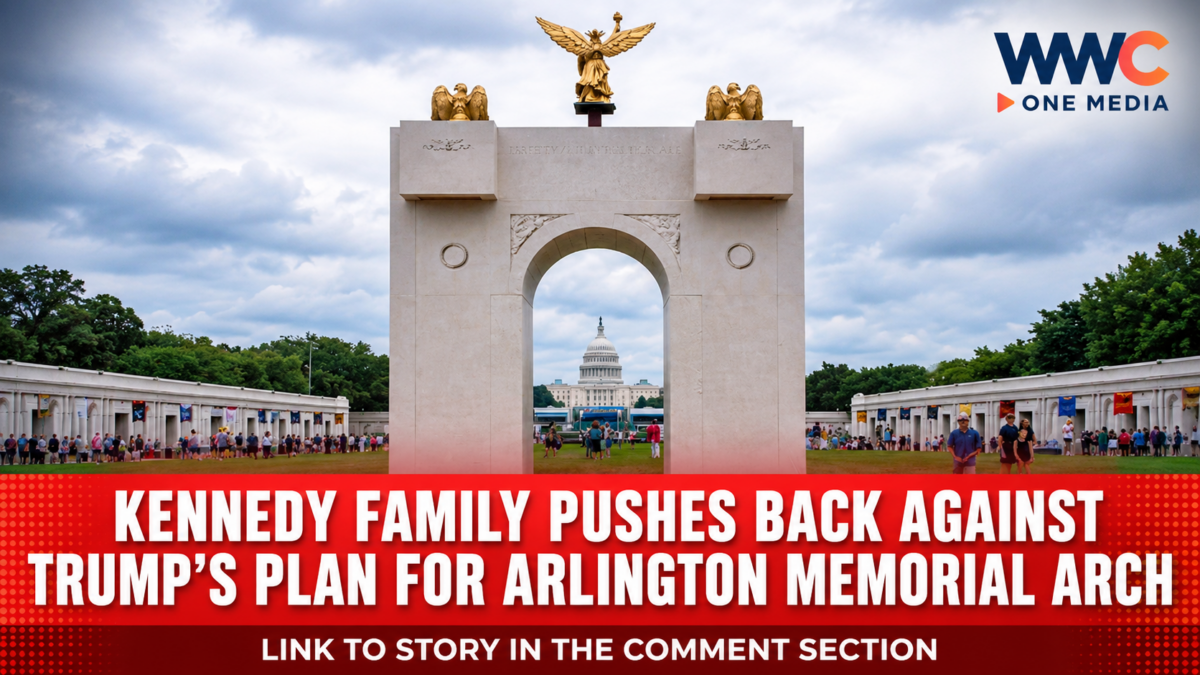
Trump wants to construct a 250-foot structure near Memorial Circle, across the Potomac River from the Lincoln Memorial and near the entrance to Arlington National Cemetery.
The proposed arch would stand between Washington’s historic monuments and the cemetery’s landscape.
The Kennedy family argues that the structure could obstruct views of the gravesites of John F. Kennedy, Robert F. Kennedy and other relatives buried or memorialized at Arlington.
One particularly important feature is the Eternal Flame at John F. Kennedy’s gravesite.
The flame has become one of America’s most recognizable presidential memorial symbols.
The family argues that the proposed arch could interfere with the carefully preserved sightlines connecting the gravesite to Arlington Memorial Bridge and Washington’s historic landmarks.
They also warn that the monument’s shadow could alter the experience of visitors, particularly those who traditionally visit the graves during the early morning.
For the relatives, Arlington is not simply a tourist destination.
It is a place of national remembrance, military sacrifice and personal family history.
Their argument is that a structure of this size could permanently change the atmosphere of a memorial landscape that was designed to remain solemn and accessible.
Trump’s 250-Foot Arch Is More Than Twice the Height of the Lincoln Memorial
The scale of the project is a major reason it has attracted national attention.
At approximately 250 feet, or 76 meters, the proposed structure would become one of the most prominent additions to Washington’s monumental landscape.
Trump has repeatedly compared his proposed arch to famous structures in major European capitals, including the Arc de Triomphe in Paris.
However, the planned Washington structure would be substantially taller than the Paris landmark.
The administration’s renderings show an imposing monument featuring large stone surfaces, prominent golden statues and a dramatic central architectural opening.
The project is intended to commemorate America’s 250th anniversary, which falls in 2026.
Trump has presented the arch as a symbol of American strength, national pride and military history.
The administration has also promoted a military-related concept for the structure.
Trump previously described plans involving drones, snipers and ammunition storage, saying the monument could serve national security purposes.
However, an important distinction emerged when the administration submitted its final planning documents.
A Washington Post investigation published in October found that the submitted plans did not contain the military features Trump had previously described.
The White House disputed the suggestion that the plans had fundamentally changed.
This discrepancy has added another layer to the controversy over the project’s purpose, design and authorization.
Federal Judge Already Blocks Construction for 14 Days
The Kennedy family’s legal action comes after an important court development on November 5.
US District Judge Tanya Chutkan issued a temporary restraining order preventing the Trump administration from beginning construction for 14 days.
The order followed a decision by the National Capital Planning Commission to approve the project’s final plans in an 8–4 vote.
The commission’s approval represented a major administrative step toward construction.
However, the federal court’s intervention meant that the administration could not immediately proceed with breaking ground.
Judge Chutkan questioned the administration’s argument that an old congressional statute provided sufficient authority to build the proposed structure.
In her written opinion, she expressed skepticism about interpreting a law dating back approximately a century as authorization for a 250-foot monument in such a prominent location.
The court’s decision also reflected broader concerns about whether the administration had obtained the necessary legal approvals.
The temporary order does not permanently cancel the arch.
Instead, it preserves the situation while the court examines the legal challenges.
The Kennedy family’s filing could strengthen the opposition by bringing additional historical and personal interests into the proceedings.
The White House Faces More Than One Lawsuit
The Kennedy family is not the first group to challenge Trump’s monument.
Earlier lawsuits were brought by parties including the governments of Washington, D.C., and Virginia, as well as veterans and historic-preservation advocates.
The challenges raise several major issues:
Congressional authorization: Opponents argue that the administration cannot independently approve a monument of this scale on federal land without appropriate congressional authorization.
Historic preservation: Critics say the proposed structure could damage the historic relationship between Arlington National Cemetery, Arlington House and the Lincoln Memorial.
Environmental and transportation concerns: Opponents have also raised concerns about construction disruption, traffic, public access and the surrounding environment.
Government authority: The lawsuits question whether the administration has followed the legal procedures required for a major federal construction project.
The Trump administration maintains that existing legal authority allows the project to proceed.
The disagreement is now before the courts, where the competing interpretations will have to be examined.
The Kennedy family’s involvement adds a particularly significant historical dimension to the dispute.
Why Robert F. Kennedy Jr. Is Not Part of the Legal Challenge
One detail that has attracted attention is the absence of Robert F. Kennedy Jr., a member of the Kennedy political family who currently serves as Trump’s health secretary.
He is not among the nine relatives participating in the November 10 filing.
Kennedy Jr. has become politically aligned with Trump, despite belonging to a family with a long history in the Democratic Party.
His political relationship with Trump differs sharply from that of several other Kennedy relatives.
The Associated Press has described the family relationships as estranged in the context of the political divide.
His absence highlights how the proposed monument has become another point of disagreement within one of America’s most prominent political dynasties.
However, it would be inaccurate to suggest that every Kennedy family member shares the same position or that the nine relatives represent the entire family.
The legal action is being pursued by the specific descendants named in the filing.
Trump’s Washington Makeover Is Facing Growing Political and Legal Resistance
The triumphal arch is part of a much broader effort by Trump to reshape the appearance of Washington.
Other projects associated with the president include the White House ballroom, changes to the Lincoln Memorial Reflecting Pool and renovations involving prominent federal properties.
Several of these plans have generated questions about financing, historic preservation, public consultation and presidential authority.
The proposed arch has become especially controversial because of its location near Arlington National Cemetery.
The Washington Post reported that the National Capital Planning Commission approved the design despite significant opposition during a lengthy public hearing.
More than 100 people reportedly testified during the commission’s proceedings.
Veterans, local officials, preservation advocates and other critics argued that the structure would undermine the dignity and historical character of the area.
The administration’s supporters have defended the arch as an important national monument.
They argue that America deserves a grand landmark commemorating its history and military achievements.
The disagreement reflects a larger debate about how public monuments should represent national identity and who should have the authority to decide their design and location.
Democrats Could Increase Congressional Scrutiny After Their Midterm Victory
The political timing also matters.
Democrats recently secured control of both chambers of Congress in the November 3, 2026 midterm elections.
Their incoming congressional majority could increase scrutiny of Trump’s Washington construction projects beginning in January 2027.
Democratic lawmakers have already criticized the arch and questioned the administration’s legal authority to move forward.
A Democratic-controlled Congress could examine federal spending, demand documents, conduct oversight hearings and consider legislation affecting the project.
However, congressional control does not automatically cancel an existing construction approval or determine the outcome of the ongoing lawsuits.
The courts will continue to play an important role in deciding whether the administration has complied with applicable laws.
The election nevertheless changes the political environment surrounding Trump’s plans.
A project that once appeared to be moving toward construction now faces opposition from historical stakeholders, local governments, veterans, preservationists and a prominent American political family.
What Happens Next to Trump’s Proposed Arch?
The immediate legal question is whether the Kennedy family will be permitted to join the existing proceedings.
The court must also consider the arguments made by the original plaintiffs and determine whether the administration has the necessary authority to construct the monument.
The 14-day temporary restraining order is a significant short-term obstacle.
It does not represent a final judgment on the arch’s legality.
Several questions remain:
- Will the court allow the nine Kennedy descendants to intervene?
- Can the Trump administration establish that Congress authorized the project?
- Will the court permanently block construction or allow it to proceed?
- Could Congress introduce legislation to address the project’s approval?
- Will the administration revise the design to address concerns about the Kennedy memorials and Arlington’s historic views?
The answers could determine whether Trump’s proposed arch becomes a permanent addition to Washington or remains a controversial project caught in a prolonged legal dispute.
The Bottom Line: A Monument Meant to Celebrate America Is Now at the Center of a National Dispute
The Kennedy family’s decision to challenge Trump’s 250-foot arch has transformed an already controversial construction project into a dispute involving one of America’s most recognizable political legacies.
Nine descendants of Robert F. Kennedy and Edward M. Kennedy argue that the structure could overshadow their relatives’ graves, interfere with JFK’s Eternal Flame and alter the historical landscape surrounding Arlington National Cemetery.
Their legal action comes as a federal judge has already temporarily stopped construction and other plaintiffs continue challenging the administration’s authority.
Trump, meanwhile, continues defending the project as a monument to America’s history and military heritage.
The final outcome will depend on the courts, the applicable laws and potentially future congressional action.
But the controversy now extends beyond architecture.
It touches on the meaning of national remembrance, the preservation of historic landmarks and the limits of presidential power.
Trump wants to leave a towering monument in the nation’s capital. But with the Kennedy family now joining the legal fight, could the gravesite of one former president become the place where his biggest Washington project is stopped?