The Armed Forces of the Philippines (AFP) has pushed back against suggestions that the country’s firm position in the West Philippine Sea could provoke a conflict with China, insisting that defending Philippine maritime rights is a national responsibility—not an attempt to start a fight.
Rear Admiral Roy Vincent Trinidad, the AFP’s spokesperson for the West Philippine Sea, made the statement on November 10, 2026, amid renewed public debate over how Manila should manage its increasingly complicated relationship with Beijing.
His remarks followed Vice President Sara Duterte’s call for the government to avoid confrontational language and pursue diplomatic negotiations in addressing disputes with China. The AFP said it supports peaceful engagement but stressed that diplomacy should not mean abandoning the country’s legally recognized maritime entitlements, sovereignty and sovereign rights. SunStar Publishing Inc.+3
AFP: Protecting Philippine Rights Does Not Mean Seeking War
Trinidad said the Philippines is not looking for a confrontation with China or any other country. Instead, he explained that the military is carrying out its mandate to protect the country’s territory, national interests and maritime entitlements.
He emphasized that the Philippines has a responsibility to stand up for rights recognized under international law, including those upheld by the 2016 South China Sea arbitral ruling.
The AFP’s position is that the country can continue asserting its rights while maintaining diplomatic channels and avoiding unnecessary escalation.
The military also rejected the idea that differences in military strength should prevent the Philippines from defending its interests. Trinidad said the country must continue improving its capabilities while making use of the resources it currently has.
His message comes as the government faces pressure to balance two priorities: protecting Philippine interests in disputed waters and preventing tensions with China from developing into a wider confrontation. GMA News Online+2
Sara Duterte Calls for Diplomacy in Dealing With China
The AFP statement came after Vice President Sara Duterte urged Philippine officials to approach disputes with China through diplomatic discussions rather than heated public exchanges.
Speaking to overseas Filipino workers in Hong Kong on November 8, Duterte said relations between countries involve many interconnected interests, including trade, employment and the welfare of citizens living or doing business overseas.
She warned that strained relations could have consequences beyond the maritime dispute itself.
Her remarks have brought renewed attention to the debate over whether the Philippines should adopt a more cautious public approach toward Beijing or continue speaking firmly about its maritime rights.
Trinidad said the AFP agrees that the government should not pick fights with other countries. However, he maintained that defending Philippine rights is not the same as provoking China.
The distinction is important: diplomatic engagement and the assertion of maritime rights are not necessarily opposing policies. SunStar Publishing Inc.+2
The 2016 Arbitral Ruling Remains Central to the Dispute
One of the strongest legal foundations of the Philippine position is the July 12, 2016, arbitral award issued under the United Nations Convention on the Law of the Sea (UNCLOS).
The tribunal rejected the legal basis for China’s claim to historic rights over resources within the so-called nine-dash line insofar as those claims exceeded the maritime entitlements allowed under UNCLOS.
The ruling also clarified important maritime entitlements involving the Philippines and China. Beijing has rejected the decision, while Manila continues to invoke it in defending its rights in the West Philippine Sea.
There is an important legal distinction: the 2016 ruling did not decide sovereignty over every land feature in the South China Sea, nor did it establish a final maritime boundary between the two countries. It addressed maritime rights and obligations under UNCLOS.
For the Philippines, the award remains a significant legal reference in challenging China’s expansive maritime claims.
AFP Reports 29 Chinese Vessels in West Philippine Sea in One Week
The debate over the country’s approach to China is unfolding alongside continuing Chinese maritime activity in areas monitored by Philippine forces.
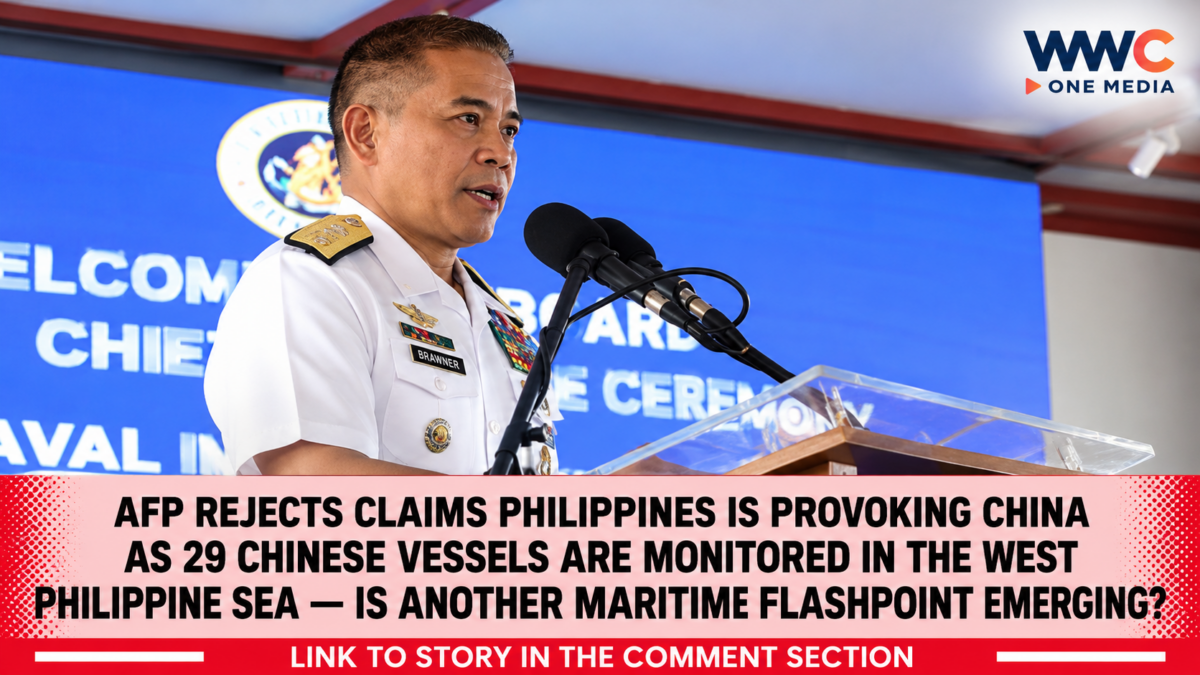
In a separate November 10 report, GMA News said the AFP monitored 29 Chinese vessels in several West Philippine Sea features from November 3 to 8, 2026.
The military’s reported breakdown was:
- Ayungin Shoal: One People’s Liberation Army Navy vessel and nine China Coast Guard vessels
- Bajo de Masinloc: Three naval vessels and five China Coast Guard vessels
- Escoda Shoal: Three naval vessels and three China Coast Guard vessels
- Pag-asa Islands: Two naval vessels and three China Coast Guard vessels
The AFP also reported that 80 Chinese vessels were monitored in the West Philippine Sea during October, down from 101 recorded in September.
These figures refer to vessels monitored at specific maritime features during the periods reported. They should not be interpreted as proof that all the vessels were present simultaneously or that every sighting involved a direct confrontation.
Nevertheless, the reports demonstrate why the West Philippine Sea remains a major security and diplomatic concern for Manila. GMA News Online+1
Palace Says Diplomacy and Defending Philippine Rights Can Go Together
Malacañang has also emphasized that diplomatic engagement with China does not prevent Philippine officials from defending the country’s maritime interests.
In a November 4 statement reported by the Philippine News Agency, Palace Press Officer Claire Castro said discussions with other countries should proceed through diplomacy, while recognizing that government officials and agencies have mandates to protect Philippine rights and interests in the West Philippine Sea.
The statement reflects the challenge facing the administration: maintaining communication with Beijing while avoiding any impression that the Philippines is giving up its position in disputed waters.
Defense Secretary Gilberto Teodoro Jr. has likewise stressed the importance of strengthening the country’s capabilities to protect its people and maritime interests.
The government’s approach therefore involves more than public statements. It includes diplomatic engagement, maritime monitoring, defense modernization and coordination among agencies responsible for national security. Philippine News Agency+1
Why the West Philippine Sea Matters to Ordinary Filipinos
The dispute is not simply a disagreement between governments over maps and maritime boundaries.
The West Philippine Sea is connected to fishing grounds, marine resources, shipping routes and the livelihoods of Filipino coastal communities. The Philippines’ exclusive economic zone gives it sovereign rights to explore, exploit, conserve and manage natural resources in the relevant maritime areas under international law.
Developments in the area can therefore affect Filipino fisherfolk, national food security, economic interests and the country’s broader maritime security.
The continuing presence of Chinese government and naval vessels in areas monitored by the AFP also places pressure on Philippine authorities to maintain surveillance and protect the country’s interests without allowing incidents at sea to escalate.
WWC ONE MEDIA has previously examined several developments that help explain the dispute:
- China Is Building on Philippine Reefs—but Manila Says Beijing Still Can’t Change Their Legal Status
- DFA Draws the Line: Philippines Tells China to Leave Two West Philippine Sea Reefs
- AFP Draws the Line on BRP Sierra Madre Resupply as China’s Permission Claim Raises Tensions
- Army Commander Urges Filipino Youth Not to Fall for West Philippine Sea Lies
These developments show how the dispute involves legal arguments, maritime operations, diplomatic exchanges and public understanding—not just military strength.
The Philippines Faces a Difficult Balance Between Diplomacy and National Defense
The AFP’s latest statement sends a clear message: the Philippines does not need to choose between pursuing diplomacy and defending its maritime rights.
Manila can continue engaging Beijing while invoking the 2016 arbitral ruling, monitoring maritime activity and strengthening its defense capabilities. At the same time, officials must communicate carefully to avoid unnecessary escalation and preserve opportunities for dialogue.
China’s rejection of the arbitral ruling and its continuing maritime presence mean that the underlying dispute remains unresolved. The challenge for the Philippines is to protect its interests while ensuring that every response remains grounded in international law and avoids triggering a wider confrontation.
For Filipino communities that depend on the sea, the issue is about more than diplomatic statements. It concerns access to resources, national security and the rights that future generations may inherit.
The AFP insists that standing up for those rights is not an act of aggression. But as Chinese vessels continue to be monitored in disputed waters and political leaders debate the best way forward, the question remains how the Philippines can defend its interests firmly without allowing tensions to spiral out of control.