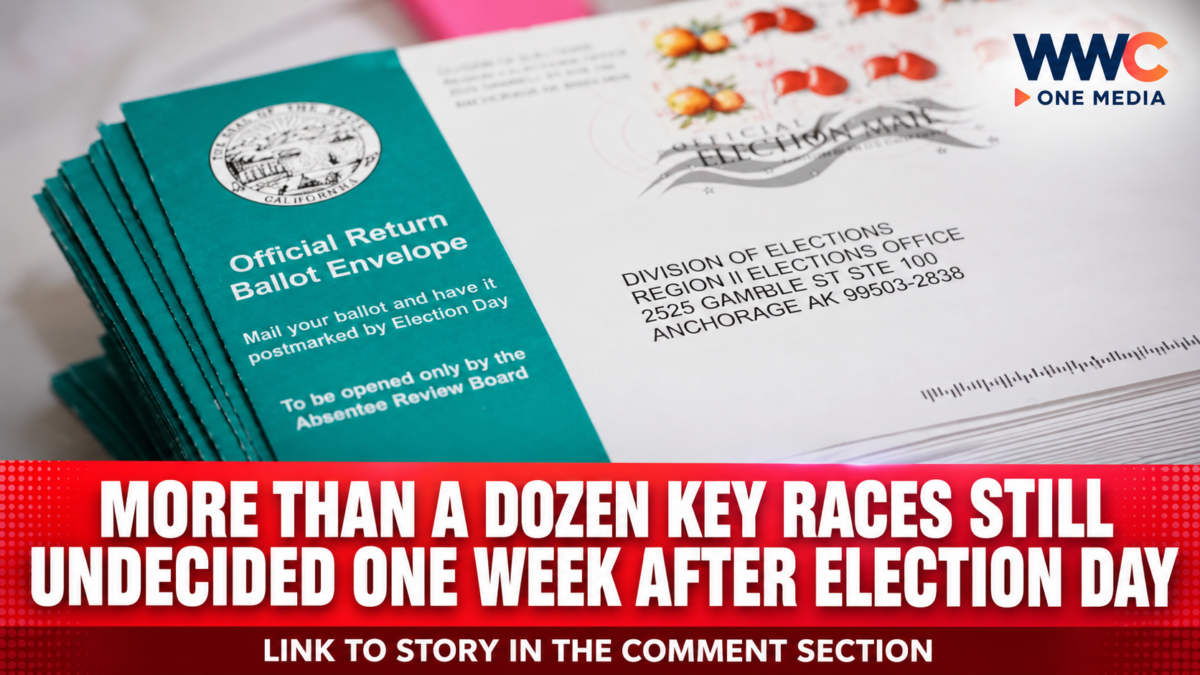
Democrats Secure Congress, but 12+ US Election Races Remain Uncalled — Could Alaska and Mississippi Deliver an Even Bigger Political Shock?
WASHINGTON, D.C. — November 11, 2026 — America’s midterm elections may have already delivered a historic political victory for Democrats, but the final battle for congressional seats is far from over.
More than a dozen major election races remain too close to call, one week after Americans voted on November 3, leaving the final size of the incoming Democratic majorities in the House of Representatives and Senate uncertain.
The Associated Press reported Tuesday that Democrats are on track to control 54 Senate seats beginning in January 2027 and have secured 255 House seats, potentially giving the party its largest elected House majority since 2008.
But two closely watched Senate contests in Mississippi and Alaska could still add one or two more seats to the Democratic column.
The outstanding results also include several tightly contested House districts and two gubernatorial races, where candidates remain separated by narrow margins or face additional rounds of counting.
For President Donald Trump and the Republican Party, the remaining ballots represent another political concern following their sweeping midterm losses.
For Democrats, the question is whether their already historic victory could become even larger.
Democrats Have Already Taken Control of Congress — But the Final Numbers Are Not Settled
The November 3 elections delivered a major reversal of political power in Washington.
Democrats won control of both chambers of Congress, ending Republican dominance of the House and Senate during Trump’s second presidency.
The victory gives Democrats greater influence over legislation, government spending, congressional investigations and oversight of the executive branch.
According to AP’s November 10 report, Democrats have secured 255 House seats and are projected to hold 54 Senate seats when the new Congress begins in January.
However, several races remain unresolved.
That means the final composition of Congress could still change as election officials complete the counting, resolve provisional ballots and certify results.
The distinction is important: control of Congress has already been determined, but the exact number of seats each party will hold is still being finalized.
A larger Democratic majority could give party leaders additional flexibility when organizing committees, managing legislation and deciding which investigations to prioritize.
Mississippi Senate Race: Scott Colom Leads Cindy Hyde-Smith by 2,600 Votes
One of the most closely watched remaining contests is Mississippi’s Senate election between Democratic challenger Scott Colom and Republican incumbent Cindy Hyde-Smith.
As of late Tuesday afternoon, November 10, Colom was leading Hyde-Smith by approximately 2,600 votes.
The narrow advantage has kept the race uncalled despite the growing Democratic lead.
The remaining ballots are particularly important because Mississippi has a complicated process for handling provisional and absentee votes.
According to AP, approximately 14,200 provisional ballots had been processed by Monday, with around 80% accepted.
Another approximately 2,700 mail-in absentee ballots had not yet been returned at that point.
Mississippi’s election officials faced a November 10 deadline for receiving eligible late-arriving absentee ballots.
Counties are required to submit certified election results, including provisional-ballot totals, to the state by Friday, November 13.
The state is scheduled to certify its final election results on December 3.
Why Mississippi’s Recount Rules Matter
Unlike many other states, Mississippi does not automatically conduct recounts when election margins are extremely close.
Candidates cannot simply request a recount because they disagree with the result.
A recount can take place only when ordered by a court.
That makes the remaining ballot count particularly important for both campaigns.
If Colom maintains his advantage after all eligible ballots are processed, Democrats could gain another Senate seat.
If Hyde-Smith closes the gap, Republicans could retain an important seat despite their nationwide electoral losses.
The outcome will depend on the remaining valid ballots and the state’s official procedures, not political predictions.
Alaska: Mary Peltola Holds a Narrow Lead Over Republican Dan Sullivan
Another major Senate contest is unfolding in Alaska, where Democrat Mary Peltola is challenging Republican incumbent Dan Sullivan.
As of Tuesday afternoon, Peltola was leading Sullivan by approximately 2,500 votes, with an estimated 76% of the vote counted.
The race is particularly complicated because Alaska uses ranked-choice voting.
Under the state’s system, voters rank candidates in order of preference.
If no candidate receives more than 50% of the first-choice votes, the lowest-performing candidates are eliminated and their ballots are redistributed according to voters’ next preferences.
This process continues until a candidate secures a majority.
Peltola was slightly more than one percentage point short of the majority needed to win outright in the AP’s Tuesday snapshot.
That means the final result could depend on additional absentee ballots and the ranked-choice tabulation.
November 18 Could Be the Decisive Date
Alaska accepts certain absentee ballots mailed from outside the United States as late as November 18.
The state has scheduled ranked-choice tabulation for that date if no candidate secures the required majority.
The target date for certifying the results is November 25.
Reuters previously reported that the Alaska Senate race could take weeks to resolve because of the state’s absentee-ballot deadlines and ranked-choice voting procedures.
Local reporting by Alaska Beacon also documented Peltola’s expanding lead in updated first-choice vote totals.
These developments show why the initial election-night results cannot be treated as the final outcome.
For Republicans, retaining Sullivan’s seat would prevent Democrats from making another Senate gain.
For Democrats, a Peltola victory could strengthen their already substantial majority.
More Than a Dozen House Races Remain Unresolved
The Senate is not the only battleground.
More than a dozen congressional races remain uncalled, with many candidates separated by less than one percentage point in the ballots counted by late Tuesday.
North Carolina has four unresolved House contests, the largest number among the states with outstanding races.
Other closely watched contests include:
- South Carolina’s 2nd Congressional District, where Republican incumbent Joe Wilson faces Democrat Zyon Khalia.
- Minnesota’s 1st Congressional District, where approximately 300 votes separated the leading candidates in the AP’s Tuesday count.
- Tennessee’s 4th Congressional District, where Democrat Victoria Broderick was trailing Republican incumbent Scott DesJarlais by approximately 300 votes.
- California’s 23rd Congressional District, one of the remaining contests with implications for the balance of the House.
The South Carolina contest has also involved a recount.
Wilson held a lead of approximately 3,000 votes in the original tally, with about 99% counted in AP’s Tuesday afternoon report.
In Minnesota, a recount may be requested under state law if the margin is below the required threshold.
Different states have different recount rules, certification deadlines and procedures for resolving disputed ballots.
That is why the remaining congressional contests may take additional days or weeks to settle.
Two Governor’s Races Are Also Still Undecided
The uncertainty extends beyond Congress.
Two gubernatorial contests also remained unresolved in AP’s November 10 reporting.
Kansas: Cindy Holscher Holds a Narrow Lead
Democratic state Senator Cindy Holscher was leading Republican state Senate President Ty Masterson by less than one percentage point in the Kansas governor’s race.
The state had already triggered a close-race audit requiring selected ballots to be counted by hand.
The audit must be completed before November 16, when counties are scheduled to certify their results.
The outcome could determine whether Democrats gain another governorship in a state where Republicans have traditionally held significant political influence.
Alaska: Ranked-Choice Voting Could Determine the Governor
Alaska’s gubernatorial contest is also awaiting a final outcome.
Democratic candidate Jonathan S. Kreiss-Tomkins was leading Republican Bernadette M. Wilson by approximately 45,000 votes in AP’s Tuesday afternoon snapshot.
However, Kreiss-Tomkins had approximately 49.6% of the first-choice vote, short of the majority required to win outright.
If no candidate crosses the 50% threshold, the race will proceed through ranked-choice tabulation.
This means Alaska’s election authorities may need additional time before determining the final winner.
Why These Remaining Votes Matter to Donald Trump
Although Democrats have already secured control of Congress, the unresolved races could influence how effectively the opposition party challenges Trump’s administration.
A larger Democratic majority could provide party leaders with additional support when organizing congressional committees, negotiating legislation and conducting investigations.
The Senate results are especially significant because Democrats are positioned to control the chamber during the final two years of Trump’s second term.
This could make confirmation proceedings, federal spending negotiations and major policy debates more difficult for the White House.
Democrats are also preparing investigations involving federal spending, the Iran war, artificial intelligence and cryptocurrency regulation.
However, a congressional majority does not automatically give Democrats the power to enact every policy they support.
Trump retains presidential veto authority, and Senate procedures can still affect how legislation advances.
The remaining election results will determine the precise balance of power, but the broader political shift has already occurred.
Why Vote Counting Takes So Long in the United States
The continuing uncertainty has raised questions among international observers about why American election results can take days or weeks to finalize.
The answer lies partly in the country’s decentralized election system.
Unlike countries with a single national election authority responsible for processing all ballots, the United States relies heavily on state and local election officials.
Each state has its own laws covering:
- Mail-in and absentee ballots.
- Provisional ballots.
- Voter identification requirements.
- Ballot verification.
- Recounts and legal challenges.
- Election certification deadlines.
Some states also have ranked-choice voting, which requires additional tabulation when no candidate receives the necessary first-choice majority.
In Mississippi, for example, provisional ballots require additional verification.
In Alaska, late-arriving eligible absentee ballots and ranked-choice procedures affect when final results become available.
These processes can delay final results without necessarily indicating that something has gone wrong.
The most important distinction is between unofficial vote totals, media projections and officially certified election results.
The Associated Press can call an election when its analysis determines that the trailing candidate no longer has a realistic path to victory, even while official certification remains pending.
What Other News Organizations Are Reporting
The latest developments have received attention from several American and international news organizations.
Reuters: Its November 6 reporting on Mississippi described disputes over the handling and preservation of remaining provisional ballots. It also explained how the Mississippi and Alaska Senate races could affect the final Democratic majority.
The Washington Post: Its November 9 coverage examined Mississippi’s ballot-counting deadlines and explained why the state does not provide an automatic recount when a race is extremely close.
Alaska Beacon: Its November 9 report documented Mary Peltola’s expanding lead over Dan Sullivan, including updated first-choice vote totals and the potential impact of ranked-choice voting.
Mississippi Today: Its November 10 coverage reported Colom’s approximately 2,604-vote lead and explained the importance of outstanding ballots in Hinds County, the state’s largest county.
Fox News: Its November 10 reporting also examined the expanding Alaska Senate margin and the possibility that ranked-choice tabulation could determine the winner.
Together, these reports demonstrate that the remaining contests are not simply delayed election results. They involve different state procedures, outstanding ballots and, in Alaska, an additional voting round.
What Happens Next?
The coming days will be crucial for determining the final composition of the incoming Congress.
Mississippi counties must transmit their election results to the state by November 13.
Kansas officials must complete the required close-race audit before November 16.
Alaska’s outstanding absentee ballots and possible ranked-choice tabulation could keep its Senate and gubernatorial races unresolved until November 18.
The certification schedule also differs by state.
Mississippi is targeting December 3 for certification, while Alaska has November 25 as its target date.
For House races, several states have their own recount and certification procedures that could further extend the process.
Until those procedures are completed, the remaining candidates cannot be treated as officially elected simply because they hold narrow leads in preliminary totals.
The Bottom Line: Democrats Have Won Congress, but the Final Election Score Is Still Being Written
The 2026 US midterm elections have already delivered a major political defeat for Donald Trump and the Republican Party.
Democrats have secured control of both chambers of Congress and are positioned to enter January 2027 with 54 Senate seats and at least 255 House seats.
But more than a dozen unresolved races could still reshape the final numbers.
In Mississippi, Scott Colom’s narrow lead over Cindy Hyde-Smith could deliver Democrats another Senate victory.
In Alaska, Mary Peltola’s advantage over Dan Sullivan could produce another major upset, although ranked-choice voting and outstanding absentee ballots remain decisive factors.
Several House districts and two gubernatorial races are also awaiting final results.
For the Republican Party, the remaining contests represent a final opportunity to limit the scale of its midterm losses.
For Democrats, they could provide even greater political leverage as the party prepares to confront the White House.
The bigger question now is whether the remaining ballots will simply confirm the Democratic wave — or deliver an even stronger congressional majority that could make Trump’s final two years in office far more difficult than expected.