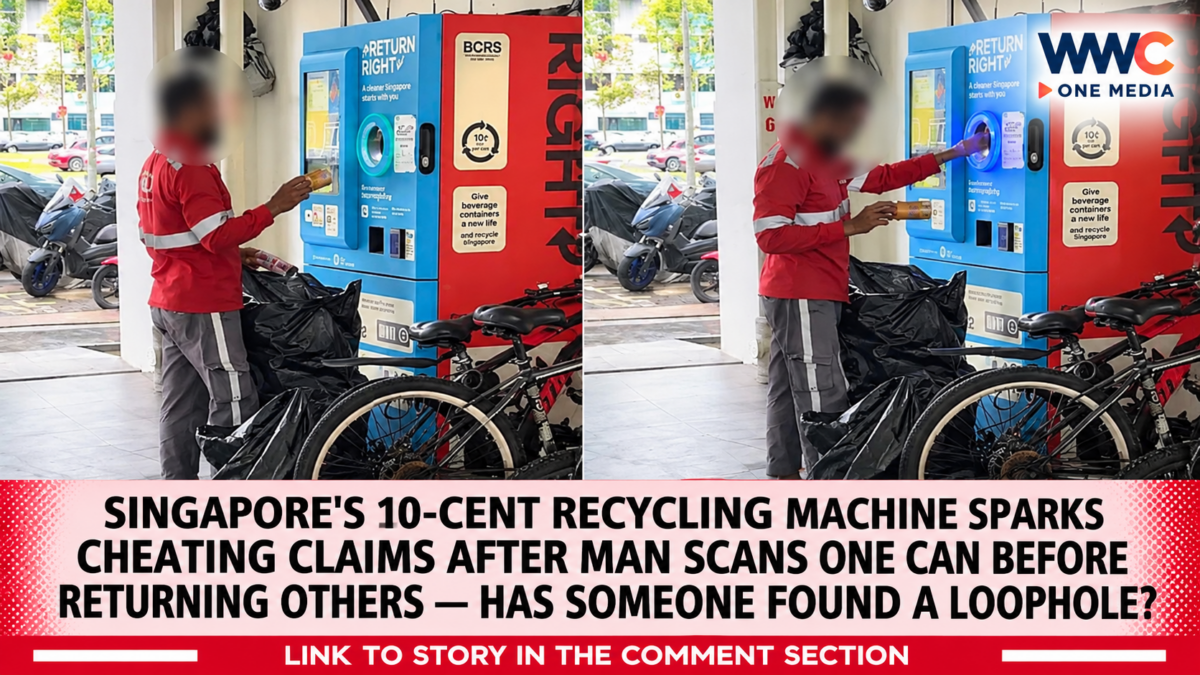
A viral video showing a man repeatedly scanning the barcode of one beverage can before inserting different containers into a Singapore recycling machine has triggered a heated online debate over whether the country’s 10-cent bottle-and-can refund scheme has a potential loophole.
The footage, shared on Reddit on November 9 and reported by AsiaOne on November 11, shows a man wearing a red uniform taking containers from a large black bag and placing them into a Beverage Container Return Scheme (BCRS) machine. Before inserting each container, he appears to scan the barcode from the same empty can.
The unusual sequence has prompted questions about whether the machine is recognising each container individually or whether scanning one eligible barcode could allow other containers to be accepted.
Some viewers suspect the man may have found a way to claim deposits on containers that do not qualify. Others believe he could simply be using a working barcode to speed up the process because some machines reportedly struggle to read damaged or poorly positioned labels.
But there is an important distinction: the video does not establish that the man committed fraud, that the other containers were ineligible, or that he successfully received refunds for every item. AsiaOne reported that the location and date of the recording were unclear and that the National Environment Agency (NEA) had been contacted for clarification. AsiaOne+2
The incident has nevertheless raised a bigger question about Singapore’s nationwide recycling programme: can its reverse vending machines reliably verify every bottle and can, or could weaknesses in the return process undermine public confidence in the system?
What the Video Actually Shows
The video, originally posted by TikTok user @galileolu and subsequently shared on Reddit’s r/singaporespeaks forum, shows the man taking several containers from a large black bag.
He appears to scan the barcode on one empty can, remove that can and then insert another beverage container into the machine. He repeats the sequence several times.
The footage attracted different interpretations:
- Possible loophole: Some viewers believe the machine may be accepting different containers after recognising the barcode on the first can.
- A practical workaround: Others suggest that the man may be using a readable barcode because the labels on his other containers are difficult for the machine to scan.
- Recycling rather than cheating: Some commenters argue that the important outcome is that more beverage containers are being collected instead of discarded.
- Questions about fairness: Others want to know whether someone should receive a refund for a container that does not carry the required deposit mark.
AsiaOne reported that the video did not establish whether the other containers carried the BCRS Deposit Mark or whether the man was actually receiving refunds for ineligible items.
That distinction matters because an unusual-looking method of operating a machine is not, by itself, proof of fraud. AsiaOne+2
How Singapore’s 10-Cent BCRS Scheme Works
Singapore introduced the Beverage Container Return Scheme on April 1, 2026, with full implementation beginning October 1 after a six-month transition period.
The programme places a refundable S$0.10 deposit on eligible pre-packaged beverages sold in regulated plastic and metal containers.
Consumers pay the deposit when purchasing a qualifying drink and can recover it by returning the empty container through an approved Return Right reverse vending machine.
The scheme covers:
| Requirement | BCRS rules |
|---|---|
| Refund | S$0.10 per eligible container |
| Container materials | Plastic and metal |
| Container size | 150ml to 3 litres |
| Identification | Official BCRS Deposit Mark |
| Condition | Empty and uncrushed, with barcode clearly visible |
| Excluded packaging | Glass bottles, cartons and pouches |
The scheme includes pre-packaged beverages such as bottled water, soft drinks, juices, dairy drinks and alcoholic beverages.
Freshly prepared drinks, including freshly brewed coffee, freshly squeezed juice and bubble tea prepared at the point of sale, are generally excluded.
Most importantly, not every empty bottle or can automatically qualifies for a 10-cent refund. The official deposit mark is essential. National Environment Agency+1
Could Scanning One Can Allow Someone to Return Another?
This is the central technical question raised by the footage.
The man appears to use the barcode on one can repeatedly while inserting other containers. Some viewers interpreted this as a possible way of bypassing the machine’s container-recognition process.
However, the video does not provide enough information to establish exactly how the machine processed each transaction.
There are several possibilities:
- The machine may have accepted each container through a process that viewers cannot fully see in the recording.
- The other containers may have carried valid deposit marks, but their barcodes were difficult to scan.
- The man may have been using the first can to help position or trigger the scanning process.
- The footage may not show whether the machine actually credited a refund for every container.
These are possibilities raised by the video and online discussion, not confirmed explanations from the scheme operator.
Lianhe Zaobao separately reported that another user tested a possible workaround by scanning an eligible bottle, withdrawing it and then inserting a different container while the machine’s conveyor belt was still running.
That test raised further questions about whether a machine could continue its acceptance process after the original container was removed.
But a demonstration or apparent machine response does not establish that an invalid refund was successfully processed. The operator would need to examine transaction records and machine data to determine whether any technical weakness exists. Lianhe Zaobao+1
Netizens Are Divided Over Whether the Man Was Cheating
The online reaction has been far from unanimous.
Some users questioned whether the man was exploiting a weakness in the system, arguing that the machines should verify every container independently before issuing a refund.
Others defended him, suggesting that he might simply have discovered a faster way to process a large collection.
One argument repeatedly raised was that some containers carrying the official deposit mark can still be rejected because their barcodes are difficult for machines to detect.
Other commenters focused on the environmental objective, arguing that collecting more cans and bottles is beneficial regardless of who returns them.
The debate also reflects a broader question about how Singaporeans view people collecting recyclable materials for financial returns.
For some, the 10-cent deposit is simply a refund for a drink they purchased. For others, collecting discarded containers can become a small source of additional income.
The disagreement is therefore about more than machine technology. It also touches on fairness, recycling habits and whether the scheme is working as intended. AsiaOne+1
More Than 48 Million Containers Had Already Been Collected
Despite the controversy, Singapore’s BCRS has recorded substantial participation.
According to the NEA’s October 1 update, more than 48 million beverage containers had been collected by September 27, 2026, representing more than 823 tonnes of material diverted from incineration.
The average number of containers returned per transaction also increased from 2.8 in April to 8.2 in September.
The collected materials consisted of approximately 55 per cent plastic and 45 per cent metal.
These figures suggest that consumers were becoming more familiar with the return process during the scheme’s initial months.
The collection network has also expanded, with more than 1,300 machines deployed by late September and further expansion planned. AsiaOne+1
The figures are encouraging, but the latest video highlights why participation numbers alone cannot determine whether the system is operating perfectly. Machines must also accurately recognise eligible containers and prevent incorrect refunds.
The Scheme Has Already Faced Complaints About Machine Performance
The latest controversy is not the first time Singapore’s recycling machines have attracted criticism.
During the transition period, consumers reported problems involving rejected containers, scanning difficulties, machine errors and cleanliness.
In response to feedback, BCRS introduced operational improvements ahead of full implementation on October 1.
These included adjustments to machine performance and a simpler digital refund process for users who encounter transaction problems.
The refund portal allows consumers to submit a claim using information from the machine’s service ticket. The expected processing period for verified claims was reduced from up to 30 working days to up to 10 working days, subject to bank processing.
WWC ONE MEDIA previously reported on these changes in Singapore’s Beverage Container Return Scheme Fully Begins With Faster Refunds and Improved Machines.
A separate report examined the updated refund arrangements in Singapore’s Beverage Container Return Scheme Goes Fully Live With Faster Refunds.
The new video could add another issue for the operator to investigate: whether the machines consistently verify the actual container being returned rather than relying on an earlier scanning action.
BCRS Has Also Created Unexpected Competition Over Discarded Bottles and Cans
The 10-cent refund has changed how some people view empty beverage containers.
Items that previously had little immediate financial value can now be collected and exchanged for money if they meet the scheme’s requirements.
In September, a Singapore man attracted attention after showing how he collected large quantities of bottles and cans and reportedly received nearly S$80 in refunds.
WWC ONE MEDIA covered the story in Good Morning, 10 Cents: Singapore Man Turns Discarded Bottles and Cans Into Nearly $80 Through Recycling.
Another unusual example involved a young Singapore boy who built his own miniature BCRS machine to encourage recycling in his neighbourhood.
Read the report: Singapore Boy Builds His Own BCRS Machine and Becomes a Neighbourhood Recycling Ambassador.
These stories demonstrate two very different responses to the same programme: some people see the deposit as an opportunity to earn extra money, while others see it as a way to encourage environmental awareness.
But as more people begin collecting containers, authorities must also ensure that recycling activity does not create problems in shared public spaces.
What the Rules Say About Collecting Containers From Public Bins
The BCRS encourages people to return eligible containers, but it does not give everyone unrestricted permission to remove items from public rubbish bins.
Singapore’s Minister for Sustainability and the Environment, Grace Fu, previously clarified that rummaging through public refuse bins to retrieve bottles and cans is discouraged and may constitute an offence under existing public-cleansing regulations.
The concern includes hygiene risks, possible exposure to sharp or contaminated waste and disruption to public refuse management.
Authorities may issue advisories depending on the circumstances and can refer vulnerable individuals to social service agencies for support.
WWC ONE MEDIA examined the clarification in Singapore Warns Against Rummaging Through Public Bins for 10-Cent Drink Deposits — Even Without Leaving a Mess, Offenders Could Face Fines.
However, this is a separate issue from the barcode-scanning video. There is no confirmed evidence in the footage that the man obtained the containers by rummaging through a public rubbish bin.
It is important not to confuse the legality of collecting containers with the separate question of whether a machine has a technical weakness.
What the NEA and BCRS Need to Clarify
The controversy leaves several questions that could help restore public confidence in the scheme:
- Does the machine independently verify every container before crediting a refund?
- Can a barcode scan remain active after the original container is removed?
- What happens when a container has the official deposit mark but its barcode cannot be read?
- Can transaction records identify whether the same barcode is being used repeatedly for multiple refunds?
- Are the machines designed to prevent refunds for containers that do not meet the scheme’s requirements?
AsiaOne reported that it had contacted the NEA for further information.
Until the authorities or BCRS provide an explanation, it would be premature to conclude that the man exploited a confirmed loophole or that the scheme has a widespread technical problem.
A clear explanation of how the machines verify containers would help distinguish legitimate workarounds from actual misuse.
Why This Matters for Singapore’s Recycling Targets
The BCRS was introduced to improve the recovery of plastic and metal beverage packaging and encourage consumers to develop better recycling habits.
The NEA estimates that the programme could cover more than one billion beverage containers annually and recover over 16,000 tonnes of material each year.
The scheme also forms part of Singapore’s wider move towards a circular economy, in which materials are collected and reused instead of being discarded after a single use.
But a deposit-return system depends on public trust.
Consumers must believe that the refund process is fair, that eligible containers are recognised correctly and that the system does not reward improper claims.
If the machines can be manipulated, the operator may need to strengthen technical controls. If the footage simply shows a practical way to handle difficult-to-scan containers, clearer public guidance could prevent unnecessary accusations.
Either way, the latest controversy offers an opportunity to improve the programme while it is still relatively new.
The Bigger Question Behind the Viral BCRS Video
Singapore’s 10-cent recycling scheme was designed to make returning bottles and cans simple. Yet a short video showing one man apparently scanning a single can before inserting several others has raised questions that go beyond the value of the refund.
The footage has not proven fraud, and the eligibility of the containers remains unclear. But the public deserves to know how the machines verify each item and whether the same barcode can be used to obtain multiple refunds.
With millions of containers already collected, the programme has demonstrated significant public participation. Its next challenge is ensuring that the technology, rules and refund process remain reliable as usage grows.
If one viral video can raise doubts about how Singapore’s recycling machines work, could a confirmed technical loophole put the entire 10-cent refund scheme under pressure?