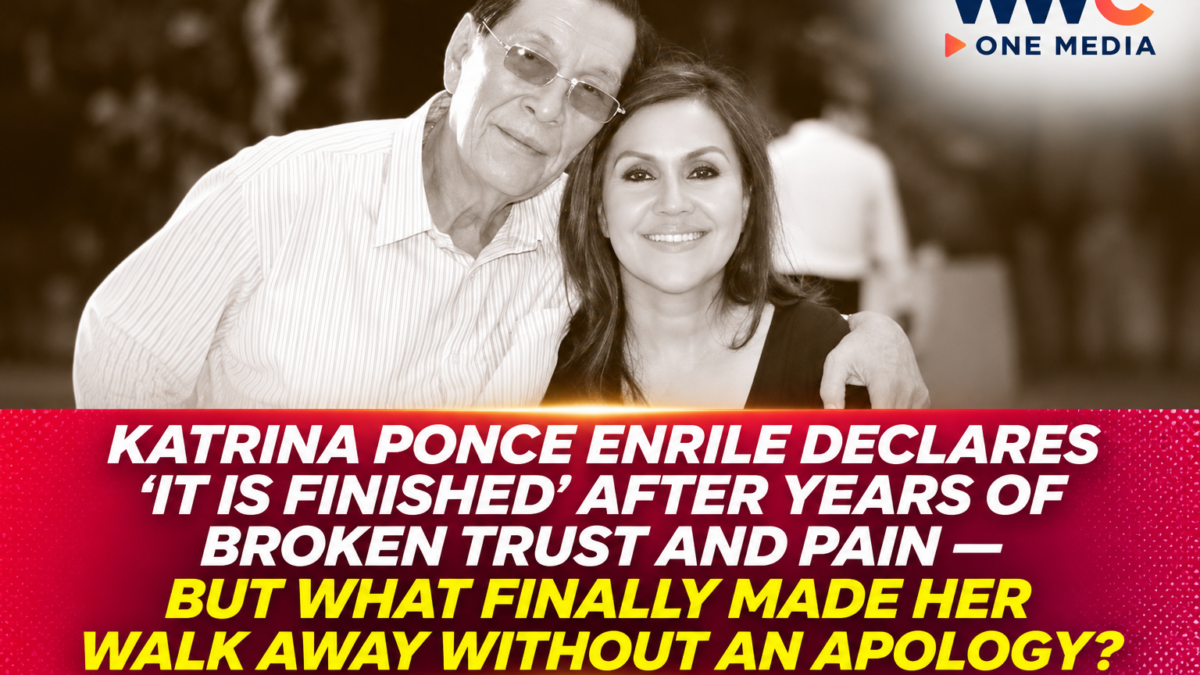
MANILA, PHILIPPINES — November 10, 2026 — Cagayan Economic Zone Authority (CEZA) Administrator and Chief Executive Officer Katrina Ponce Enrile has shared an emotional declaration about broken trust, painful disappointments, forgiveness and finally finding the courage to move forward without waiting for explanations or apologies.
In a deeply personal Facebook reflection reported by Bilyonaryo on Tuesday, November 10, the daughter of the late Senate President Juan Ponce Enrile revealed that she had reached the end of what she described as a long and difficult chapter in her life.
Her message carried a striking title: “Tetelestai: It is finished. It is accomplished. It is fulfilled.”
But rather than publicly confronting anyone or revealing the identities of people who may have disappointed her, Enrile chose a different approach.
She spoke about accepting painful experiences, forgiving herself for past decisions and recognizing that closure does not always require another person’s participation.
For the public official and businesswoman, the message was not about seeking revenge.
It was about reclaiming peace.
Katrina Ponce Enrile Explains Why ‘Tetelestai’ Means More Than Goodbye
At the center of Enrile’s statement was the ancient Greek word Tetelestai, commonly translated as “It is finished.”
The expression carries particular significance in Christianity because it is associated with the final words of Jesus Christ on the cross, recorded in the Gospel of John.
Enrile drew on that spiritual meaning to explain why the word resonated with her present circumstances.
For her, the expression meant more than simply declaring that something had ended.
It represented the completion of a difficult personal journey and the acceptance of lessons learned along the way.
Her message suggested that some experiences are not meant to last indefinitely, even if they profoundly influence the person who goes through them.
Some relationships, expectations and promises may shape a person’s life without becoming permanent parts of their future.
That realization formed the foundation of her announcement.
Rather than measuring closure through an apology, a confrontation or a final explanation, Enrile described reaching a point where she had learned enough to move forward.
Broken Trust, Disappointment and Lessons Learned the Hard Way
One of the most revealing parts of Enrile’s reflection concerned the disappointment of placing trust in people and situations that failed to meet her expectations.
She acknowledged that sincerity is not always returned with sincerity.
Good intentions, she suggested, do not guarantee that others will respond with equal commitment or honesty.
She also reflected on questioning her judgment and continuing to believe in promises longer than she now thinks she should have.
The statement offered a glimpse into the emotional weight of those experiences.
However, she did not identify specific individuals, relationships or incidents connected to her remarks.
That distinction is essential.
Although her reflections addressed broken trust, they should not be interpreted as confirmation of a romantic separation, a particular business dispute or an accusation against a known public figure.
Enrile’s message was about her personal response to disappointment rather than a public disclosure of the events behind it.
Why Katrina Says Forgiving Herself Matters
Perhaps the most significant part of her statement was her emphasis on self-forgiveness.
Enrile acknowledged that part of moving forward involved accepting her own decisions, including moments when she overlooked warning signs or continued extending second chances.
Rather than continuing to punish herself for the time and opportunities she believed she had lost, she expressed a desire to make peace with the past.
This shift from seeking accountability from others to examining one’s own response is a familiar theme in conversations about personal healing.
People who experience broken trust may spend considerable time trying to understand why an event occurred or why someone acted in a particular way.
Enrile’s message suggested that she no longer wished to make her future dependent on obtaining those answers.
The distinction between forgiveness and reconciliation is important.
Forgiving someone does not necessarily mean restoring a relationship, accepting harmful conduct or abandoning personal boundaries.
Sometimes forgiveness means choosing not to allow past experiences to determine future decisions.
That idea has also appeared in other Philippine entertainment stories.
In related coverage, WWC ONE MEDIA reported how actor Buboy Villar and former partner Angillyn Gorens reached a place of forgiveness after years of public conflict.
Their circumstances were different from Enrile’s, but both stories illustrate how forgiveness can take different forms.
In Villar’s case, it involved improved communication and co-parenting.
For Enrile, her latest message centers on personal acceptance and moving forward.
‘Not Directed at Anyone’: Enrile Clarifies Her Emotional Declaration
Despite the strong language in her message, Enrile made clear that her declaration was not an attack on another person.
She described Tetelestai as a deeply personal acknowledgment that she had completed a painful period in her life.
She also said she was leaving unresolved matters to God rather than continuing to seek answers.
That clarification matters because emotional social media messages from public personalities are frequently interpreted as indirect references to specific individuals.
Without supporting evidence, however, such interpretations can quickly turn personal reflections into unfounded rumors.
Enrile did not announce a new legal dispute.
She did not accuse an identified individual of betrayal.
She did not announce that she was ending a specific relationship.
Instead, she presented her statement as a personal turning point.
Her emphasis was on letting go of emotional burdens while remaining open to the future.
A Difficult Year Following the Death of Juan Ponce Enrile
The reflection comes as Enrile approaches the first anniversary of her father’s death.
Former Senate President Juan Ponce Enrile died on November 13, 2025, at the age of 101.
His death marked the end of a long and controversial political career spanning several administrations and important periods of Philippine history.
For Katrina, the loss was also deeply personal.
In a January 11, 2026 interview published by Daily Tribune, she discussed her life following her father’s passing and described the difficulty of processing grief while continuing her responsibilities.
She had already spoken about releasing bitterness and learning from painful experiences in reflections on the previous year.
Her latest message therefore follows earlier public statements about loss, forgiveness and personal change.
However, she did not say that her November 10 declaration was specifically caused by her father’s death.
It would be inaccurate to present grief over his passing as the sole explanation for the disappointments she described.
Rather, her remarks suggest a broader process of reflection that she has chosen to discuss publicly without revealing every personal detail.
Katrina Ponce Enrile’s Public Life Beyond Her Family Name
Katrina Ponce Enrile is known not only as the daughter of a former Senate president but also as a business executive and public official.
She was appointed administrator and chief executive officer of the Cagayan Economic Zone Authority in May 2023.
CEZA is responsible for developing and managing the Cagayan Special Economic Zone and Freeport, an area intended to attract investment, business activity and employment opportunities.
Before her appointment, Enrile held leadership roles in businesses associated with the JAKA Group and other corporate interests.
Her public responsibilities have placed her in situations involving economic development, investment promotion and government accountability.
Yet her latest social media reflection focused almost entirely on personal experiences rather than her professional responsibilities.
That contrast is one reason the message has drawn attention.
It offered a more introspective side of a personality commonly associated with business, government and Philippine political history.
The Difference Between Closure and Public Reconciliation
Enrile’s statement also raises a question that extends beyond her own experience: does moving forward require another person’s apology?
In many public controversies, reconciliation is treated as the expected conclusion.
People are often encouraged to explain themselves, apologize and eventually repair damaged relationships.
But closure does not always involve a reunion.
Sometimes individuals decide that maintaining distance is necessary even after letting go of resentment.
A similar distinction appeared in WWC ONE MEDIA’s coverage of actress and content creator Jelai Andres, who spoke about finding peace after the annulment of her marriage.
Andres described moving forward after a long period of controversy, although her circumstances were separate from Enrile’s.
Another example involves Olympic champion Carlos Yulo, whose public comments about forgiving family members have not necessarily meant that every family disagreement has been resolved.
These stories highlight an important distinction: forgiveness, reconciliation and renewed trust are not interchangeable.
Enrile’s message fits into that broader discussion, although she has deliberately kept the circumstances behind her reflections private.
Faith and Acceptance Take Center Stage
Religion also plays an important role in Enrile’s declaration.
By invoking Tetelestai, she connected her experience to a Christian expression of completion and fulfillment.
She emphasized leaving unresolved questions to God and trusting that her future could hold meaningful possibilities beyond the difficulties of the past.
Her words presented acceptance as an active decision rather than a passive surrender.
She was not suggesting that disappointment had never occurred.
Instead, she appeared to be acknowledging that continually revisiting old experiences no longer served the future she wanted to build.
A different but related story of forgiveness appeared in WWC ONE MEDIA’s report on Singapore hawker Dominic Neo, who publicly appealed for reconciliation with his estranged children after more than two decades apart.
Neo’s public appeal sought a response from family members, while Enrile’s statement emphasized moving forward without requiring answers.
Both accounts demonstrate how people can approach unresolved relationships differently.
For Enrile, faith appears to be central to the peace she says she has found.
Why Her Message Is Resonating Beyond Politics
Katrina Ponce Enrile’s statement may attract attention because of her prominent family name and public position, but its central themes are familiar to many people.
Broken trust, disappointment, self-doubt and the difficulty of letting go are experiences that extend across personal and professional relationships.
Her reflections also challenge the idea that people must always receive an apology or explanation before they can move forward.
There is no confirmed public evidence identifying the individuals or situations behind her latest declaration.
But her refusal to name names may itself be significant to the message she intended to communicate.
Rather than inviting an argument about the past, she framed her statement as the conclusion of a personal chapter.
Whether people interpret it as an act of forgiveness, spiritual growth or simply a declaration of independence, the message she shared was clear: she wants to focus on the life ahead rather than remain attached to past disappointments.
The Bigger Picture: Katrina Ponce Enrile Chooses a New Beginning
Katrina Ponce Enrile’s November 10 declaration is not a formal announcement of a breakup, resignation or dispute.
It is a personal statement about difficult lessons, forgiveness and the decision to stop searching for answers she may never receive.
Her use of Tetelestai suggests that she sees the chapter as complete—not because every question has been answered, but because she has decided that the unanswered questions no longer need to control her future.
The CEZA chief has chosen not to reveal the identities of those involved in her reflections.
She has also made clear that she does not intend to reopen the past through the statement.
What remains is a declaration of personal closure.
Katrina Ponce Enrile says she has finished carrying the weight of old disappointments. But as she turns toward a new chapter, the most intriguing question may not be who broke her trust—it may be what she will build now that she has chosen to move forward.