TOKYO, JAPAN — November 10, 2026 — The Japanese yen could stage a significant comeback against the US dollar in 2027, according to one of the currency market’s most accurate forecasters, challenging widespread expectations that Japan’s currency will remain under pressure from higher American interest rates.
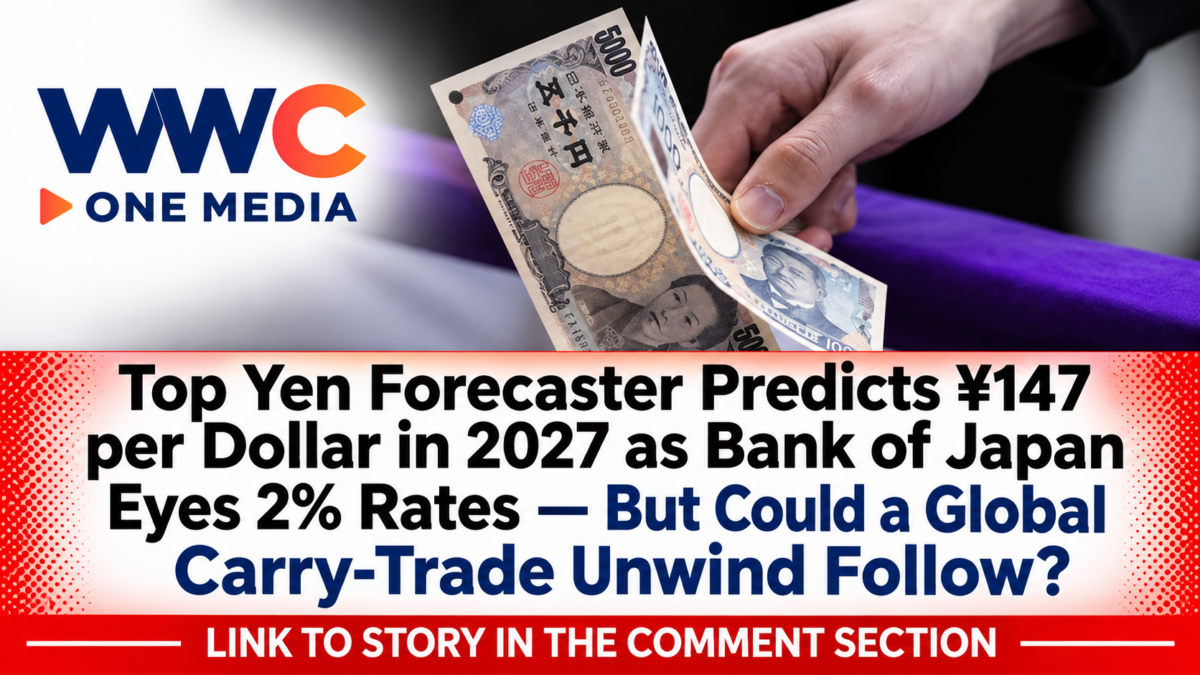
Neil Parker, head of economics and market strategy at London-based foreign-exchange company TTT Moneycorp, predicts the yen will strengthen to approximately ¥147 per US dollar in 2027, compared with around ¥158 currently.
The forecast, reported by Bloomberg on November 9, follows Parker’s rise to the top of the news organization’s latest dollar-yen forecasting rankings.
His outlook is based on one central expectation: the Bank of Japan will raise interest rates more aggressively than many investors anticipate, reducing the return advantage currently available on US dollar assets.
Parker expects the Japanese central bank to lift its benchmark interest rate from 1.25% to at least 2%, with a possible increase to 2.25%.
He also believes the US Federal Reserve may deliver another rate increase in December before holding borrowing costs around 4.00% to 4.25%.
But his prediction comes with a remarkable contradiction.
Another leading currency forecaster, who topped Bloomberg’s rankings in the previous quarter, expects the yen to weaken as far as ¥170 per dollar in 2027.
The enormous difference between those projections highlights how uncertain the outlook has become.
As Japan prepares for potentially higher interest rates and the United States confronts persistent inflation, could the yen’s recovery toward ¥147 reshape global investment flows—or will the currency instead plunge toward ¥170 and trigger another round of government intervention?
Why Bloomberg’s Top Yen Forecaster Expects ¥147
Parker has spent nearly three decades studying foreign-exchange markets.
His experience includes major financial crises, repeated currency interventions and periods of extreme volatility in the yen.
His latest Bloomberg ranking reflects the accuracy of his recent forecasts relative to other participating analysts.
But strong past performance does not guarantee that his next prediction will prove correct.
Parker expects the currency to strengthen to approximately ¥155 per dollar by the end of 2026 before appreciating further toward ¥147 next year.
The forecast represents a significant change from the yen’s average exchange rate of approximately ¥158 during 2026.
At an exchange rate of ¥158, one US dollar buys 158 yen.
At ¥147, the same dollar would buy only 147 yen.
That means the yen would have strengthened against the US currency.
Measured from ¥158 to ¥147, the yen’s dollar value would increase by approximately 7.5%.
For businesses, travelers, currency traders and international investors, such a movement could have meaningful financial consequences.
Bank of Japan Could Raise Interest Rates Above 2%
Parker’s prediction rests heavily on the direction of Japanese monetary policy.
The Bank of Japan currently maintains its benchmark interest rate at 1.25%, its highest level in approximately three decades.
For much of the previous generation, Japan operated with extremely low or negative borrowing costs.
Those policies were designed to stimulate economic activity and combat persistent deflation.
But Japan’s economic environment has changed.
Consumer prices have increased, wages have begun responding and the central bank now believes underlying inflation is broadly consistent with its 2% target.
Parker expects the BOJ to continue raising rates.
His forecast of at least 2%, potentially reaching 2.25%, is more aggressive than the outlook of many other analysts.
A move from 1.25% to 2% would represent an additional 75 basis points of tightening.
Reaching 2.25% would require a full percentage point of further increases.
These are Parker’s forecasts, not decisions already made by the central bank.
WWC ONE MEDIA examined the BOJ’s latest internal debate in Bank of Japan Signals December Rate Hike to 1.50% as Inflation Pressure Mounts — But Could the Yen Trigger a Global Market Shock?.
That report explored why some policymakers want faster tightening while others remain concerned about weak household spending.
Japan’s November 10 Policy Summary Strengthens the Debate
The Bank of Japan released a summary of opinions from its October 29–30 policy meeting on November 10.
The document showed that some policymakers believe another interest-rate increase should occur without excessive delay.
Others argued for caution because previous increases have not yet fully affected the economy.
The central bank held rates at 1.25% during the October meeting.
Reuters reported that economists generally expected another increase to 1.50% in December, with eventual rates potentially reaching 1.75% to 2%.
That is broadly consistent with the direction of Parker’s forecast, although his upper range is more aggressive.
A December increase remains uncertain.
Governor Kazuo Ueda and the BOJ’s Policy Board must consider inflation, wages, consumption and financial conditions.
The decision will also be influenced by the outlook for global demand and Japan’s financial markets.
For the yen, the central question is not simply whether the BOJ raises rates.
It is whether the central bank tightens more quickly or more extensively than investors already expect.
Currency prices generally reflect anticipated policy decisions before they happen.
A widely expected rate increase may therefore produce a smaller reaction than an unexpected shift in guidance.
US Interest Rates Remain the Other Half of the Equation
The yen’s direction also depends on Federal Reserve policy.
Parker expects the Fed to raise rates once more in December before pausing around a federal funds target range of 4.00% to 4.25%.
That would leave US rates substantially higher than Japanese borrowing costs.
However, the difference would be narrower if the BOJ continued increasing rates.
For investors, that matters because higher-yielding currencies often attract capital from countries with lower interest rates.
If the advantage of holding US dollar assets diminishes, some investors may reconsider their allocations.
But the Fed is not committed to Parker’s forecast.
On November 9, Richmond Federal Reserve President Tom Barkin emphasized the need for caution as policymakers balance persistent inflation against possible risks to employment and growth.
Markets were anticipating another US rate increase, particularly after stronger-than-expected employment data.
Reuters reported that investors were assigning a high probability to a December hike.
The US inflation report due later in the week could shift those expectations.
Stronger inflation could support higher US yields and the dollar.
Weaker price pressures or deteriorating economic conditions could change the outlook.
Consequently, Parker’s prediction depends on monetary developments in both countries.
How a Narrower Interest-Rate Gap Could Strengthen the Yen
The difference between US and Japanese interest rates is one of the most closely watched factors in foreign-exchange markets.
For example, a US benchmark rate of 4.25% compared with a Japanese rate of 1.25% produces a three-percentage-point difference.
If Japanese rates rise while US rates remain stable, that gap narrows.
A smaller difference can reduce the financial incentive to borrow yen and invest in dollar-denominated assets.
It may also encourage investors to hold more Japanese securities.
Parker believes another approximately 50 basis points of narrowing in the interest-rate differential during the middle to latter part of 2027 could be sufficient to change market expectations.
That does not mean a half-percentage-point change automatically produces a specific exchange rate.
Currency prices also respond to economic growth, government policy, geopolitical risks and investor behavior.
Parker’s argument is that markets may be underestimating how far the BOJ is prepared to tighten.
If he is correct, the yen could strengthen as investors adjust their positions.
Japan’s Underlying Inflation Could Be the Deciding Factor
Parker pays particular attention to Japanese inflation excluding fresh food and energy.
That measure helps reveal more persistent domestic price pressures.
Japan’s September reading increased approximately 2.4% from a year earlier.
Parker believes an acceleration toward 2.6% or higher could encourage the central bank to tighten more aggressively.
The underlying concern is that inflation may become increasingly embedded in wages and corporate pricing decisions.
For decades, Japan struggled to generate sustained inflation.
Now policymakers must determine whether price growth is becoming too strong.
A faster pace of monetary tightening could support the yen by increasing returns on Japanese assets.
But higher rates could also make borrowing more expensive for businesses and households.
The BOJ must therefore balance inflation control against economic growth.
WWC ONE MEDIA previously examined this challenge in Japanese Yen Gains as Bank of Japan Declares Inflation Has Reached 2% Target — But Could a December Rate Hike Trigger a Bigger Currency Rally?.
That report explained how Japan’s changing inflation outlook is influencing currency expectations.
Why Another Top Forecaster Sees ¥170 Instead
The strongest challenge to Parker’s view comes from the opposite end of the forecasting spectrum.
According to Bloomberg, the top dollar-yen forecaster from the previous quarter expects the currency pair could reach ¥170 per dollar in 2027.
That would represent considerable yen weakness.
At ¥170, each US dollar would buy more yen than it does today.
Such a scenario could develop if US rates remain high, the BOJ tightens more slowly than anticipated or Japanese economic growth disappoints.
Investors could also continue favoring dollar-denominated assets because of their higher yields.
The competing predictions illustrate the difficulty of forecasting currencies during a period of monetary-policy transition.
Parker believes the market is underestimating Japanese tightening.
Other forecasters see persistent support for the US dollar.
Neither outcome is certain.
The ¥147 and ¥170 figures are alternative forecasts, not announced trading targets that central banks are obligated to defend.
Japan Already Intervened After the Yen Hit ¥163.99
The debate follows an extremely volatile year for the Japanese currency.
Bloomberg reported that the yen weakened to approximately ¥163.99 per dollar in July, before Japanese and US authorities intervened.
The move came after the currency had experienced sustained pressure from the wide interest-rate difference between the two countries.
Japan’s government has repeatedly expressed concern about excessive and disorderly currency movements.
In earlier interventions, authorities sold dollars and purchased yen to support the Japanese currency.
Reuters reported that the United States and Japan coordinated their efforts during 2026, demonstrating unusual cooperation between the two countries.
But foreign-exchange intervention has limitations.
Buying yen can temporarily strengthen the currency, especially when traders are caught holding large speculative positions.
However, the effect may fade if interest-rate differences continue favoring the dollar.
WWC ONE MEDIA explored that problem in Japan’s Yen Suddenly Surges as Tokyo Warns Currency Traders — But the Real Trigger May Not Be Intervention.
The report highlighted why durable currency support may require changes in monetary fundamentals, not just government purchases.
Could ¥147 Trigger a Yen Carry-Trade Unwind?
One of the biggest international concerns is the yen carry trade.
For years, investors have borrowed yen at relatively low interest rates and invested the proceeds in higher-yielding foreign assets.
The strategy can generate returns when foreign yields exceed Japanese funding costs and exchange rates remain favorable.
But it carries currency risk.
If the yen appreciates substantially, investors who borrowed in yen may need more foreign currency to repay the same yen-denominated debt.
That can erase interest-rate gains or produce losses.
For example, a trader who borrowed yen when the exchange rate was ¥158 per dollar could face a more expensive repayment if the currency strengthened to ¥147.
A rapid adjustment could encourage investors to close positions.
That may involve selling overseas assets and buying yen.
In heavily leveraged markets, simultaneous selling could intensify volatility.
However, the forecast of ¥147 does not automatically imply a disorderly carry-trade unwind.
Some investors use hedging strategies, and others hold yen-denominated liabilities for legitimate commercial purposes.
The effect depends on leverage, positioning and how quickly the exchange rate changes.
A gradual appreciation could be easier for financial markets to absorb than a sudden shock.
A Stronger Yen Could Help Japanese Households
A strengthening currency would have consequences beyond financial trading.
Japan imports substantial quantities of energy, food and industrial materials.
Many international commodities are priced in US dollars.
When the yen appreciates, those imports can become less expensive in yen terms, assuming foreign prices remain unchanged.
That could help reduce some inflationary pressure.
Lower imported costs may eventually benefit businesses and consumers.
But those effects are not immediate or guaranteed.
Retail prices depend on contracts, transportation, taxes, operating costs and company decisions.
For households already struggling with high living expenses, lower import-price pressure could provide relief.
Yet stronger yen exchange rates are only one part of the economic outlook.
WWC ONE MEDIA examined the weakness in domestic demand in Japan Household Spending Crashes 6.8% in Worst Slump Since 2020 as Inflation Squeezes Families — But Could a December BOJ Rate Hike Make Things Worse?.
The report illustrates why policymakers cannot focus solely on strengthening the currency.
Higher borrowing costs could ease inflation but may also discourage spending.
Japanese Exporters Could Face New Challenges
The effects of yen appreciation would not be equally positive across the economy.
Many Japanese exporters earn substantial revenue in foreign currencies.
Automakers, electronics companies and machinery producers sell products across international markets.
When the yen strengthens, the domestic-currency value of those overseas sales may decline.
That can affect reported revenue and profitability.
A stronger yen can also make Japanese-made products more expensive for overseas buyers.
However, multinational businesses often manufacture products abroad and use currency hedging arrangements.
Those strategies can reduce, but not necessarily eliminate, their foreign-exchange exposure.
The consequences therefore depend on each company’s business model and financial arrangements.
A sustained move toward ¥147 could improve conditions for importers while creating challenges for certain exporters.
That trade-off is one reason Japanese policymakers generally focus on stable market conditions rather than promoting a particular exchange-rate level.
Higher Rates Could Raise Japan’s Government Debt Costs
The Bank of Japan’s tightening cycle also carries consequences for government finances.
Japan has one of the largest public-debt burdens among advanced economies.
For years, extremely low interest rates helped contain the cost of borrowing.
As yields increase, refinancing maturing government debt becomes more expensive.
WWC ONE MEDIA previously reported on the pressure in Japan’s Debt Bill Is About to Hit a Record — and Rising Interest Rates Are Making It Worse.
That report examined projections that debt-servicing costs could reach approximately ¥36.64 trillion in fiscal 2027.
The figure includes interest and debt redemption rather than interest payments alone.
For Japan’s government, higher interest rates could create tension between controlling inflation and financing public expenditure.
Prime Minister Sanae Takaichi’s administration is also pursuing economic-security and investment priorities.
Rising borrowing costs may complicate those plans.
That creates another reason why the BOJ’s rate path is economically and politically sensitive.
Why the Yen Forecast Matters to the Philippines
A major move in the yen could also affect the Philippines.
Japan is an important source of investment, technology, tourism and employment opportunities for Filipinos.
A stronger yen against the Philippine peso could increase the peso value of salaries and remittances earned in Japan.
But it could also make travel to Japan and purchases of Japanese goods more expensive for Filipino consumers.
The impact depends on both the yen-dollar and peso-dollar exchange rates.
For example, a stronger yen against the dollar does not automatically mean the same percentage gain against the peso.
The Philippine currency may also change in value.
Businesses importing Japanese machinery or products may face different costs depending on their contracts and exchange-rate arrangements.
The yen outlook is therefore relevant to Philippine households and companies with exposure to Japan.
However, the ¥147 forecast should not be used as a guaranteed basis for remittance or travel budgeting.
What Happens Next for the Yen?
The next major developments will come from the Bank of Japan and Federal Reserve.
On November 10, the BOJ’s policy summary revealed disagreement over how quickly interest rates should rise.
Some policymakers favor faster tightening.
Others remain concerned about weak consumption and uncertain economic growth.
The BOJ’s December 17–18 meeting is an important decision point.
Markets will also watch Governor Kazuo Ueda’s scheduled November 30 remarks.
In the United States, October inflation data and the Federal Reserve’s December 8–9 meeting could change expectations for dollar interest rates.
The yen’s movement will depend on how those decisions compare with investors’ forecasts.
Unexpected changes could produce significant volatility.
For Parker, the central issue remains whether Japan tightens monetary policy more aggressively than financial markets currently anticipate.
The Bigger Picture: Japan’s Currency Outlook Is at a Turning Point
The latest ¥147 forecast highlights how dramatically Japan’s monetary environment has changed.
For decades, low interest rates made the yen an attractive funding currency for international investors.
That advantage contributed to persistent currency weakness during periods when US borrowing costs were substantially higher.
Now Japan is moving away from exceptionally cheap money.
Inflation has become more persistent.
The Bank of Japan is discussing additional tightening.
And currency investors are reassessing the possibility that Japanese rates could eventually rise above 2%.
Parker believes those developments could support a meaningful yen recovery in 2027.
But his forecast faces substantial uncertainty.
The Federal Reserve may keep rates higher than expected.
Japan’s economy could weaken.
Or investors may continue favoring US assets.
The competing ¥170 forecast shows that there is no consensus.
As Bloomberg’s latest top yen forecaster predicts a recovery toward ¥147 per dollar while another leading analyst warns of a slide to ¥170, the defining question is whether Japan’s return to higher interest rates will finally reverse years of currency weakness—or unleash another volatile adjustment across global financial markets.