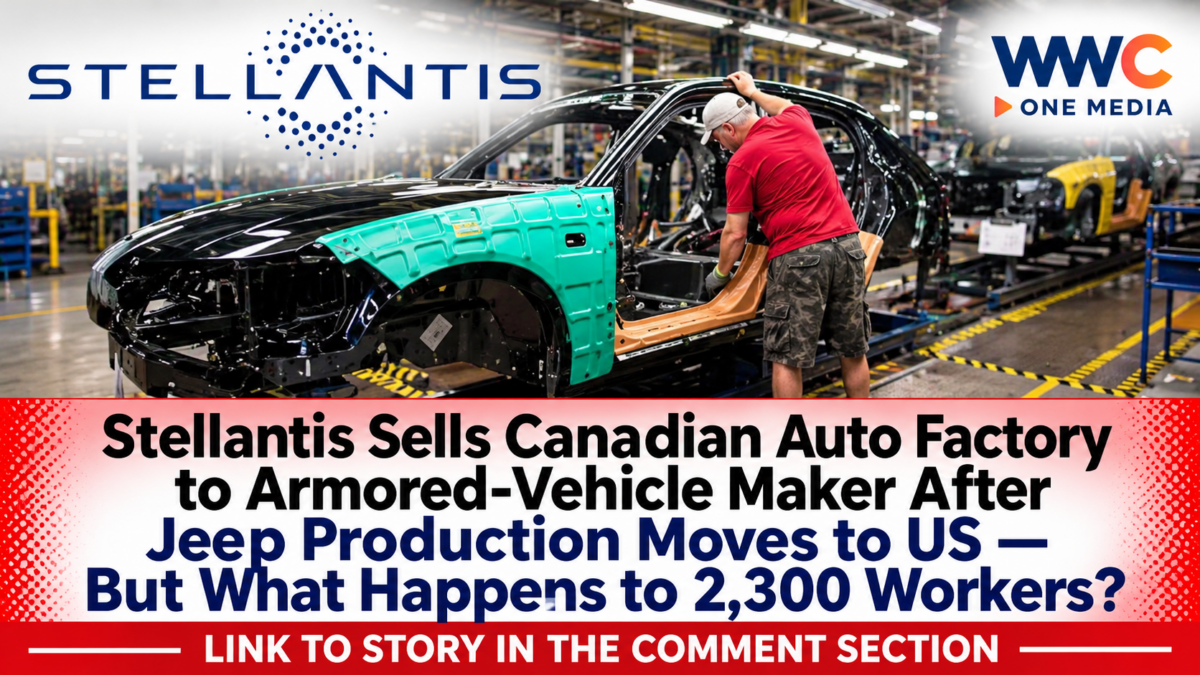
BRAMPTON, ONTARIO — November 10, 2026 — Global automaker Stellantis has agreed to sell its idled Brampton Assembly Plant to Canadian armored-vehicle manufacturer Roshel, marking a major transformation of one of Ontario’s established automotive manufacturing sites and intensifying a bitter dispute over thousands of workers whose jobs have remained in limbo for nearly three years.
The November 9 agreement effectively ends Stellantis’ previous plan to manufacture the next-generation Jeep Compass at the facility, after the company shifted the vehicle’s future production to Illinois amid US tariff pressure and changing business conditions.
For Canadian officials, the transaction presents an uncomfortable contradiction.
A major automotive assembly plant could return to industrial use through a growing domestic defense manufacturer, potentially creating new jobs and strengthening Canada’s military vehicle production capacity.
But thousands of laid-off autoworkers are still waiting for clarity about their employment, wages and future.
Unifor, the union representing affected Stellantis employees, has strongly criticized the sale, accusing the automaker of abandoning its commitments to Canadian workers and manufacturing.
Meanwhile, the federal government says the proposed sale does not eliminate Stellantis’ existing obligations.
As Canada attempts to turn a shuttered car factory into an advanced defense manufacturing center, the biggest question is whether Roshel can create enough quality jobs to offset the loss of automotive production—or whether the deal signals a deeper retreat of major automakers from Canada.
Stellantis Signs Deal to Sell Brampton Assembly Plant to Roshel
Stellantis announced on Monday, November 9, that it had entered into an asset purchase agreement with Roshel.
The deal covers the Brampton Assembly Plant and its associated equipment.
The companies did not disclose the purchase price.
The transaction is expected to close before the end of 2026, subject to applicable approvals and other closing requirements.
The announcement follows a memorandum of understanding signed in September, when Stellantis and Roshel began publicly outlining a possible transfer of the facility.
According to Bloomberg, Reuters and The Canadian Press, the two companies also intend to explore cooperation involving defense vehicle technologies and related services.
That potential partnership is separate from the plant sale itself.
No finalized large-scale joint vehicle production program was announced alongside the purchase agreement.
The companies describe the transaction as a way to return the idled site to productive industrial activity.
But questions remain about the number of workers Roshel will ultimately employ and how quickly manufacturing could restart.
Why Stellantis Is Leaving Brampton
The plant’s difficulties began well before the November sale.
Brampton Assembly had produced vehicles for decades and served as an important source of manufacturing employment in the Greater Toronto Area.
Production stopped in late 2023 as Stellantis prepared to retool the facility for future vehicles.
The automaker had planned to manufacture the next-generation Jeep Compass in Brampton.
However, the retooling program was subsequently paused.
Stellantis eventually announced that future Jeep Compass production would move to Illinois.
The decision followed US tariff measures targeting Canadian-made products and broader questions about the economics of North American vehicle production.
The development highlighted the vulnerability of Canadian factories that depend heavily on access to the American market.
Automakers must consider transportation costs, import duties, supplier locations, manufacturing capacity and long-term regulatory uncertainty when deciding where to produce vehicles.
For Stellantis, concentrating more production in the United States became part of its response to those pressures.
For Brampton workers, however, the change eliminated the expected product that was supposed to restore assembly operations.
More Than 2,000 Workers Face an Uncertain Future
Before the shutdown, Brampton Assembly supported thousands of employees.
Recent local reporting identifies approximately 2,300 union-represented workers associated with the facility, while earlier estimates placed its workforce closer to 3,000 before production stopped.
The different figures reflect workforce counts from different periods.
Most affected employees have remained on layoff while the factory’s future was being determined.
Stellantis chief executive Antonio Filosa acknowledged the workers’ contributions and said the company would continue negotiating with Unifor on a fair resolution.
But the announcement did not guarantee that employees would return to their former jobs.
Roshel is a different employer operating in a different industry.
Producing armored vehicles can require skills that overlap with automotive manufacturing, including welding, assembly, metal fabrication and quality control.
However, production volumes, employment arrangements, training requirements and collective bargaining terms could differ substantially.
The possibility of future employment therefore does not automatically resolve the status of workers laid off by Stellantis.
Roshel Could Offer 700 to 1,000 Job Opportunities
Global News reported that Roshel could provide opportunities for approximately 700 to 1,000 former Stellantis employees as the Brampton facility returns to operation.
The company is also expected to lease about one-quarter of the site’s space back to Stellantis for automotive-related work.
These details suggest the facility may ultimately accommodate a mix of defense manufacturing and other industrial activities.
But there is an important qualification.
The anticipated 700 to 1,000 opportunities are not confirmed job placements.
There has been no completed hiring program guaranteeing that number of former Stellantis employees will be employed.
The actual outcome will depend on Roshel’s production plans, customer contracts, workforce requirements and negotiations with workers’ representatives.
Even if the higher estimate is achieved, it would not automatically replace every affected position at the plant.
The distinction between potential job creation and confirmed rehiring is essential when evaluating the transaction’s benefits.
Who Is Roshel?
Roshel is a Canadian defense technology company based in Brampton.
The company specializes in designing and manufacturing armored vehicles for military, security and other specialized uses.
Its operations have expanded as governments and institutional customers seek vehicles capable of operating in dangerous environments.
Roshel is particularly known for its Senator family of armored vehicles.
These vehicles can be configured for roles including personnel transport and other defense or security functions.
The Brampton acquisition would provide the company with additional industrial space and manufacturing infrastructure.
Roshel founder and CEO Roman Shimonov has described the planned facility as a center for advanced manufacturing that would help Canadian companies serve domestic customers and export to allied markets.
The objective is to strengthen Canada’s capacity to manufacture defense equipment rather than depend entirely on overseas suppliers.
For Brampton, the proposal creates an opportunity to preserve industrial activity at a site that might otherwise remain unused.
But Roshel will still need to convert its plans into production contracts, equipment investment and sustainable employment.
Could a Canadian Military Contract Help Restart the Factory?
Roshel’s expansion plans are linked to growing opportunities in Canadian defense procurement.
Earlier Bloomberg reporting identified a possible military vehicle program worth up to approximately C$4.9 billion as a potential driver of the company’s factory ambitions.
However, the existence of a procurement opportunity does not mean Roshel has secured the entire contract.
Defense procurement programs involve competitive processes, technical requirements, budgets and approval procedures.
Roshel’s ability to expand production could depend on whether it wins contracts and obtains sufficient long-term orders.
The Brampton factory may improve its ability to compete by providing additional manufacturing capacity.
But purchasing a plant does not itself guarantee a specific level of future revenue.
The distinction matters for workers and investors alike.
A factory’s potential capacity can be considerable, yet actual employment and output depend on customer demand.
Canada’s wider defense-industrial strategy may support new opportunities, but the timing and scale remain uncertain.
Unifor Accuses Stellantis of Betraying Its Workers
The reaction from Canada’s largest private-sector union was sharply critical.
Unifor national president Lana Payne described the sale as a betrayal of the workers who had been waiting for the Brampton factory to reopen.
The union argues that Stellantis previously made commitments to maintain automotive production and employment in Canada.
It also contends that selling the plant undermines Canada’s industrial capacity at a time when US trade restrictions are already threatening domestic manufacturing.
Unifor has alleged that the company violated its collective agreement and earlier commitments.
Those allegations represent the union’s position and should not be presented as a final legal finding.
Stellantis maintains that it recognizes its responsibilities under applicable laws and employment agreements.
The automaker says it is prepared to work toward a settlement with the union.
The dispute therefore remains unresolved.
For affected workers, the central questions concern employment protections, compensation, future hiring rights and whether any return to work will involve comparable pay and benefits.
Nearly All Voting Union Members Backed a Strike Mandate
The sale was announced against the backdrop of stalled labor negotiations.
In October, Stellantis union members voted overwhelmingly to authorize potential strike action.
Global News reported that 97.3% of participating members supported the strike mandate.
That vote demonstrated the strength of dissatisfaction among workers.
However, a strike mandate is not the same as an active strike.
It authorizes the union’s leadership to consider industrial action under applicable rules and bargaining arrangements.
Unifor has said that a strike remains a last resort.
The union is also pursuing negotiations involving Stellantis and government representatives.
The parties face difficult decisions because the sale could proceed while disputes over employee compensation and legal obligations remain unresolved.
The coming negotiations may determine whether the workers receive a settlement and what opportunities exist for employment under the new owner.
Canada’s Government Says Stellantis Still Has Obligations
Canadian Industry Minister Mélanie Joly responded by emphasizing that the sale does not erase Stellantis’ commitments to workers.
The government has been seeking discussions with the automaker, Unifor and provincial officials.
Joly said she intended to bring the parties together during the week of November 9.
The objective is to establish a clear plan for protecting workers and addressing commitments associated with the Brampton factory.
Prime Minister Mark Carney’s government has previously questioned Stellantis’ decision to move Jeep Compass production to the United States.
Federal officials have warned that public financial support for Canadian automotive production must be accompanied by appropriate corporate obligations.
The government is therefore examining whether Stellantis has fulfilled conditions tied to earlier funding arrangements.
No final resolution of those questions was announced with the Roshel agreement.
More Than $700 Million in Public Support Comes Under Scrutiny
According to The Wall Street Journal, Canadian governments provided more than $700 million in taxpayer-backed support associated with retooling projects involving Brampton and Stellantis’ Windsor operations.
The financing has become a political issue because the Brampton production plan did not proceed as originally expected.
Officials have raised the possibility of seeking repayment if Stellantis breached relevant funding commitments.
Brampton Mayor Patrick Brown has also urged the federal government to recover public money where appropriate.
But the exact amount recoverable cannot be established simply by citing the overall funding figure.
Government agreements may contain specific conditions concerning eligible investments, job retention, project completion and repayment.
Any repayment claim would depend on the agreements’ terms and the findings of the responsible authorities.
The more than $700 million figure also should not be described as money paid exclusively to Brampton.
The cited funding involved projects associated with more than one Stellantis facility.
This distinction is important when evaluating the potential cost to taxpayers.
Trump’s Tariffs Reshape North American Auto Manufacturing
The sale highlights the wider consequences of trade tensions between the United States and Canada.
North America’s automotive industry developed around interconnected supply chains.
Vehicles and components often cross borders multiple times before a finished vehicle reaches a customer.
Tariffs can disrupt that model by increasing the cost of moving products between factories.
For automakers operating in Canada, the risk of higher US import duties may encourage changes in future production decisions.
WWC ONE MEDIA previously examined that issue in Toyota, Honda Face Fresh Tariff Shock as Trump Targets Canadian Auto Imports.
The report considered how threatened increases in tariffs could affect Canadian factories operated by Japanese automakers.
The proposed increase to 50% should not be confused with a universally implemented tariff on all Canadian vehicles.
Actual duties depend on the governing trade measures and product circumstances.
Nevertheless, tariff uncertainty has already influenced manufacturing strategies.
Stellantis’ decision to shift Jeep Compass production to Illinois illustrates how trade policy can affect the geographic allocation of future investment.
Canada’s Trade Negotiations With Washington Remain Crucial
The Brampton sale comes as Ottawa and Washington continue attempting to resolve disputes over tariffs and trade rules.
Prime Minister Carney recently indicated that US negotiators had softened some demands that Canada previously considered unacceptable.
However, no final comprehensive agreement eliminating the automotive tariff dispute has been announced.
WWC ONE MEDIA examined those developments in Trump Backs Down on Key Canada Trade Demands as Carney Claims Major Breakthrough — But Will Washington Finally Lift Its 50% Tariffs?.
An agreement could help Canadian manufacturers make future investment decisions with greater confidence.
But restoring trade certainty would not automatically reverse Stellantis’ Brampton sale.
The automaker has already entered into a purchase agreement with Roshel.
The immediate fate of the facility therefore depends on the completion of that transaction and the buyer’s plans.
Defense Manufacturing Offers Canada a New Industrial Opportunity
Roshel’s proposed expansion is occurring as Canada seeks to strengthen domestic defense manufacturing.
Governments increasingly want reliable domestic and allied suppliers for military vehicles, equipment and advanced technology.
That demand could create opportunities for Canadian companies involved in engineering, vehicle assembly and industrial components.
WWC ONE MEDIA recently explored the wider trend in South Korea and Canada Move to Expand Defense, Energy and AI Cooperation — With Bigger Plans Ahead.
The report examined how Canada is expanding partnerships involving security, technology and advanced manufacturing.
Roshel’s Brampton plans fit within that broader industrial direction.
A new defense manufacturing center could support specialized jobs and create demand for local suppliers.
However, automotive manufacturing and defense manufacturing operate on different production models.
A mass-market car plant can build large volumes of vehicles annually.
An armored-vehicle manufacturer may produce far fewer units, each requiring specialized components and labor.
Consequently, even successful defense production may not restore the exact employment levels or economic activity associated with a major automotive assembly operation.
Canada’s European Defense Partnerships Could Matter
The country’s growing relationship with European defense manufacturers and buyers may also influence future industrial opportunities.
Canada and the European Union have established frameworks for cooperation involving security and defense technology.
WWC ONE MEDIA discussed that strategy in Canada and EU Push Historic New Alliance as Carney and Macron Challenge US Dominance — But Could Europe’s Internal Divisions Derail the Deal?.
Such partnerships could eventually benefit Canadian firms seeking access to international defense markets.
But participation in wider cooperation frameworks does not guarantee sales for Roshel.
The company would still need to meet procurement requirements and compete for contracts.
For the Brampton facility, the practical test will be whether the new owner can obtain enough orders to support consistent manufacturing operations and employment.
Brampton Mayor Calls for Jobs and Accountability
Brampton Mayor Patrick Brown has welcomed the possibility that a local company could return the facility to productive use.
Roshel is headquartered in the city, creating a potential opportunity to retain industrial activity within the community.
But Brown has also emphasized the need to protect laid-off workers.
He has called on Stellantis to negotiate a fair settlement with Unifor and urged Roshel to work with the union on training and hiring opportunities.
The mayor has also pressed for accountability over public financial assistance previously provided to support automotive manufacturing.
Brampton has a long history as an automotive manufacturing center.
The factory’s closure has affected not only direct employees but also businesses that depend on industrial activity.
Local suppliers, transportation companies, restaurants and service providers can all be affected by the loss of a major employer.
Roshel’s expansion may help rebuild some of that economic activity.
However, the extent of any recovery will depend on actual production volumes and the number of workers hired.
Will Stellantis Leave Canadian Manufacturing Entirely?
The Brampton sale does not mean Stellantis is exiting Canada altogether.
The automaker continues to identify several important Canadian operations, including Windsor Assembly, Etobicoke Casting and its Automotive Research and Development Centre in Windsor.
It also maintains automotive components and related activities in the country.
Stellantis said it employs more than 10,000 Canadians outside the Brampton facility.
The Brampton agreement therefore represents the loss of a particular assembly site, not the complete disappearance of the company’s Canadian operations.
Nevertheless, the decision is a significant development for Canada’s automotive industry.
It removes an established factory from Stellantis’ planned passenger-vehicle production footprint.
The long-term implications depend partly on whether other Canadian facilities receive new products and future investment.
What Happens Next?
The immediate milestone is the expected closing of the Stellantis–Roshel transaction by the end of 2026.
Before completion, the parties must satisfy relevant contractual and regulatory requirements.
The companies also need to clarify operational arrangements, including the reported plan to lease part of the site back to Stellantis.
Meanwhile, Unifor is seeking a settlement addressing the position of affected employees.
Federal and provincial officials are expected to participate in discussions involving the automaker and union.
Roshel will need to present a more detailed manufacturing and hiring plan.
Workers will want to know how many jobs are available, which qualifications are required and whether former Stellantis employees will receive priority consideration.
Governments may also examine whether previous funding obligations have been fulfilled.
Until these matters are settled, the Brampton plant’s future remains partly uncertain.
The Bigger Picture: From Passenger Cars to Armored Vehicles
The proposed sale of Brampton Assembly represents more than an ordinary industrial property transaction.
It illustrates a major transformation in North American manufacturing.
A factory once associated with Canadian automotive employment is being transferred to a domestic defense technology company.
For Stellantis, the transaction supports a broader effort to manage its manufacturing footprint and adapt to changing business conditions.
For Roshel, the purchase could create a major opportunity to expand Canadian armored-vehicle production.
For governments, it raises questions about industrial policy, public financing and the consequences of tariff disputes.
For workers, it presents an immediate concern about lost livelihoods and whether promised new jobs will materialize.
The agreement could eventually become an example of successful industrial redevelopment.
But that outcome is not guaranteed.
The factory must reopen, the buyer must obtain sufficient orders, and workers must receive meaningful employment opportunities.
As Stellantis prepares to hand a historic Canadian auto plant to armored-vehicle manufacturer Roshel, the defining question is whether the deal will give Brampton a new industrial future—or leave thousands of autoworkers paying the price for North America’s deepening trade and manufacturing upheaval.