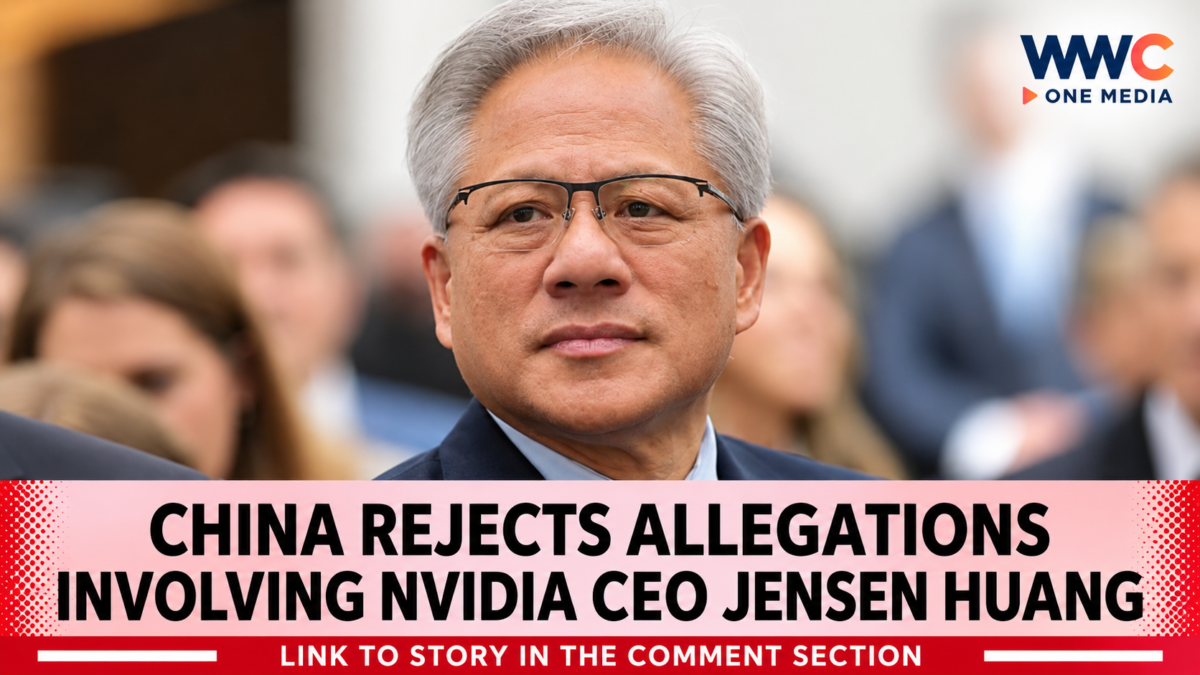
Beijing’s response followed reports that US intelligence agencies had assessed Alice Huang, a Chinese national and former executive associated with Singapore-based Megaspeed International, as an intelligence asset gathering information for China.
The allegations were reported by The New York Times, which described concerns among US officials about her relationship with Jensen Huang and whether that relationship could have provided Beijing with access to sensitive information.
China has firmly rejected the accusations.
Foreign Ministry spokesperson Guo Jiakun described the alleged Chinese spy operation as unsubstantiated and an attempt to smear the country.
Beijing had previously dismissed the reporting as groundless speculation.
The Chinese government’s position is important because the allegations involve a highly sensitive intersection of national security, artificial intelligence and the US-China technology rivalry.
However, China’s denial does not resolve the questions raised by US intelligence reporting. Equally, the allegations should not be treated as proven facts simply because they have appeared in media reports.
There has been no publicly established finding that Jensen Huang knowingly participated in espionage or deliberately supplied confidential information to Beijing.
Jensen Huang Admits to an Affair as Nvidia Launches Independent Investigation
The controversy has also become a major personal and corporate crisis for Nvidia’s chief executive.
On November 8, Jensen Huang acknowledged in a message to employees that he had been unfaithful to his wife, Lori Huang, taking responsibility for his actions and apologising to his family and the company.
He did not publicly identify the woman involved in the message.
The New York Times had previously reported that the woman was Alice Huang, a former executive associated with Megaspeed International. The report also described US intelligence concerns about her alleged connections to Chinese intelligence.
Nvidia subsequently announced an independent investigation into reports that its chief executive may have been targeted in a foreign intelligence effort.
The company said an independent committee of directors, assisted by outside legal counsel, would oversee the review.
Nvidia has also said its board has no reason to believe that US national security or company secrets were compromised.
Huang has expressed support for the investigation and pledged to cooperate fully.
The distinction is critical: admitting to an affair does not establish that espionage took place, that confidential information was disclosed or that Nvidia’s export-control procedures were violated.
Who Is Alice Huang and Why Is Megaspeed Under Scrutiny?
Alice Huang, also known as Huang Le, is a Chinese national and former senior executive associated with Megaspeed International, a Singapore-based data-centre and cloud-computing company.
She is not related to Nvidia CEO Jensen Huang, despite sharing his surname.
Megaspeed has attracted attention because of its connection to Nvidia’s advanced computing hardware and the wider investigation into possible chip diversion to China.
According to The New York Times’ reporting, US authorities had been examining Megaspeed’s business activities over suspicions that advanced Nvidia processors could have been redirected to Chinese customers despite American export restrictions.
The investigation reportedly examined whether overseas data-centre arrangements were being used to obtain computing resources that would otherwise be restricted.
These are allegations and investigative concerns, not proof that every transaction involving Megaspeed was illegal.
Nvidia has defended its business relationship with the company and said its dealings with regional customers were ordinary commercial interactions.
Nvidia Says Its Dealings With Megaspeed Were Normal
Jensen Huang previously defended Nvidia’s relationship with Megaspeed, describing the company’s dealings with its representatives as normal and proper.
In comments reported by Bloomberg and carried by CNA, Huang said Nvidia had examined the deployment of its graphics processing units and checked whether its products had been illegally diverted to China.
He said the company had reviewed the locations where its GPUs were deployed and counted the equipment involved.
Nvidia also maintained that regional cloud customers receive ordinary business information rather than sensitive company trade secrets or information relevant to national security.
The company has argued that its customer relationships should not automatically be interpreted as evidence of improper activity.
Nevertheless, the independent board investigation will be important in determining whether any relevant information was compromised and whether the company’s internal safeguards were adequate.
Singapore Government Clarifies Its Position on Alice Huang and Megaspeed
The allegations have attracted particular attention in Singapore because Megaspeed operates within the country’s technology and data-centre sector.
Singapore’s Ministry of Home Affairs clarified that the government had not investigated Alice Huang over her alleged connections to Chinese intelligence or her reported relationship with Jensen Huang.
The ministry also rejected suggestions that Singapore officials had expressed concerns about those specific allegations.
However, the Singapore Police Force confirmed that investigations involving Megaspeed were ongoing and declined to provide further details.
The distinction matters.
Singapore’s authorities have confirmed an investigation involving the company, but that does not establish that Alice Huang was investigated by the Singapore Government as an alleged Chinese intelligence operative.
The Police Force also emphasised that Singapore does not enforce unilateral export controls imposed by foreign governments. At the same time, businesses operating in Singapore are expected to comply with applicable laws and avoid fraudulent or dishonest practices.
Singapore has previously taken action in cases involving alleged misrepresentations to suppliers of advanced servers.
Between February 2025 and July 2026, four individuals and four companies were charged in separate cases involving alleged fraud against server suppliers, according to information provided by the Police Force.
Those cases should not be confused with the Megaspeed investigation.
For additional background on Singapore’s growing AI infrastructure sector, read WWC ONE MEDIA’s report on Singapore’s Digital Infrastructure Bill and the New Rules for Data Centres and Cloud Providers.
Why the United States Is Worried About Nvidia Chips Reaching China
The controversy is unfolding against the backdrop of Washington’s efforts to restrict China’s access to advanced semiconductor technology.
Since 2022, the United States has introduced increasingly stringent export controls covering certain advanced chips and semiconductor manufacturing technologies.
The restrictions are designed to limit China’s access to computing capabilities that could support advanced artificial intelligence development and military applications.
Nvidia is at the centre of this debate because its graphics processing units are widely used to train and operate powerful AI models.
The company’s processors are also important for cloud computing, scientific research, autonomous systems and large-scale data-centre operations.
When advanced chips are sold to overseas customers, American authorities are concerned about whether the equipment remains with authorised buyers and is used in permitted locations.
The possibility of restricted processors reaching Chinese customers through third-country arrangements has therefore become a major enforcement concern.
Singapore and Malaysia are particularly relevant to the discussion because both countries have become important destinations for data-centre investment and regional computing infrastructure.
The investigation highlights the difficulty of monitoring sophisticated hardware once it moves through international suppliers, cloud operators and data-centre networks.
Previous AI Server Cases Show How Complicated Chip Diversion Can Become
The Megaspeed controversy is not the first case to raise questions about the movement of advanced AI hardware across borders.
In August 2026, Taiwanese prosecutors indicted nine people in a separate investigation involving allegations that high-end AI servers containing Nvidia technology had been illegally exported to China.
The case involved employees linked to Nvidia and Super Micro, with prosecutors alleging that the defendants had participated in arrangements to move restricted equipment.
The allegations remain subject to legal proceedings and should not be treated as convictions.
The case nevertheless demonstrates why governments are increasingly examining the entire supply chain rather than focusing exclusively on the original sale of a processor.
WWC ONE MEDIA previously reported on Taiwan’s Indictment of Nine People in an AI Server Export Case.
The central issue is whether advanced computing equipment ends up in locations or with customers that are prohibited under applicable export-control rules.
Could the Scandal Affect Nvidia’s Relationship With Donald Trump?
The controversy also arrives at a sensitive moment in US-China technology negotiations.
Jensen Huang has become an influential voice in Washington’s debate over semiconductor export restrictions.
He has argued that allowing American technology companies to compete internationally is important for maintaining US leadership in artificial intelligence.
Huang has also supported a more flexible approach to certain chip sales to China, arguing that overly restrictive policies could encourage Chinese customers to adopt domestic alternatives.
The Trump administration has allowed certain Nvidia products to be sold to China under specific conditions, although restrictions on more advanced processors remain.
President Donald Trump said on November 9 that the FBI was looking into the matter. He also said he had spoken with Huang and believed the Nvidia chief executive had no reason to worry.
Trump’s comments have drawn attention because of his relationship with Huang and the broader national security implications of the allegations.
The president has not publicly established that Huang was involved in espionage.
The controversy could nevertheless complicate discussions about whether Washington should permit additional Nvidia chip sales to Chinese customers.
For more context, WWC ONE MEDIA has examined the technology dispute in AI Rivalry Set to Feature in Trump-Xi Talks.
Nvidia Shares Come Under Pressure as Investors Watch the Investigation
The allegations have also created uncertainty for Nvidia investors.
The company’s shares fell more than 4 per cent during trading on November 9, according to Associated Press reporting, as investors reacted to the growing controversy.
The stock had also experienced losses in the days leading up to the announcement, amid broader concerns about the sustainability of the artificial intelligence investment boom.
Nvidia’s importance to the global AI industry makes the investigation particularly sensitive.
Major technology companies rely on its processors to build and operate AI systems, while investors closely monitor its ability to maintain its technological advantage.
A prolonged investigation could create reputational and governance concerns, even if it does not ultimately establish wrongdoing by the chief executive.
However, it would be premature to conclude that the controversy will materially damage Nvidia’s business or its position in the AI market.
The outcome will depend on what investigators establish and whether the company identifies weaknesses in its internal controls.
China’s Growing AI Ambitions Add Another Layer to the Controversy
The dispute is also connected to China’s determination to reduce its dependence on American semiconductor technology.
Beijing has invested heavily in domestic chip development, AI computing infrastructure and software ecosystems.
Chinese companies such as Huawei are attempting to build alternatives to Nvidia’s hardware and software platforms.
DeepSeek’s partnership with Huawei to develop tools for the company’s Ascend AI processors is one example of this strategy.
The collaboration reflects China’s wider effort to develop the software, hardware and technical expertise needed to support domestic AI development despite US restrictions.
WWC ONE MEDIA previously covered the development in DeepSeek Partners With Huawei to Build AI Chip Tools and Reduce Reliance on Nvidia.
The Jensen Huang controversy could add further political pressure to an already complicated technology relationship between Washington and Beijing.
What Investigators Still Need to Establish
Several major questions remain unanswered.
First, investigators need to determine whether any restricted Nvidia processors were actually diverted to prohibited destinations.
Second, they must establish whether Megaspeed or individuals associated with the company violated applicable laws.
Third, Nvidia’s independent investigation must assess whether sensitive corporate information or information relevant to national security was compromised.
Finally, authorities will need to clarify whether any individuals knowingly participated in intelligence activities or unlawful transactions.
Until evidence is made public, allegations involving espionage, chip diversion and the use of commercial relationships to obtain restricted technology must be treated carefully.
Neither an alleged personal relationship nor a company’s connection to Nvidia automatically proves illegal conduct.
The Singapore Police Force’s ongoing investigation, the US intelligence reporting and Nvidia’s independent board review are separate processes that may address different aspects of the controversy.
A Growing National Security Test for the Global AI Industry
The dispute involving Jensen Huang, Alice Huang and Megaspeed International demonstrates how closely commercial technology relationships are now linked to national security.
Advanced AI chips are no longer ordinary computer components. They are strategic assets that can influence economic competitiveness, scientific research and military capabilities.
For Nvidia, the challenge is to protect its technology, maintain investor confidence and continue operating across international markets while complying with increasingly complex export restrictions.
For Singapore, the case highlights the importance of maintaining its reputation as a trusted international business and data-centre hub.
For China and the United States, it adds another sensitive issue to an already difficult relationship dominated by technology competition, trade restrictions and national security concerns.
The investigation has not established that Jensen Huang knowingly participated in espionage or that Nvidia’s secrets were handed to Beijing. But the questions surrounding chip movements, customer relationships and access to sensitive information are unlikely to disappear quickly.
The biggest test now is whether investigators uncover evidence of an actual security breach — or whether one of the world’s most powerful technology companies has become caught in an increasingly explosive US-China intelligence dispute.