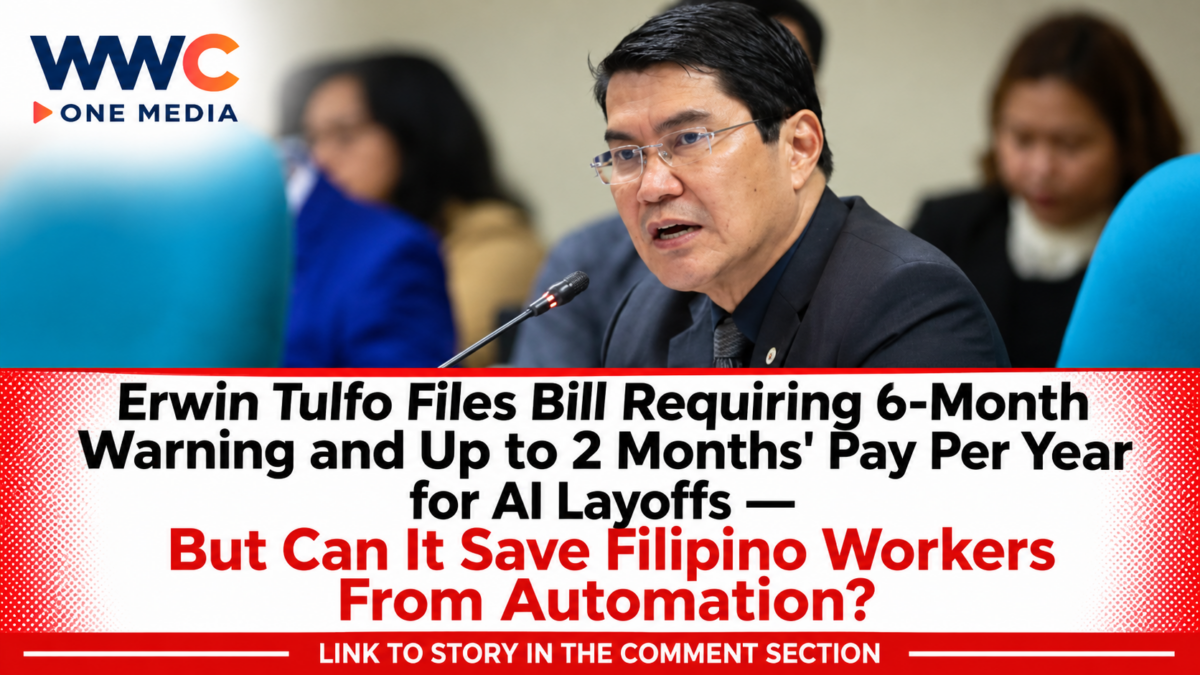
MANILA, PHILIPPINES — November 8, 2026 — Filipino employees facing possible replacement by artificial intelligence could receive stronger legal protection under a proposed Senate measure that would require employers to justify AI-related dismissals, explore retraining opportunities and provide significantly higher separation pay.
Senator Erwin Tulfo has filed Senate Bill No. 2563, seeking to amend the Labor Code of the Philippines as businesses increasingly use artificial intelligence to automate tasks traditionally performed by human workers.
The proposal would require companies planning AI-related terminations to notify the Department of Labor and Employment (DOLE) at least six months in advance.
It would also entitle workers who are lawfully dismissed because of AI implementation to separation pay equivalent to at least two months’ salary or two months’ salary for every year of service, whichever is higher.
Under the proposed formula, an employee earning ₱30,000 monthly with five years of service could qualify for ₱300,000 in separation pay, assuming the bill becomes law and its conditions apply.
The measure comes as new research shows that approximately 12.7 million Philippine jobs are exposed to generative artificial intelligence, although exposure does not mean all those positions will disappear.
Tulfo argues that technological progress should not come at the expense of employees who depend on their salaries to support their families.
But the proposed legislation raises a difficult question for businesses, workers and policymakers.
Can the Philippines protect employees from sudden AI-driven job losses without discouraging investment, productivity improvements and the creation of new technology-related jobs?
Tulfo Pushes Senate Bill 2563 to Protect Workers From AI Layoffs
According to GMA Integrated News, Tulfo introduced the legislation to establish clearer requirements for companies seeking to terminate employees because of artificial intelligence.
Tulfo chairs the Senate Committee on Social Justice, Welfare and Rural Development.
The proposed measure would amend Article 298 of the Labor Code, which governs employment termination involving authorized causes such as redundancy, installation of labor-saving devices and business closure.
The senator wants the law to address situations in which employers replace human tasks with AI software, automated systems or related technologies.
The proposal does not seek to prohibit companies from adopting artificial intelligence.
Instead, it would require employers to demonstrate that dismissals are justified and that reasonable alternatives have been considered.
Tulfo said employees should not bear the consequences of technological change alone.
His proposal emphasizes job security, fair compensation, retraining and greater employer accountability.
The bill remains pending in the legislative process and has not yet changed existing employment law.
Five Conditions Companies Must Meet Before AI-Related Dismissals
Senate Bill No. 2563 proposes safeguards intended to prevent employers from using artificial intelligence as an unsupported justification for dismissing employees.
Under the bill, employers would have to satisfy five conditions:
- Genuine AI implementation. The company must actually introduce or implement artificial-intelligence technology or systems.
- Good-faith adoption. The technology must be introduced for legitimate business purposes rather than as a pretext for unfairly removing employees.
- Valid economic justification. The implementation must have a reasonable objective, such as improving operational efficiency or reducing costs.
- No reasonable alternative. The employer must establish that there is no reasonable alternative to the proposed termination in connection with the AI implementation.
- Fair employee selection. Any employees selected for termination must be chosen using fair and reasonable criteria.
These requirements would place greater emphasis on how businesses justify workforce reductions.
A company introducing an AI chatbot, for example, would not automatically be entitled to dismiss customer-service employees merely because the technology can perform some of their tasks.
It would need to demonstrate that the employment decisions satisfy the proposed legal standards.
However, the bill would not permanently guarantee employment for every worker.
It recognizes that some terminations may still be justified after the relevant conditions and safeguards have been met.
Six-Month Advance Notice Could Give Workers More Time to Prepare
One of the proposal’s most significant provisions is the requirement for employers to notify DOLE at least six months before an intended AI-related termination.
The extended notification period is designed to create time for preparation and possible intervention.
Affected employees could use that period to explore other positions, acquire new skills or seek alternative employment.
Employers would also have more time to consider whether existing staff could be transferred into other roles.
The proposed six-month period represents a major change from the existing general rule under Article 298.
Current law generally requires written notice to affected employees and DOLE at least one month before termination for authorized causes.
Tulfo’s proposal would introduce a longer notification requirement specifically for the AI-related employment situations covered by the bill.
But the proposed six-month notice is not currently a mandatory requirement for all automation-related dismissals.
That protection would apply only if the legislation is enacted and becomes effective.
Proposed Separation Pay Could Be Twice the Existing Redundancy Formula
Another major provision concerns separation benefits.
Under existing Article 298 rules, employees terminated because of redundancy or installation of labor-saving devices are generally entitled to separation pay of at least one month’s salary or one month’s salary for every year of service, whichever is higher.
Tulfo proposes a different formula for qualifying AI-related terminations.
The bill would provide at least two months’ salary or two months’ salary for every year of service, whichever is higher.
The difference can be substantial.
| Years of service | Existing redundancy formula | Proposed AI-related formula |
|---|---|---|
| 1 year | 1 month’s pay | 2 months’ pay |
| 3 years | 3 months’ pay | 6 months’ pay |
| 5 years | 5 months’ pay | 10 months’ pay |
| 10 years | 10 months’ pay | 20 months’ pay |
These examples assume complete years of service and the applicable grounds for termination. They exclude other possible contractual or statutory benefits.
For an employee earning ₱30,000 monthly, five years of service would translate into ₱150,000 under the existing redundancy formula and ₱300,000 under Tulfo’s proposed AI-specific formula.
That could provide more financial support while the employee searches for new work.
For employers, the proposed increase would also raise the direct cost of reducing staff through AI implementation.
How companies respond to those costs would depend on their business circumstances and the final wording of any enacted legislation.
Reskilling Before Retrenchment: Can Employers Find New Roles for Workers?
Tulfo’s proposal also emphasizes retraining and redeployment.
Rather than immediately dismissing employees whose existing responsibilities can be automated, businesses would be expected to explore ways to help those workers adapt.
That might involve training customer-service representatives to supervise AI-assisted interactions.
Administrative employees could learn data analysis or digital workflow management.
Technical-support workers might receive instruction in AI-enabled troubleshooting.
However, reskilling does not guarantee that every employee can transition into another available job.
Some positions require specialized qualifications, and not all companies have enough alternative roles.
The effectiveness of retraining programs will depend on their accessibility, quality, financing and relevance to actual job vacancies.
The bill’s challenge is therefore not simply requiring companies to offer training.
It is ensuring that retraining creates realistic opportunities for employees to remain productive.
ILO Warns 12.7 Million Philippine Jobs Are Exposed to Generative AI
The urgency surrounding the proposal is supported by research from the International Labour Organization.
In a February 5, 2026 study, the ILO estimated that approximately 12.7 million jobs in the Philippines have some exposure to generative artificial intelligence.
That represents more than one-quarter of national employment.
However, the organization made an important distinction.
Exposure does not automatically mean that an employee will lose their job.
Artificial intelligence can automate selected tasks while allowing people to continue performing other responsibilities.
The ILO estimated that only 3.6% of Philippine jobs fall into the highest exposure category, where the potential for displacement is greater.
Women face particularly significant exposure because of their concentration in administrative, clerical and service occupations.
The study also found that approximately two in five jobs in Metro Manila are exposed to generative AI.
These estimates highlight why workforce policies need to address both risks and opportunities.
The central issue is how workers can adapt as job descriptions change.
As WWC ONE MEDIA previously examined, the global debate over AI unemployment is more complicated than predictions of mass job destruction suggest.
Related WWC ONE MEDIA coverage: Silicon Valley Warns AI Could Wipe Out Millions of Jobs — But Economists Say the Real Threat May Be Hiding in Entry-Level Hiring
The research suggests that some of the most immediate effects may involve fewer entry-level opportunities, changed responsibilities and greater demand for specialized skills.
Philippine Unemployment Rises to 5.4% as Job Security Concerns Grow
Tulfo’s bill also comes during a period of increased concern over unemployment.
According to the Philippine Statistics Authority’s November 6 release, the national unemployment rate reached 5.4% in September 2026, compared with 5.3% in August.
The number of unemployed Filipinos was estimated at 2.86 million.
That was higher than the approximately 1.96 million recorded in September 2025.
At the same time, total employment reached about 50.32 million.
The figures demonstrate a labor market experiencing both employment growth and an increase in the number of people seeking work.
But the data does not prove that artificial intelligence caused the rise in unemployment.
Joblessness can be affected by economic growth, business closures, seasonal hiring, changing labor-force participation and other factors.
AI-related automation represents one possible source of labor-market disruption rather than the confirmed explanation for all recent employment changes.
The challenge for policymakers is to identify technology-related displacement accurately while responding to broader employment pressures.
The Philippine BPO Industry Faces a Major AI Transition
The business-process outsourcing industry is particularly relevant to the proposed legislation.
For decades, the Philippines has built a major international services industry around customer support, back-office processing, technical assistance and other business functions.
Many of those activities involve repetitive tasks that can increasingly be supported or partially automated by AI.
Chatbots can answer routine inquiries.
Automated systems can summarize conversations, organize documents and assist with data processing.
But more complex interactions still require human involvement.
These include sensitive customer complaints, unusual technical problems, financial disputes and situations requiring judgment.
The IT and Business Process Association of the Philippines has revised its longer-term employment projections as technology and international demand reshape the sector.
Its updated outlook estimates approximately 1.85 million to 2.14 million workers in 2028, compared with an earlier target of 2.5 million.
The revision should not be interpreted as proof that the difference represents completed AI-related layoffs.
Industry officials have attributed changes to several factors, including global business demand, technology adoption and evolving outsourcing requirements.
For workers, the key concern is whether new positions can absorb employees whose traditional responsibilities are becoming automated.
BPO Companies Are Already Training Filipino Workers to Use AI
Some companies are responding through workforce development.
TP in the Philippines, formerly Teleperformance, has introduced AI literacy and readiness lessons into its Skills Training to Employment Program.
The training aims to help applicants prepare for employment in an increasingly technology-enabled outsourcing industry.
Participants learn about artificial intelligence, digital responsibility and how new systems affect workplace operations.
As WWC ONE MEDIA previously reported, the program reflects a broader change in the skills companies expect from customer-service workers.
Related WWC ONE MEDIA coverage: This BPO Giant Is Teaching Applicants AI Before Hiring Them — And It Reveals Where Philippine Call Center Jobs Are Headed
Programs like this may help employees remain competitive.
But the success of retraining should ultimately be measured by outcomes such as job placement, retention, improved skills and access to higher-value work.
Training participation alone is not proof that workers have been protected from displacement.
PLDT’s AI Agents Show How Technology Is Changing Office Work
Artificial intelligence is also changing operations outside the BPO industry.
Philippine telecommunications company PLDT has deployed AI-enabled systems to help employees prepare sales proposals, retrieve information and perform selected administrative tasks.
The company has reported substantial reductions in time spent on certain manual activities.
Those efficiency improvements illustrate why businesses are interested in adopting AI.
But they also raise questions about how work will be reorganized when routine tasks require fewer human hours.
As WWC ONE MEDIA previously examined, PLDT’s AI initiatives highlight the difference between automating work and eliminating positions.
Related WWC ONE MEDIA coverage: PLDT’s AI Agents Are Saving Tens of Thousands of Work Hours — But the Bigger Question Is What Happens to the Human Workforce
Companies may use productivity gains to expand operations, improve customer service or reduce costs.
Some may redeploy employees into more complex roles.
Others may conclude that fewer workers are needed.
The outcome depends on management decisions, customer demand and business strategy—not solely on what AI technology can perform.
Global Companies Are Already Cutting Jobs While Expanding Automation
Developments abroad show why lawmakers are considering stronger safeguards.
Some international firms have announced workforce reductions while simultaneously investing in automation and artificial intelligence.
In Brazil, Galapagos Capital reportedly reduced its workforce by approximately 9% while expanding selected technology and business operations.
According to Bloomberg reporting previously covered by WWC ONE MEDIA, the company eliminated around 45 positions as part of a restructuring.
Related WWC ONE MEDIA coverage: Galapagos Capital Cuts 9% of Global Workforce as AI Takes Over More Finance Tasks — But Why Is the $7.8-Billion Investment Firm Still Hiring?
The example shows how automation can coincide with workforce reductions.
However, the existence of both developments does not establish that every affected employee was directly replaced by AI.
Companies also restructure because of demand changes, costs, business priorities and organizational decisions.
That distinction could become particularly important if Tulfo’s bill is enacted.
Regulators would need to determine when a dismissal is specifically connected to artificial intelligence and when other authorized grounds apply.
Could Tougher AI Layoff Rules Affect Business Investment?
The proposed legislation also creates questions for businesses.
Supporters argue that longer notice periods and more substantial separation pay could discourage unnecessary dismissals and encourage workforce planning.
Employers might have stronger incentives to retrain staff rather than treat automation as an immediate reason to reduce headcount.
But businesses may also raise concerns about compliance costs and operational flexibility.
For smaller firms, six months of advance planning and higher termination benefits could represent significant financial obligations.
The legislation would therefore need clear definitions and practical implementation rules.
For example, lawmakers may need to clarify how AI-related termination differs from ordinary redundancy involving other technologies.
They may also need to determine what evidence employers must provide to demonstrate that reasonable alternatives were considered.
These questions are important because workers need enforceable protections, while businesses need predictable legal requirements.
The measure’s eventual impact will depend on its final wording, enforcement and the broader employment environment.
The Philippines Must Prepare Workers for New AI Jobs
AI could also create employment opportunities.
Businesses adopting new systems may require people with expertise in cybersecurity, software integration, data management, compliance and AI governance.
Some workers may move from repetitive service activities into specialized roles involving human oversight and more complicated customer needs.
The Philippine IT-BPM industry is pursuing higher-value operations as part of its long-term development strategy.
As WWC ONE MEDIA previously reported, industry forecasts suggest that Philippine IT-BPM revenue could approach US$45 billion in 2027 despite AI-related disruption.
Related WWC ONE MEDIA coverage: Philippine IT-BPM Revenue Seen Nearing $45 Billion in 2027 Despite AI Disruption
However, revenue growth does not necessarily mean that employment will increase at the same rate.
Companies may generate more revenue through higher-value services, better technology and increased productivity.
The central challenge is ensuring that Filipino workers can participate in those opportunities.
That will require cooperation among government agencies, employers, educational institutions and training providers.
What Happens Next to Senate Bill No. 2563?
The proposed law must still pass through the legislative process.
The Senate will need to consider the measure through its applicable committee procedures and readings.
Any approved legislation would also need to clear the House of Representatives and receive presidential approval, or otherwise complete the constitutional lawmaking process.
The final version could differ from the measure Tulfo originally filed.
Provisions involving advance notice, retraining, separation benefits and employer obligations may be revised during deliberations.
Until a new law takes effect, existing Labor Code rules continue to govern termination, redundancy and related worker protections.
Employees concerned about possible layoffs should therefore distinguish between rights they already possess and protections that are still being proposed.
The Bigger Picture: Can the Philippines Protect Workers Without Falling Behind in AI?
The filing of Senate Bill No. 2563 comes at an important moment for Philippine employment.
Artificial intelligence is becoming part of the way businesses operate.
Workers are learning new systems.
Companies are reconsidering staffing requirements.
And policymakers are facing pressure to ensure that the economic benefits of automation do not come at the expense of vulnerable employees.
Tulfo’s proposal attempts to address that challenge by requiring advance notice, retraining efforts, fair selection criteria and stronger financial protection.
The bill does not ban artificial intelligence or prohibit all technology-related layoffs.
Instead, it proposes a more demanding legal process before workers can lose their jobs because of AI implementation.
For employers, that could mean greater responsibility to plan workforce changes carefully.
For employees, it could provide additional time, financial support and opportunities to transition into new roles.
But the legislation also raises questions about enforcement, cost and the proper treatment of businesses facing genuine technological disruption.
The Philippines is confronting two economic priorities at the same time: remaining competitive in an AI-driven global economy and protecting the livelihoods of workers whose jobs may change or disappear.
The outcome will depend on more than legislation alone.
Reskilling programs must provide useful qualifications. Employers must make responsible decisions. And the government must ensure that labor protections remain effective as technology changes.
With 12.7 million Philippine jobs exposed to generative AI and lawmakers preparing new safeguards, one question now stands at the center of the debate: Will Tulfo’s proposed law give Filipino workers a stronger future in the AI economy—or will automation move faster than the country can protect its workforce?