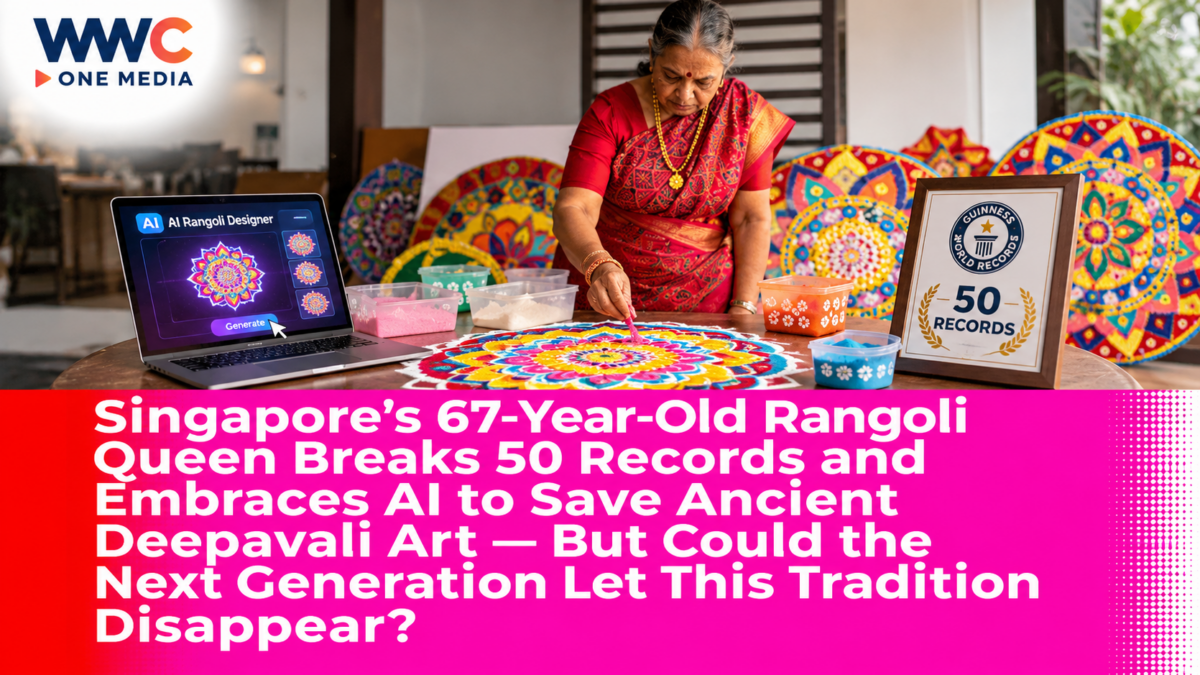
SINGAPORE — A centuries-old Indian art form is undergoing a remarkable transformation in Singapore, where a 67-year-old record-breaking artist is using technology, unconventional materials and the creativity of younger generations to ensure that one of Deepavali’s most recognizable traditions does not fade away.
For more than six decades, Vijaya Mohan has dedicated her life to rangoli, the intricate practice of arranging coloured powders and other materials into elaborate patterns that decorate homes, temples and public spaces.
Her extraordinary journey includes a Guinness World Record, more than 50 entries in the Singapore Book of Records and an artistic career that has taken her around the world.
But the challenge she faces today is different from anything she has encountered before.
How do you persuade a generation raised on smartphones, digital entertainment and artificial intelligence to embrace an art form traditionally created by hand, one careful movement at a time?
Her answer is surprising: do not fight technology. Learn how to use it.
As Singapore celebrates Deepavali on November 8, artists like Vijaya are demonstrating that preserving cultural heritage may require more than protecting old techniques.
It may require reinventing how those traditions are experienced.
A Grandmother, Her 15-Year-Old Grandson and a Tradition That Refuses to Fade
At her home in Singapore, Vijaya carefully creates intricate patterns using brightly coloured powder.
Her movements appear effortless, shaped by decades of experience.
But when her 15-year-old grandson, Pranav Bakshi, began working on a design, a familiar disagreement emerged.
Vijaya wanted him to follow the traditional technique.
Pranav believed a different approach could improve the artwork.
Instead of insisting that her way was the only acceptable method, Vijaya agreed to a compromise.
The exchange, documented in a November 8 Channel News Asia feature by Charmaine Jacob, captured the larger challenge confronting traditional artists.
Older generations have inherited techniques, knowledge and cultural practices that younger people may interpret differently.
But Vijaya believes those differences can become opportunities rather than obstacles.
Her approach is to introduce young people to rangoli through methods they understand before teaching them its traditional foundations.
That philosophy could prove essential to keeping the art form relevant.
What Is Rangoli and Why Is It Important During Deepavali?
Rangoli is a traditional Indian decorative art commonly associated with Deepavali, also known as Diwali or the Festival of Lights.
The word is linked to the Sanskrit term rangavalli, associated with colourful patterns and designs.
Families traditionally create rangoli at the entrances of their homes to welcome visitors and express hopes for happiness, prosperity and good fortune.
Depending on the community and region, designs may incorporate flowers, geometric arrangements, lamps and other symbolic motifs.
Materials can include rice flour, coloured powders, flower petals and natural substances.
In some traditions, the designs are also associated with welcoming blessings and positive energy into the household.
For many families, rangoli is not simply a decorative activity.
It represents a connection to cultural identity, family traditions and the passing of knowledge between generations.
The practice also reflects the broader meaning of Deepavali: the triumph of light over darkness and good over evil.
In Singapore, the celebration is particularly visible in Little India, where festive illuminations, cultural performances and family gatherings highlight the country’s Indian heritage.
As previously covered by WWC ONE MEDIA in its guide to Singapore’s special Deepavali menus and celebrations, the 2026 holiday brings together food, family traditions and cultural experiences across the city-state.
Rangoli is one of the most recognizable visual expressions of that celebration.
Vijaya Mohan’s World Record: A 2,756-Square-Foot Masterpiece
Vijaya’s artistic career began in India when she was a young child.
She learned rangoli from her mother and spent her childhood experimenting with increasingly ambitious designs.
Even then, she dreamed of producing the world’s largest rangoli.
That ambition became reality in Singapore in 2003.
At Whampoa Community Club, Vijaya created a rangoli measuring approximately 2,756 square feet, equivalent to around 256 square metres.
The enormous design covered an area roughly the size of three badminton courts.
According to CNA, she worked alone for seven hours, arranging hundreds of kilograms of coloured powder into a carefully planned composition.
The achievement earned a Guinness World Record for the largest rangoli at the time.
It was a demanding physical undertaking, requiring sustained concentration and hours of bending close to the floor.
But the accomplishment marked only one chapter in her career.
Over the years, Vijaya has accumulated more than 50 entries in the Singapore Book of Records.
Her creations have included rangoli made from drinking straws, bananas and numerous unconventional materials.
The achievements helped attract wider attention to an art form that she believes deserves greater recognition.
More Than 40 Materials: How Rangoli Is Being Reinvented
Traditional rangoli often uses coloured powder or rice flour.
Vijaya has gone much further.
She has experimented with more than 40 different materials, including flowers, pistachio shells, fruits, vegetables and bottle caps.
She has also developed rangoli designs on acrylic sheets and boards.
These alternatives address practical challenges that can discourage people from creating traditional floor decorations.
Powder-based designs are temporary and may be easily disturbed.
Some households want decorations that can remain on display throughout the festive season.
Others prefer artwork that can be framed, transported or reused.
Working on boards also allows people who cannot comfortably bend down to participate more easily.
The alternative materials may benefit individuals sensitive to coloured powders.
These changes demonstrate how traditional art can evolve without necessarily abandoning its recognizable visual identity.
In 2015, Vijaya founded Singa Rangoli, an initiative intended to give the craft a distinctive Singaporean character.
Her work has since reached international audiences in countries including Japan, China and the United States.
Digital Rangoli: Can Technology Bring Young People Back to Tradition?
Perhaps Vijaya’s most ambitious innovation involves digital technology.
Several years ago, she collaborated with an electronics company on an interactive rangoli installation.
Participants could step onto a musical pad that triggered colourful projections overhead.
The installation featured approximately 200 designs created by Vijaya.
Another component allowed visitors to colour patterns on their mobile phones and see those creations projected onto the ceiling.
The experience connected traditional visual motifs with interactive digital entertainment.
For young people accustomed to smartphones and digital applications, the approach offered a different introduction to rangoli.
Rather than beginning with traditional powder techniques, participants could first experiment with patterns through familiar technology.
Vijaya now hopes to expand this educational approach.
Her idea is to introduce students to digital rangoli before encouraging them to try creating physical designs.
She also sees potential in artificial intelligence.
However, she has not yet incorporated AI into her work.
She has expressed interest in experimenting with it in the future.
That distinction is important because her current innovation centres on digital interactivity, not an established AI-generated art programme.
For Vijaya, technology represents a possible gateway to cultural learning.
But it also raises a larger question.
Could digital convenience eventually weaken the patience, craftsmanship and personal involvement that define handmade rangoli?
The Hidden Economic Struggle Behind Beautiful Rangoli Designs
Despite decades of artistic achievement, Vijaya says traditional artists continue to face an uncomfortable challenge.
Many people admire intricate rangoli designs but underestimate the work required to produce them.
Corporate clients sometimes request elaborate pieces while offering limited budgets.
Some designs measure up to two metres by two metres and require planning, detailed sketches and extensive labour.
Rising material costs have added financial pressure.
According to CNA, Vijaya charges corporate clients approximately S$500 to more than S$1,000, depending on the work.
Yet she says some clients still bargain aggressively.
The frustration reflects a broader problem faced by many traditional craftspeople.
Handmade cultural work can require years of accumulated knowledge, but the finished product may appear deceptively simple.
Consumers who compare it with inexpensive mass-produced decorations may overlook the labour behind the artwork.
The economic challenge also creates uncertainty about whether younger artists can pursue traditional crafts sustainably.
If artisans struggle to earn fair compensation, fewer people may choose to develop the necessary skills.
The result could be a gradual loss of expertise even if the decorative style remains popular.
A Team of 35 Artists and Volunteers Keeps the Craft Growing
Vijaya does not work alone.
She now collaborates with approximately 35 artists and volunteers.
The group participates in commissioned projects and community initiatives.
Some members provide their time voluntarily for public-benefit activities, while corporate work is compensated.
One member, 50-year-old Nalini Shastri, describes the team as a close-knit family.
The group shares an interest in ensuring that rangoli remains part of Singapore’s cultural life.
Vijaya also conducts free workshops for children, older adults and people with disabilities.
These activities broaden access beyond households that already practise the tradition.
Community engagement matters because traditional crafts survive through participation rather than observation alone.
People may admire a finished rangoli without understanding how to create one.
Workshops give participants an opportunity to experience the skill, patience and coordination involved.
They also create opportunities for people from different backgrounds to learn about Indian culture.
That approach reflects Singapore’s wider efforts to protect living cultural traditions.
As WWC ONE MEDIA reported on Singapore’s participation in a regional UNESCO heritage nomination for zapin, traditional arts remain significant when communities continue practising and sharing them.
Rangoli and zapin are different art forms with distinct histories.
However, both illustrate the importance of intergenerational learning.
A Mother and Daughter Prove Handmade Rangoli Still Has a Future
Vijaya is not the only Singaporean artist adapting rangoli to modern life.
Another family is demonstrating how the craft can strengthen relationships across generations.
Sudha Ravi, 55, has spent more than a decade creating rangoli alongside her daughter, 21-year-old Rakshita Ravi.
The pair combine traditional methods with contemporary visual styles.
Their designs sometimes include glitter accents and modern patterns.
They also create decorations on acrylic sheets and foam boards, allowing their work to be used as backdrops and displays.
Sudha takes pride in preparing some of her own materials.
Her process involves combining rice flour, coloured powder and water, then allowing the mixture to dry over several days.
The preparation reflects the patience required for traditional handmade work.
Together, the mother and daughter have produced commissioned art for banks, retail brands and Singapore Airlines.
They also volunteer at temples and conduct free workshops for children and elderly communities.
Their achievements include four entries in the Singapore Book of Records.
One creation featured recognizable Singapore landmarks, including the Merlion and Marina Bay Sands.
The design demonstrated how Indian artistic traditions can incorporate imagery associated with modern Singapore.
Ready-Made Rangoli Stickers Create a New Challenge
Not everyone has the time or skill to create handmade rangoli.
As a result, ready-made stickers and decorative decals have become increasingly popular.
They offer convenience, affordability and an easy way to decorate homes during Deepavali.
But Sudha worries about what could happen if handmade rangoli eventually disappears.
The issue is not simply whether traditional patterns remain visible.
It is whether future generations will continue understanding how those patterns are made.
A sticker may reproduce the appearance of rangoli.
But it cannot fully reproduce the experience of choosing materials, preparing colours and creating the design by hand.
For Sudha, that shared activity is central to the tradition’s value.
She believes the craft preserves family memories and encourages patience, creativity and cooperation.
Her daughter provides an encouraging example.
Rakshita, an engineering undergraduate, uses an iPad to experiment with designs and gather inspiration.
She balances university commitments and social activities with hours of rangoli preparation.
Their collaboration sometimes involves disagreements over design choices.
But those conversations are part of the learning process.
The result is more than decorative artwork.
It is a continuing relationship between generations.
Singapore’s Wider Cultural Revival Gives Rangoli New Relevance
The effort to preserve rangoli reflects a broader discussion about cultural heritage in Singapore.
Traditional languages, artistic practices and family customs face challenges as lifestyles change.
Some practices become less common because younger generations have fewer opportunities to learn them.
Others evolve through new materials, digital platforms and contemporary creative approaches.
As highlighted by WWC ONE MEDIA in its feature on efforts to revive Singapore’s Hokkien, Teochew and Baba Malay languages, community initiatives and renewed interest among younger people can play an important role in keeping heritage practices alive.
The same principle applies to traditional arts.
Preservation does not necessarily mean freezing a practice in one historical form.
It can involve maintaining its cultural meaning while allowing artists to develop new ways of expressing it.
Singapore’s cultural institutions have also embraced the relationship between traditional identity and contemporary creativity.
As WWC ONE MEDIA reported on the country’s first cultural festival in Shanghai and Beijing, Singapore has promoted its multicultural heritage through exhibitions, performances, food and digital storytelling.
These initiatives demonstrate how cultural identity can reach audiences beyond traditional settings.
For rangoli artists, that creates opportunities to introduce their work to people who may never have encountered it otherwise.
Deepavali 2026 Brings Rangoli Beyond Homes and Temples
The role of rangoli in Singapore’s public celebrations has also expanded.
Deepavali decorations now appear in transport spaces, community centres, commercial venues and cultural exhibitions.
According to AsiaOne, Singapore’s Land Transport Authority introduced Deepavali-themed decorations across selected trains, buses and MRT stations beginning October 8.
The installations are scheduled to remain until November 11.
They feature festive imagery including traditional lamps, elephants and rangoli-inspired motifs.
The decorations extend the visual language of Deepavali into everyday public transport.
Meanwhile, Mediacorp’s 2026 Deepavali programming includes cultural performances, films and celebrations highlighting the Indian community.
The official Visit Singapore tourism website also promotes Little India’s festive light-up, food bazaars and cultural activities.
Together, these events show that Deepavali is celebrated not only within individual households but also across public spaces.
For artists like Vijaya and Sudha, this greater visibility creates opportunities to introduce rangoli to new audiences.
But visibility alone does not guarantee that traditional skills will survive.
The next challenge is encouraging participation.
Could Artificial Intelligence Preserve Traditional Art — Or Change It Forever?
Vijaya’s interest in AI raises an important question for artists across the world.
Digital tools can help people discover traditional crafts, experiment with designs and share cultural knowledge.
AI-assisted design systems could potentially introduce users to historical patterns or help them plan complex compositions.
However, those are possibilities rather than confirmed features of Vijaya’s current practice.
Her experience illustrates both the promise and uncertainty surrounding technology’s role in cultural preservation.
On one hand, digital tools can make creative activities more accessible.
On the other, excessive dependence on automated design could reduce opportunities to develop manual skills.
There are also questions about cultural authenticity and proper recognition for traditional artists whose work may influence digital creations.
For rangoli, the challenge is finding a balance.
Technology may help young people discover the art.
But continued learning from experienced practitioners remains essential to understanding its cultural meaning.
The digital image may attract attention.
The human connection may be what keeps the tradition alive.
The Bigger Question: What Happens When the Masters Are Gone?
One of the most emotional aspects of CNA’s reporting is the determination of older artists to continue practising rangoli for as long as possible.
At 67, Vijaya maintains a routine of yoga and exercise to preserve her physical fitness.
Years of working close to the ground have required considerable endurance.
She is gradually training younger members of her team to take on more physically demanding sections of major designs.
But she has no intention of abandoning the art.
Her ambition is to continue making rangoli throughout her life.
Sudha shares similar concerns about the future.
She hopes she will remain physically capable of creating designs for many more years.
Both women understand that passing on skills takes time.
Their work involves knowledge that cannot always be learned from photographs or instructional videos.
Students must understand materials, proportions, movement and technique.
They also need opportunities to develop patience and confidence.
The success of these efforts may ultimately determine whether rangoli remains a widely practised living tradition or becomes primarily something displayed during special events.
The Bottom Line: Rangoli’s Future May Depend on Both Tradition and Innovation
Vijaya Mohan’s extraordinary career demonstrates what dedication to a traditional art form can achieve.
From learning rangoli as a child in India to creating a Guinness World Record-setting masterpiece in Singapore, she has helped expand recognition of the craft.
Her more than 50 Singapore Book of Records entries show an ability to experiment with unconventional materials and ambitious designs.
But her greatest legacy may not be a record.
It may be her willingness to teach younger generations through methods they understand.
Interactive digital installations, alternative materials and family workshops are bringing new possibilities to an ancient practice.
Meanwhile, Sudha and Rakshita Ravi are proving that handmade rangoli can remain meaningful even in a world dominated by ready-made decorations.
Their stories highlight a central truth about cultural heritage.
Traditions survive when people continue practising, adapting and sharing them.
Technology can offer new ways to participate.
But cultural knowledge still depends on human relationships.
And as Singapore celebrates Deepavali 2026, rangoli artists are confronting a question that extends far beyond their colourful creations.
Will digital innovation inspire a new generation to carry this centuries-old tradition forward—or could a future filled with instant designs and artificial intelligence slowly erase the human craftsmanship that made rangoli special in the first place?