NEW YORK / SAN DIEGO / WASHINGTON / MANILA — November 7, 2026 | WWC ONE MEDIA | Global Sports, Women’s Soccer and Sports Business
America’s top professional women’s soccer league is facing a potential playoff scheduling crisis, with its three highest-seeded teams at risk of losing access to their regular home stadiums because of competing men’s sporting events.
The National Women’s Soccer League (NWSL) is preparing contingency plans that could force semifinal matches into smaller stadiums or alternative locations, despite clubs earning the right to host important postseason games.
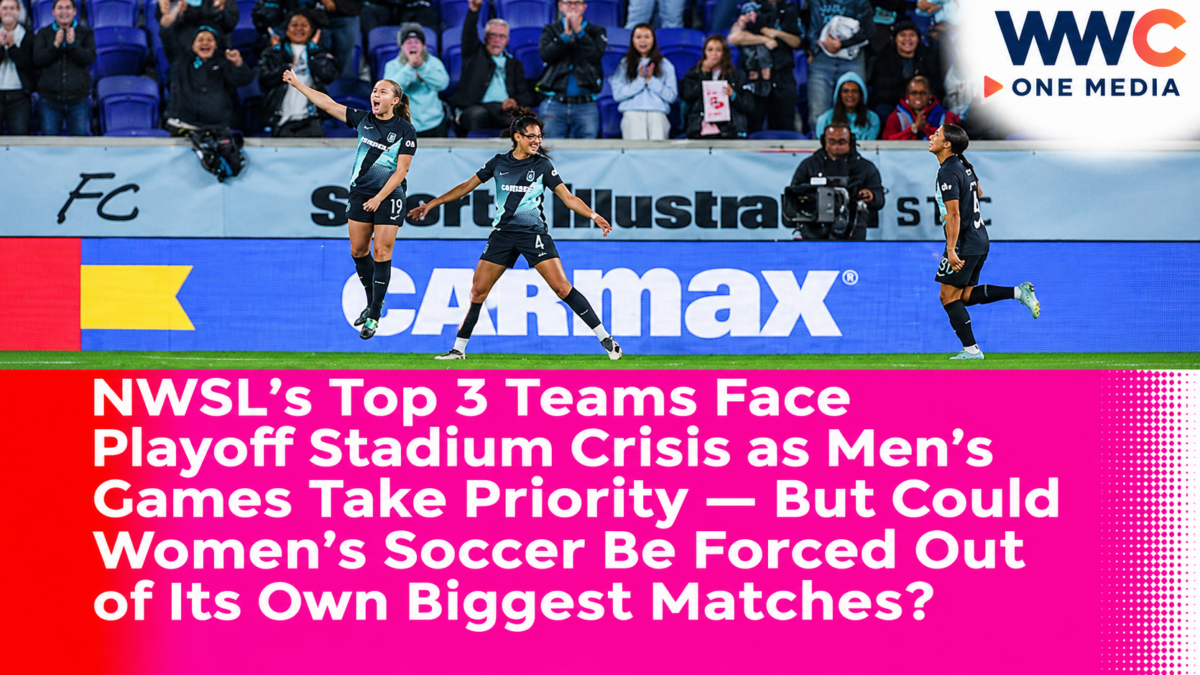
The controversy affects Gotham FC, San Diego Wave FC and Washington Spirit, the top three seeds in the 2026 playoffs.
According to Bloomberg’s November 6 report and independent reporting by ESPN, all three clubs face stadium availability problems for Saturday, November 14, when one of the league’s nationally televised semifinal matches is scheduled.
The issue comes just weeks after the Women’s National Basketball Association (WNBA) was forced to move a Finals game to a Thursday afternoon because its preferred arena had a scheduling conflict with the NBA’s Atlanta Hawks.
The similarities have reignited debate over whether the rapid commercial growth of women’s professional sports is being matched by adequate investment in stadiums, scheduling rights and infrastructure.
For the NWSL, the immediate problem is particularly serious.
Top-seeded Gotham FC could be forced to play a semifinal in a stadium holding approximately 5,000 spectators, rather than its usual venue with roughly five times that capacity.
Meanwhile, San Diego Wave and Washington Spirit face their own conflicts with college football.
Could the biggest games of the women’s soccer season become another example of female athletes being forced to adjust to the schedules of men’s sports?
Gotham FC Could Lose Its Home Stadium Despite Winning the NWSL Shield
Gotham FC finished the regular season as the NWSL’s top seed and secured the Supporters’ Shield equivalent, known as the NWSL Shield.
The achievement should give the club a major advantage during the playoffs: the opportunity to host postseason games.
But Gotham’s usual home, Sports Illustrated Stadium in Harrison, New Jersey, is unavailable during the Saturday semifinal window.
The stadium is scheduled to host a friendly match between Major League Soccer’s New York Red Bulls and Mexican club América later on November 14.
Although Gotham’s possible semifinal would be played earlier in the day, stadium operations and preparation requirements have created an availability conflict.
ESPN reported that Gotham could instead be required to host its semifinal at Icahn Stadium on Randall’s Island in New York City, a venue with approximately 5,000 seats.
The alternative would keep the match within the club’s wider home market.
However, it would also substantially reduce potential attendance compared with Sports Illustrated Stadium, which accommodates approximately 25,000 spectators.
That could affect ticket availability, hospitality revenue and the matchday experience.
Gotham has previously used Icahn Stadium, including for a regular-season match during the summer.
The stadium is therefore a known alternative.
But moving a championship-contending team into a significantly smaller venue during the playoffs would raise questions about whether the league’s infrastructure arrangements reflect its commercial ambitions.
San Diego Wave Faces a Football Conflict at Snapdragon Stadium
The second-seeded San Diego Wave faces a different scheduling problem.
The club normally plays at Snapdragon Stadium, which is also home to the San Diego State Aztecs college football program and MLS club San Diego FC.
On November 14, San Diego State is scheduled to host Utah State in a football game beginning at 6:30 p.m. Pacific Time.
That creates a conflict with the NWSL’s national television window.
The timing is particularly difficult because the planned Saturday semifinal broadcast is expected around noon Eastern Time.
For a match in San Diego, that would translate to approximately 9 a.m. Pacific Time.
Such an unusually early kickoff could create problems for athletes, match operations and spectators.
The NWSL has reportedly identified a preference for games not to begin before 11 a.m. local time.
One possible solution would place San Diego’s semifinal on Sunday, November 15, assuming the Wave advances.
But the decision is tied to which other clubs qualify, because two semifinals must fit into separate national broadcast windows.
That means a scheduling problem involving one team can affect the entire playoff bracket.
Washington Spirit Could Move to an NFL Stadium
Third-seeded Washington Spirit also faces uncertainty.
The Spirit normally hosts matches at Audi Field in Washington, D.C.
However, the stadium is scheduled to stage the Secretaries’ Cup on November 14, featuring the US Coast Guard Academy and the US Merchant Marine Academy.
That is a Division III college football event.
It is not a D.C. United match, even though the Spirit shares Audi Field with the men’s MLS club.
The conflict means Washington may need an alternative venue if it qualifies for a Saturday semifinal.
According to ESPN and local reporting, one possibility is Northwest Field in Landover, Maryland, the home of the NFL’s Washington Commanders.
The stadium provides substantially more capacity than Audi Field.
But moving a game to a different location could still create logistical problems for fans, teams and match organizers.
Transportation, staffing, security, ticketing and broadcast operations would all need coordination.
The move is not inevitable.
Depending on which teams advance, Washington could potentially host a Sunday semifinal at Audi Field.
The final solution will depend on the quarterfinal results and the league’s scheduling decisions.
NWSL Has Eight Possible Scenarios — And Few Perfect Solutions
The league has reportedly developed an internal planning document outlining potential semifinal arrangements.
ESPN obtained the document and reported that the league examined eight possible scenarios based on which teams advance.
Only three reportedly satisfy all four of the league’s planning principles.
Those principles place importance on maintaining a team’s home-market advantage, avoiding excessively early kickoffs, protecting higher-seeded teams and preventing unnecessary reversals of home-field rights.
A fixture reversal would involve awarding hosting responsibilities to the lower-seeded club.
The league regards that as a last-resort option.
One reported scenario would have Gotham hosting at Icahn Stadium on November 14, while San Diego hosts at Snapdragon Stadium on November 15.
Another could involve Washington playing at Northwest Field.
A different set of quarterfinal results might allow Kansas City Current to host a semifinal at its own stadium, avoiding some of the major conflicts.
These options remain conditional.
The NWSL has not announced that every semifinal must be relocated, and no team has been guaranteed an alternate venue simply because it occupies a high seed.
The central issue is the league’s limited control over stadium availability.
Kansas City Current Shows What Stadium Ownership Can Change
One club stands apart from the others.
Kansas City Current owns and operates CPKC Stadium, a purpose-built women’s professional soccer venue that opened in March 2024.
The stadium holds approximately 11,500 spectators.
Unlike clubs sharing facilities controlled by men’s teams, universities or other venue operators, Kansas City has greater control over its home schedule.
That provides meaningful advantages when organizing matches, selling tickets and accommodating television requirements.
It also illustrates the importance of long-term infrastructure investment.
Stadium ownership can give a club more control over commercial revenue, fan experiences and event planning.
But owning a venue requires substantial investment and ongoing operating expenses.
Not every NWSL team is in a position to finance and operate a dedicated stadium.
The resulting difference in infrastructure can affect how clubs respond to scheduling conflicts.
For Kansas City, the immediate hurdle is sporting rather than logistical.
The Current must advance through the playoffs and qualify to host a semifinal.
For Gotham, San Diego and Washington, reaching the semifinals may only be the beginning of another challenge.
WNBA Finals Controversy Shows This Is Not Just a Soccer Problem
The NWSL’s situation comes shortly after a major controversy involving the WNBA.
During the 2026 WNBA Finals, the Atlanta Dream faced an arena scheduling conflict involving the NBA’s Atlanta Hawks.
The Dream wanted to play Game 6 in the larger State Farm Arena.
But the Hawks had a previously scheduled game at the same venue that evening.
As a result, the WNBA moved Game 6 to 12:30 p.m. Eastern Time on Thursday, October 29.
The game was played in the larger arena rather than the Dream’s smaller regular venue.
However, the weekday afternoon timing generated criticism from fans and team ownership.
Atlanta Dream ownership said it had raised concerns about potential conflicts months earlier.
The owners argued that the scheduling problems should have been addressed before the championship series reached that stage.
Despite the unusual time, Game 6 sold out.
That demonstrated substantial demand for women’s basketball while highlighting the difficulties created by limited control over venues.
The Golden State Valkyries eventually defeated Atlanta in Game 7 to win the WNBA championship.
The scheduling controversy nevertheless continued fueling debate about how major women’s sporting events are prioritized.
Why Women’s Sports Continue Facing Venue Problems
Women’s professional sports have experienced major growth in attendance, media coverage, sponsorship and commercial investment.
But many teams still play in facilities owned or controlled by other organizations.
When several events compete for the same venue, the allocation of dates can become complicated.
Contractual priority, stadium ownership, television agreements and existing event commitments all influence the outcome.
The issue is not always a direct decision by a men’s team to displace a women’s team.
In some cases, conflicts involve university athletics or previously contracted outside events.
Nevertheless, the practical consequence may be the same: a women’s team must accept a less favorable date, time or venue.
NWSL Players Association executive director Meghann Burke told ESPN that the league had been working seriously to manage the problem.
She also argued that insufficient investment and control over dedicated women’s sports infrastructure are underlying causes.
That distinction is important.
The players’ union is not simply blaming the NWSL for failing to plan.
It is questioning a wider sporting system in which women’s professional leagues often have less leverage over the venues they use.
Television Contracts Create Another Scheduling Challenge
The NWSL is also trying to preserve its national television commitments.
The 2026 semifinals are scheduled for November 14 and 15, with CBS and ABC carrying one match each.
National television windows can help leagues attract wider audiences and generate commercial value.
But those windows also reduce flexibility.
Moving a game to a different day or time may affect broadcasting agreements and audience reach.
The challenge is especially difficult when the clubs that advance are not known until the quarterfinals conclude.
The NWSL must therefore plan for multiple possible matchups while maintaining television commitments.
That is why the league is considering alternate venues rather than simply moving every match to whichever time is convenient for the stadium operator.
The problem illustrates a central tension in professional sports.
The broadcast opportunities that help leagues grow can also create difficult scheduling obligations when clubs do not control their own venues.
Women’s Sports Are Growing — But Infrastructure Must Keep Up
The controversy is emerging during a period of expanding commercial opportunities for women’s athletics.
Leagues are attracting larger audiences, increasing sponsorship activity and developing stronger relationships with television networks.
But growth in commercial interest does not automatically create additional stadium capacity.
Venue construction requires land, financing, government approvals and long-term planning.
Those investments can take years.
In the meantime, clubs may continue operating under shared-stadium arrangements.
The issue is relevant beyond American soccer.
Women’s basketball, volleyball, tennis and other sports also require dependable facilities, event schedules and commercial investment.
As WWC ONE MEDIA reported on UST’s winning streak in the UAAP women’s basketball tournament, women’s competitions can generate strong sporting storylines and dedicated fan interest.
Similarly, WWC ONE MEDIA covered Ateneo’s women’s badminton championship, highlighting the competitiveness of women’s collegiate athletics.
Those Philippine competitions operate under different venue and commercial arrangements from the NWSL.
But they underscore a common principle: investment in athletes, event organization and facilities helps determine how effectively women’s sports can grow.
What This Means for Women’s Sports in the Philippines
The stadium controversy provides a useful lesson for Philippine sports organizations.
Women’s professional and collegiate competitions need dependable playing facilities, broadcast planning and opportunities to reach spectators.
As women’s sports gain popularity, event organizers may need to reconsider whether existing venues and scheduling practices can support larger audiences.
The Philippines has experienced increasing public interest in female athletes across basketball, volleyball, tennis and other sports.
For example, WWC ONE MEDIA recently reported on Filipina tennis star Alex Eala’s strong support from fans in Hong Kong.
The country’s interest in emerging sports is also growing, with WWC ONE MEDIA covering world No. 1 pickleball star Anna Leigh Waters’ planned appearance in Manila.
These stories involve different sporting systems, but they demonstrate the opportunities created by strong fan engagement.
For organizers, accommodating that demand requires suitable venues, reliable event scheduling and long-term commercial planning.
The NWSL controversy is a reminder that sporting popularity and infrastructure capacity must develop together.
What Happens Next in the 2026 NWSL Playoffs?
The quarterfinal round runs from November 6 to November 8.
The official schedule features four matches:
- San Diego Wave vs. Utah Royals — November 6
- Kansas City Current vs. Angel City FC — November 7
- Gotham FC vs. Seattle Reign — November 8
- Washington Spirit vs. Portland Thorns — November 8
The winning teams will advance to the semifinals on November 14 and 15.
Only then will the league know which stadium conflicts actually need to be resolved.
The NWSL Championship is scheduled for November 21 at Audi Field in Washington, D.C.
That final has a predetermined host venue and is not subject to the same semifinal home-field calculations.
The immediate question is how the league will accommodate the teams that earn the right to host semifinal matches.
The Bigger Question: Is Women’s Soccer Growing Faster Than Its Stadium Infrastructure?
The NWSL’s playoff dilemma has exposed a challenge extending far beyond a single weekend.
The league is growing in national visibility and commercial importance.
Its strongest teams are competing for a championship.
And national broadcasters are prepared to carry the semifinal matches.
Yet several of those clubs may not be able to stage their biggest games at their regular home stadiums.
Gotham could be moved to a venue with only 5,000 seats.
San Diego faces a football scheduling conflict.
Washington may need to use an NFL stadium.
The WNBA recently faced a similar controversy during its championship series.
Together, the incidents have raised difficult questions about the treatment of women’s sports within America’s wider sporting infrastructure.
The immediate NWSL scheduling decisions remain unresolved. But the broader concern is already clear: successful women’s teams need access to facilities and playing times that match the importance of their competitions.
The next week will reveal whether the NWSL can preserve home-field advantages and national television commitments without placing unreasonable burdens on players or supporters.
And as the league prepares for its most important postseason matches, one question now hangs over American women’s sports:
If women’s professional leagues are attracting larger audiences and stronger investment than ever before, why are some of their biggest games still being forced to accommodate other sporting events—and how long can that continue before fans, athletes and sponsors demand a different system?