WASHINGTON / NEW YORK / MANILA — November 7, 2026 | WWC ONE MEDIA | US Politics, Global Finance, Artificial Intelligence and Housing
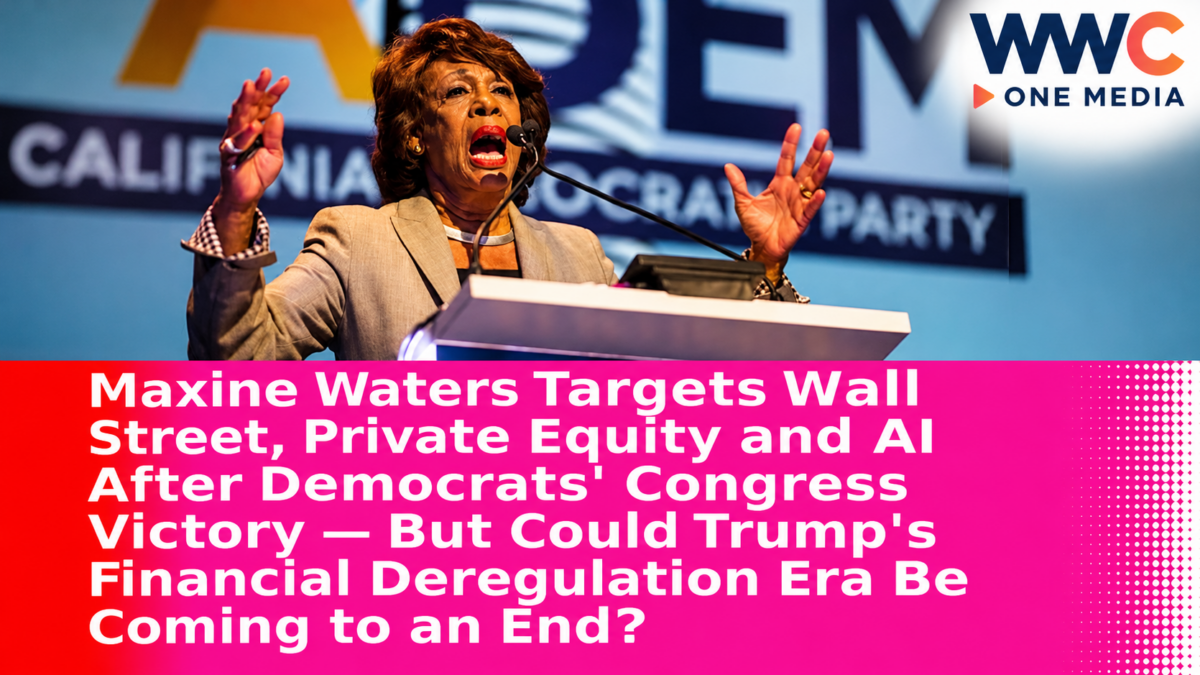
Wall Street could be heading toward a major political confrontation as veteran Democratic lawmaker Maxine Waters launches a campaign to reclaim one of Congress’ most powerful financial oversight positions, promising tougher scrutiny of private equity firms, artificial intelligence, cryptocurrency and America’s worsening housing affordability crisis.
The 88-year-old California representative, who currently serves as the top Democrat on the House Financial Services Committee, formally asked fellow Democrats on November 6 to support her bid to chair the panel when the party takes control of the House in January 2027.
Her announcement comes just days after Democrats won control of both chambers of Congress in the November 3 midterm elections, setting the stage for an aggressive new phase of financial oversight during President Donald Trump’s second term.
According to Bloomberg’s November 6 report, Waters wants to expand scrutiny of private equity, develop safeguards against artificial intelligence-related financial risks and make housing affordability a central focus of the committee.
She is also promising to challenge what she describes as the Trump administration’s attempts to weaken consumer protections.
The proposed agenda could have far-reaching implications for major banks, alternative asset managers, cryptocurrency businesses, mortgage lenders and companies investing billions of dollars in artificial intelligence.
But Waters faces an unexpected obstacle.
Fellow Democrat Sean Casten of Illinois has launched his own bid to lead the committee, presenting himself as a candidate capable of addressing emerging risks involving financial technology, climate change and systemic instability.
The leadership contest could determine how aggressively the incoming Democratic majority challenges Wall Street and the Trump administration.
With private equity expanding into housing, healthcare and retirement investments while artificial intelligence reshapes global finance, could Waters’ return to power trigger a new era of financial regulation—or will a leadership battle inside her own party derail her plans?
Maxine Waters Launches Bid to Reclaim House Financial Services Committee
Waters formally announced her candidacy in a letter to Democratic colleagues on November 6.
Reuters obtained and reported the letter, which outlines her argument for returning to the committee’s leadership.
Waters emphasized her experience overseeing financial institutions, negotiating legislation and challenging policies she believes threaten ordinary Americans.
She has served as the senior Democrat on the committee since 2013 and previously chaired it during periods of Democratic control.
The committee has broad authority over federal financial policy.
Its responsibilities include oversight of banking, housing finance, securities markets, insurance-related issues, consumer financial protection and parts of the financial technology industry.
Committee leaders can schedule hearings, oversee investigations, question corporate executives and help determine which legislation advances for consideration.
For Wall Street, the identity of the next chair is therefore important.
Waters has a long record of criticizing practices she considers harmful to consumers, including predatory lending, excessive fees and weaknesses in financial oversight.
Her latest leadership campaign signals that those issues could return to the center of congressional debate.
But a successful bid is not automatic.
House Democrats must select their committee leadership, and Waters is facing an organized challenger.
Private Equity Could Face a Wave of Congressional Scrutiny
One of Waters’ most significant priorities is stronger oversight of private equity.
Private equity firms invest in businesses using capital raised from institutions and other eligible investors, often combining equity with borrowed funds.
Their activities extend across healthcare, real estate, technology, financial services, infrastructure and numerous other sectors.
Supporters argue that private equity can provide companies with access to capital, operational expertise and restructuring support.
The industry also finances businesses that may struggle to obtain comparable investment through traditional public markets.
Critics, however, raise concerns about debt levels, fee structures, transparency and the consequences of aggressive cost-cutting.
Waters wants Congress to examine whether certain investment practices are exposing workers, consumers and financial institutions to unnecessary risks.
According to reporting on her leadership letter, she intends to pursue oversight and regulation of private equity operators whose conduct she considers abusive.
That could translate into additional hearings involving major investment firms and questions about their ownership structures, financing arrangements and treatment of customers.
The Wall Street Journal separately reported that Democratic control of Congress could increase investigations involving private equity investments in healthcare, housing, digital infrastructure and youth sports.
However, stronger oversight should not be confused with a blanket prohibition on private equity investment.
Waters has not secured passage of legislation banning the industry.
Her proposals would still need to go through the congressional process.
America’s Housing Crisis Could Become Her Biggest Political Weapon
Housing affordability is central to Waters’ campaign.
She wants to rename the House panel the Committee on Housing and Financial Services, underscoring her intention to give housing policy greater prominence.
The proposal is symbolic but politically significant.
Millions of Americans remain concerned about mortgage costs, rent, home prices and the difficulty of purchasing their first property.
Waters argues that large institutional investors have contributed to these problems by competing with ordinary buyers for residential properties.
She has advocated restrictions on certain institutional purchases of single-family homes.
On October 22, Waters welcomed a Treasury Department proposal to implement restrictions under the bipartisan 21st Century ROAD to Housing Act.
She also warned that regulations must prevent large investors from circumventing the restrictions through alternative arrangements.
The broader objective is to improve opportunities for individual homebuyers.
But the economic effects of restricting institutional investors are debated.
Supporters believe limiting purchases by large investors could reduce competition for some homes.
Critics argue that housing affordability is driven by multiple factors, including insufficient construction, zoning restrictions, land costs and mortgage interest rates.
They also point out that institutional investment can support some rental housing development and property improvements.
The extent to which large investors influence prices varies by location.
A nationwide solution will therefore require more than focusing on private equity ownership alone.
Waters’ proposed agenda includes expanding affordable housing programs and reforming mortgage finance.
Those initiatives could become major subjects of congressional hearings during 2027.
Trump and Democrats Could Clash Over Housing Regulation
The housing debate presents an unusual political landscape.
Although Waters strongly opposes much of Trump’s financial policy, restrictions on institutional investors purchasing homes have attracted support from lawmakers in both parties.
The 21st Century ROAD to Housing Act emerged from bipartisan cooperation involving Republican committee Chairman French Hill and Waters.
The House passed the legislation in June by a vote of 358 to 32.
That result demonstrated broad congressional support for at least some housing reforms.
However, disagreements remain over implementation and the role of federal regulation.
Waters wants stronger safeguards against loopholes that could allow large firms to continue acquiring homes through structures not covered by the restrictions.
Industry representatives may argue that overly broad rules could discourage investment or reduce the supply of professionally managed rental properties.
The outcome could affect private equity firms, real estate investment businesses and companies involved in mortgage finance.
But congressional oversight alone cannot determine housing prices.
Any legislative changes would depend on the final provisions approved by Congress and signed into law.
Artificial Intelligence Is Becoming a New Wall Street Risk
Another important part of Waters’ agenda concerns artificial intelligence.
Banks and financial institutions increasingly use AI to detect fraud, assess risk, process documents, support customer service and improve compliance operations.
These technologies can increase efficiency.
They may also reduce some operating costs and identify suspicious activity faster than older systems.
However, their expanding use raises questions about accountability, data protection and financial stability.
AI systems can produce inaccurate outputs.
Poorly designed models may introduce bias into lending or insurance decisions.
Financial institutions may also become more dependent on technology providers whose services are used across the industry.
That concentration could create risks if critical systems fail.
Waters wants lawmakers to examine whether existing regulations adequately address these developments.
Her proposed agenda includes legislation intended to make the financial system more resilient to AI-related risks.
In July, Waters launched a formal request for information concerning artificial intelligence in financial services.
The initiative invited feedback from consumer advocates, regulators, industry participants and technical experts.
It was designed to examine both the opportunities and the risks created by AI adoption.
The latest leadership bid suggests she intends to turn that work into a broader legislative effort.
AI’s Trillion-Dollar Investment Boom Could Face More Oversight
Waters’ concerns extend beyond the use of AI inside banks.
She has also warned about the financial risks associated with enormous investments in AI-related companies and infrastructure.
On October 29, Waters and Representative Greg Casar introduced a resolution opposing a potential taxpayer-funded bailout of major technology companies or executives if an AI-related asset bubble bursts.
The proposal reflects growing concern about the scale of investment in chips, data centers, electricity infrastructure and computing systems.
As WWC ONE MEDIA reported on the estimated $3.2-trillion Wall Street selloff involving AI-related stocks, investor confidence in the technology sector has become vulnerable to sudden changes in expectations.
A decline in technology valuations does not automatically create a systemic financial crisis.
But losses could have broader consequences if banks, investment funds or other financial institutions are heavily exposed to companies unable to meet their obligations.
Waters’ proposed oversight could examine financing arrangements, valuation practices and the risks of excessive leverage.
The initiative may also intensify debate over whether AI developers should receive government support if major investments fail.
However, no nationwide AI bailout has been announced simply because Waters introduced an opposing resolution.
Data Centers Could Become a Major Political Target
Artificial intelligence infrastructure is another emerging source of controversy.
Data centers require substantial electricity, cooling equipment, land and financing.
Major technology companies are committing large amounts of capital to facilities capable of operating advanced AI systems.
But the projects face increasing public resistance.
As WWC ONE MEDIA reported on the wave of local opposition to AI data center development, communities across the United States have been demanding stronger oversight of proposed facilities.
Residents have raised concerns about electricity prices, water consumption, noise and the distribution of economic benefits.
Private equity firms and other financial investors have become important participants in financing this infrastructure.
That creates a connection between Waters’ concerns about alternative investment firms and her plans for AI-related financial oversight.
Lawmakers could examine whether data center financing exposes lenders and investors to excessive risk.
They may also investigate whether public infrastructure costs are being unfairly transferred to households.
But Waters has not announced a blanket ban on AI data centers.
The potential focus is on accountability, financial stability and consumer protection.
Cryptocurrency and Prediction Markets Face Tougher Questions
Waters also wants Congress to revisit cryptocurrency regulation.
Her leadership letter calls for stronger rules to address financial misconduct while creating a workable framework for legitimate digital asset businesses.
The proposal reflects longstanding disagreements over how cryptocurrency exchanges, stablecoin issuers and digital asset intermediaries should be supervised.
Republicans generally favor approaches intended to encourage financial innovation while limiting regulatory uncertainty.
Many Democrats support stronger consumer protections and safeguards against market manipulation, illicit finance and conflicts of interest.
Prediction markets could also face closer scrutiny.
These platforms allow users to trade contracts tied to future events, including elections and economic outcomes.
Supporters argue that they can provide useful information by combining the expectations of market participants.
Critics warn that some markets may be vulnerable to price manipulation, insider information and misleading interpretations.
As WWC ONE MEDIA reported in its analysis of research showing that many election prediction markets could be moved by relatively small trades, trading prices do not necessarily provide reliable measures of public opinion.
The research highlighted limited liquidity in some contracts.
However, it did not establish that all prediction markets are manipulated or that trading had changed election outcomes.
Waters’ proposed agenda could increase pressure for disclosure requirements, consumer protections and stronger monitoring of suspicious activity.
For market operators, the next Congress could therefore represent a more challenging regulatory environment.
The Consumer Financial Protection Bureau Could Return to the Spotlight
Another major priority is the Consumer Financial Protection Bureau, or CFPB.
The agency was established following the global financial crisis to oversee aspects of consumer financial products and services.
Its responsibilities include enforcing federal consumer-finance laws and addressing practices that can harm borrowers.
Waters has criticized the Trump administration’s efforts to reduce the bureau’s operations and authority.
Her leadership letter promises to pursue restoration of the CFPB and support its independent funding.
She also wants stronger protections against excessive fees and predatory lending.
The proposed measures would target practices involving overdraft charges, late-payment fees and other consumer financial costs.
Supporters argue that stronger enforcement can help households avoid unfair financial practices.
Industry groups often contend that excessive regulation can increase compliance costs, reduce product availability or limit financial innovation.
The debate is likely to become particularly contentious because changes to the CFPB have been a major part of the administration’s financial policy.
A Democratic-led House committee could hold hearings and demand explanations from regulators.
But restoring or changing the bureau’s statutory powers would require legislation or other legally authorized action.
Sean Casten Challenges Waters for the Financial Services Gavel
Despite her experience, Waters is not guaranteed the chairmanship.
Illinois Representative Sean Casten announced his candidacy on November 5.
Casten, 54, is presenting himself as a leader with experience in business, science and public policy.
He has emphasized housing and insurance affordability, consumer protection and the need to address emerging financial risks.
His agenda also includes concerns about cryptocurrency, prediction markets and the possibility of another financial crisis.
Casten has called for stronger oversight of the Trump administration’s business activities and potential conflicts of interest.
His candidacy creates a choice for House Democrats.
Waters offers decades of congressional experience and an established record of financial oversight.
Casten represents a different leadership approach, emphasizing technical expertise and newer financial challenges.
Representative Bill Foster has also been discussed as a potential contender, although Roll Call reported on November 6 that he was leaning against entering the race.
Waters appears to have substantial support among committee Democrats.
But the selection has not been finalized.
The leadership decision will be important because committee chairs influence priorities, hearing schedules and the pace at which legislation is considered.
Democrats’ Midterm Victory Gives Wall Street a New Political Reality
The leadership contest follows the November 3 midterm elections, in which Democrats secured control of the incoming House and Senate.
As WWC ONE MEDIA reported on the Democratic congressional victory, the result changes the balance of power in Washington.
Democrats will gain greater authority over congressional hearings and investigations.
For financial institutions, that could mean more scrutiny of lending practices, capital requirements, cryptocurrency operations and investment-management activities.
The Wall Street Journal reported that private equity companies are already considering the consequences of increased congressional oversight.
Barron’s likewise highlighted the possibility that Democratic committee leaders could challenge financial deregulation under Trump.
However, Democrats will not automatically be able to reverse every regulatory decision.
The president retains veto authority.
Federal regulators also exercise powers established under existing laws.
Some regulatory decisions may be challenged through judicial proceedings.
Congressional committees can exert pressure through oversight, legislation and appropriations, but they do not directly control every independent regulatory agency.
The result could be a period of intense hearings and political confrontation without equally rapid legislative change.
What the Potential Crackdown Means for Wall Street Investors
For investors, Waters’ proposed agenda could influence sentiment across several sectors.
Private equity and private credit firms may face questions about leverage, disclosures and investment practices.
Cryptocurrency businesses could confront demands for additional compliance safeguards.
Banks may face renewed scrutiny of consumer fees, lending standards and their use of artificial intelligence.
Housing investors could encounter further debate over institutional purchases of residential properties.
But potential oversight should not automatically be interpreted as a prediction that financial-sector stocks will decline.
Regulation can create costs, but clear and predictable standards may also improve confidence in financial markets.
The impact would depend on the specific policies adopted and the response of affected businesses.
For example, stronger disclosure requirements may help investors better understand risks.
Conversely, poorly designed restrictions could reduce access to capital or discourage certain investments.
The challenge for policymakers will be balancing innovation and financial stability with consumer protection.
Why the Debate Matters for the Philippines
The potential changes in American financial oversight could also have implications for international markets, including the Philippines.
US banks, private investment firms and technology companies participate in global financial activity.
Changes in American financial policy can influence investment decisions, access to capital and the operations of multinational businesses.
Philippine companies seeking foreign investment may therefore monitor developments involving private equity and credit markets.
Financial technology firms may also pay attention to proposed US rules on artificial intelligence and digital assets.
However, US congressional proposals do not automatically apply to Philippine banks, housing developers or financial technology companies.
Domestic financial regulation remains under Philippine authorities, including the Bangko Sentral ng Pilipinas and the Securities and Exchange Commission.
The broader relevance lies in how financial markets balance innovation with consumer protection.
AI systems can improve lending and fraud detection, but they also introduce operational and data-governance risks.
Private investment can support business expansion, but financing structures must remain sustainable.
Prediction markets and digital assets can create new financial products, while also raising questions about transparency and investor protection.
These are challenges confronting regulators around the world.
Could Waters and Casten Find Common Ground?
Although Waters and Casten are competing for the same leadership position, their agendas overlap in several areas.
Both identify housing affordability as an important priority.
Both want stronger safeguards against financial fraud.
Both are concerned about emerging financial risks involving cryptocurrency and prediction markets.
And both have emphasized the need for accountability in the financial system.
Their differences may involve leadership style, policy emphasis and the approach to working with other committee members.
That overlap could create opportunities for cooperation after Democrats select their chair.
But leadership contests can also expose divisions over strategy.
Some lawmakers may favor aggressive investigations and public confrontation.
Others may emphasize detailed legislation and bipartisan negotiations.
The eventual chair will need to manage both approaches while maintaining support within the Democratic caucus.
The committee will also need to work with the Senate, whose leadership and policy priorities will influence the prospects for legislation.
Three Possible Outcomes for America’s Financial Regulation
Scenario 1: Waters wins and launches aggressive oversight.
The committee could prioritize hearings involving private equity, banks, AI-related financing, housing investors and the CFPB.
That would increase public scrutiny even if major legislation faced obstacles.
Scenario 2: Casten wins and emphasizes emerging financial risks.
A Casten chairmanship could place greater emphasis on technical regulation, financial stability, crypto markets, insurance affordability and investigations into conflicts of interest.
However, his agenda also includes consumer protections and housing policy.
Scenario 3: Democrats face prolonged legislative gridlock.
The new majority could conduct investigations and advance bills through committee while struggling to secure presidential approval for major changes.
Under that outcome, oversight activity might increase without producing a comprehensive regulatory overhaul.
None of these outcomes is certain.
The committee leadership vote and subsequent legislative agenda will determine the next phase.
The Bigger Question: Is Wall Street About to Face a New Era of Accountability?
Maxine Waters’ leadership bid represents more than a contest for a congressional committee position.
It reflects a broader struggle over the future direction of America’s financial system.
Private equity has expanded into sectors that directly affect household finances.
Artificial intelligence is changing how banks evaluate customers, manage risks and deploy capital.
Cryptocurrency and prediction markets are introducing new products that challenge traditional regulatory frameworks.
And housing affordability remains a major political concern.
Waters wants Congress to respond with stronger oversight, consumer protection and financial accountability.
Her critics may argue that excessive regulation could discourage investment and innovation.
Her supporters believe stronger safeguards are necessary to prevent financial companies from imposing unacceptable risks on consumers.
For Wall Street, the immediate uncertainty concerns who will lead the House Financial Services Committee in 2027.
For American households, the bigger question is whether stronger oversight can produce meaningful improvements in affordability and financial protection.
Waters has outlined an ambitious agenda, but she must first win the leadership contest—and then confront the political and legal limits of divided government.
Her challenge from Sean Casten shows that even within the Democratic Party, the debate over how to regulate modern finance is far from settled.
And as Democrats prepare to take control of Congress, one question could define the next chapter for Wall Street: Will Maxine Waters finally secure the authority to confront private equity, AI and financial misconduct—or will internal Democratic competition and Trump’s resistance prevent her promised crackdown from becoming reality?