NEW YORK / LONDON / SINGAPORE / MANILA — November 7, 2026 | WWC ONE MEDIA | Global Oil Markets, Hedge Funds, US Politics and Energy Prices
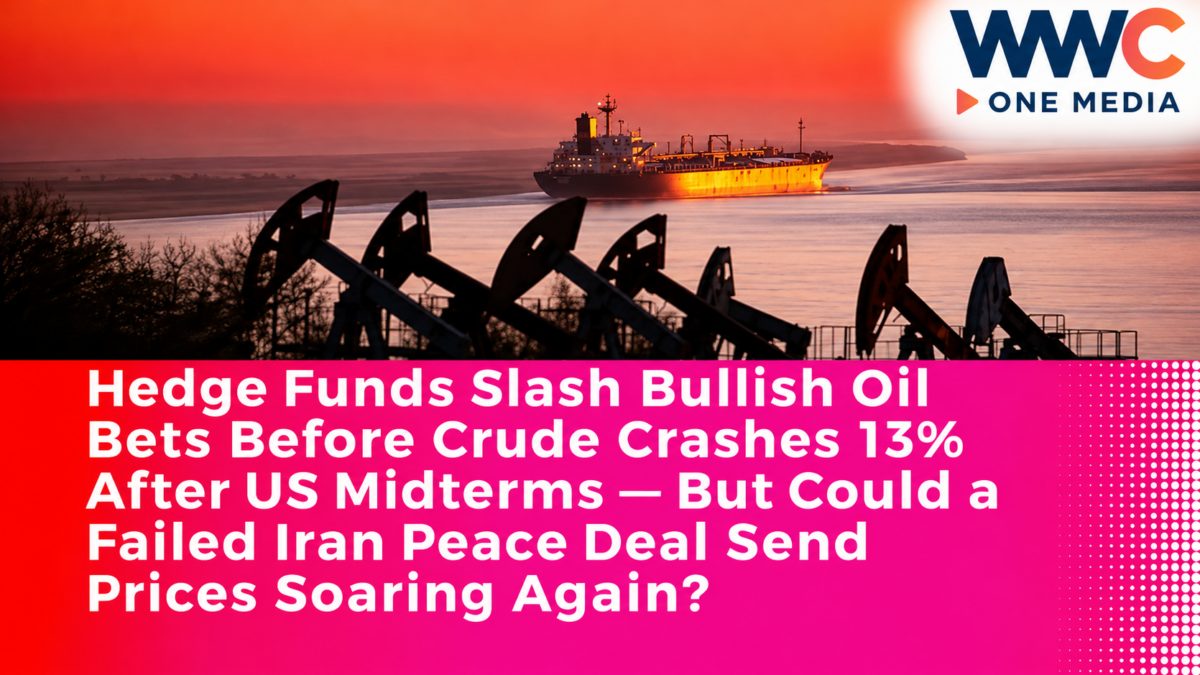
Some of the world’s biggest speculative oil traders were already abandoning bullish positions before crude prices suffered one of their sharpest weekly collapses of 2026, raising fresh questions about whether Wall Street saw the warning signs of a historic energy-market reversal.
Hedge funds reduced their bullish bets on crude oil by the largest amount since June ahead of the November 3 US midterm elections, according to a Bloomberg report published on November 6.
The repositioning came as Washington and Tehran offered cautious signals that tensions surrounding their months-long conflict could ease.
Those developments encouraged traders to reconsider the risk of prolonged disruptions to oil shipments from the Middle East.
Then came the election results.
Democrats secured control of both chambers of the US Congress, dealing a major political setback to President Donald Trump.
Oil prices immediately plunged as markets interpreted the result as increasing pressure on Washington to seek a negotiated resolution to the conflict with Iran.
By Friday, November 6, Brent crude had settled at $98.32 per barrel, while US West Texas Intermediate (WTI) closed at $90.83.
Using comparable futures contracts, the two benchmarks had lost approximately 13% over the week.
For oil-importing economies such as the Philippines, lower international crude prices could eventually reduce pressure on fuel costs, transportation and inflation.
But the retreat in hedge-fund positions reveals a more complicated story.
Some professional investors had already become less optimistic about oil before voters delivered the political shock that accelerated the selloff.
The bigger question now is whether their retreat marks the beginning of a sustained decline in energy prices—or whether unresolved military tensions could trigger another violent reversal.
Hedge Funds Cut Bullish Crude Positions by the Most Since June
Bloomberg’s November 6 report, Hedge Funds Fled Bullish Oil Bets Ahead of Election Day Drop, revealed a major change in speculative positioning.
Hedge funds reduced their bullish crude exposure by the largest amount since June as the United States and Iran signaled a possible easing of tensions.
The timing was significant.
During much of 2026, energy markets had been dominated by uncertainty surrounding the conflict in the Middle East.
Threats to tankers, shipping disruptions and fears of military escalation helped push crude prices sharply higher.
Investors who believed the conflict would continue threatening supplies had an incentive to maintain bullish oil positions.
But indications that Washington and Tehran might become more willing to negotiate changed that calculation.
Some funds cut their long exposure before the election.
Others may have reduced risk by closing positions or adjusting derivatives.
Those decisions reduced vulnerability to falling prices.
However, Bloomberg’s summary does not establish that all funds were outright bearish.
Cutting a bullish position means becoming less exposed to rising oil prices; it does not necessarily mean actively betting on a decline.
That distinction is important when evaluating whether hedge funds anticipated the eventual selloff.
What Does It Mean to Reduce a Bullish Oil Bet?
Hedge funds use several financial instruments to trade oil.
These include futures contracts, options and other derivatives linked to crude prices.
A long position generally benefits when the price of the underlying asset rises.
A short position generally benefits when its price falls.
A fund that expects oil prices to increase may buy crude futures or use options designed to profit from higher prices.
If the outlook changes, it can reduce exposure by selling those contracts.
A trader does not have to predict a crash perfectly to benefit from cutting risk before prices fall.
Simply reducing an existing long position can prevent additional losses.
But that is not equivalent to making money from the downturn.
For example, an investor who sells bullish contracts before a price decline avoids the loss that would otherwise occur on those contracts.
An investor who opens a short position may profit if the market subsequently falls.
The two strategies produce different results.
The November positioning report indicates a broad retreat from bullish exposure, not an independently verified profit statement for every hedge fund.
US Midterm Elections Trigger a Dramatic Oil-Price Collapse
The political catalyst arrived on November 3.
Democrats won control of the US House of Representatives and Senate, a major setback for Trump’s Republican Party.
The election was widely interpreted as a referendum on affordability, the economy and the costs of the conflict with Iran.
Investors increasingly considered whether the new congressional balance would make an extended military confrontation more politically difficult for the administration.
On Wednesday, November 4, crude prices suffered a severe decline.
Reuters reported that Brent crude fell 8.7% to settle at $94.62 per barrel, while WTI declined 8.3% to $88.12.
Both benchmarks reached their lowest settlements since August 31.
The movement reflected a rapid repricing of geopolitical risk.
Oil markets had previously built a substantial premium into prices because of fears that military escalation could interrupt Middle Eastern exports.
The election encouraged traders to reassess that risk.
But the market was responding to the possibility of diplomatic progress—not to a completed peace agreement.
WWC ONE MEDIA examined the initial plunge in Oil Prices Crash Nearly 9% as Brent Falls Below $95 After Democrats Sweep US Congress — But Could a Failed Iran Peace Deal Send Crude Soaring Again?.
That earlier report detailed the election-driven collapse and its potential consequences for energy consumers.
Why Iran Peace Hopes Are Moving Oil Prices
The war involving the United States, Israel and Iran has disrupted global energy markets.
The Middle East is critical to international oil production and shipping.
Threats to export infrastructure, tanker routes and shipping insurance can increase the cost of moving crude to consumers.
When traders fear that supplies may be interrupted, oil prices can rise even before a major physical shortage occurs.
This additional cost is often described as a geopolitical risk premium.
If traders believe the likelihood of conflict or supply disruption is declining, that premium may shrink.
The November election changed expectations about the direction of US policy.
A Democratic-controlled Congress could apply pressure through spending decisions, hearings and legislation.
However, the president still retains considerable foreign-policy and military authority.
Congressional control therefore does not guarantee a peace agreement.
A negotiated settlement would also require agreement between Washington and Tehran on issues that remain deeply contested.
For that reason, the decline in oil prices should not be interpreted as proof that the conflict has ended.
Brent Crude Falls Below $100, but a Recovery Quickly Follows
The market did not continue falling in a straight line.
Following Wednesday’s sharp decline, crude prices rebounded on Thursday as fresh attacks against commercial shipping renewed concerns over Middle Eastern supplies.
Reuters reported that Brent rose $3.67, or 3.88%, to settle at $98.29 on November 5.
WTI increased $2.40, or 2.72%, to $90.52.
The rebound demonstrated how quickly supply fears could return.
On Friday, November 6, oil prices stabilized.
Brent settled at $98.32, while WTI finished at $90.83.
Despite the late-week recovery, both benchmarks recorded substantial weekly losses.
The movement reflected two competing forces.
Optimism about diplomacy encouraged selling.
Continued threats to tankers and shipping infrastructure supported prices.
The result was a market responding sharply to political statements, security incidents and changes in investor positioning.
Tanker Attacks Keep the Strait of Hormuz in Focus
The Strait of Hormuz remains one of the world’s most strategically important maritime routes.
A significant share of globally traded oil traditionally moves through the waterway.
Disruption to shipping can influence crude availability, tanker charter rates and insurance costs.
Reuters reported that security incidents involving commercial vessels continued even as oil markets became more optimistic about diplomacy.
A November 5 incident reportedly killed a crew member after an explosion involving a ship.
British maritime-security data also indicated that vessel attacks remained unusually frequent.
The continuing threats matter because a decline in crude futures does not automatically mean physical shipping conditions have returned to normal.
A tanker operator must still consider safety, insurance, routing and port access.
Those costs can remain elevated even when benchmark crude prices fall.
The situation also explains why some oil traders remain cautious about treating the latest decline as a permanent change.
A renewed military confrontation could increase prices again.
Global Oil Supply and Demand Are Also Changing
Geopolitics is not the only reason crude prices have weakened.
Investors are also reassessing the balance between global oil supply and demand.
As some Middle Eastern exports recover, buyers may find more crude available.
At the same time, high fuel prices can discourage consumption and reduce economic activity.
The Wall Street Journal reported that JPMorgan estimated global oil supply exceeded demand by approximately 1.1 million barrels per day in September and 1.4 million barrels per day in October.
These are analyst estimates, not final measurements of every barrel produced and consumed worldwide.
Nevertheless, they illustrate why concerns about a possible surplus have become more prominent.
If additional production reaches international markets while demand remains weak, crude prices could face downward pressure even without a comprehensive peace agreement.
But prolonged shipping disruptions could prevent some of that potential supply from reaching buyers efficiently.
The interaction between physical supply, transport costs and investor expectations will shape the market’s next move.
Hedge-Fund Positioning Adds Another Layer of Volatility
Professional investors can amplify commodity-market movements when large numbers of participants adjust their positions at the same time.
A reduction in bullish exposure may remove some of the buying support that helped sustain prices.
If declining prices trigger additional selling by trend-following strategies, the movement can accelerate.
Bloomberg’s November 4 market coverage indicated that trend-following commodity trading advisers also sold as oil prices plunged.
Such strategies often respond to price movements and market trends rather than relying exclusively on forecasts about political developments.
This can create a feedback effect.
Prices fall, prompting some systematic strategies to reduce exposure.
Additional selling may then push prices lower.
But the reverse is also possible.
A sudden rise in prices may force short sellers to close bearish positions, adding buying pressure.
Consequently, a market with sharply reduced bullish positions is not necessarily guaranteed to continue declining.
The eventual price direction depends on supply, demand, positioning and new information.
What the Latest CFTC Positioning Data Shows
The US Commodity Futures Trading Commission publishes weekly Commitments of Traders reports showing how different categories of market participants are positioned in futures markets.
These reports are important because they offer a more systematic view of speculative and commercial activity.
The November 6 release covered positions held as of November 3.
One publicly available compilation of the WTI report showed managed-money traders holding approximately 147,382 long contracts and 125,654 short contracts.
That represented a net long position of roughly 21,728 contracts, down approximately 9,400 from the previous week.
These figures refer to a specific WTI futures market and trader classification.
They should not be presented as the complete global position of every hedge fund trading Brent and WTI.
Different contracts, venues and reporting categories can produce different totals.
The direction of the managed-money change nevertheless supports the broader conclusion that speculative bullish exposure had weakened ahead of the sharp post-election decline.
Asian Fuel Markets Are Already Feeling the Change
The impact of falling crude prices is extending into Asian energy markets.
Singapore is a major hub for oil trading, refining and marine fuel.
Changes in Middle Eastern supply expectations can influence prices for fuel oil and other petroleum products traded in the region.
WWC ONE MEDIA examined the regional impact in Asia’s Fuel Oil Prices Just Plunged as Iran War Peace Hopes Grow — But Could Expensive Tankers and Another Supply Shock Send Prices Soaring Again?.
The report detailed a sharp deterioration in Singapore’s high-sulphur fuel-oil refining margin.
That movement reflected expectations that more Middle Eastern supply could become available.
But regional fuel prices are not determined solely by crude benchmarks.
Refining capacity, product demand, freight rates and inventories also matter.
For shipping companies and industrial consumers, a sustained improvement in supply conditions could eventually reduce certain costs.
However, expensive transport and continuing maritime risks could delay the benefits.
What Falling Crude Prices Mean for Philippine Fuel Costs
The Philippines remains heavily dependent on imported petroleum.
Consequently, movements in global oil prices can affect domestic fuel costs, inflation and transportation expenses.
A sustained decline in international crude prices may help reduce import costs.
That could eventually benefit motorists, delivery businesses, airlines and public transport operators.
But Philippine pump prices do not move directly in line with Brent or WTI.
Local prices depend on regional gasoline and diesel markets, exchange rates, shipping costs, taxes and retailer inventories.
WWC ONE MEDIA recently covered the uneven effects of global energy-market pressure in Gasoline Up ₱3.50/Liter on Nov. 3; Diesel, Kerosene Down.
The article reported the different adjustments affecting gasoline, diesel and kerosene at the start of November.
Those changes demonstrate why one falling crude benchmark does not guarantee an immediate or identical reduction at Philippine fuel stations.
The durability of the global decline will matter more than a single trading session.
The peso-dollar exchange rate will also influence how much relief Philippine consumers eventually receive.
Could Oil Fall Further?
Several developments could put additional downward pressure on crude prices.
A credible US-Iran diplomatic agreement could reduce fears of attacks on energy infrastructure.
A sustained recovery in Middle Eastern exports could increase available supply.
Weaker industrial activity or consumer demand could further reduce oil consumption.
Speculative funds may also remain cautious about rebuilding bullish positions while market uncertainty persists.
But none of these developments is guaranteed.
An agreement could take longer than investors expect.
Shipping disruptions could continue even after a political breakthrough.
And oil producers may alter output in response to changing market conditions.
Therefore, any forecast of significantly lower prices should be treated as a scenario rather than a certainty.
What Could Send Oil Prices Higher Again?
The most immediate risk is renewed military escalation.
Further attacks against tankers, ports or export infrastructure could disrupt shipping and push prices higher.
The Strait of Hormuz remains especially important because of the volume of energy trade traditionally associated with the route.
A breakdown in negotiations between Washington and Tehran could also revive geopolitical risk premiums.
The Wall Street Journal reported that some analysts considered the recent selloff excessive given the continuing danger to oil shipments.
Even after Brent fell below $100, the market remained vulnerable to sudden changes in security conditions.
WWC ONE MEDIA previously examined the continuing uncertainty in Oil Prices Plunge More Than 8% After Trump’s Midterm Defeat — Could the Iran War Finally Be Heading Towards an Exit?.
The central issue remains whether political optimism can translate into a meaningful and lasting reduction in physical supply risks.
Until then, another price spike remains possible.
What Investors Should Watch Next
Several indicators will help determine whether the change in hedge-fund positioning marks a broader shift.
Weekly CFTC reports can show whether managed-money investors continue reducing long positions or begin rebuilding bullish exposure.
Brent and WTI futures prices will reveal how the market responds to new information.
Tanker movements and maritime-security alerts can provide evidence about physical shipping conditions.
US-Iran diplomatic announcements will remain important because negotiations could materially change expectations about future supply.
Oil inventory reports and producer decisions will help establish whether the market is moving toward surplus or shortage.
For energy-importing countries such as the Philippines, regional refined-product prices and exchange rates will be equally important.
The strongest market conclusions will come from assessing these indicators together rather than relying on a single political headline.
The Bigger Question: Did Hedge Funds See the Oil Crash Coming?
The latest positioning data reveals a significant change in the energy market.
Before US voters delivered a political shock, hedge funds had already reduced their bullish oil bets by the most since June.
The November 3 elections then accelerated expectations of a diplomatic shift in the Iran conflict.
Oil prices responded with a dramatic November 4 collapse and ended the week approximately 13% lower.
The result suggests some traders were already preparing for a less bullish environment.
But it does not establish that every fund predicted the election outcome or successfully profited from the selloff.
For consumers, lower oil prices could eventually provide economic relief.
For producers, the decline raises questions about revenues and future investment.
For policymakers, it illustrates how quickly geopolitical developments can influence global energy costs.
And for financial markets, it exposes the difficulty of valuing crude oil while military and diplomatic risks remain unresolved.
As hedge funds retreat from bullish crude positions and Brent falls below $100 following the US midterms, the next question may be even more consequential: Have investors correctly anticipated the end of oil’s war-driven price surge—or could one failed Iran peace negotiation send crude soaring again and catch Wall Street on the wrong side of the trade?