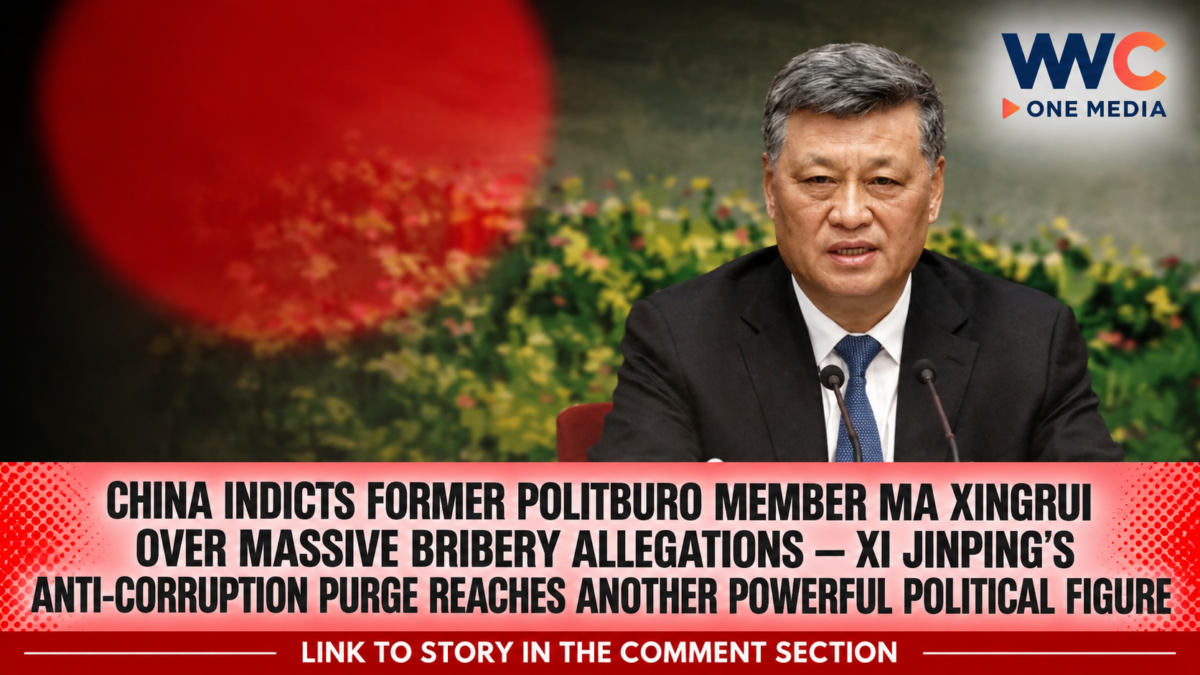
BEIJING — China’s sweeping anti-corruption campaign has reached another high-ranking political figure after prosecutors formally indicted former Politburo member Ma Xingrui on bribery charges, marking a significant escalation in President Xi Jinping’s efforts to tighten control over the ruling Communist Party.
The indictment, announced by China’s official Xinhua News Agency on November 5, accuses Ma of abusing his government positions and political influence to secure benefits for others in exchange for exceptionally large amounts of illegal payments.
Ma previously held several influential positions, including Communist Party secretary of the Xinjiang region, governor of Guangdong province and senior leadership roles within China’s state-owned aerospace industry.
His downfall represents another major development in a political crackdown that has increasingly targeted senior government officials, military commanders and executives connected to powerful state-owned institutions.
The former official was among 33 senior figures whose expulsions from the Communist Party were confirmed during the party’s recent fifth plenum.
The list also included former senior military leader Zhang Youxia, former diplomat Liu Jianchao and former industry minister Jin Zhuanglong.
The indictment now moves Ma’s case beyond the party’s internal disciplinary process and into the criminal justice system.
With another former member of China’s top political leadership facing prosecution, the latest development raises questions about how far Xi Jinping’s anti-corruption campaign will reach — and whether even the most powerful figures in the Communist Party can remain protected from its scrutiny.
Former Politburo Member Ma Xingrui Formally Indicted Over Bribery
According to Xinhua, China’s Supreme People’s Procuratorate approved Ma’s arrest on suspicion of accepting bribes before assigning the case to prosecutors in Yichang, Hubei province.
The Yichang People’s Procuratorate has subsequently filed the indictment with the Yichang Intermediate People’s Court.
Prosecutors accused Ma of exploiting the authority and influence associated with his previous government positions to obtain benefits for other individuals and illegally accept particularly large amounts of money and property.
The alleged misconduct spans several positions he held throughout his career.
These included his leadership roles at China Aerospace Science and Technology Corporation, his positions in Guangdong province and Shenzhen, and his membership in the Communist Party’s powerful Politburo.
The indictment specifically identifies his former responsibilities within China’s state-owned aerospace industry as part of the alleged bribery arrangements.
However, the announcement does not publicly provide a specific total value for the alleged bribes.
The charges remain allegations that must be addressed through the judicial process. An indictment is not a criminal conviction.
Reuters reported that it had attempted to obtain comment from Ma through email and fax but received no immediate response.
The case is particularly significant because Ma once belonged to the 24-member Politburo, one of the Communist Party’s highest decision-making bodies.
His prosecution demonstrates that the ongoing disciplinary campaign is extending beyond military institutions and into China’s civilian political leadership.
Who Is Ma Xingrui and How Did He Rise to China’s Political Elite?
Ma Xingrui, 67, built his career through China’s aerospace industry before becoming one of the country’s most influential regional political leaders.
An engineer by training, Ma initially established his reputation through work in China’s state-owned space programme.
He held senior positions at China Aerospace Science and Technology Corporation, a major state-owned enterprise responsible for developing and manufacturing space-related technologies.
The company plays an important role in China’s satellite programmes, space exploration initiatives and broader aerospace ambitions.
Ma’s experience in the industry helped him establish a reputation as a technically knowledgeable administrator.
His political career subsequently accelerated.
He moved into Guangdong’s provincial leadership, serving as deputy party secretary and eventually governor.
Guangdong is among China’s most economically important provinces, containing major manufacturing and commercial centres connected to international trade.
Ma also served as Communist Party secretary of Shenzhen, one of China’s most important technology and financial hubs.
In 2021, he was appointed Communist Party secretary of Xinjiang, a strategically sensitive region in northwestern China.
His appointment placed him in charge of one of the country’s most politically significant administrative areas.
Ma joined the Politburo in 2022, becoming part of the Communist Party’s top leadership structure.
His subsequent investigation and removal therefore represented a major reversal for an official who had once occupied some of China’s most influential political positions.
How Ma Xingrui’s Political Downfall Began
Ma’s political troubles became public in April 2026, when Chinese authorities announced that he was under investigation for suspected serious violations of party discipline and national laws.
At the time, officials provided limited details about the allegations.
The investigation was conducted through China’s internal disciplinary and supervisory institutions.
On July 14, 2026, Chinese authorities announced that Ma had been expelled from the Communist Party and dismissed from public office following the investigation.
The disciplinary findings included allegations that he:
- Accepted money, gifts and other valuable items through improper arrangements.
- Used his political influence to benefit individuals in business operations and government appointments.
- Helped relatives and associates obtain financial advantages through his positions.
- Allowed family members to exploit his official influence for personal gain.
- Engaged in improper power-for-money and power-for-sex transactions.
Authorities also alleged that Ma had failed to properly supervise individuals close to him and had allowed corrupt practices to continue.
The disciplinary announcement described the misconduct as particularly serious.
These findings formed part of the Communist Party’s internal investigation and should be distinguished from the specific criminal allegations now being prosecuted.
The case subsequently moved toward criminal proceedings after investigators transferred the suspected bribery offences to prosecutors.
The latest indictment represents the next major stage in that process.
Why the Indictment Matters: Another Politburo Member Falls Under Xi’s Anti-Corruption Campaign
Ma’s prosecution comes amid one of the most extensive periods of senior-level political investigations under Xi Jinping.
Since becoming China’s top leader in 2012, Xi has made combating corruption a defining feature of his administration.
The campaign has targeted officials across government departments, financial institutions, military organisations and state-owned enterprises.
However, the removal of senior political figures has become particularly significant because of the positions they once occupied.
According to the Associated Press, three members of the Politburo have recently been purged: Ma and two senior military figures.
The Politburo previously had 24 members.
The removal of such senior figures highlights the increasing reach of the party’s disciplinary institutions.
The campaign has also become closely connected to the Communist Party’s broader efforts to reinforce political loyalty and ensure that senior officials follow central leadership directives.
Analysts have noted that anti-corruption investigations can serve both as an effort to address genuine misconduct and as a mechanism for strengthening political control.
This creates a wider political question: Is the campaign primarily about eliminating corruption, reinforcing loyalty to Xi, or pursuing both objectives simultaneously?
The Ma case has become another example through which observers are examining that question.
China’s Fifth Plenum Reinforces Xi Jinping’s Anti-Corruption Priorities
The timing of Ma’s indictment is particularly important.
The Communist Party’s Central Committee concluded its fifth plenum in late October 2026, adopting a resolution focused on strengthening internal discipline and combating corruption.
The gathering also ratified the expulsions of more than 30 senior officials, including Ma and former senior military figures.
According to the Associated Press, Chinese authorities have reported that disciplinary and supervisory agencies opened approximately 8.1 million cases and punished 7.9 million people since Xi took power in 2012.
The figures included 963 senior officials under the direct management of the party’s central leadership.
These numbers illustrate the enormous scale of China’s anti-corruption machinery.
During the plenum, party leaders reaffirmed their intention to continue severe punishment for officials found guilty of corruption and disciplinary violations.
The leadership has argued that eliminating corrupt officials protects the integrity of the Communist Party and helps ensure effective governance.
However, analysts have also raised concerns about the consequences of increasingly strict political supervision.
Some warn that officials may become reluctant to make decisions or take risks if mistakes could lead to serious disciplinary consequences.
This could potentially weaken administrative initiative, particularly in a country that depends on local officials to implement national economic and industrial policies.
The challenge for Beijing is therefore not simply removing corrupt officials, but ensuring that the resulting political system remains effective and capable of governing China’s vast economy.
The Broader Purge: Military Leaders, Diplomats and Senior Officials Also Removed
Ma’s indictment is part of a broader series of high-profile removals involving senior Chinese officials.
Among the most prominent figures is Zhang Youxia, a former vice-chairman of China’s Central Military Commission.
Zhang was one of the country’s most influential military leaders and had previously been regarded as a close ally of Xi Jinping.
His removal attracted international attention because of his position within the People’s Liberation Army and his long-standing role in China’s military establishment.
Former senior diplomat Liu Jianchao and former industry minister Jin Zhuanglong were also among the officials named in the latest group of party expulsions.
The developments indicate that investigations are not limited to one government department or industry.
They span political administration, military leadership, foreign affairs and industrial management.
WWC ONE MEDIA previously examined the consequences of the military leadership shake-up in China’s Military Purges Raise Questions Over PLA War-Fighting Readiness as Xi Tightens Control.
That report explored how removing senior commanders could affect military experience, leadership continuity and China’s preparations for potential regional conflicts.
Although Ma’s case concerns civilian political leadership rather than military command, both developments highlight the growing reach of China’s disciplinary campaign.
Ma’s Former Role in China’s Space Programme Adds Another Dimension
One particularly important aspect of the indictment involves Ma’s previous leadership positions in China’s aerospace industry.
Before becoming a major political figure, Ma held senior management responsibilities at China Aerospace Science and Technology Corporation.
The state-owned enterprise is central to China’s ambitions in space exploration, satellite technology and aerospace development.
Its responsibilities include major programmes connected to satellite launches, space infrastructure and national technological development.
Ma’s background in the sector makes the bribery allegations particularly significant from a governance perspective.
State-owned aerospace companies operate within industries that receive substantial government investment and have strategic importance for China’s technological development.
Decisions involving contracts, procurement, research partnerships and industrial projects can involve considerable financial resources.
Prosecutors now allege that Ma used the authority and influence associated with his positions to benefit others and illegally accept payments.
The indictment does not establish that China’s space programme itself was involved in wrongdoing, nor does it identify a specific aerospace project as the source of the alleged bribes.
Nevertheless, the case raises questions about oversight and accountability within strategically important state-owned enterprises.
Could Ma’s Case Lead to More Investigations Into Former Associates?
The investigation could also attract attention to individuals who previously worked with Ma or benefited from his official positions.
During his career, Ma occupied senior roles in aerospace administration, Guangdong’s provincial government, Shenzhen and Xinjiang.
These positions involved extensive professional and political networks.
China’s disciplinary authorities have previously examined the conduct of relatives, business associates and former subordinates in major corruption investigations.
The allegations against Ma also include claims that family members and close associates benefited from his influence.
The available indictment announcement does not establish that additional individuals will be prosecuted in connection with this particular case.
However, investigators may continue examining related evidence as the judicial proceedings develop.
Any further action would depend on the findings of the relevant authorities.
For now, Ma remains the central defendant in the bribery prosecution announced by prosecutors.
What the Ma Xingrui Indictment Means for Xi Jinping’s Leadership
Ma’s prosecution sends another powerful message throughout China’s political establishment.
Senior officials can lose their positions, party membership and political influence if disciplinary authorities determine that they have violated party rules or national laws.
For Xi, the anti-corruption campaign remains closely connected to the Communist Party’s ability to maintain internal discipline.
The leadership argues that corruption threatens the party’s legitimacy, weakens government institutions and creates opportunities for officials to abuse public authority.
But the campaign also strengthens the central leadership’s influence over political appointments and internal supervision.
A report by The Guardian in July 2026 examined the political significance of Ma’s removal, noting that his case demonstrated that even senior civilian Politburo members could be removed through the campaign.
Analysts have also questioned whether stricter enforcement could make officials more cautious and less willing to take independent initiative.
The challenge is particularly important as China prepares for its next major political transition in 2027.
WWC ONE MEDIA explored the political implications in Xi Jinping Tightens Grip on China Ahead of 2027 Leadership Shake-Up — But What Is Beijing Really Preparing For?.
The report examined the party’s renewed focus on political discipline, internal governance and accountability ahead of the next Communist Party congress.
Ma’s indictment adds another important development to that wider political picture.
A Wider Pattern of Political Control and Accountability in China
China’s anti-corruption campaign has become one of the defining political developments of Xi’s leadership.
The removal of powerful officials demonstrates the ruling party’s ability to investigate individuals who once occupied influential positions.
However, the long-term effectiveness of the campaign will depend on whether investigations lead to stronger institutional safeguards rather than simply replacing one group of officials with another.
Corruption in large political and economic systems can involve complicated networks of business relationships, government influence and personal connections.
Investigating individual officials may punish misconduct, but preventing similar practices requires effective procurement rules, transparent decision-making and reliable oversight.
China’s leadership faces the difficult task of maintaining political discipline while ensuring that its government institutions remain capable of making decisions and implementing policies.
The prosecution of Ma Xingrui is therefore more than another high-profile bribery case.
It is another test of how China’s political system handles corruption at the highest levels of power.
What Happens Next in Ma Xingrui’s Bribery Case?
With the indictment formally filed at the Yichang Intermediate People’s Court, the case now enters the judicial process.
Prosecutors will need to establish the allegations presented in the indictment through the relevant legal proceedings.
The court will examine the evidence and determine Ma’s criminal responsibility.
At this stage, authorities have described the alleged bribes as exceptionally large, but they have not publicly announced a total financial amount.
There is also no publicly announced verdict or prison sentence.
The next significant development will be the court proceedings and any additional information released by prosecutors concerning the alleged payments, beneficiaries and circumstances surrounding the offences.
The case could provide further insight into the extent of corruption investigations involving China’s senior political leadership.
For now, Ma’s indictment marks another major development in a campaign that continues to reshape the country’s political establishment.
THE BIGGER PICTURE: NO POSITION APPEARS IMMUNE FROM CHINA’S ANTI-CORRUPTION CAMPAIGN
The indictment of Ma Xingrui highlights the growing reach of China’s efforts to investigate and punish senior officials accused of corruption.
From the aerospace industry to provincial government leadership and the Politburo, Ma once held positions that placed him close to some of China’s most important political and economic institutions.
His prosecution demonstrates how dramatically an official’s position can change when the party’s disciplinary machinery turns against them.
For Xi Jinping, the campaign remains an important instrument for addressing corruption and reinforcing the Communist Party’s authority.
For China’s bureaucracy, it serves as a warning that seniority and political influence do not necessarily provide protection from investigation.
But the broader consequences remain uncertain.
Can Beijing eliminate entrenched corruption without creating an environment where officials become too cautious to make important decisions?
And as more powerful figures fall under investigation, will the campaign ultimately strengthen China’s institutions — or further concentrate political authority around Xi Jinping?
With another former Politburo member now facing criminal prosecution, China’s anti-corruption campaign is sending a message across the political establishment: even the highest-ranking officials are not beyond scrutiny. But how far will Xi Jinping’s purge go before the country’s next leadership transition?