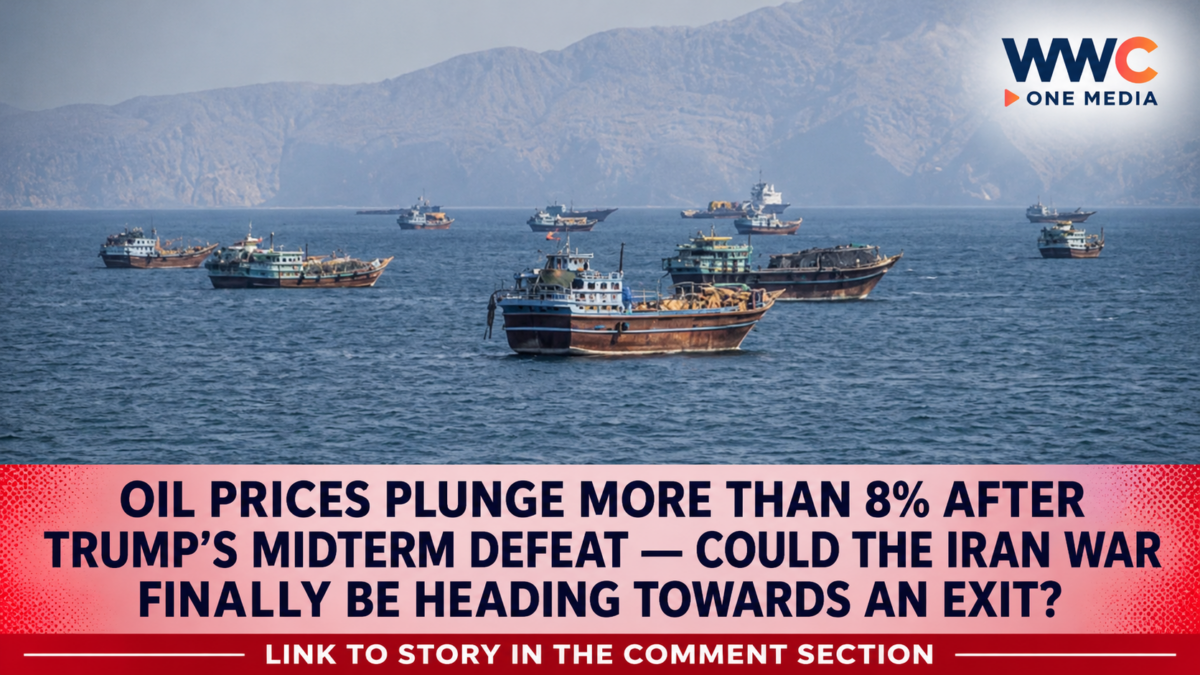
Global oil prices suffered a sharp sell-off on Wednesday after US President Donald Trump’s Republican Party lost control of both chambers of Congress in the November midterm elections, prompting investors to reassess the possibility of an end to the US-Israeli war with Iran.
Brent crude, the international oil benchmark, settled at US$94.62 per barrel, falling US$8.98, or 8.7 per cent, in one session. US West Texas Intermediate (WTI) crude dropped US$7.97, or 8.3 per cent, to US$88.12 per barrel.
Both benchmarks finished at their lowest closing levels since August 31, marking one of the market’s most significant daily declines in recent months.
The dramatic reversal came after Democrats secured control of the US House of Representatives and Senate, dealing Trump a major political setback less than a year into his second term.
For oil traders, the election result raised an important possibility: a weakened president facing a Democratic-controlled Congress may have stronger incentives to pursue negotiations rather than prolong a costly and politically damaging conflict.
But the market’s optimism comes with a major qualification.
The fall in oil prices does not mean the war is over, and Washington and Tehran have not reached a peace agreement.
Investors are reacting to the possibility of a diplomatic breakthrough, not a confirmed end to the conflict.
Why did oil prices suddenly collapse after Trump’s election defeat?
The immediate trigger was the political shock delivered by American voters.
Democrats’ victory means Trump will face a divided government for the remainder of his second term. Although the president retains significant authority over foreign policy and military operations, Democratic control of Congress could complicate efforts to secure funding and political support for an extended military campaign.
That possibility has changed how investors assess the future of the Iran conflict.
Two sources close to Gulf government circles told Reuters that Trump’s weakened political position could increase his incentive to negotiate an exit. A full-scale assault on Iran appeared less likely, although analysts warned that the situation remained unpredictable.
The oil market had already been sensitive to developments surrounding possible US-Iran negotiations. The election result strengthened expectations that Washington might seek a diplomatic solution rather than risk another escalation.
Oil prices had been elevated by fears that attacks, shipping disruptions and military confrontation could restrict supplies from the Middle East.
A credible path towards de-escalation could reduce that geopolitical risk premium — the additional amount traders are willing to pay because of uncertainty over future supplies.
That expectation helped drive Wednesday’s steep decline.
Trump acknowledges that the Iran war contributed to Republican losses
The political consequences of the election became even more significant after Trump acknowledged that the war with Iran played a role in his party’s defeat.
The president had previously indicated that the United States had no immediate plans to launch another major strike against Iran.
His comments helped reinforce the market’s expectation that Washington might avoid an immediate return to large-scale military operations.
US Vice-President JD Vance also publicly questioned the political consequences of the war, distancing himself from the decision and attributing the Republican electoral setback to the conflict.
His remarks were significant because the war had become a major political and economic issue for the administration.
Higher fuel costs have placed additional pressure on American households, while the conflict has created uncertainty for businesses, investors and energy markets.
However, political pressure does not automatically translate into a peace agreement.
Trump still faces the challenge of securing an outcome that he can present as a strategic success, while Iran has its own demands concerning sanctions, military restrictions and regional security.
An agreement perceived as a defeat for either side could create fresh pressure for escalation.
Iran and the United States remain far from a peace deal
Despite the market rally in hopes of de-escalation, negotiations remain difficult.
A senior Iranian official told Reuters that Washington and Tehran were still far from reaching an agreement to end the war.
Qatar has intensified its mediation efforts to prevent another round of attacks and encourage the two sides to return to negotiations.
The issues are substantial.
They include sanctions against Iran, restrictions on maritime trade, the US naval blockade, Iran’s enriched uranium stockpile and the future security arrangements surrounding the Strait of Hormuz.
These disputes are not minor technical disagreements. They involve some of the central objectives that both governments have pursued throughout the conflict.
Iran’s Supreme Leader, Ayatollah Mojtaba Khamenei, also said in a written statement that US hostility towards Iran would continue regardless of which political party controlled Washington.
That message underscores why investors should be cautious about interpreting the oil-price decline as evidence that a settlement is close.
The diplomatic channel may be active, but a breakthrough has not been confirmed.
The Strait of Hormuz remains the biggest threat to global oil supplies
One of the most important factors behind the oil-market volatility is the Strait of Hormuz.
Located between Iran and Oman, the narrow waterway connects the Persian Gulf with the Gulf of Oman and the wider international shipping network.
It is one of the world’s most strategically important energy routes because large volumes of crude oil, petroleum products and liquefied natural gas pass through it.
Any serious disruption can affect energy supplies far beyond the Middle East.
The conflict has already complicated shipping activity and reduced the volume of oil and petroleum products leaving the Gulf.
According to ship-tracking data from Vortexa cited by Reuters, Gulf exports of crude oil, condensate and refined products — excluding liquefied petroleum gas — averaged 17.1 million barrels per day in October.
That was below the 18.9 million barrels per day recorded in September.
Although exports had recovered from earlier disruptions, October’s level remained roughly three-quarters of pre-war volumes.
The figures illustrate an important point: even if military activity decreases, the global oil market will still need to account for disrupted supply routes and the time required to restore normal shipping operations.
WWC One Media previously examined the danger surrounding the waterway in its report, Iran Escalates the War as US Elections Near — But the Next Strike Could Shake Global Markets.
The Strait of Hormuz is also central to the latest debate over whether countries can reduce their dependence on the route.
UAE considers another oil pipeline to reduce reliance on Hormuz
The United Arab Emirates is reportedly considering the construction of a third oil pipeline that would allow more crude to reach export markets without passing through the Strait of Hormuz.
Bloomberg reported the proposal, citing people familiar with the matter.
The idea reflects a broader concern among Gulf energy producers: relying heavily on a single maritime chokepoint creates significant economic and security risks.
Additional pipeline capacity could give the UAE more flexibility during future disruptions.
However, a new pipeline would not immediately solve the current supply problem. Infrastructure projects require investment, planning, construction and time before they can significantly change export capacity.
The possibility of additional infrastructure also does not eliminate the strategic importance of the Strait of Hormuz for other regional producers.
For now, the waterway remains a central factor in the oil market’s assessment of the conflict.
WWC One Media has also covered the issue in its report on Iran’s economy, war and sanctions — and why the Strait of Hormuz could become the next global shock.
Oil prices fell despite an unexpected drop in US crude inventories
The decline was particularly notable because another market development would ordinarily have supported oil prices.
The US Energy Information Administration reported that American crude inventories fell by 865,000 barrels during the week ended October 30, reaching 409.8 million barrels.
Analysts surveyed by Reuters had expected inventories to increase by approximately 877,000 barrels.
A decline in crude inventories can indicate stronger demand, lower imports or reduced domestic supply, depending on the circumstances.
Gasoline and distillate inventories also declined, adding another layer to the market’s supply-and-demand picture.
Despite those figures, the geopolitical outlook dominated trading.
Investors appeared more focused on the possibility that the war could become less disruptive to global energy supplies than on the immediate inventory data.
This demonstrates how strongly geopolitical developments can influence oil prices, sometimes outweighing conventional supply-and-demand indicators in the short term.
Could cheaper oil finally bring relief to Singapore motorists?
The sharp decline in global crude prices could eventually help countries that depend heavily on imported energy.
Singapore is particularly exposed to movements in international energy markets because it imports virtually all of its energy resources.
When crude and refined-fuel prices rise, the effects can spread through petrol, diesel, transport, logistics and other business costs.
However, Singapore motorists should not expect petrol prices to fall immediately simply because crude oil has dropped.
In fact, Singapore’s pump prices had been moving in the opposite direction before Wednesday’s international sell-off.
On November 2, Sinopec raised its posted petrol prices by three cents per litre, matching increases previously announced by Caltex, Esso and Shell.
The latest round marked the fourth consecutive week of petrol-price increases among major retailers.
As of 9pm on November 2, posted prices for 95-octane petrol ranged from S$3.56 per litre at SPC to S$3.63 at Caltex, Esso, Shell and Sinopec, before discounts.
WWC One Media reported on the increases in its coverage of Singapore petrol prices rising for a fourth straight week as the Middle East conflict keeps fuel markets on edge.
The latest global oil decline could ease some of the pressure, but retail fuel prices are influenced by more than crude benchmarks.
They also reflect refined-product prices, wholesale costs, exchange rates, operating expenses and the timing of fuel purchases.
CNA previously explained that Singapore pump prices can take time to respond even when international crude prices fall.
That means motorists may have to wait for sustained market declines before seeing meaningful relief at the petrol station.
The same applies to businesses that depend on diesel, including transport operators and logistics companies.
What happens next? Three factors could determine oil’s direction
Wednesday’s sell-off has raised expectations that the conflict could move towards diplomacy. But the next stage will depend on developments that remain uncertain.
1. Whether Washington and Tehran can reach an agreement
The most important factor is whether the two governments can resolve their disagreements over sanctions, maritime restrictions, nuclear issues and security arrangements.
A credible agreement could encourage oil prices to fall further by reducing fears of prolonged supply disruption.
But if negotiations collapse, the market could quickly restore the geopolitical risk premium.
2. Whether military operations remain limited
Trump’s statement that the United States has no immediate plans for another strike has helped calm some investor concerns.
However, recent military activity shows that the conflict has not ended.
WWC One Media previously reported on the limited US strikes on Iran’s Qeshm Island, which American officials described as defensive operations. Read the report: US Carries Out Defensive Strikes on Iran’s Qeshm Island as Trump Talks Down Renewed War.
Any major new attack, retaliation or threat to shipping could reverse the latest decline.
3. Whether oil shipments through the Gulf recover
Even if negotiations make progress, the market will need evidence that oil exports and shipping activity can return to more normal levels.
A sustained recovery in exports would help reduce supply concerns.
On the other hand, renewed attacks or restrictions around the Strait of Hormuz could keep prices elevated despite political efforts to end the war.
The Bottom Line
Oil’s more-than-8-per-cent plunge following Trump’s midterm defeat is one of the clearest signs yet that investors are beginning to price in the possibility of a diplomatic exit from the Iran conflict.
Brent crude settled at US$94.62 per barrel, while WTI closed at US$88.12, as traders assessed whether Democratic control of Congress could make a prolonged military campaign more difficult for the Trump administration.
But the market’s optimism should not be mistaken for certainty.
The United States and Iran remain far apart on key issues, Qatar’s mediation efforts have yet to produce a confirmed agreement, and the Strait of Hormuz continues to expose global energy supplies to serious disruption.
For Singapore motorists, the decline could eventually offer some relief, but pump prices are unlikely to respond immediately.
The next major move in oil prices may depend less on the election result itself and more on what Washington and Tehran do in the days ahead.
Could Trump’s midterm defeat become the turning point that finally ends the Iran war — or will another military escalation send oil prices surging again?