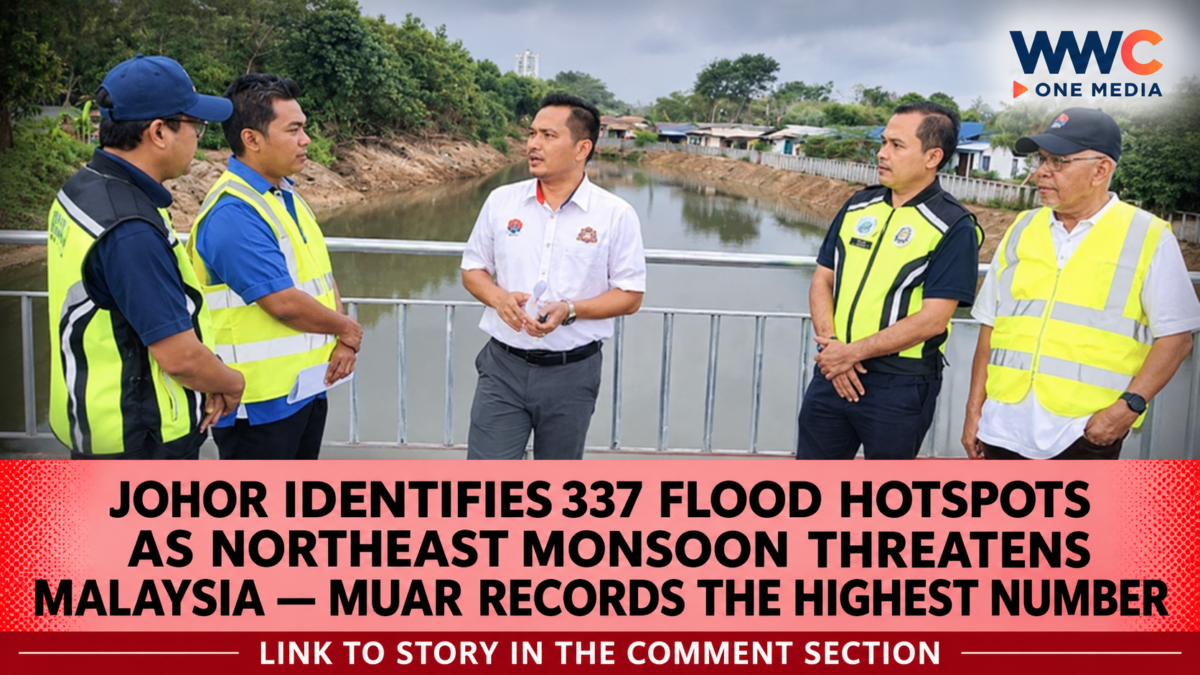
Johor is stepping up its flood preparations after identifying 337 flood-prone locations across the state, as Malaysia enters the 2026/2027 Northeast Monsoon season, bringing renewed concerns about heavy rainfall, rising rivers, flooded roads and possible evacuations.
The Johor state government is prioritising areas with a history of serious flooding, particularly Muar, Johor Bahru, Batu Pahat, Kota Tinggi and Segamat. Officials are coordinating drainage maintenance, road inspections, flood monitoring and emergency response preparations ahead of the months expected to bring substantial rainfall.
The preparations come as the state also identifies 67 high-risk roads that could become dangerous or inaccessible during severe flooding.
Johor Public Works, Transport, Infrastructure and Communications Committee chairman Mohamad Fazli Mohamad Salleh disclosed the figures on November 3 following an inspection of the Sungai Rinting flood wall project in Pasir Gudang.
The state is also preparing to apply for an emergency allocation of between RM20 million and RM30 million to carry out immediate maintenance and flood-preparedness work during November and December.
With the Northeast Monsoon expected to affect Johor through January 2027, authorities are now under pressure to ensure that vulnerable communities, transport routes and essential infrastructure are ready before prolonged rainfall intensifies.
Muar Leads Johor’s Flood Hotspot List With 65 Locations
Of the 337 identified flood hotspots across Johor’s 10 districts, Muar recorded the highest number, with 65 locations.
The distribution released by state officials is as follows:
| Johor district | Identified flood hotspots |
|---|---|
| Muar | 65 |
| Johor Bahru | 44 |
| Batu Pahat | 41 |
| Kota Tinggi | 35 |
| Kluang | 29 |
| Segamat | 29 |
| Kulai | 27 |
| Tangkak | 26 |
| Mersing | 22 |
| Pontian | 19 |
| Total | 337 |
The figures show that flood preparedness is a statewide concern rather than a problem confined to one part of Johor.
Muar’s 65 identified locations place the district at the top of the list, while Johor Bahru follows with 44. Batu Pahat has 41, and Kota Tinggi has 35.
State officials have also highlighted Batu Pahat, Kota Tinggi and Segamat because these areas have experienced significant flooding in the past, including incidents that displaced residents and disrupted road access.
The Star reported that 105 of the 337 identified hotspots are located across those three districts.
The priority is to monitor areas where heavy rainfall, river systems, drainage capacity and existing infrastructure could combine to create dangerous conditions.
67 High-Risk Roads Could Face Flood Disruptions
Beyond residential and community flood hotspots, Johor authorities have identified 67 high-risk road locations across the state.
The reported breakdown in three particularly vulnerable districts is:
- Kota Tinggi: 30 high-risk road locations
- Batu Pahat: 21 high-risk road locations
- Segamat: 16 high-risk road locations
These locations include federal and state roads that could be affected by rising water levels, damaged drainage systems or prolonged rainfall.
The road risks are particularly concerning because flooding can cut off access to residential areas, delay emergency services and disrupt the movement of goods and commuters.
In Batu Pahat, the Public Works Department has identified 21 high-risk road locations covering approximately 6.5 kilometres.
Authorities are preparing alternative routes through Federal Route FT024 and the North-South Expressway, also known as the PLUS Highway, to help maintain access if roads become impassable.
Mobile pumps at the Parit Botak sluice gate and flood mitigation schemes in Bandar Batu Pahat and along Sungai Batu Pahat are also receiving attention.
For residents and motorists, the warning is straightforward: a familiar road may become unsafe during prolonged rain, even if it is normally passable.
Johor Seeks Up to RM30 Million for Immediate Flood Preparations
To strengthen its response, the Johor government is preparing an application for an emergency allocation ranging from RM20 million to RM30 million.
The proposed funding is intended to support maintenance and flood-preparedness measures in high-risk areas throughout November and December.
Mohamad Fazli said immediate work would receive priority, particularly maintenance that can be carried out quickly before heavier rainfall arrives.
However, larger infrastructure projects, including the construction of embankments and flood-retaining walls, require more time.
This distinction matters because emergency maintenance and long-term flood prevention serve different purposes.
Clearing blocked drains, dredging waterways, inspecting culverts and preparing pumps can help improve the immediate response to rainfall. Major flood walls, embankments and river-management projects require planning, construction and sustained funding.
The proposed RM20 million to RM30 million should not be confused with money already approved or fully disbursed. The state was preparing to apply for the allocation, according to the reported announcement.
Batu Pahat Receives Major Drainage and Road Maintenance Attention
Batu Pahat is among the districts receiving significant attention because of its flood history and the number of vulnerable roads.
The preparations outlined by the state include:
- RM11.79 million for road pavement maintenance.
- RM3.20 million for non-pavement road works.
- RM1.92 million under the Malaysian Road Records Information System (MARRIS) for drainage-related work.
The measures are intended to improve road conditions and drainage performance ahead of the monsoon.
Officials are also monitoring the Parit Botak sluice gate, where mobile pumps are part of the flood-response preparations.
Flood mitigation schemes in Bandar Batu Pahat and along Sungai Batu Pahat are among the projects receiving attention, alongside coastal embankment upgrading.
In Segamat, authorities are focusing on river levels, road conditions and coordination with Batu Pahat because the districts are connected through downstream water flows.
These preparations demonstrate why flood management cannot be limited to individual neighbourhoods. Water moving through rivers and drainage systems can affect communities beyond the location where heavy rainfall initially occurs.
Flood Mitigation Projects Underway in Johor
The state has identified several infrastructure projects as part of its broader effort to reduce flood risks.
These include:
Sungai Johor Flood Mitigation Plan — Phase 1
The project is intended to improve flood management along the Sungai Johor system, where water levels and river conditions can affect surrounding communities.
Sungai Pemandi Flood Mitigation Plan
This project forms part of the state’s efforts to address flooding through targeted river and drainage interventions.
Kampung Sungai Kapal Lama flood alleviation project
Located in the Pengerang area of Kota Tinggi, the project is intended to help reduce flooding affecting the community.
The state is also carrying out drainage inspections, cleaning and dredging, culvert checks, road monitoring and preparations for emergency machinery.
The measures involve coordination between the Public Works Department, Department of Irrigation and Drainage, local authorities, district offices and other relevant agencies.
The official Johor government report also highlighted the importance of hotspot mapping, public information and alternative access routes to reduce disruption when flooding occurs.
A Separate Fire and Rescue Department Figure: 399 Hotspots
There is another important figure that residents should know about.
A separate report by The Star on November 4 quoted Johor Fire and Rescue Department director Tarmizi Taha as saying that 399 flood hotspots had been identified for monitoring during the monsoon season.
The department also said fire stations had been instructed to patrol identified flood-prone areas when heavy rain continued for more than two hours.
All four fire and rescue zones and 34 fire stations in Johor were directed to inspect operational logistics and test equipment on October 31. The checks included rescue boats, marine equipment, vehicles, flood-response equipment and personal protective equipment.
The 399 figure should not automatically be treated as a correction to the state government’s 337 locations.
The two figures were reported by different agencies and may reflect different operational monitoring lists or definitions of flood hotspots. The available reports do not provide a detailed reconciliation between them.
The difference nevertheless highlights the scale of preparedness required across the state, particularly for emergency responders who may need to conduct rescues during rapidly rising floodwaters.
The Fire and Rescue Department has also warned that some residents remain reluctant to evacuate until water levels become dangerous. Authorities have urged people to follow evacuation instructions and move to temporary relief centres when directed.
Recent Flash Floods Show Why Preparations Matter
The latest preparations come after several flooding incidents in Malaysia, including a flash flood in Johor Bahru in late September.
On September 30, 44 people — 37 children and seven teachers — were rescued after a kindergarten and nursery along Jalan Muhd Amin became trapped by rapidly rising floodwaters.
The Johor Fire and Rescue Department deployed a team to the premises, and all 44 people were safely evacuated without reported injuries.
The incident followed heavy afternoon rain. Reports also described flooding in other parts of Johor Bahru, including Jalan Kolam Air in Nong Chik, Jalan Ayer Molek and Jalan Yahya.
WWC One Media covered the incident in its report, 44 Pupils and Teachers Rescued After Flash Flood Traps Kindergarten in Johor Bahru.
The rescue operation demonstrated how quickly heavy rain can disrupt ordinary activities and place vulnerable people at risk.
Flooding has also remained a concern in other parts of Malaysia. In October, residents in Selangor raised concerns about repeated flash floods following heavy rainfall, with one resident asking the authorities to investigate possible drainage and construction-related issues.
WWC One Media reported on the complaint in Selangor Resident Urges Minister to Intervene After Repeated Flooding Following Heavy Rain.
The reported connection between the unfinished walkway project and the flooding was an allegation by the resident, not an independently established cause.
These incidents illustrate why flood preparedness must involve both major infrastructure projects and the maintenance of everyday drainage systems.
Malaysia’s Northeast Monsoon Brings Months of Flood Risk
The Northeast Monsoon is a recurring seasonal weather pattern that brings substantial rainfall to parts of Malaysia.
The season typically affects the east coast of Peninsular Malaysia particularly strongly, while other states, including Johor, can also experience heavy rain and flooding.
According to reporting by The Star, the 2026/2027 Northeast Monsoon had already begun the previous week, with Johor expecting substantial rainfall from November through January.
The exact timing and severity of rainfall can vary. Residents should therefore rely on official weather warnings rather than assume that every district will experience the same conditions at the same time.
Malaysia’s past monsoon seasons demonstrate the potential scale of the danger. During the severe November 2024 floods, tens of thousands of people were evacuated across multiple states, with homes, roads and public facilities affected.
The Associated Press reported that more than 90,000 people had been displaced by November 29, 2024, as Malaysia prepared for what authorities feared could become its worst flooding in a decade.
That was a separate monsoon season and should not be interpreted as a prediction for 2026. It does, however, show why early preparation, evacuation planning and reliable emergency response systems matter.
What Residents Should Do Before Heavy Rain Arrives
Authorities are urging the public to remain alert, follow official weather warnings and obey safety instructions, especially when roads become flooded.
Residents in identified flood-prone areas can take practical precautions before severe weather develops:
- Prepare essential supplies. Keep drinking water, basic food, medication, flashlights, batteries and important documents in a waterproof container.
- Monitor official warnings. Follow updates from Malaysia’s Meteorological Department and relevant disaster-management authorities.
- Know evacuation routes. Identify the nearest temporary relief centre and alternative roads before flooding begins.
- Protect electrical equipment. Switch off electricity when instructed or when floodwater threatens to enter the home, and avoid handling electrical equipment in wet conditions.
- Never drive through floodwater. Water depth and road conditions can be difficult to judge, and moving water can sweep vehicles away.
- Evacuate when instructed. Do not wait until water enters the home or reaches a dangerous level before seeking help.
The public should also avoid walking or playing in floodwater, which may conceal open drains, damaged roads, debris and electrical hazards.
The Bottom Line
Johor has identified 337 flood hotspots across its 10 districts as Malaysia enters the 2026/2027 Northeast Monsoon season, with Muar recording the highest number at 65 locations.
Authorities have also identified 67 high-risk roads, particularly across Kota Tinggi, Batu Pahat and Segamat, where flooding could disrupt transport and cut off access to communities.
The state is preparing to seek an emergency allocation of RM20 million to RM30 million for immediate maintenance and preparedness work, while drainage improvements, mobile pumps, road maintenance and major flood mitigation projects are also receiving attention.
A separate Fire and Rescue Department report cited 399 flood hotspots for operational monitoring, highlighting the need to distinguish between different agencies’ assessments rather than assume that the figures are directly interchangeable.
Recent flash floods in Johor Bahru and other parts of Malaysia show how quickly heavy rainfall can affect homes, schools, roads and public safety.
The challenge now is turning the warnings and funding plans into effective action before the heaviest rainfall arrives.
With hundreds of flood-prone locations identified and the monsoon season already underway, will Johor’s preparations be enough to protect residents and keep critical roads accessible when the heaviest rains hit?